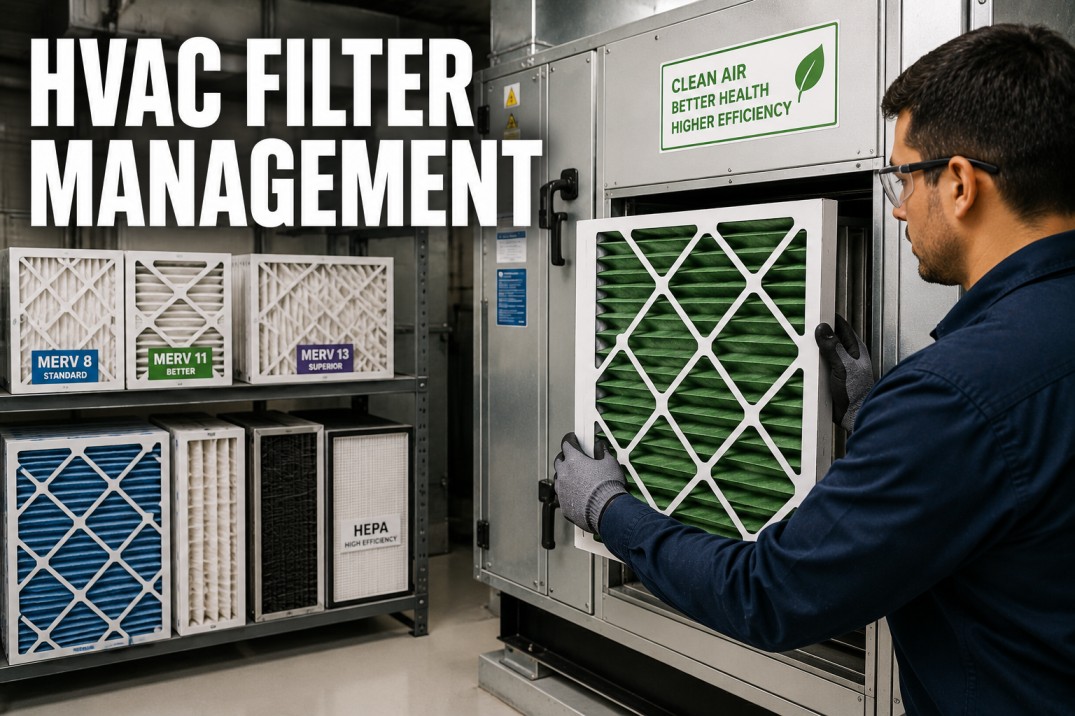
HVAC filters are the first line of defense for both equipment protection and indoor air quality, yet they are the most commonly overlooked component in commercial maintenance programs. Selecting the right filter, changing it at the right interval, and monitoring pressure drop across the filter bank directly impacts energy consumption, equipment life, occupant health, and regulatory compliance. This guide covers everything facility managers need to know about HVAC filter management: MERV ratings, filter types, replacement schedules, pressure drop monitoring, and the measurable impact on indoor air quality and system performance.
Optimize Filter Management With Preventive Analytics
iFactory's Preventive analytics module provides filter tracking, pressure drop monitoring, condition-based replacement scheduling, and cost analysis. Book a demo to see how data-driven filter management reduces energy waste and improves IAQ.
MERV Ratings Guide: Selecting the Right Filter for Each Application
Minimum Efficiency Reporting Value (MERV) measures filter efficiency across particle size ranges from 0.3 to 10 microns.
| MERV Rating | Particle Capture | Typical Applications | Pressure Drop | Cost Premium |
|---|---|---|---|---|
| MERV 1-4 | Pollen, dust mites, sanding dust (>10 micron) | Residential, minimum code | 0.1-0.3 in. w.g. | Baseline |
| MERV 5-8 | Mold spores, hair, dust (3-10 micron) | Commercial office standard | 0.2-0.5 in. w.g. | +20-40% |
| MERV 9-12 | Lead dust, humidifier dust, legionella (1-3 micron) | Healthcare, schools, hospitality | 0.4-0.8 in. w.g. | +50-80% |
| MERV 13-14 | Bacteria, tobacco smoke, virus carriers (0.3-1 micron) | Hospitals, clean rooms, labs | 0.6-1.2 in. w.g. | +100-150% |
| MERV 15-16 | All particles including most smoke (0.3 micron) | Pharma, semiconductor, operating rooms | 0.8-1.5 in. w.g. | +200-300% |
| HEPA (MERV 17+) | 99.97% at 0.3 micron | Isolation rooms, bio-safety | 1.0-2.5 in. w.g. | +400-600% |
Filter Types: Construction, Performance & Best Applications
Beyond MERV rating, filter construction affects performance, lifespan, and system compatibility.
Pleated Panels (Disposable)
Standard for 1-2 inch commercial filters. MERV 5-13. Cost $3-15 each. Replace every 1-3 months. Good balance of efficiency, cost, and availability. Most common type in office buildings.
Bag Filters (Pocket)
Deep pocket design for 4-12 inch filter slots. MERV 8-15. Cost $15-40 each. Replace every 6-12 months. Lower pressure drop than pleated at same MERV. Best for high-CFM air handlers.
Cartridge Filters
Rigid cylindrical design. MERV 13-16. Cost $25-60 each. Replace every 6-12 months. Excellent sealing, no bypass. Best for healthcare and clean room applications.
Electrostatic (Washable)
Reusable with aluminum or foam media. MERV 4-8. Cost $20-50 initial. Wash every 1-3 months. Lowest lifetime cost but lower efficiency. Best for residential or light commercial.
Track Filter Performance and Catch Problems Early
iFactory's platform integrates with pressure sensors to monitor filter loading in real time, alerting when replacement is needed. Book a demo to see how automated filter monitoring optimizes replacement intervals.
Filter Replacement Schedules: Optimizing Change Intervals
Fixed calendar schedules waste filters or compromise IAQ depending on actual loading conditions.
| Building Type | Filter Type | Standard Interval | Optimized Interval | Cost Impact |
|---|---|---|---|---|
| Office (standard) | MERV 8 pleated, 2" | 3 months | 2-4 months based on DP | $0.01-0.03/sq ft/yr |
| Office (high IAQ) | MERV 13 bag, 6" | 6 months | 4-8 months based on DP | $0.04-0.08/sq ft/yr |
| Healthcare | MERV 14-16 cartridge | 3 months | 2-4 months based on DP | $0.08-0.15/sq ft/yr |
| School | MERV 11 pleated, 4" | 3 months | 3-6 months based on DP | $0.03-0.06/sq ft/yr |
| Restaurant | MERV 8 bag, 4" | 1-2 months | Monthly required (grease) | $0.05-0.10/sq ft/yr |
| Data Center | MERV 11 pleated, 2" | 3 months | 3-6 months based on DP | $0.02-0.05/sq ft/yr |
Filter Pressure Drop: The Key Metric for Condition-Based Replacement
Measuring static pressure drop across the filter is the most reliable indicator of loading and replacement need.
Clean Filter DP
Baseline pressure drop for clean filter. Varies by MERV rating and filter depth. Record at each change to establish baseline for condition-based monitoring.
Change Threshold
Industry standard replacement threshold. Replace when DP reaches 2x clean baseline or 1.0 in. w.g. minimum. At threshold, fan energy increases 8-15%.
Energy Impact
Every 0.5 in. w.g. above clean baseline increases fan energy 5-8%. A 200-ton building wastes $200-800/yr per 0.5 in. w.g. excess DP across filters.
Airflow Reduction
Higher DP reduces CFM proportionally. 15% airflow reduction = 15% capacity loss and 15% longer run times. Dirty filters cause 25% of comfort complaints.
Filter Impact on Indoor Air Quality: Measurable Benefits
Proper filter selection and maintenance delivers documented improvements in occupant health and productivity.
Occupant Health Outcomes
Upgrading from MERV 8 to MERV 13 reduces fine particulate (PM2.5) by 60-80%. Studies show 8-15% reduction in respiratory symptoms, 20-30% reduction in allergy complaints, and 5-10% reduction in absenteeism in schools and offices.
Productivity & Cognitive Performance
Harvard COGfx study: improved ventilation and filtration increased cognitive function scores 61% for crisis response, 33% for strategy, and 25% for information usage. Productivity gain worth $2,000-6,000 per employee annually.
Regulatory & Liability Risk
ASHRAE 62.1 requires minimum MERV 8 for commercial buildings, MERV 13 for healthcare. LEED, WELL, and RESET standards impose higher requirements. Proper documentation protects against IAQ-related liability claims.
Frequently Asked Questions
What MERV rating do I need for my commercial building?
ASHRAE 62.1 requires minimum MERV 8 for commercial buildings with mechanical cooling. Most commercial offices benefit from MERV 11-13 for improved IAQ without excessive pressure drop. Healthcare facilities require MERV 14-16 minimum depending on area classification. Schools should use MERV 11 minimum with MERV 13 recommended for classrooms. The sweet spot for most commercial applications is MERV 11: provides 85% capture of 1-3 micron particles at 0.4-0.6 in. w.g. pressure drop, balancing IAQ improvement with energy cost.
How often should HVAC filters be changed in commercial buildings?
Standard intervals: MERV 8 pleated filters every 1-3 months, MERV 11-13 pleated every 2-4 months, MERV 13-16 bag or cartridge every 4-8 months, HEPA filters every 12-24 months. Condition-based replacement using pressure drop measurement is more cost-effective: replace when differential pressure reaches 1.0-1.5 in. w.g. or 2x clean baseline. High-occupancy buildings, near construction sites, or wildfire smoke areas may need 2-3x more frequent changes.
Can using higher MERV filters damage my HVAC system?
Higher MERV filters have higher pressure drop, which can reduce airflow and increase fan energy if the system is not designed for them. Before upgrading from MERV 8 to MERV 13, verify the fan motor and ductwork can handle the additional static pressure. Key checks: measure static pressure at current filter condition, verify fan motor amp draw is below nameplate, calculate available static pressure. Consider using deeper filter racks (4-6 inch instead of 2 inch) to reduce face velocity when upgrading.
What is filter bypass and why does it matter?
Filter bypass occurs when unfiltered air passes around the filter rather than through it, typically through gaps in the filter rack, missing gaskets, or improperly seated filters. Even 5% bypass reduces effective filtration efficiency by 30-50%. For MERV 13 filters, 5% bypass reduces effective rating to MERV 7. Fix bypass by: installing spring-loaded filter racks, using filters with integrated gaskets, sealing all filter rack joints, and verifying seal with smoke test during filter changes.
How do I calculate the ROI of upgrading HVAC filters?
Calculate ROI by comparing costs (higher filter purchase price + potential energy increase) against benefits (health/productivity gains + equipment protection + regulatory compliance). Upgrade from MERV 8 to MERV 11: filter cost increase $500-2,000/yr per 100K sq ft, energy increase $200-500/yr. Benefits: reduced absenteeism saving $10K-30K/yr, reduced coil cleaning saving $500-1,500/yr, extended equipment life. Conservative ROI: 3-8x annually.
Complete Filter Lifecycle Management With Preventive Analytics
iFactory's Preventive analytics delivers end-to-end filter management including MERV selection guidance, inventory tracking, replacement scheduling, pressure monitoring, and IAQ compliance documentation. Book a demo to see how structured filter management protects equipment and occupants.