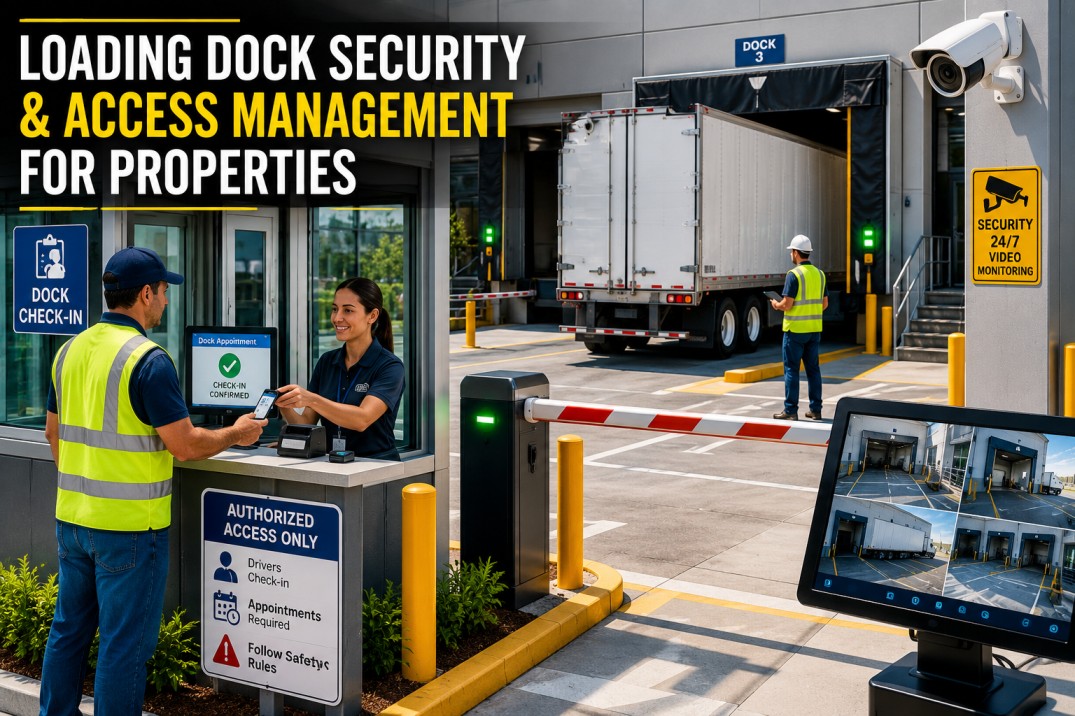
Loading docks are among the most vulnerable access points in commercial and industrial properties, handling high volumes of daily truck traffic from numerous carriers, drivers, and delivery personnel who require temporary building access while posing significant security risks including theft of goods through unauthorized vehicle departure, tailgating where unauthorized individuals follow credentialed drivers into secure areas, undocumented inventory movements that create reconciliation gaps of 3-8% in annual physical counts, and safety incidents from vehicles maneuvering in congested dock areas where pedestrian and forklift traffic intersect without adequate separation or monitoring. Unlike main lobby entrances with dedicated security personnel and visitor management systems, loading docks are frequently under-monitored with fewer cameras, minimal access control, and paper-based check-in processes that create audit blind spots and make it difficult to verify who accessed the building through the dock on any given date. A comprehensive loading dock security program addresses five critical dimensions: driver identity verification and credentialing at check-in with photo capture and vehicle registration, dock appointment scheduling that allocates specific bay assignments and time windows to reduce uncontrolled access, physical access restriction with interlocked doors and man-trap configurations that prevent unauthorized pedestrian entry from the dock into the warehouse, multi-angle camera monitoring with license plate recognition and wide-angle coverage of all bay positions, and audit and compliance documentation that captures complete dock activity records for inventory reconciliation and loss prevention investigations. This article profiles five core loading dock security threat types with their risk profiles and mitigation strategies, maps the complete driver check-in and dock appointment workflow from arrival through departure, diagrams a four-zone dock security layout with physical barrier placement, compares four categories of dock security technology across key performance parameters, and summarizes benchmark compliance and loss prevention metrics for commercial properties.
Secure Your Loading Dock With Comprehensive Access Management
iFactory's platform includes dock appointment scheduling, driver check-in with identity verification, camera monitoring integration, access restriction management, dock activity audit trails, and compliance documentation for commercial properties. Book a demo to see how structured dock security reduces theft and improves inventory accuracy.
Loading Dock Security Threat Profiles — Risk Assessment Cards
Each loading dock threat type has distinct characteristics, frequency patterns, and loss impact that determine the appropriate mitigation strategy. The risk assessment cards below profile five common dock security threats with their severity level, typical occurrence frequency, primary detection method, and estimated financial impact per incident for a mid-size commercial property.
Driver Check-In & Dock Appointment — End-to-End Workflow
The dock check-in and appointment workflow ensures every driver and vehicle entering the loading dock area is verified, authorized, and tracked from arrival through departure. The process flow below maps the six sequential stages of driver processing with the security controls, documentation requirements, and system integrations at each step.
Eliminate Dock Security Blind Spots With Structured Check-In
iFactory's platform digitizes the complete dock check-in and appointment workflow with driver ID verification, bay assignment, manifest reconciliation, departure checks, and audit trail generation. Book a demo to see how structured dock processing reduces theft and improves operational accountability.
Dock Security Zone Layout — Four-Zone Physical Design
A well-designed loading dock security layout divides the dock area into four concentric zones with increasing access restrictions, physical barriers at each zone boundary, and escalating authentication requirements for moving inward from public roadway access to the secure warehouse interior. The overhead layout diagram below maps the four zones with their physical barrier types, camera coverage positions, access control points, and pedestrian segregation measures.
Dock Security Technology Comparison — Solutions Matrix
Four categories of security technology address the specific challenges of loading dock access management. The comparison matrix below evaluates each technology type across installation complexity, deterrence effectiveness, integration capability, and typical cost range for a commercial property loading dock with four to eight bay positions.
Compliance & Loss Prevention Metrics — Benchmark Data
Properties with formal loading dock security programs achieve measurable improvements across inventory accuracy, theft reduction, and operational efficiency. The metrics below present benchmark data comparing properties with structured dock security programs against those with minimal or informal dock controls, based on industry surveys across commercial and industrial facilities.
Frequently Asked Questions About Loading Dock Security & Access Management
What are the most common loading dock security risks in commercial properties?
The most common loading dock security risks include vehicle overload theft where drivers conceal additional inventory on the truck beyond what is documented on the bill of lading and depart without authorization, tailgating where unauthorized individuals follow credentialed drivers through dock doors into the warehouse interior, fake driver fraud where individuals impersonate legitimate carriers using forged credentials or stolen identity information to gain building access for theft, inventory spoofing where paper bills of lading are altered or fabricated to match discrepancies between shipped and received quantities, and vehicle collision damage where trucks back into dock equipment, doors, or building infrastructure causing property damage and potential security breaches through compromised dock seals. Industry data indicates that facilities without structured dock security programs experience 3-8% annual inventory shrinkage attributed to dock-related losses, with the average theft incident valued at $5,000 to $15,000 depending on the cargo type and quantity removed. Tailgating is the most frequent risk with 5-8 incidents per 1,000 dock events, while fake driver fraud is the least frequent but most costly at $10,000 to $50,000 per successful incident. Implementing a layered security approach with verified driver ID checks, man-trap door configurations, digital manifest reconciliation, and departure weight verification reduces total dock-related losses by 70-85% within the first year of deployment.
How does dock appointment scheduling improve security and operational efficiency?
Dock appointment scheduling improves security by requiring carriers to pre-register driver identity information, vehicle license plate numbers, cargo descriptions, and expected arrival times before any truck is permitted to enter the dock yard, creating a known-entity baseline against which actual arrivals can be verified. When a truck arrives without an appointment or with driver or vehicle details that do not match the pre-registered information, security personnel receive an alert and can deny entry or escalate for additional verification before granting dock access. This pre-approval process eliminates the common vulnerability of unscheduled trucks claiming to have legitimate business and being waved through without proper vetting. From an operational perspective, appointment scheduling distributes dock traffic evenly across the day to reduce peak-hour congestion that creates opportunities for theft due to overwhelmed security staff. Facilities with appointment systems achieve 97% driver compliance with scheduled time windows, reducing average wait times from 45 minutes to 12 minutes and eliminating the common practice of drivers waiting in the yard for extended periods where they may attempt unauthorized building access. The appointment system also generates a complete manifest of expected traffic for each day, enabling security teams to plan staffing levels and prioritize high-value or sensitive cargo shipments for enhanced monitoring and verification procedures.
What physical barriers and access controls are needed for loading dock security?
A layered physical barrier system for loading dock security should include a perimeter vehicle gate at the yard entrance with automated operation triggered by license plate recognition or RFID credential reader, recessed tire shredders that can be deployed at the gate to prevent unauthorized vehicle departure, vehicle restraints at each dock bay position that lock onto the truck's rear impact guard to prevent premature departure while the dock door is open, interlocked dock doors that cannot be opened unless the vehicle restraint is engaged and the dock leveler is properly positioned, and interlocked man-trap doors between the dock platform and warehouse interior where only one door can open at a time and re-authentication is required before entering the secure warehouse area. The man-trap configuration is the single most effective physical control for preventing tailgating because it forces each individual to authenticate independently before passing through the second door. Additional recommended barriers include wheel chocks with position sensors that alert if a truck moves without authorization, dock shelters or seals that close the gap between the truck and building to prevent access between vehicles, bollards at critical building infrastructure points to prevent vehicle collision damage, and segregated pedestrian walkways with physical separation from truck maneuvering areas to reduce the risk of pedestrian injuries. Each barrier type should be integrated with the access control system to provide real-time status monitoring and automatic alerting for any barrier tampering, forced entry attempt, or unexpected state change.
How should driver identity verification work at the loading dock check-in point?
Driver identity verification at the loading dock should follow a multi-step process starting with appointment confirmation lookup where the guard or kiosk system retrieves the carrier appointment record and confirms the driver name, company, and vehicle details match what was pre-registered. The driver should present a government-issued photo ID which is scanned and authenticated through an identity verification service that checks for ID forgery indicators, expiration dates, and matches the photo and name against known watchlists or previous incident records. A photo of the driver's face should be captured at the kiosk or guard station and compared against the ID photo using facial matching software to confirm the person presenting the ID is the person named on the credential. The vehicle license plate should be captured either manually by the guard or automatically by LPR cameras and cross-referenced against the appointment record to ensure the vehicle matches the pre-registered plate number. The driver should sign a digital check-in log that acknowledges the facility's security policies, cargo handling procedures, and departure verification requirements. For high-security facilities requiring enhanced verification, additional steps may include biometric fingerprint or palm scan capture, carrier confirmation phone call to verify the driver is an authorized employee of the registered carrier company, and tamper-evident wristband issuance that the driver must wear while on the dock platform. All verification records should be stored with the dock session record for audit trail completeness.
What camera system coverage is needed for loading dock security monitoring?
Loading dock camera coverage should include a license plate recognition camera at the vehicle entry gate capturing every plate entering and exiting with date-time stamp, a wide-angle overview camera covering the entire truck court yard from an elevated position to monitor vehicle movements, staging patterns, and unauthorized activity between vehicles, individual bay cameras at each dock position positioned to capture the truck license plate, the dock door open-close cycle, cargo being loaded or unloaded, and the driver's face during the dock event, an interior warehouse camera covering the man-trap door and dock platform area to monitor personnel access between dock and warehouse, and a departure camera at the exit gate capturing the departing vehicle's plate, the loaded cargo visible in the truck bed, and the driver's face before departure. All cameras should be high-definition with minimum 1080p resolution and IR capability for 24-hour operation in all lighting conditions. Recommended retention periods vary by camera type: LPR cameras should retain 90 days for vehicle tracking analysis, bay cameras should retain 60 days for incident investigation, and yard and interior overview cameras should retain 30 days for general monitoring. AI-enabled video analytics for loitering detection, after-hours motion alerts, vehicle stopped duration exceeding configurable thresholds, and person detection in restricted areas can significantly improve the effectiveness of dock camera systems by alerting security to potential issues in real time rather than relying on post-incident footage review. Camera system design should eliminate blind spots at dock positions, with particular attention to the gap between adjacent docked trucks where individuals may attempt to move between vehicles unseen.
Protect Your Loading Dock With Integrated Security Management
iFactory's platform provides dock appointment scheduling, driver identity verification, camera monitoring integration, access restriction management, cargo verification workflows, and complete audit trail documentation for commercial and industrial properties. Book a demo to see how structured dock security reduces theft losses and improves inventory accountability.