Parking facility access control is a critical component of commercial property management, encompassing gate and barrier systems, license plate recognition technology, permit management workflows, visitor parking protocols, revenue control equipment, and real-time occupancy monitoring — yet it remains one of the most overlooked areas of building security infrastructure, with an estimated 35-45% of commercial parking facilities lacking a structured access control maintenance program, relying instead on tenant complaints and revenue discrepancies to identify equipment degradation or security vulnerabilities. Unlike other building security systems where failures are immediately visible, parking access control degradation often goes unnoticed until a gate mechanism jams during peak entry hours, an LPR camera fails to recognize a registered vehicle, a pay station accepts payment without crediting the transaction, or a permit database becomes desynchronized across multiple entry points — each scenario creating operational disruption, revenue leakage, and tenant dissatisfaction that could have been prevented with routine system monitoring and preventive maintenance. This page profiles five common parking access control equipment types with their performance characteristics, presents a zone-based capacity overview for standard commercial parking layouts with occupancy tracking, tracks key operational metrics including traffic volume, occupancy rates, and revenue performance with period-over-period comparison, maps the end-to-end vehicle journey from approach to exit with system touchpoints at each stage, and provides a structured troubleshooting reference for the most frequent parking access control faults encountered in commercial property environments.
Parking Facility Access Control & Management for Commercial Properties
Effective parking access control management covers five essential domains: entry equipment performance across different gate and barrier technologies, zone-level capacity utilization and pricing strategy, operational metrics that track traffic patterns and revenue trends, the complete vehicle journey from approach through exit with system interactions at each stage, and structured troubleshooting for the most common system faults that disrupt daily operations in commercial parking facilities of any scale.
Get Complete Visibility Into Your Parking Operations
iFactory's platform monitors gate health, LPR read rates, pay station status, occupancy trends, and revenue data across your entire parking facility. Book a demo to see how automated parking access control management improves operational reliability and revenue assurance.
Parking Access Control Equipment Comparison
Five common parking access control equipment types each have distinct performance characteristics, maintenance requirements, and ideal applications. The comparison below provides key specifications for selecting and maintaining the right equipment for each entry point in your commercial parking facility.
Parking Zone Capacity and Utilization Overview
Understanding parking zone utilization by category helps property managers optimize space allocation, adjust pricing strategies, and identify underperforming or overutilized areas. The five standard commercial parking zones below show typical capacity, current occupancy, and rate structures for a mid-size facility.
Parking Facility Key Performance Metrics
Tracking operational metrics provides visibility into parking facility performance, enabling data-driven decisions about capacity allocation, pricing adjustments, staffing requirements, and equipment maintenance prioritization across all zones and entry points in the facility.
Monitor Parking Metrics in Real Time
iFactory's parking analytics platform tracks traffic volume, occupancy by zone, revenue data, and violation trends with automated alerts when metrics deviate from target ranges. Book a demo to see how real-time parking data improves operational decision-making and revenue optimization.
Vehicle Journey — Approach to Exit System Touchpoints
The end-to-end vehicle journey through a parking facility involves six sequential stages, each with specific system interactions that must function reliably to ensure smooth traffic flow, accurate billing, and a positive user experience. Understanding these touchpoints helps maintenance teams prioritize system checks by operational impact.
Common Parking Access Control Faults — Reference Guide
The most frequent parking access control issues fall into recurring categories across gate systems, LPR cameras, pay stations, and communication infrastructure. The reference below organizes twelve common faults by symptom with likely cause, frequency of occurrence, and recommended solution for rapid diagnosis and resolution by maintenance teams.
Frequently Asked Questions About Parking Access Control Management
How often should parking gate and barrier equipment be serviced?
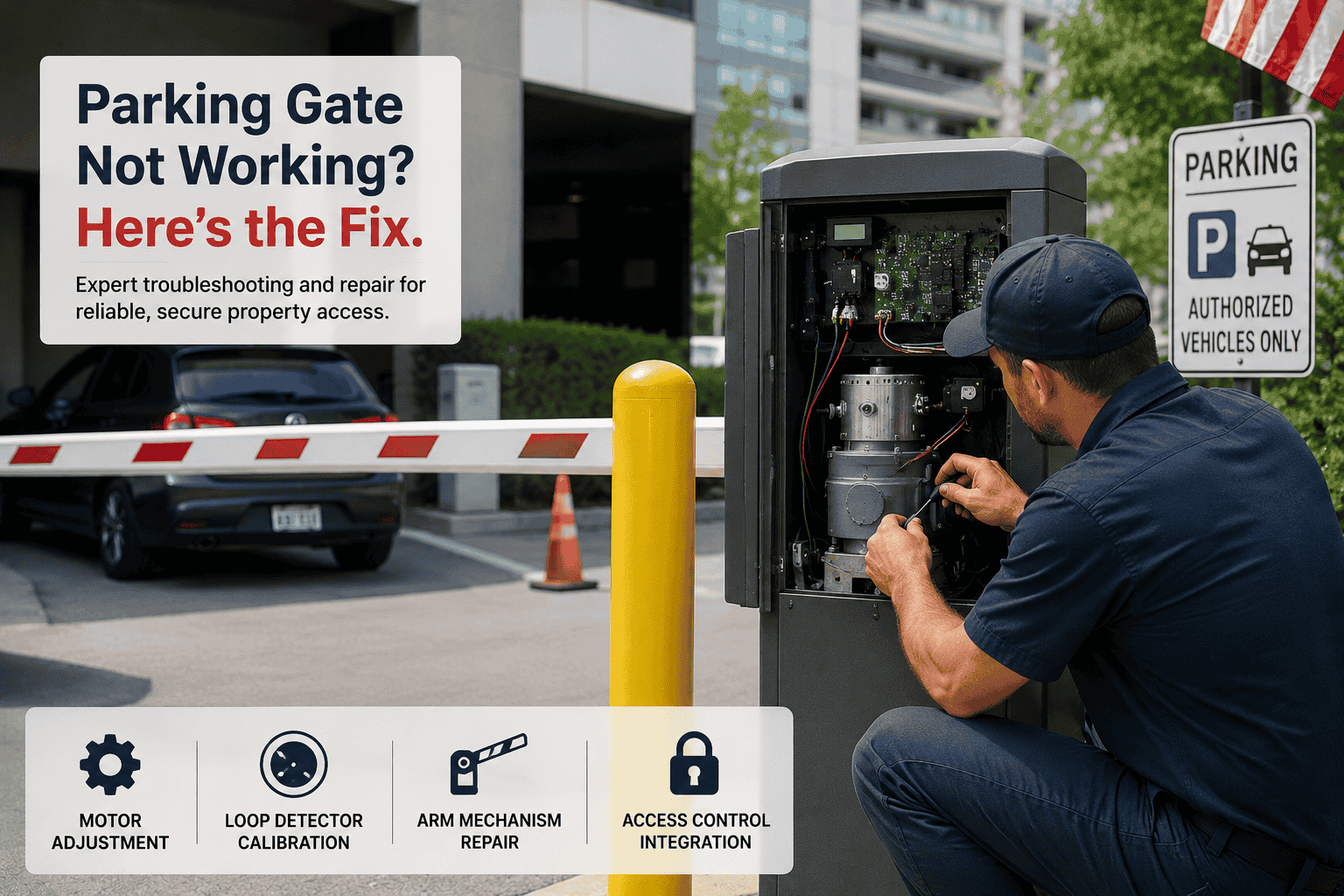
Barrier gates should be serviced monthly for basic inspections including motor noise assessment, belt tension verification, loop detector sensitivity testing, and safety edge operation check. Quarterly comprehensive checks should cover gear condition, limit switch calibration, cabinet wiring inspection, and battery backup testing. Annual major service includes motor bearing replacement, gearbox oil change, and full system cycle testing with load simulation. High-traffic entries handling over 1,000 vehicles per day may require bi-monthly basic inspections and semi-annual major service to prevent premature wear. Common failure patterns include motor capacitor degradation after 3-5 years causing slow or failed opening, limit switch drift after 6-12 months causing incomplete travel, and loop detector failure from pavement shifting causing missed vehicle detections.
What causes LPR camera misreads and how can they be reduced?
License plate recognition errors are typically caused by dirty or obstructed camera lenses accounting for about 30% of misreads, poor lighting conditions including direct sunlight glare or insufficient nighttime illumination at 25%, plate damage or obstructions like trailer hitches or bumper guards at 20%, camera positioning misalignment after wind or vibration at 15%, and software configuration issues such as incorrect region settings or outdated character recognition databases at 10%. To reduce misreads, cameras should be cleaned weekly in dusty environments and monthly otherwise, lighting should be verified at night with IR illuminators checked for proper function, camera mounts inspected for tightness quarterly, and recognition software updated when jurisdictions update plate formats. A well-maintained LPR system should achieve 95-98% read rates in controlled access lanes and 88-93% in uncontrolled environments.
How do pay station failures impact parking revenue and operations?
Pay station failures directly impact revenue collection and create significant operational disruption. When a pay station goes offline, the facility may lose 15-30% of daily revenue from that lane or zone, with each hour of downtime costing an estimated $50-200 depending on traffic volume and rate structure. Beyond direct revenue loss, pay station failures cause customer frustration, lane congestion as vehicles queue for working stations, increased violation rates as customers abandon payment attempts, and additional labor costs for manual fee collection. Common failure modes include coin jam or bill acceptor malfunction at 40% of incidents, receipt printer jams or paper depletion at 25%, touchscreen unresponsiveness at 15%, network connectivity loss at 12%, and card reader failure at 8%. Preventive measures include daily self-test execution, weekly paper and coin level checks, monthly reader head cleaning, and quarterly full-cycle testing with multiple payment methods.
What is the optimal parking occupancy target for commercial facilities?
The optimal parking occupancy target for most commercial properties is 85-92% during peak periods, representing the balance between maximizing revenue and maintaining adequate availability for arriving vehicles. Occupancy below 80% suggests underutilized capacity and potential revenue loss, while occupancy above 95% creates frequent full lot conditions that send customers to competing facilities and increase congestion from vehicles circulating in search of spaces. For employee parking, a target of 90-95% is acceptable since demand is predictable and alternative arrangements can be made. For visitor and customer parking, 80-85% is preferable to ensure availability. For EV charging spaces, 60-75% utilization is healthy since charging sessions are longer and turnover is lower. Facilities should monitor occupancy trends weekly and adjust pricing, permit allocation, or space designations when occupancy consistently falls outside target ranges for more than 30 days.
How should gate communication failures be diagnosed and resolved?
Gate communication failures fall into four categories: network connectivity issues where the gate controller cannot reach the management server, power supply problems where the gate board is not receiving correct voltage, signal interference where loop detector or wireless communication is disrupted, and hardware faults where the gate controller board, motor driver, or encoder has failed. Diagnosis should follow a logical sequence: first verify power at the gate controller checking for correct voltage at the board using a multimeter, then check network connectivity by pinging the controller from the management server and verifying switch port status and PoE delivery if applicable, then test the communication protocol checking for RS-485 termination issues, TCP port blocking, or serial converter faults, and finally inspect for environmental factors including water ingress in the gate cabinet, rodent damage to wiring, and temperature extremes. Most communication failures can be resolved within 30 minutes by a trained technician with the right diagnostic tools and spare components on hand.
Automate Parking Access Control Monitoring Across Your Facility
iFactory's platform monitors gate controller status, LPR read rates, pay station availability, occupancy by zone, and revenue data across all parking entry points — alerting your team the moment an issue develops. Book a demo to see how proactive parking system monitoring protects revenue and improves operational reliability.