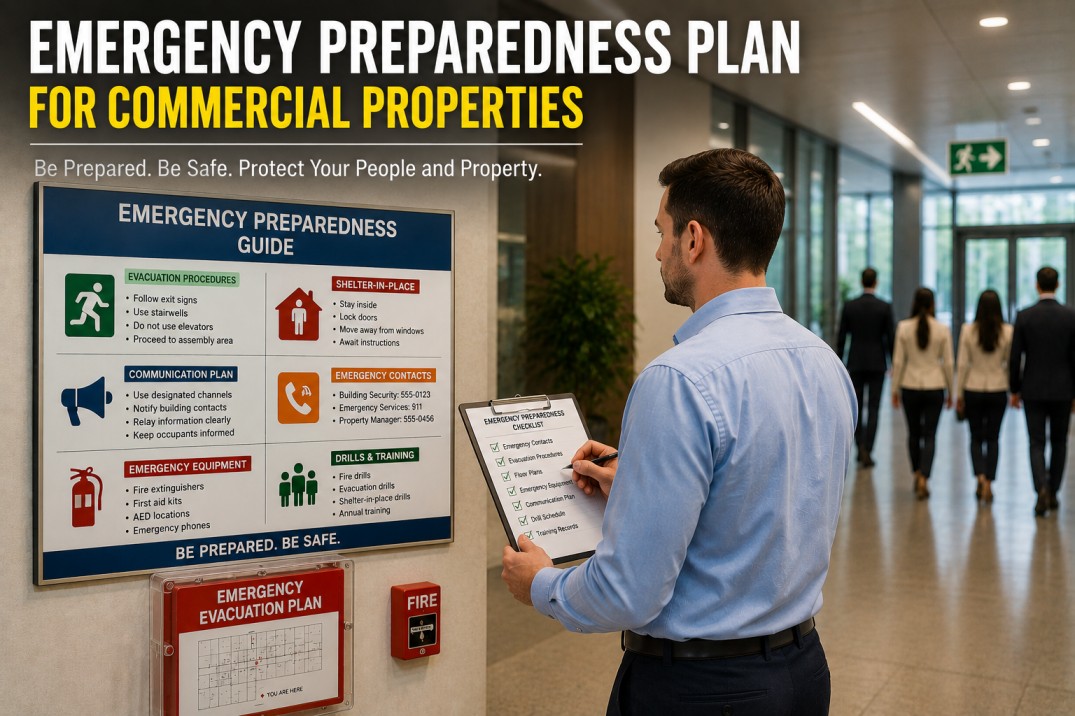
Emergency preparedness is one of the most critical yet commonly deferred responsibilities in commercial property management, with industry surveys indicating that 40-50% of commercial buildings have emergency plans that are outdated by more than two years, 60% have never conducted a full-building evacuation drill, and fewer than 25% have designated and trained emergency response teams — leaving occupants vulnerable during the first critical minutes of an incident when proper procedures can mean the difference between an orderly evacuation and a chaotic, dangerous response. Unlike routine security procedures that operate in the background of daily building operations, emergency preparedness must be actively maintained through regular plan reviews, drill execution, team training, and communication system testing, with each element validated before an actual emergency occurs rather than after. A comprehensive emergency preparedness program addresses six core components: documented response procedures for each emergency type the building may face, designated evacuation routes with primary and secondary paths from every area, a multi-layered communication cascade that ensures all occupants receive timely alerts, trained emergency response team members with defined roles and responsibilities, scheduled drills that exercise different scenarios and measure performance against established benchmarks, and plan maintenance processes that keep documentation current as building occupancy, layout, and systems change over time. This page profiles six common emergency types with their specific response protocols and severity indicators, maps primary and secondary evacuation routes from building zones to designated assembly points, illustrates the hierarchical communication cascade from incident discovery through building-wide occupant notification, defines five essential emergency response team roles with their key responsibilities, and provides an annual drill schedule template that exercises four different emergency scenarios across the calendar year with completion verification and evaluation tracking.
Emergency Preparedness Plan for Commercial Properties
A thorough emergency preparedness program covers five essential dimensions: scenario-specific response procedures for the range of emergencies a property may face, clearly mapped evacuation routes with primary and secondary options from every building zone, a hierarchical communication cascade that ensures timely and accurate information flow during an incident, trained emergency response team members with defined responsibilities and reporting relationships, and a structured drill schedule that exercises multiple scenarios across the year with documented performance evaluation and continuous improvement.
Build a Comprehensive Emergency Plan for Your Property
iFactory's platform includes emergency plan templates, drill scheduling and tracking, communication cascade tools, role management, and compliance documentation for commercial properties. Book a demo to see how structured emergency preparedness improves occupant safety and regulatory compliance.
Emergency Type Response Reference
Each emergency type requires a specific response protocol that occupants and emergency team members must execute without hesitation. The reference below profiles six common commercial building emergencies with their severity level, primary response action, notification method, and expected response time for initial action.
Evacuation Route Map — Zones to Assembly Points
Every building zone must have clearly defined primary and secondary evacuation routes that lead occupants to designated assembly points at a safe distance from the structure. The flow diagram below maps three typical building zones to their primary assembly points with secondary route alternatives for scenarios where the primary path is compromised.
Emergency Communication Cascade — Notification Hierarchy
During an emergency, timely and accurate communication is essential to ensure all occupants receive the correct instructions. The hierarchical cascade below defines the notification flow from initial incident discovery through building-wide alert, with each level having specific responsibilities for information verification, escalation, and dissemination.
Never Be Unprepared — Automate Your Emergency Plan
iFactory's platform provides emergency plan templates, drill scheduling with automated reminders, communication cascade tools, role assignment and training tracking, and compliance documentation for commercial properties. Book a demo to see how structured emergency preparedness protects your occupants and your property.
Emergency Response Team — Roles and Responsibilities
A trained emergency response team is the most important resource during a building incident. Each team member has specific responsibilities that must be clearly defined, documented, and practiced through regular drills to ensure effective coordination under the stress of an actual emergency.
- Overall authority for emergency response decisions
- Coordinates with emergency services on-site
- Authorizes building re-entry after all-clear
- Maintains and updates the emergency plan
- Activates mass notification system
- Contacts 911 and provides building details
- Provides periodic updates to all occupants
- Manages two-way radio communication channel
- Directs evacuation of assigned floor or zone
- Checks all rooms including restrooms
- Assists occupants with disabilities
- Reports floor status and headcount
- Provides initial first aid and CPR/AED
- Triages injured occupants for EMS
- Maintains first aid kit and supplies
- Documents all medical aid provided
- Searches assigned areas after evacuation
- Takes headcount at assembly points
- Reports missing persons to coordinator
- Accounts for visitors from lobby log
Annual Emergency Drill Schedule — Scenario Planning
A comprehensive drill program exercises different emergency scenarios across the year to ensure occupants and response team members are prepared for a range of incidents. The schedule below maps four drill types across a 12-month cycle with completion tracking and performance evaluation for each drill event.
| Drill Type | Q1 | Q2 | Q3 | Q4 |
|---|---|---|---|---|
| Fire Evacuation | CompletedJan 15 | CompletedApr 10 | ScheduledJul 12 | ScheduledOct 18 |
| Severe Weather Shelter | N/A | CompletedMay 22 | ScheduledAug 14 | N/A |
| Power Outage / Lockdown | ScheduledFeb 20 | N/A | ScheduledSep 5 | N/A |
| Full-Scale Drill (with FD) | N/A | N/A | ScheduledJun 28 | ScheduledDec 12 |
Frequently Asked Questions About Emergency Preparedness for Commercial Properties
How often should emergency drills be conducted in commercial buildings?
Emergency drills should be conducted at least quarterly for most commercial properties, with monthly drills recommended for high-occupancy buildings, schools, healthcare facilities, and properties with elevated risk profiles such as those handling hazardous materials. Each drill should exercise a different scenario to ensure occupants are prepared for various emergency types including fire evacuation, severe weather sheltering, and active threat or lockdown response. Drills should be conducted at varying times of day to test response during different occupancy conditions including normal business hours, during lunch periods when occupants may be in break rooms or cafeterias, and occasionally during shift changes for properties with 24-hour operations. After each drill, a debrief session should be conducted with floor wardens and emergency team members to identify issues and document lessons learned. A formal written evaluation should capture drill performance including total evacuation time, communication effectiveness, any equipment or system issues, and specific areas requiring improvement with assigned corrective actions and completion deadlines.
What should be included in a commercial building emergency plan?
A comprehensive emergency plan should include emergency contact information for building management, security, and local emergency services with multiple communication methods for each contact such as phone, email, and radio. Evacuation procedures should be documented with primary and secondary routes from every floor, designated assembly areas with weather alternatives identified, and accountability procedures for confirming all occupants have evacuated including visitor tracking from lobby sign-in logs. Shelter-in-place protocols should identify safe areas for severe weather, chemical events, and security threats with sealing procedures and emergency supply inventories for each shelter location. Emergency communication procedures must define the notification cascade from incident discovery through building-wide alert with backup communication methods if primary systems fail. The plan should also include occupant training requirements including new hire orientation, annual refresher training, specialized training for emergency team members, procedures for assisting individuals with disabilities during evacuation, utility shut-off locations for gas, water, and electrical systems, and a scheduled plan review and update cycle with annual comprehensive review responsibility assigned.
Who should be on a building emergency response team?
A commercial building emergency response team should include an emergency coordinator who has overall authority for response decisions, coordination with on-site emergency services, and authorization for building re-entry after an all-clear is declared. A communication officer is responsible for activating the mass notification system, contacting 911 with accurate building details, and providing periodic updates to occupants throughout the incident. Floor wardens for each floor or zone direct evacuations, ensure all rooms including restrooms are checked, assist occupants with disabilities, and report floor status and headcount to the coordinator. First aid responders trained in CPR, AED use, and basic first aid provide initial medical assistance and triage injured occupants until professional help arrives. Search and assembly team members conduct final searches of evacuated areas, take headcounts at each assembly point using occupant rosters and visitor logs, and report any missing persons to the emergency coordinator. Each team member should have a clearly defined alternate in case they are absent when an incident occurs, and all roles should be practiced during drills at least quarterly.
What communication systems should be in place for building emergencies?
A multi-layered communication system should include a primary mass notification platform capable of reaching all occupants simultaneously through email, SMS text, and in-app push notifications with a centralized management dashboard for sending targeted messages to specific floors or zones. A backup communication system independent of the building's primary network must be available when power or network connectivity is compromised, such as a battery-powered public address system, bullhorns for floor wardens, or two-way radios for the emergency response team with dedicated emergency channels. Visual alert systems including strobe lights and digital signage displays should supplement audible alerts for occupants who are hearing-impaired or in areas where audible alerts may not be heard such as mechanical rooms or loud manufacturing environments. Floor-specific intercom or paging systems enable targeted communication to affected areas without causing unnecessary alarm in unaffected zones. A dedicated emergency communication channel should be established for the response team to coordinate without interference from non-emergency communications, with all team members trained on radio protocols including proper channel selection, clear speech, and message acknowledgment procedures.
How should assembly areas be designated for commercial building evacuations?
Assembly areas should be designated at a safe distance from the building, typically at least 100 feet for low-rise buildings and 200 feet or more for high-rise buildings to account for falling debris, smoke plume dispersion, and emergency vehicle access. Multiple assembly points should be designated to accommodate different evacuation directions from the building and to provide alternatives when primary areas are compromised by weather conditions, ongoing emergency operations, or the nature of the incident itself. Each assembly point must have a designated coordinator responsible for taking headcounts using printed occupant rosters, current visitor logs from the lobby management system, and the building access control system to identify anyone who may still be inside. Assembly points should be clearly marked on evacuation diagrams posted throughout the building, communicated during new hire safety orientation and annual refresher training, and physically verified during each drill to ensure they remain clear of construction, landscaping, landscaping equipment, or vehicle obstructions. Weather alternatives such as adjacent covered parking structures, nearby buildings with prior occupancy agreements, or designated public transit shelters should be identified for use during inclement weather evacuations and documented in the emergency plan.
Protect Your Building and Occupants With a Ready Emergency Plan
iFactory's platform provides emergency plan management, drill scheduling with performance tracking, communication cascade tools, team role management, and compliance documentation for commercial properties of any size. Book a demo to see how structured emergency preparedness improves occupant safety, demonstrates regulatory compliance, and reduces liability exposure.


.jpg)