A preventive maintenance task that just says "inspect chiller" tells a technician almost nothing useful — which specific components, what frequency, what tools and parts to bring, and what skill level the job actually requires. A well-designed PM library replaces that vague instruction with a specific, structured template for every equipment type, and the difference between a library built this way and one that isn't shows up directly in how consistently technicians actually follow it. Designing that structure properly is the focus of this guide, built around the same PM library architecture iFactory uses across commercial HVAC deployments.
PM LIBRARY DESIGN
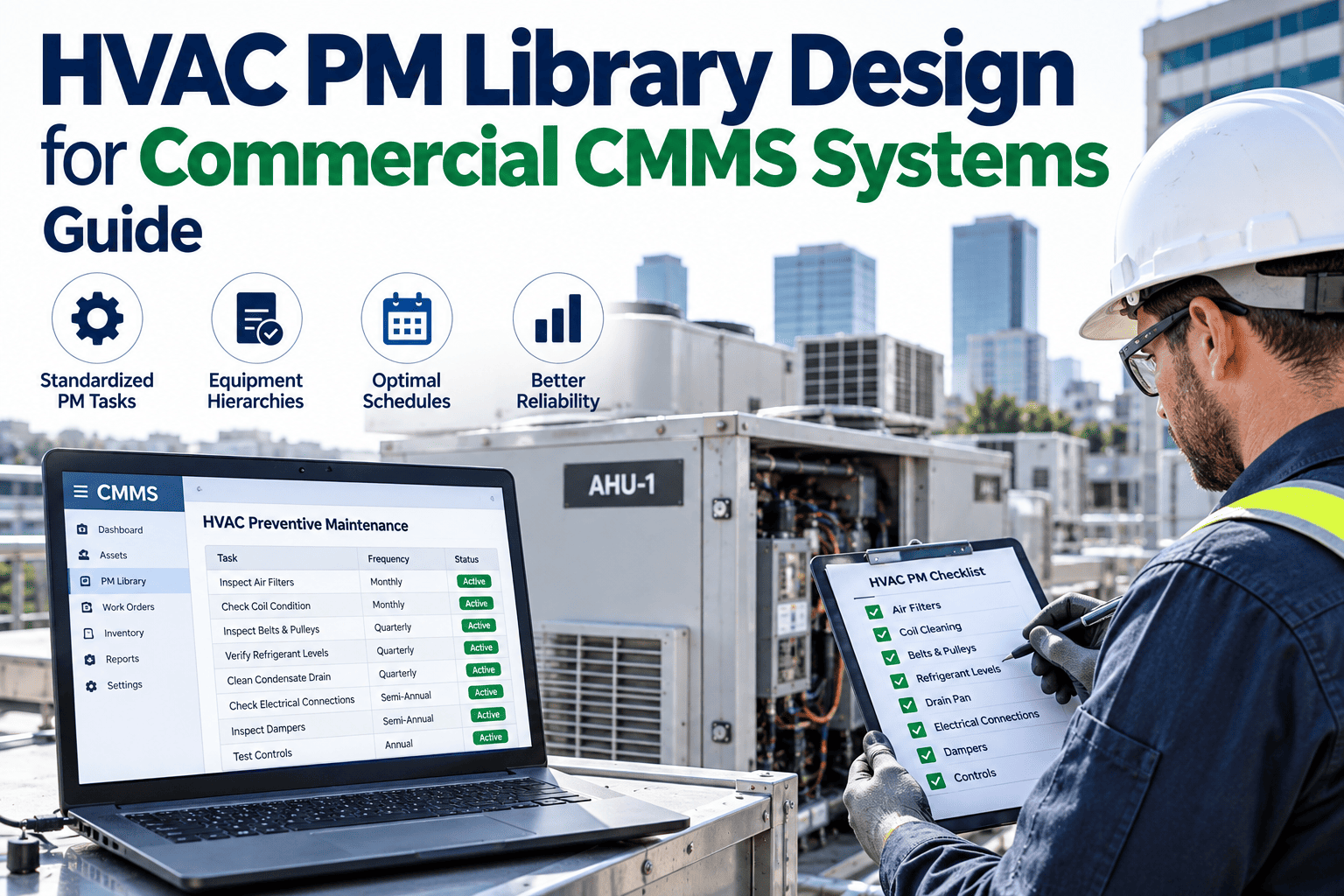
HVAC PM Library Design for Commercial CMMS Systems
Chiller, AHU, RTU, and cooling tower task templates with frequency, skill level, and parts BOM linked directly to each task — not a generic checklist stretched across every equipment type.
Chiller — Condenser Tube Inspection
FrequencyQuarterly
Skill LevelJourneyman
Parts BOMTube brushes, cleaning solution
Why a Vague PM Task Is Worse Than No PM Task at All
A PM task with no real structure creates a false sense of coverage — the work order shows as "completed" on schedule, but what actually happened underneath that checkmark varies wildly depending on which technician was assigned and how much time they had that day. A properly designed task, by contrast, produces consistent results regardless of who performs it, because the specific steps, parts, and required skill level are defined in advance rather than left to individual judgment in the moment.
The Four Fields Every PM Task Template Needs
A complete PM task template goes well beyond a task name and a due date. Four specific fields, linked together, are what turn a generic instruction into something a technician can actually execute consistently and a manager can actually plan resourcing around.
FIELD 1
Frequency
Based on manufacturer recommendations, run hours, or condition data, rather than an arbitrary calendar interval applied uniformly across all equipment.
FIELD 2
Skill Level
Tagging whether a task requires an apprentice, journeyman, or specialized certification helps route work to the right technician and plan staffing accordingly.
FIELD 3
Parts & Tools BOM
A linked bill of materials tells a technician exactly what to bring before starting, avoiding a wasted trip back to the parts room mid-job.
FIELD 4
Step-by-Step Task Detail
Specific inspection points and acceptance criteria for that exact equipment type, not a generic instruction that could apply to almost anything.
Equipment-Specific Task Design by Category
Each HVAC equipment family has its own dominant failure modes and service requirements, and a well-designed PM library reflects that difference explicitly rather than reusing the same task structure across categories.
| Equipment Type | Core PM Focus | Typical Frequency |
|---|
| Chillers | Refrigerant circuit, condenser tubes, compressor oil analysis | Monthly to quarterly, seasonal deep service |
| Air Handling Units (AHUs) | Filter replacement, coil cleaning, belt and bearing inspection | Monthly to quarterly depending on filter type |
| Rooftop Units (RTUs) | Refrigerant charge, economizer function, condenser coil condition | Quarterly, with seasonal transition checks |
| Cooling Towers | Water treatment, basin cleaning, fill media and fan inspection | Weekly water checks, quarterly deep service |
See a Full PM Library Built for Your Equipment Mix
iFactory's HVAC CMMS ships with structured PM task templates for chillers, AHUs, RTUs, and cooling towers, each with frequency, skill level, and parts BOM already linked.
Building the Library — A Practical Sequence
Designing a complete PM library from scratch is a substantial undertaking, and most facility teams find it manageable when broken into the sequence below rather than attempting to build every template for every equipment type simultaneously.
1
Start With Manufacturer Documentation
Pull baseline frequency and task requirements directly from equipment manufacturer service manuals as the starting foundation for each template.
2
Adjust for Site-Specific Conditions
Local water quality, run hours, and environmental exposure often justify adjusting frequency beyond generic manufacturer defaults.
3
Link Parts and Skill Requirements
Attach the specific parts BOM and required skill level to each task before it goes live, rather than leaving technicians to figure it out on-site.
4
Validate With Experienced Technicians
Review draft templates with technicians who service that equipment daily, catching gaps a desk-based design process alone would miss.
A Chief Engineer on Rebuilding the PM Library From Scratch
"
Our PM library before this project was a collection of tasks that had accumulated over probably fifteen years, added by different engineers with different habits, and the level of detail varied wildly from one task to the next. Some chiller tasks had a paragraph of specific inspection points, while others just said something like "monthly chiller check" with no further guidance at all, which meant the actual work performed depended entirely on which technician got assigned and how thorough they personally tended to be. Rebuilding it properly, starting from manufacturer documentation and then adjusting for our specific water quality and run-hour patterns, took a few months of real effort, and honestly it wasn't the most exciting project any of us had worked on. But the consistency it created was immediately noticeable — every chiller inspection now produces the same level of detail regardless of which technician performs it, and having parts linked directly to each task has genuinely cut down on the wasted trips back to the parts room that used to eat into a technician's day without anyone really tracking how much time that added up to.
— Chief Engineer, Commercial Office Tower · Rebuilt PM Library Across 40+ HVAC Assets
Frequently Asked Questions
How much time does building a complete HVAC PM library typically take?
For a mid-size commercial building with a mixed equipment inventory, building a properly structured PM library — covering frequency, skill level, parts BOM, and step-by-step detail for each equipment category — typically takes several weeks of focused effort, though this varies significantly based on how many distinct equipment types and models are in the portfolio. Starting from pre-built equipment-specific templates and adjusting for site-specific conditions is considerably faster than building every template entirely from scratch, which is one of the main advantages of platforms that ship with a base HVAC PM library already included.
Should PM frequency always follow manufacturer recommendations exactly?
Manufacturer recommendations are a reasonable starting point, but they're typically based on general operating conditions rather than your specific site's water quality, run hours, or environmental exposure. Equipment operating in harsher conditions — poor water quality affecting a cooling tower, for example — often benefits from more frequent service than the generic manufacturer interval suggests, while equipment running fewer hours than a typical assumption might reasonably tolerate a longer interval. Adjusting from the manufacturer baseline based on your actual operating data tends to produce a more accurate and cost-effective PM schedule than following generic recommendations unadjusted.
How do you decide the right skill level requirement for a given PM task?
Skill level should reflect the actual complexity and risk of the specific task rather than a blanket assumption based on the equipment type overall — a basic visual inspection on a chiller might reasonably be performed by a less experienced technician, while refrigerant circuit work on the same piece of equipment typically requires certification and more advanced skill. Reviewing draft skill-level assignments with senior technicians who understand both the task complexity and your team's actual skill distribution is the most reliable way to calibrate this correctly.
Can a PM library be updated after it's initially built, or is it fixed once configured?
A PM library should absolutely be treated as a living document rather than a one-time build, updated as equipment ages, as new failure patterns are identified, or as technician feedback surfaces gaps in the original task design. Platforms that allow PM templates to be edited without requiring vendor involvement make this ongoing refinement significantly easier, which is one of the evaluation criteria worth checking when selecting HVAC CMMS software in the first place.
Can iFactory help design a PM library specific to our equipment inventory?
Yes — iFactory's HVAC CMMS ships with a base library of equipment-specific PM templates for chillers, AHUs, RTUs, and cooling towers, and our implementation team works with your facilities staff to adjust frequency, skill level, and parts BOM based on your specific equipment models and site conditions. To see a sample PM library built around your equipment inventory,
book a demo with our team.
Replace Vague PM Tasks With Templates Technicians Actually Follow
Frequency, skill level, and parts BOM linked to every chiller, AHU, RTU, and cooling tower task turn a generic checklist into a PM library your team can rely on. iFactory builds it around your specific equipment mix.