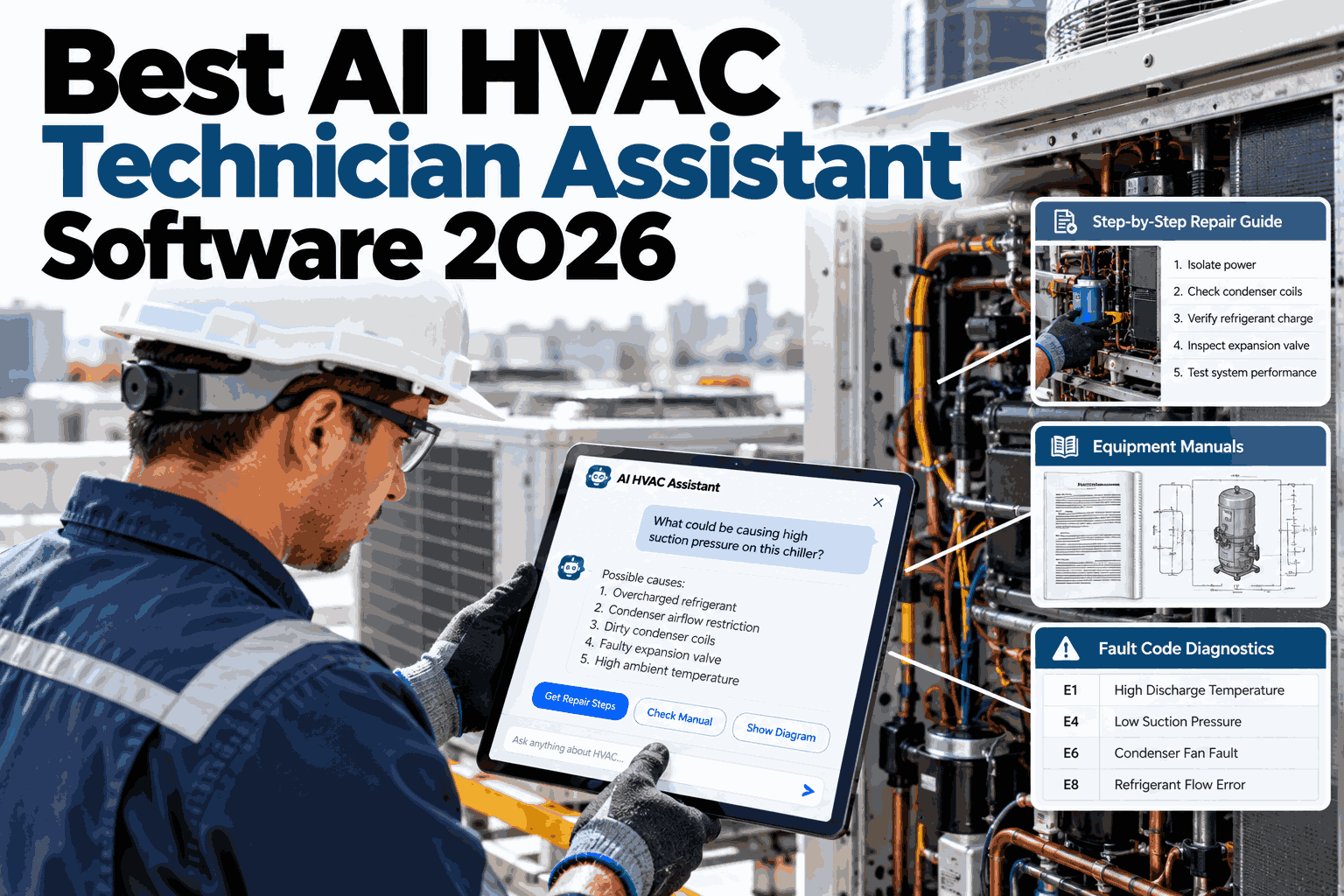
A field tech standing in front of a rooftop unit with a vague complaint like "building is warm" usually spends the first twenty minutes just narrowing down where to look. That narrowing step, done from memory and a mental checklist, is where most service calls quietly run long before any actual repair begins. An AI troubleshooting assistant does not replace that judgment, but it compresses the narrowing step by reasoning from symptom to likely cause the same way an experienced senior tech would, only faster and without needing someone to call. If you want to see how that reasoning plays out on a real symptom from your own fleet, you can walk through a live troubleshooting example with our team.
AI technician assistant, 2026
Turn a Vague Symptom Into a Confident Next Step in Minutes
A practical guide to symptom-to-cause reasoning, the diagnostic questions that narrow a fault fastest, and the next-best-action suggestions that shorten every HVAC service call.
Symptom reported
→
Likely causes ranked
→
Targeted questions
→
Next best action
The real cost
Why Troubleshooting Time Eats Into Every Service Window
Most HVAC service contracts are priced around a target time per call, but the diagnostic phase is the least predictable part of that window. A tech who guesses wrong on the first component check adds a full extra trip to the truck before the real fix even starts.
Guess-and-check habits
Without a structured path, techs often check the parts they know best first, not the ones most likely to be at fault.
Knowledge walks out the door
Senior techs carry years of symptom patterns in their heads, and that reasoning rarely gets written down anywhere.
Callback risk
A fix aimed at the wrong root cause often resolves the symptom briefly, then triggers a callback within days.
Inconsistent documentation
Without a shared reasoning trail, two techs on the same unit can log the same fault completely differently.
How it reasons
How Symptom-to-Cause Reasoning Actually Works
The assistant does not diagnose from a single symptom alone. It combines the reported symptom with unit type, recent fault history, and live sensor readings where available, then ranks probable causes instead of handing back one guess.
1
The tech enters or speaks the symptom in plain language, such as "short cycling" or "low airflow on return."
2
The assistant pulls the unit's make, model, age, and any fault codes or recent service history on file.
3
Known symptom-to-cause patterns are ranked by likelihood, weighted by what is actually common on that equipment type.
4
The top-ranked causes are turned into a short list of targeted diagnostic questions instead of a long generic checklist.
5
As the tech answers each question, the ranking updates and the next-best-action narrows further until one path remains.
Common patterns
Symptom-to-Cause Patterns Techs See Every Week
Most recurring service calls trace back to a small set of root causes. Seeing the pattern laid out side by side is often enough to recognize which one applies before a single tool comes out.
| Reported symptom | Most likely cause | Second likely cause | First check |
| Short cycling |
Oversized unit or dirty airflow sensor |
Refrigerant overcharge |
Airflow sensor reading and duct restriction |
| Warm air from supply |
Low refrigerant charge |
Failed reversing valve |
Suction and discharge pressure |
| Unit runs, no cooling |
Compressor not engaging |
Blocked condenser coil |
Contactor and capacitor condition |
| High humidity indoors |
Oversized equipment, short run time |
Low airflow across evaporator |
Run-time logs against setpoint |
| Unusual noise at startup |
Worn motor bearing |
Loose fan blade or belt |
Visual and vibration check on start |
This table reflects general patterns, not a guarantee for any single unit, which is exactly why the assistant pairs it with live diagnostic questions rather than treating it as a fixed lookup chart.
See the Symptom Table Applied to Your Own Fleet
Bring a recent call to the walkthrough and we will show how the same reasoning ranks causes for that specific unit and history.
Narrowing the fault
The Diagnostic Questions That Narrow a Fault Fastest
A good diagnostic question eliminates more than one possible cause at once. The assistant orders its questions by how much they narrow the ranked list, not by the order a checklist happens to be written in.
Is the compressor engaging at all?
No
Check contactor, capacitor, and control voltage first
Yes
Check suction pressure against ambient conditions
Low
Leak search and charge verification path
Normal
Check airflow restriction and coil condition path
This single branching question often separates an electrical fault from a refrigerant fault within the first two answers, which is exactly the kind of early split that saves a tech from checking the wrong system entirely.
What comes next
Next-Best-Action Suggestions, Not Just a Diagnosis
Knowing the likely cause is only half the job. The assistant also suggests the specific next action, ranked by how quickly it confirms or rules out the leading cause.
Measure first
Where a quick reading settles the question, the assistant suggests the exact gauge or meter check before any parts are touched.
Inspect visually
Loose connections, worn belts, and blocked coils often show themselves on a focused visual check guided by the ranked cause.
Test a component
When a part is the leading suspect, the assistant points to the correct test procedure for that specific make and model.
Escalate or order
If the leading cause needs a part not on the truck, the assistant flags it early instead of after an hour of unrelated checks.
Trust the ranking
Reading the Confidence Score Behind Each Suggestion
Every ranked cause carries a confidence level, not a flat yes or no answer. That score tells a tech how much weight to put on the suggestion before committing shop time to it.
High confidence
Symptom, history, and sensor data all point the same direction
Moderate confidence
Pattern matches but at least one data point is missing or unclear
Low confidence
Symptom is ambiguous enough to fit several unrelated causes
A low-confidence suggestion is still useful, since it tells the tech exactly which extra reading would turn an uncertain answer into a confident one, rather than leaving them guessing blind.
Measured impact
What Changes on the Service Call Once Reasoning Is Structured
The time saved rarely comes from one dramatic shortcut. It comes from removing the small repeated delays that add up across a full day of calls.
Unstructured troubleshooting
Diagnostic phase often runs 20 to 35 minutes
Root cause found by trial and error
Callback risk when symptom masks a different cause
Reasoning lives only in the tech's head
AI-guided troubleshooting
Diagnostic phase often runs 8 to 15 minutes
Root cause narrowed through ranked questions
Confidence score flags when more data is needed first
Reasoning path logged automatically on the ticket
Frequently asked questions
What Techs and Service Managers Ask First
Does the assistant replace a tech's own judgment on the call?
No, it narrows the starting point and ranks likely causes, but the tech still confirms with their own hands-on checks before any repair decision is made.
See how it fits your workflow on a short call with our team.
What happens when the reported symptom does not match any known pattern?
The assistant flags it as low confidence and suggests the broadest diagnostic questions first, rather than forcing a match to a pattern that does not fit.
Ask support about edge cases specific to your equipment mix.
Does this work on older rooftop units without smart sensors installed?
Yes, the reasoning still works from symptom description, unit history, and manual readings a tech enters on site, though live sensor data sharpens the ranking further where it is available.
Check coverage for your unit types with our specialists.
How does the symptom pattern library get built and updated over time?
Patterns start from established service knowledge and get refined using confirmed outcomes logged from real calls, so the ranking improves as more tickets close with a verified root cause.
Learn how pattern updates roll out with our team.
Can new techs rely on this the same way an experienced tech would?
It is especially useful for newer techs, since it surfaces the kind of ranked reasoning a senior tech builds over years, while still leaving the final hands-on call to the person on site.
Talk through onboarding use cases on a quick walkthrough.
Shorten the guesswork on every call
Give Your Field Techs an AI Troubleshooting Partner
Book a session with iFactory AI to see symptom-to-cause reasoning, diagnostic questions, and next-best-action suggestions working on real HVAC service scenarios.