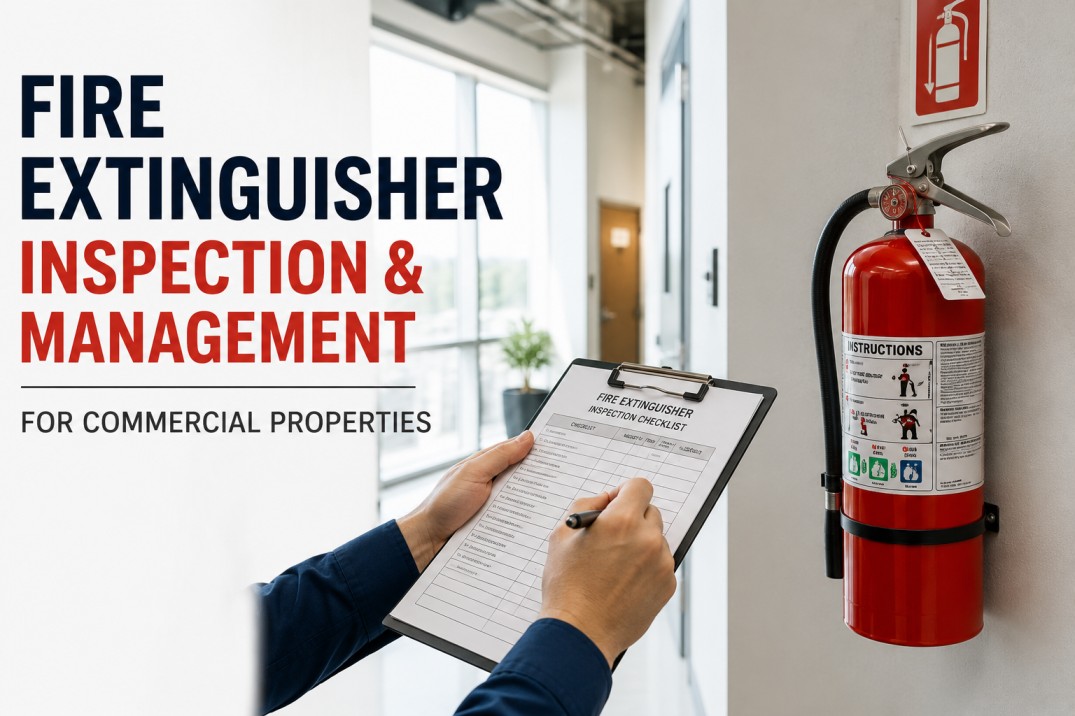
Fire Extinguisher Inspection & Management for Commercial Properties

By Nicole Kensington on May 29, 2026

fire-extinguisher-inspection-management-commercial

Fire extinguisher inspection compliance isn't optional — it's the difference between a protected property and a six-figure OSHA penalty. For facility managers and safety professionals overseeing commercial properties across the U.S., staying ahead of NFPA 10 requirements demands more than a clipboard and good intentions.

4 min read  ·  NFPA 10 Compliance Guide
Fire & Life Safety Systems

Fire Extinguisher Inspection & Management for Commercial Properties

A complete compliance framework — monthly checks, annual servicing, 6-year internal exams, and hydrostatic testing — managed digitally across every asset in your portfolio.

93–95%
Fires suppressed when extinguisher is deployed

$3.4M
OSHA penalties issued to one retail chain for missed inspections

4
Mandatory NFPA 10 service intervals every facility must track
iFactory for Fire Safety Teams
Automate your entire extinguisher compliance program

From monthly visual checks to 12-year hydrostatic tests — schedule, track, and document every inspection across all properties in one platform.

The Compliance Stakes

Why Missed Inspections Cost More Than You Think

OSHA inspected over 34,600 American workplaces in FY2024. The same violations surface repeatedly: fire safety equipment not inspected on schedule, maintenance records unavailable. The consequences extend far beyond a warning.

Per-Extinguisher OSHA Fines
Penalties compound per extinguisher, per violation type. A large multi-unit property can accumulate six-figure fines from a single inspection visit.
Liability in Fire Events
If a fire occurs and documentation shows missed inspections, insurers can deny claims and property owners face direct negligence liability in litigation.
Severe Violator Program
Repeated fire safety violations can land your company in OSHA's Severe Violator Enforcement Program — triggering enhanced oversight across all locations.
NFPA 10 Framework

The 4 Mandatory Service Intervals

NFPA 10 — the Standard for Portable Fire Extinguishers — establishes four distinct service intervals. Each has different frequency requirements, performer qualifications, and documentation obligations.

Every Month
Visual Inspection
Performed by: Building staff (no certification required)
  • Extinguisher in designated, unobstructed location
  • Tamper seal and safety pin intact
  • Pressure gauge in operable range
  • No visible corrosion, dents, or physical damage
  • Operating instructions legible on nameplate
Every 12 Months
Annual Maintenance Examination
Performed by: Certified technician
  • Full inspection of shell, hose, nozzle, and handle
  • Verification of agent charge weight or pressure
  • Examination of valve assembly condition
  • Date tag affixed; documented in inspection records
  • Deficiencies trigger immediate repair or replacement
Every 6 Years
Internal Examination
Performed by: Certified technician (stored-pressure dry chemical units)
  • Full disassembly and internal inspection
  • Check for hidden corrosion and agent caking
  • Examination of internal valve components
  • Recharge and reassemble to manufacturer specs
  • Most frequently missed interval — extinguisher appears functional externally
Every 5–12 Years
Hydrostatic Testing
Performed by: Trained technician with certified equipment
  • Pressure tests cylinder shell and valve assembly integrity
  • Interval depends on extinguisher type (5 or 12 years)
  • Must be performed by trained personnel with suitable facilities
  • Failed units must be removed from service immediately
  • Full documentation required per NFPA 10
Field-Ready Checklist

Monthly Visual Inspection — Complete Checklist

NFPA 10 requires monthly visual inspections that building staff can perform without certification. Use this checklist for every extinguisher in your portfolio.

Location & Accessibility

Extinguisher is in its designated mounting location

No obstructions blocking access or visibility

Maximum 75-foot travel distance maintained (NFPA 10)

Signage and identification markings visible
Physical Condition

No dents, rust, or corrosion on cylinder body

Hose and nozzle undamaged and unobstructed

Handle and pull pin in proper condition

Safety seal and tamper indicator intact
Charge & Readiness

Pressure gauge needle in operable (green) range

Unit weight consistent with charged state

No signs of discharge or partial use

Annual inspection tag present and current
Documentation

Date of inspection recorded

Inspector name and signature documented

Any deficiencies noted and flagged for service

Records stored and accessible for AHJ review
Hydrostatic Testing Reference

Testing Intervals by Extinguisher Type

Hydrostatic testing intervals vary by extinguisher type per NFPA 10 Chapter 8. Knowing your asset mix is essential for scheduling compliance accurately.

Extinguisher Type Common Use Case 6-Year Internal Exam Hydrostatic Test Interval
Stored-Pressure Dry Chemical General commercial, offices, warehouses Required 12 Years
Wet Chemical (Class K) Commercial kitchens, restaurants Not Required 5 Years
Carbon Dioxide (CO₂) Electrical equipment, server rooms Not Required 5 Years
Pressurized Water Class A fires, general occupancies Not Required 5 Years
Halogen / Clean Agent Data centers, sensitive equipment areas Not Required 12 Years
Cartridge-Operated Dry Chemical Industrial, manufacturing Not Required 12 Years
Operational Efficiency

Paper Tracking vs. Digital Management

Managing dozens or hundreds of extinguishers across multiple buildings with spreadsheets and paper tags is how compliance gaps happen. Here's what the shift to digital looks like in practice.

Paper & Clipboard
  • Manual scheduling — easy to miss 6-year or 12-year intervals
  • Records stored in filing cabinets; unavailable during AHJ inspections
  • No alerts when extinguishers become overdue
  • No multi-site visibility for portfolio managers
  • Technicians must re-enter data from paper forms
  • Deficiencies tracked manually, prone to falling through cracks
Digital Platform
  • Automated scheduling for all four NFPA 10 service intervals
  • Cloud-based records accessible instantly from any device
  • Proactive alerts before due dates — never miss an interval
  • Portfolio-wide dashboard: all locations, all assets, one view
  • Mobile-first field capture — technicians log in real-time
  • Deficiency tracking with automatic escalation workflows
Manage every extinguisher across every property — from one dashboard

iFactory's fire & life safety module tracks monthly, annual, 6-year, and hydrostatic schedules automatically. Built for U.S. compliance teams managing multi-site portfolios.

Operational Workflow

How a Compliant Inspection Program Runs

A well-structured extinguisher compliance program follows a repeatable workflow — from asset inventory to corrective action closure. Here's the process that keeps multi-property portfolios audit-ready.

01
Asset Inventory & Tagging
Catalog every extinguisher by location, type, manufacture date, and last service date. Assign a unique asset ID (barcode or QR code) for field scanning and digital tracking.

02
Schedule All Four Service Intervals
Based on manufacture date and extinguisher type, auto-generate due dates for monthly checks, annual maintenance, 6-year internal exams, and hydrostatic testing.

03
Execute & Document Field Inspections
Inspectors use mobile devices to complete digital checklists, capture photos of deficiencies, and log findings in real-time — no re-entry, no lost paperwork.

04
Flag & Remediate Deficiencies
Deficient units trigger work orders automatically. Track corrective action status, assign technicians, and close out findings with documented proof of repair.

05
Audit-Ready Reporting
Generate inspection history, compliance certificates, and deficiency logs on demand. Present complete documentation to AHJs, insurers, or internal stakeholders in minutes.
Frequently Asked Questions

Fire Extinguisher Compliance — Common Questions

Who is responsible for monthly fire extinguisher inspections?
Monthly visual inspections can be performed by building staff or the property owner's designated personnel — no certification is required. Annual maintenance, 6-year internal exams, and hydrostatic testing must be performed by a certified, trained technician.
Is documentation required for monthly inspections?
NFPA 10 mandates documentation for annual and beyond inspections. Monthly records are not strictly required by the standard, but maintaining them is strongly recommended — particularly when OSHA violations are per-extinguisher and documentation gaps are a primary finding in inspections.
What is the maximum travel distance to a fire extinguisher?
NFPA 10 requires that no point in a commercial building be more than 75 feet from a portable fire extinguisher for Class A hazards. Placement requirements vary by hazard class — Class B and K applications have different spacing rules that must be evaluated per occupancy type.
Why is the 6-year internal exam frequently missed?
The 6-year internal exam is required for stored-pressure dry chemical extinguishers. Because these units appear fully functional from the outside, facilities often pass annual inspections without triggering the internal service. Digital scheduling systems that track manufacture dates and service history are the most reliable way to ensure this interval isn't overlooked.
Can fire extinguisher inspection software help with multi-site portfolios?
Yes. Purpose-built platforms centralize asset records, automate service schedules, enable mobile field documentation, and provide portfolio-wide compliance dashboards — eliminating the coordination gaps that cause violations across distributed properties. The fire prevention inspection software market is growing at 8.4% CAGR as facilities teams make this transition.
Built for U.S. Compliance Teams
Stop Managing Fire Safety with Spreadsheets

iFactory gives facility managers, safety officers, and property management teams a single platform to track every extinguisher, every inspection, and every service interval — across every building in your portfolio.
NFPA 10 compliant scheduling
Mobile-first field inspections
Audit-ready digital records
Multi-site portfolio dashboard

Share This Story, Choose Your Platform!