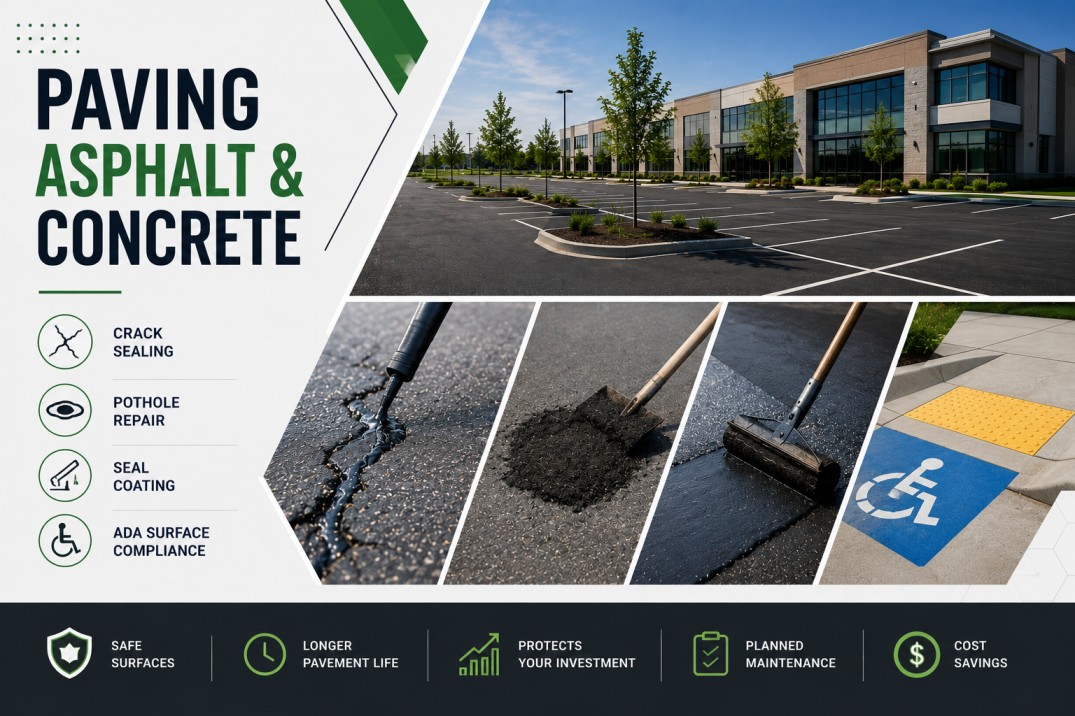
Paving surfaces — parking lots, driveways, loading zones, and pedestrian walkways — are among the most heavily used and visually prominent assets on any commercial property. Asphalt pavement naturally oxidizes and embrittles over time, while concrete slabs are susceptible to joint deterioration, freeze-thaw spalling, and subgrade settlement that creates tripping hazards. A single unaddressed crack in asphalt can widen into a pothole requiring $500–$2,000 in emergency repair within a single winter cycle, and a non-compliant concrete trip hazard can expose a property owner to ADA litigation with settlements averaging $35,000–$75,000. A systematic paving analytics program — encompassing crack sealing, seal coating, joint maintenance, and scheduled structural assessments — extends pavement service life by 40–60%, eliminates emergency pothole repair costs, and maintains the safe, professional appearance that tenants, visitors, and municipal inspectors expect. This guide provides facility managers and property owners with a data-driven framework for scheduling, inspecting, and budgeting paving maintenance across commercial portfolios.
Paving, Asphalt & Concrete Analytics for Commercial Properties
Keep every paving surface safe, compliant, and cost-efficient. iFactory's platform tracks asphalt and concrete assets, automates inspection scheduling, and digitizes pavement maintenance across your entire portfolio.
Asphalt Pavement: Components & Failure Profiles
Commercial asphalt pavement consists of multiple structural layers — subgrade, base course, and wearing surface — each with distinct failure modes. Understanding these profiles is the foundation of a preventive paving analytics program.
Surface Cracking
Hairline to 1/4-inch cracks in the asphalt wearing surface caused by oxidation, thermal cycling, and base layer movement. Longitudinal cracks follow pavement edges or construction joints; alligator cracking indicates structural base failure. Crack sealing within 12 months of appearance prevents water infiltration.
Seal Within 12 MonthsPotholes & Raveling
Potholes form when water enters unsealed cracks, freezes, and expands — dislodging aggregate from the pavement matrix. Raveling is the progressive loss of aggregate from the surface due to oxidation and traffic wear. Both accelerate rapidly in freeze-thaw climates and require immediate repair.
Repair Within 48 HoursRutting & Depressions
Longitudinal surface depressions in wheel paths caused by base layer consolidation or asphalt flow under traffic loads. Ruts deeper than 1/4 inch collect water and accelerate pavement deterioration. Structural assessment with core sampling is required to determine if base repair or full reconstruction is needed.
Assess AnnuallySeal Coat Failure
Seal coating (fog seal, slurry seal, or chip seal) that has worn beyond service life, typically 3–5 years depending on traffic volume and climate. Failed seal coat exposes the underlying asphalt to oxidation and water intrusion. Surface texture, colour fade, and aggregate exposure indicate reapplication is due.
Reapply Every 3–5 YrsDrainage & Base Issues
Standing water on pavement surfaces after 24 hours indicates drainage failure — inadequate slope, clogged catch basins, or settled subgrade. Water-saturated base layers lose structural capacity and accelerate every other failure mode. Corrective actions include regrading, drain installation, or French drain systems.
Inspect After Every StormUtility Cut & Patch Failure
Trenches and patches from utility work that settle, crack, or ravel around the repair perimeter. Improper compaction of backfill material is the primary cause. Each utility cut reduces surrounding pavement life by 30–50% unless the restoration matches original density and material specifications.
Monitor for 12 MonthsStop pavement deterioration before it reaches the base layer. iFactory's paving analytics platform tracks crack density, surface condition, and maintenance history across every parking lot and driveway in your portfolio.
Concrete Pavement: Joints, Slabs & Failure Modes
Concrete pavement (PCC — Portland Cement Concrete) fails differently than asphalt. Joint deterioration, slab settlement, and surface spalling are the primary failure modes, each requiring distinct inspection techniques and repair methods.
| Concrete Issue | Primary Cause | Inspection Method | Repair Strategy |
|---|---|---|---|
| Joint Spalling | Freeze-thaw cycling, joint filler deterioration, aggregate expansion | Visual check, joint width measurement | Joint sealant replacement, partial-depth repair |
| Slab Settlement / Faulting | Subgrade consolidation, poor compaction, water erosion | 3-ft straightedge, profilometer survey | Mudjacking, slab replacement, subgrade stabilization |
| Surface Scaling | De-icing chemicals, improper finishing, low air content | Visual inspection, ASTM C672 freeze-thaw test | Surface sealer, overlay, or slab replacement |
| Crazing / Map Cracking | Rapid surface drying during finishing, improper curing | Visual inspection, crack width measurement | Surface sealer if shallow; overlay if deep |
| Corner Break | Traffic loading at unsupported joint corner, erosion of subbase | Visual, sounding with hammer | Full-depth slab repair at joint |
| ADA Trip Hazard | Slab settlement, heaving, or vertical displacement > 1/4 inch | Level measurement per ADA Standards 303 | Grinding, slab replacement, or overlay |
| D-Cracking | Aggregate freeze-thaw deterioration, moisture-susceptible aggregate | Visual, petrographic analysis | Slab replacement with non-D-cracking aggregate |
Paving Maintenance & Inspection Calendar
A calendared approach to paving maintenance ensures critical preservation tasks are performed within their optimal windows and no seasonal requirement is overlooked.
Spring
Crack sealing and pothole repair after winter damage assessment. Seal coat application scheduling. Catch basin and drain clearing. Sweeping and debris removal. Striping restriping planning. Concrete joint inspection for winter settlement damage.
March – MaySummer
Seal coating application (optimal at 70–85°F). Crack sealing of new cracks. Asphalt overlay and milling projects. Concrete slab replacement. Striping and pavement marking installation. ADA compliance survey for trip hazards.
June – AugustFall
Final crack sealing before freeze. Catch basin cleaning and winterization. Drainage system verification. Pothole patching with cold mix for emergency winter use. Pavement condition survey and budget planning for following year.
September – NovemberWinter
Emergency pothole patching with cold mix. Snow plow damage inspection. Salt and de-icer management to minimize concrete scaling. Storm damage reporting. Plan spring crack sealing and seal coat contracts.
December – FebruaryAsphalt Pavement Condition Index (PCI) Rating
The Pavement Condition Index (PCI) is the industry-standard method for rating asphalt surface condition on a 0–100 scale. Regular PCI surveys enable data-driven capital planning and maintenance prioritization.
| PCI Range | Rating | Recommended Action | Relative Cost |
|---|---|---|---|
| 86–100 | Excellent | Routine crack sealing, annual inspection | $0.05–0.15/sq ft |
| 71–85 | Good | Crack sealing, spot seal coat, drainage check | $0.15–0.50/sq ft |
| 56–70 | Fair | Fog seal or slurry seal, crack sealing, pothole repair | $0.50–1.50/sq ft |
| 41–55 | Poor | Mill and overlay, structural patching, full seal coat | $2.00–5.00/sq ft |
| 26–40 | Very Poor | Reconstruction planning, major patching, base repair | $5.00–10.00/sq ft |
| 0–25 | Failed | Full reconstruction required | $10.00–20.00/sq ft |
From PCI surveys to ADA compliance mapping — iFactory digitizes every paving inspection across your entire commercial portfolio.
Cost of Deferred Paving Maintenance
Deferring pavement maintenance is one of the most expensive decisions a property owner can make. The cost curve from preventive crack sealing to full reconstruction is steeper than virtually any other building site asset.
Preventive Maintenance
Annual crack sealing, seal coating every 3–5 years, joint maintenance, and drainage verification. Extends pavement life to 25–35 years for asphalt and 30–40 years for concrete. The lowest total cost of ownership approach.
Annual Budget ItemCorrective Repair
Pothole patching, mill and overlay, slab replacement, mudjacking. Corrective repairs cost 3–6x more than preventive maintenance and restore only a portion of original pavement life (typically 40–60%).
3–6x PM CostLiability & Compliance
ADA trip-and-fall lawsuits, vehicle damage claims from potholes, and municipal fines for non-compliant pavement conditions. Preventable through routine PCI surveys and ADA compliance inspections.
Preventable RiskFull Reconstruction
Complete asphalt or concrete removal, subgrade preparation, base installation, and new surface placement. Required when deferred maintenance has allowed structural failure of the pavement section. 80–100x the annual preventive cost.
80–100x PM CostFrequently Asked Questions
How often should commercial asphalt parking lots be seal coated?
Asphalt seal coating is recommended every 3–5 years depending on traffic volume, climate, and existing pavement condition. High-traffic lots (retail centers, hospitals) may require seal coating every 3 years, while low-traffic lots (office parks, industrial) can extend to 5 years. Seal coating should only be applied to pavement in fair-to-good condition (PCI 56+) — applying seal coat over deteriorated pavement traps moisture and accelerates failure. Always perform crack sealing at least 2 weeks before seal coating application. The optimal application temperature is 70–85°F with no rain forecast for 24 hours.
When should crack sealing be performed vs. crack filling?
Crack sealing uses router-cut reservoir shapes and specialized sealant materials to create a waterproof barrier in working cracks (those that move with temperature changes). Crack filling uses cleaner-applied materials in non-working cracks to simply fill the void. Sealing is appropriate for cracks wider than 1/8 inch that show thermal movement; filling is appropriate for hairline cracks and surface checking. Both should be performed when ambient temperature is above 50°F and falling, with clean, dry crack surfaces. Spring and fall are the optimal seasons for crack sealing in most climates. Crack sealing extends pavement life by 3–5 years when performed before water infiltration has damaged the base layer.
What is the ADA requirement for concrete sidewalk trip hazards?
Per ADA Standards Section 303, changes in level greater than 1/4 inch (6.4 mm) at walking surfaces are prohibited. Changes between 1/4 and 1/2 inch must be beveled at a slope no steeper than 1:2. Changes greater than 1/2 inch must be treated as a ramp, stair, or other vertical access element. Vertical displacements at concrete joints, settled slabs, and root-heaved sections are the most common violations. Regular walkway surveys using a 4-foot level or proprietary ADA measurement tools should be conducted annually. Grinding down high spots, mudjacking settled slabs, or full slab replacement are the typical remediation methods. iFactory's platform digitizes ADA survey data, maps trip hazards to specific slab locations, and generates prioritized repair queues by severity.
How long does asphalt pavement typically last?
Properly maintained asphalt pavement in commercial applications typically lasts 25–35 years. Unmaintained asphalt fails in 12–18 years. The service life breakdown is: wearing surface (seal coat) 3–5 years, crack sealing cycle 3–5 years, structural overlay 15–20 years, and full-depth reconstruction at 25–35 years. Concrete pavement lasts 30–40 years with proper joint maintenance, or 15–20 years without. The single most important factor determining pavement longevity is the first 3 years after installation — prompt crack sealing and drainage verification during this period eliminates 80% of premature failure causes. iFactory's platform tracks pavement age, maintenance history, and PCI trend data to project remaining service life and optimize capital replacement timing.
What documentation should I maintain for paving assets?
Essential paving documentation includes: as-built pavement drawings showing depths, materials, and base composition; PCI survey reports from each inspection cycle with condition photos; crack sealing and seal coating records with dates, materials, and quantities; pothole repair and patching logs; concrete joint sealant replacement records; ADA compliance survey reports with trip hazard locations and remediation dates; snow plow damage repair records; capital replacement forecasts with 5- and 10-year budgets; and warranty documentation from installation contractors. iFactory's platform centralizes all paving asset documentation with automated PCI survey scheduling, condition trend analysis, and prioritized repair queue generation across your entire portfolio.
When should I replace vs. repair commercial pavement?
The decision to repair or replace pavement is driven by the Pavement Condition Index (PCI). Pavement with PCI 56–100 is suitable for preservation treatments (crack sealing, seal coating). Pavement with PCI 41–55 typically requires structural improvement (mill and overlay, structural patching). Pavement with PCI below 40 usually warrants full reconstruction. Additional factors include: percentage of alligator cracking (>25% of surface area indicates base failure requiring reconstruction), depth of rutting (>1/2 inch may require structural repair), frequency of pothole formation (multiple potholes per year indicates systemic failure), and whether drainage issues have been corrected (paving over wet base accelerates new pavement failure). iFactory's platform analyzes PCI trends, repair history, and cost projections to recommend the optimal repair-or-replace decision for each pavement section in your portfolio.
Transform paving management from reactive pothole patching to data-driven life-cycle asset management. Book an iFactory walkthrough to see how portfolio-level paving analytics work.
.jpg)