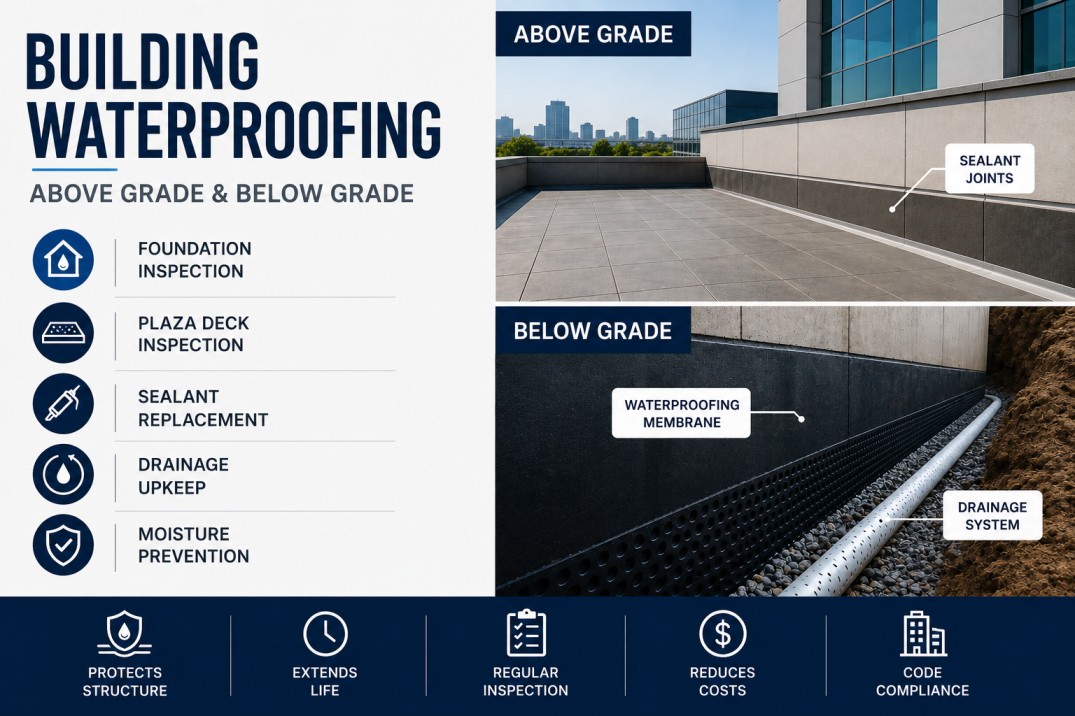
Building waterproofing is the single most critical line of defense protecting commercial real estate assets from structural degradation, mould propagation, and tenant health liability — yet it remains the most frequently deferred building system in facility maintenance budgets. Below-grade foundation walls are subjected to continuous hydrostatic pressure that, when unaddressed, leads to slab heaving, crack propagation, and basement flooding requiring remediation costing $50,000–$150,000 per incident. Above-grade plaza decks, podiums, and balcony membranes endure UV radiation, freeze-thaw cycling, and pedestrian traffic that accelerate sealant embrittlement and membrane fatigue. A systematic waterproofing analytics program — encompassing routine inspections, moisture mapping, planned sealant renewal, and drainage system maintenance — extends membrane service life by 40–60%, eliminates emergency waterproofing calls, and preserves the building's structural integrity across its full design life. This guide provides facility managers and building owners with a data-driven framework for managing both below-grade and above-grade waterproofing assets across their portfolio.
Building Waterproofing Analytics: Below Grade & Above Grade
Stop waterproofing failures before they reach the interior. iFactory's platform tracks below-grade and above-grade waterproofing assets, automates inspection schedules, and digitizes moisture mapping across your entire portfolio.
Below-Grade Waterproofing Systems & Failure Modes
Below-grade waterproofing operates under constant hydrostatic pressure where a single membrane breach can introduce thousands of gallons of water into a structure. Understanding the distinct failure profiles of each system type is the foundation of a preventive analytics program.
Sheet Membrane Systems
Self-adhering rubberized asphalt or polymeric sheets applied to foundation walls before backfill. Primary failure modes include improper lap sealing, puncture during backfill, and adhesion loss at terminations. Damage is undetectable after backfill — quality assurance during installation is the only control point.
Design Life: 25–35 yrsFluid-Applied Membranes
Polyurethane or cementitious coatings applied as liquid that cures to form a seamless monolithic barrier. Vulnerable to pinhole defects, inconsistent DFT (dry film thickness), and substrate contamination. Requires documented wet film thickness readings during every application.
Design Life: 15–25 yrsBentonite / Clay Panels
Sodium bentonite panels that swell on contact with water to create a self-sealing hydraulic barrier. Effective for below-grade applications with consistent groundwater contact. Failure occurs when panels dry out (losing swelling capacity) or are installed in confined spaces with insufficient expansion volume.
Design Life: 30–50 yrsInterior Waterproofing / Drainage
Interior perimeter drains, sump pumps, and vapour barriers that manage water that has already penetrated the exterior envelope. These are redundancy systems, not primary waterproofing. Failure modes include clogged drainage board, failed sump pump, and improperly sloped interior drains.
Inspect QuarterlyWaterstop & Joint Systems
PVC or hydrophilic waterstops installed in construction joints and cold joints to prevent water migration through concrete slab and wall interconnections. Failure occurs when concrete consolidation around the waterstop is poor, or when hydrophilic strips activate prematurely before the second pour.
Design Life: Life of StructureDrainage & Backfill Systems
Perforated drainage pipe, gravel backfill, filter fabric, and daylight outlets that relieve hydrostatic pressure before water contacts the membrane. Clogged drainage stone or fabric, crushed pipe, and outlets below grade for extended periods cause system failure.
Annual Outlet InspectionAbove-Grade Waterproofing: Plaza Decks, Balconies & Podiums
Above-grade horizontal surfaces are the most exposed waterproofing elements in any building. They endure UV radiation, pedestrian traffic, freeze-thaw cycles, and standing water — making them the highest-failure waterproofing system in commercial buildings.
| Component | Primary Failure Mode | Inspection Method | Replacement Cycle |
|---|---|---|---|
| Pedestrian Plaza Deck Membrane | Traffic wear, UV embrittlement, standing water | Moisture scan, core sample, flood test | Every 15–20 yrs |
| Vehicular Podium Membrane | Cracking from structural movement, hydrocarbon damage | Chain drag, infrared thermography | Every 20–25 yrs |
| Balcony Walk-on Coating | Foot traffic abrasion, water ponding, UV degradation | Visual check, adhesion test per ASTM D4541 | Every 10–15 yrs |
| Planter Waterproofing | Root penetration, organic acid degradation, standing water | Drainage outlet inspection, moisture monitoring | Every 15–20 yrs |
| Expansion Joint Covers | Mechanical fatigue, gasket failure, anchor corrosion | Visual inspection, water test at joint | Every 8–12 yrs |
| Sealant Joints at Curbs & Penetrations | Adhesion loss, cohesive failure, UV hardening | Visual check, ASTM C1521 hand-pull test | Every 5–7 yrs |
Track every waterproofing asset — below-grade membrane to plaza deck sealant — with iFactory's digital inspection and lifecycle management platform.
Waterproofing Inspection & Maintenance Matrix
A risk-based inspection schedule ensures both below-grade and above-grade systems are evaluated at appropriate intervals. The following matrix maps inspection frequency by system type and accessibility.
| System | Monthly | Quarterly | Annual | 5-Year |
|---|---|---|---|---|
| Interior Drainage & Sump Pumps | ||||
| Membrane Terminations & Flashings | ||||
| Plaza Deck Joint Sealants | ||||
| Balcony Coatings & Drainage | ||||
| Expansion Joint Assemblies | ||||
| Below-Grade Drainage Outlets | ||||
| Exposed Membrane (Where Accessible) | ||||
| Moisture Mapping — Below Grade | ||||
| Plaza Deck Core Sampling | ||||
| Sump Pump Load Test |
Cost of Deferred Waterproofing Maintenance
Waterproofing failures compound rapidly. A small sealant crack in a below-grade membrane can introduce enough water to saturate an entire basement slab within 48 hours. The cost curve from preventive to emergency is steeper than virtually any other building system.
Preventive Maintenance
Scheduled inspection, drain clearing, sealant spot repair, and minor coating touch-up. Keeps all waterproofing systems functional and extends membrane service life by 40–60%. The most cost-effective waterproofing strategy available.
1x Annual BudgetPlanned Repair
Localized membrane repair, sealant joint replacement, drainage outlet restoration, or interior waterproofing upgrades. Required every 5–7 years for most systems. Identified through routine inspection before water reaches the interior.
Every 5–7 YearsEmergency Remediation
Full excavation and membrane replacement for below-grade failures, interior demolition and mould remediation, tenant relocation, and business interruption. Emergency repairs cost 20–60x more than preventive maintenance.
20–60x PM CostLiability & Health Claims
Tenant lawsuits from mould exposure, slip-and-fall on wet surfaces, structural damage claims, and increased insurance premiums. Preventable water intrusion accounts for 70% of building envelope-related insurance claims.
Preventable RiskReplace reactive waterproofing repairs with a data-driven asset program. iFactory's platform digitizes every inspection, moisture reading, and membrane condition assessment across your portfolio.
The 7-Step Waterproofing Inspection Protocol
A standardized inspection protocol ensures consistent condition assessment across all waterproofing systems. Each step targets a specific failure pathway and produces documented, actionable findings.
1. Interior Moisture & Humidity Survey
Scan all below-grade interior walls and slabs with a non-destructive moisture meter. Map readings to identify moisture migration patterns, wicking, and condensation zones. Document ambient humidity, surface temperature, and dew point at each measurement location.
2. Drainage System Verification
Inspect all interior perimeter drains, sump pump basins, and daylight outlets. Verify pump operation with float-switch test, check check-valve function, and clear debris from drain screens. Document flow rate at each daylight outlet.
3. Membrane Termination & Flashing Inspection
Visually inspect all exposed membrane terminations, base flashings, and counter-flashings at grade and above-grade transitions. Look for blistering, peeling, punctures, and UV degradation. Document termination heights against design specifications.
4. Plaza Deck & Balcony Drainage Check
Clear all deck drains, scuppers, and overflow outlets. Verify proper slope to drain (minimum 1/8 inch per foot). Flood-test low areas to confirm positive drainage. Inspect coating or membrane for traffic wear, blisters, and standing-water staining.
5. Expansion Joint & Sealant Assessment
Inspect all expansion joint covers for mechanical integrity, gasket compression, and anchor security. Perform ASTM C1521 adhesion test on sealant joints at curbs, penetrations, and transitions. Document any adhesive or cohesive failure.
6. Moisture Mapping & Thermographic Scan
Conduct infrared thermography of all below-grade and plaza deck surfaces to identify subsurface moisture anomalies. Correlate thermal anomalies with moisture meter readings. Map all findings to building floor plans for trend analysis over successive inspection cycles.
7. Documentation & Capital Planning Update
Record all findings in the waterproofing asset register with photo evidence, condition scores, and recommended actions. Update remaining service life projections for each system. Generate 10-year capital replacement forecast with prioritized repair queue.
Frequently Asked Questions
What is the difference between below-grade and above-grade waterproofing?
Below-grade waterproofing protects foundation walls and slabs from hydrostatic groundwater pressure and requires continuous membrane systems that withstand constant moisture exposure. Above-grade waterproofing protects horizontal surfaces such as plaza decks, balconies, and podiums from precipitation, UV radiation, and pedestrian traffic. Below-grade systems are largely inaccessible after backfill and depend on installation QA, while above-grade systems are visible and maintainable throughout their service life. Each requires different inspection methods and replacement cycles.
How often should commercial waterproofing systems be inspected?
Interior drainage systems (sump pumps, perimeter drains) require monthly verification during wet seasons. Exposed membrane terminations, plaza deck sealants, and balcony coatings should be inspected quarterly. Below-grade drainage outlets, expansion joints, and accessible membrane areas require annual inspection. Full moisture mapping and core sampling for plaza decks should be performed every 5 years. Buildings with a history of water intrusion or in high-water-table areas should double inspection frequency.
What are the most common causes of below-grade waterproofing failure?
The most frequent causes are: improper membrane lap sealing during installation (30% of failures), puncture during backfill operations (25%), inadequate substrate priming and preparation (20%), waterstop misalignment at construction joints (15%), and incompatible membrane-adhesive-sealant combinations (10%). Most failures originate during construction and are undetectable until water reaches the interior. This is why QA documentation during installation is critical — iFactory's platform stores installation records, test reports, and photo documentation for every waterproofing asset.
How long do waterproofing membranes typically last?
Service life varies by system type and exposure. Sheet membranes: 25–35 years for below-grade, 20–25 years for above-grade. Fluid-applied membranes: 15–25 years. Bentonite clay panels: 30–50 years. Plaza deck membranes: 15–20 years for pedestrian, 20–25 years for vehicular. Balcony walk-on coatings: 10–15 years. Sealant joints: 5–7 years between full replacement. Proper maintenance extends all these ranges by 40–60%. The most reliable way to verify remaining service life is annual condition assessment with documented trend analysis.
What documentation should I maintain for waterproofing systems?
Essential documentation includes: as-built membrane installation drawings with all seam and termination locations, manufacturer warranty certificates and product data sheets, installation QA reports (film thickness readings, adhesion tests, lap seal photos), quarterly and annual inspection checklists with condition scores, moisture mapping data and thermographic images from each inspection cycle, all repair and replacement records with dates and contractor information, sump pump test logs, and 10-year capital replacement forecasts. iFactory's platform centralizes all waterproofing documentation with automated inspection schedule generation and condition trend analysis.
How can I prioritize waterproofing repairs across multiple buildings?
Prioritize by risk severity: active water intrusion requiring immediate remediation first, followed by systems at or past their design life with visible deterioration, then systems approaching end of service life with no current leakage. Below-grade failures should generally receive higher priority than above-grade due to structural impact. iFactory's platform aggregates waterproofing inspection findings across your entire portfolio into a single prioritized work queue, automatically scoring each defect by moisture severity, safety impact, and replacement urgency — so your capital budget is directed to the highest-risk waterproofing failures first.
Bring every waterproofing asset — from below-grade membrane to plaza deck sealant — into a single digital platform. Book an iFactory walkthrough to see how portfolio-level waterproofing analytics work.