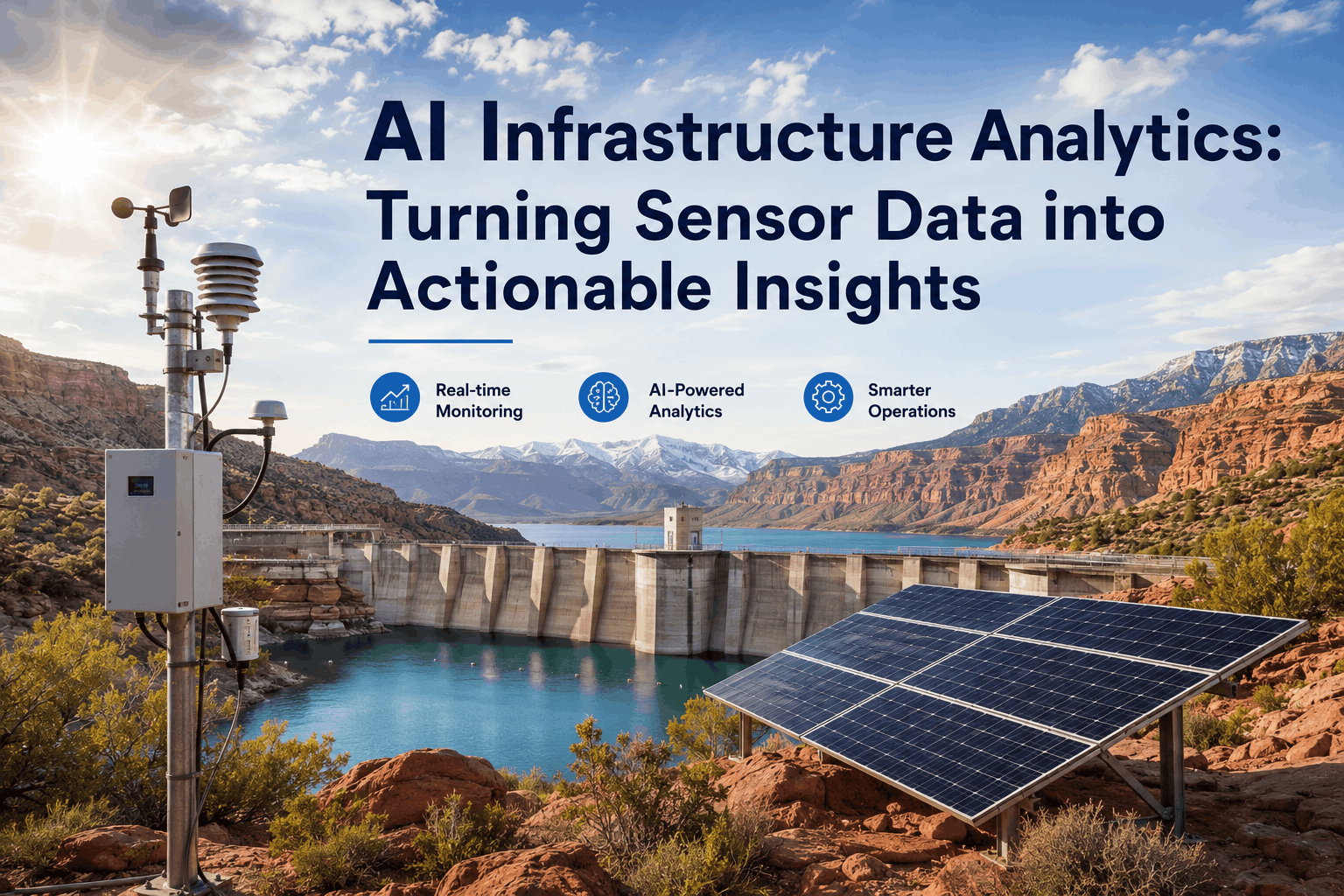
Modern infrastructure generates an extraordinary volume of sensor data — vibration readings, thermal signatures, power quality measurements, flow and pressure values, process parameters — yet the majority of this data is either discarded in real time or stored in silos where it generates no operational value. AI infrastructure analytics is the discipline of designing systems that transform this raw sensor data stream into actionable intelligence: condition-based maintenance schedules, real-time anomaly alerts, predictive failure timelines, and operational optimization recommendations. For operations directors, data engineers, and asset managers, building the right analytics pipeline architecture is the difference between a sensor deployment that generates dashboards and a smart infrastructure management system that genuinely reduces downtime, extends asset life, and improves compliance. Platforms like iFactory's AI infrastructure analytics engine are redefining how organizations design, deploy, and operate these pipelines at enterprise scale.
What Is AI Infrastructure Analytics?
AI infrastructure analytics refers to the application of machine learning, statistical modeling, and real-time data processing to infrastructure sensor data for the purpose of generating operational intelligence. Unlike basic monitoring — which displays raw sensor readings and fires alerts when values exceed static thresholds — AI analytics platforms apply learned models to detect subtle patterns across thousands of sensor streams simultaneously, identifying developing anomalies that no threshold configuration could catch and generating probability-based forecasts of future asset behavior. The output of a well-designed AI infrastructure analytics system is not a raw data visualization; it is a prioritized, contextualized action queue: which assets need attention, in what order, for what specific reasons, and with what likely consequences of delay.
The foundational challenge in infrastructure analytics sensor data work is the transformation journey — taking raw, high-frequency, heterogeneous sensor measurements and producing consistent, reliable, actionable intelligence that operations teams can trust and act on. This journey has five distinct stages, each with its own technical requirements, data quality dependencies, and architectural choices. Organizations that shortcut or skip stages in this pipeline discover, often expensively, that AI models trained on uncleaned or insufficiently contextualized data generate unreliable predictions that erode operational trust and stall adoption. Schedule a pipeline architecture review with iFactory's data engineering team to evaluate your current sensor data infrastructure against these requirements.
The Sensor Data-to-Intelligence Pipeline: Five Stages That Define Analytics Quality
Every AI infrastructure analytics deployment — regardless of the platform chosen, the assets monitored, or the industry vertical — must process sensor data through the same fundamental five-stage pipeline. The quality of intelligence generated at the output is directly determined by how well each stage is designed and executed. Organizations that invest in getting these stages right achieve prediction accuracy rates above 90% and build the operational trust that drives platform adoption. Those that rush through data preparation and model training phases produce systems that generate frequent false positives, miss real anomalies, and are abandoned by maintenance teams within months. Understanding each stage — and the specific technical and organizational requirements it demands — is the starting point for any serious AI infrastructure analytics program.
iFactory's platform implements all five pipeline stages as integrated, managed capabilities — meaning customers don't need to build custom data engineering infrastructure, manage sensor protocol translation, or develop their own ML model training pipelines. See how iFactory's end-to-end analytics pipeline works in a live infrastructure environment similar to yours.
Stage 1: Data Acquisition — Building a Complete Sensor Data Foundation
The quality of any AI infrastructure analytics system is bounded by the completeness and reliability of its data acquisition layer. Organizations with sparse sensor coverage — monitoring only the most critical assets and relying on manual inspection for the rest — produce ML models that have significant blind spots and generate unreliable fleet-wide predictions. Best practice for infrastructure health monitoring deployments is to achieve at minimum 80% coverage of the asset fleet by criticality-weighted value, prioritizing assets where failure consequence severity is highest. The specific sensor types deployed should be matched to the failure modes most prevalent for each asset class: vibration sensors for rotating equipment bearing failures, thermal sensors for electrical and mechanical hotspot-driven failures, ultrasonic sensors for steam trap and valve leak detection, and power quality meters for motor insulation and drive failures.
iFactory's data acquisition layer supports more than 200 industrial sensor protocols and communication standards, including OPC-UA, MQTT, Modbus, Profibus, EtherNet/IP, and proprietary vendor protocols — enabling integration with virtually any combination of sensor hardware, PLCs, and SCADA systems in industrial environments. The platform also supports edge preprocessing nodes that perform initial signal quality filtering and protocol translation at the asset level, reducing network bandwidth requirements and enabling real-time local anomaly detection in facilities where connectivity to a central cloud is intermittent or constrained. Talk to our data engineering team about designing the right acquisition architecture for your specific asset fleet and facility constraints.
Most infrastructure analytics platforms require homogeneous sensor ecosystems — all devices from a single vendor, using a single communication protocol. iFactory's acquisition layer is deliberately heterogeneous: it can ingest data simultaneously from legacy pneumatic sensor systems, modern IIoT-native devices, existing SCADA historians, and ERP production records, normalizing all streams into a unified operational data model without requiring hardware replacement or sensor standardization programs. This is operationally critical for manufacturing and processing organizations that have accumulated decades of heterogeneous sensor infrastructure and cannot afford a "rip-and-replace" modernization path.
Core Analytics Capabilities: What an AI Infrastructure Platform Must Deliver
The analytics capabilities that differentiate leading AI infrastructure monitoring software platforms from basic sensor dashboards are well defined by organizations that have deployed at scale. Four capabilities in particular separate platforms that generate sustained operational value from those that produce impressive demonstrations but fail in production: real-time anomaly detection that explains the reason for each alert, not just flags a threshold breach; time-to-failure prediction with confidence intervals that allow maintenance planning rather than emergency response; root-cause attribution that tells technicians which specific component is degrading and why; and fleet-wide comparative analysis that identifies assets deviating from the performance norms of equivalent equipment elsewhere in the portfolio. Book a demo to see all four capabilities operating simultaneously in iFactory's live analytics environment.
Explainable Anomaly Detection
iFactory's anomaly detection engine identifies deviations from learned normal operating envelopes across every monitored parameter — and attributes each anomaly to a specific failure mechanism. Not just "bearing temperature is elevated" but "bearing outer race wear pattern detected — consistent with lubrication degradation. Estimated time to failure: 18–24 days under current load." Technicians receive actionable context, not raw sensor alarms.
Probabilistic Failure Forecasting
Time-to-failure predictions are generated with statistical confidence intervals, not single-point estimates. Operations teams see not just "failure expected in 21 days" but a probability distribution across possible failure timelines — enabling maintenance scheduling decisions that account for production schedule constraints, spare parts availability, and acceptable risk levels for each specific asset and operating context.
Fleet Benchmarking and Comparative Analytics
Performance data from all monitored assets of the same type — whether across production lines within a single facility or across multiple sites in a global network — is aggregated into fleet-level performance norms. Individual assets are continuously benchmarked against these norms, surfacing equipment that is underperforming fleet averages even when its absolute sensor readings are within acceptable ranges. A motor running 15% below its fleet's average efficiency profile is a maintenance opportunity that threshold-based monitoring will never surface.
Operational Context Integration
Sensor readings don't exist in isolation — a vibration spike during a startup transient is normal; the same spike during steady-state operation is a serious anomaly. iFactory integrates production schedule data, operating mode flags, environmental condition monitoring, and shift pattern context into every analytics computation — eliminating the false positives that occur when AI models are trained on sensor data without operational context, and dramatically improving the signal-to-noise ratio of alerts delivered to maintenance teams.
Machine Learning Model Architecture for Infrastructure Health Monitoring
The machine learning architecture underpinning a production-grade infrastructure health monitoring system must balance prediction accuracy against the operational constraints of industrial deployment environments: limited historical failure data for rare failure modes, the need for models that can explain their predictions to maintenance technicians, the requirement to function reliably on edge hardware with constrained compute capacity, and the necessity to retrain continuously as asset condition evolves and operating patterns change. No single model type is optimal across all these requirements — leading AI infrastructure analytics platforms deploy ensemble architectures that combine multiple model types, each contributing its specific strengths to the overall prediction output.
iFactory's ML engine uses a three-tier model architecture: unsupervised anomaly detection models that identify deviations from normal operating baselines without requiring labeled failure data (critical for assets with limited historical failure records); supervised classification models trained on confirmed failure instances to identify specific failure modes as they develop; and physics-informed models that incorporate engineering knowledge of specific asset degradation mechanisms to improve prediction accuracy beyond what purely data-driven approaches can achieve. The result is a system that delivers high accuracy even for assets with limited historical failure data — the most common practical constraint in real-world predictive analytics infrastructure deployments. Explore iFactory's ML architecture in a technical deep-dive session.
Tier 1: Unsupervised Anomaly Detection
Autoencoder and isolation forest models establish normal operating envelopes for each monitored asset from 6–12 weeks of baseline data. Operates without any labeled failure data. Detects novel deviations that supervised models have not been trained to recognize. Ideal for new asset deployments, rare failure modes, and early-stage installations where confirmed failure history is limited. Provides the "something is unusual" signal that prompts deeper investigation.
Tier 2: Supervised Failure Classification
Gradient boosting and LSTM recurrent neural network models trained on confirmed failure instances. Classifies developing anomalies into specific failure categories — bearing inner race fault, stator winding insulation degradation, impeller cavitation, gearbox tooth crack — enabling targeted repair action rather than generic "check the asset" work orders. Accuracy improves continuously as the model is trained on additional confirmed failures from the monitored fleet.
Tier 3: Physics-Informed Prognostics
Remaining useful life (RUL) models that incorporate degradation physics equations — wear rate models, fatigue life curves, thermal aging profiles — alongside sensor data to generate time-to-failure predictions with physical grounding. These models are particularly accurate for well-characterized degradation mechanisms (bearing fatigue, insulation aging, lubrication breakdown) where engineering knowledge of the underlying physical process can constrain the model's prediction space and dramatically improve forecast accuracy.
Tier 4: Ensemble Fusion and Confidence Scoring
An ensemble fusion layer aggregates outputs from all three model tiers, weighting each model's contribution by its historical accuracy on the specific asset class and failure type, and generates a unified health score and maintenance recommendation with an associated confidence level. High-confidence predictions trigger automated work order generation; lower-confidence signals are flagged for maintenance planner review. The confidence layer ensures that uncertainty is communicated transparently — not hidden behind a single-point prediction that inspires false certainty.
Infrastructure Monitoring Software Integration: Connecting Analytics to Operations
An AI infrastructure analytics platform that operates in isolation from the systems that govern operational decisions — ERP work order management, CMMS maintenance scheduling, procurement systems, and workforce management platforms — generates intelligence that cannot be easily acted upon. The final-mile integration challenge is converting AI predictions into operational actions through the workflows that maintenance and operations teams already use. This requires bi-directional integration: the analytics platform receives production schedule and operating context data from operational systems, and sends prioritized maintenance recommendations and automated work orders back into those systems for dispatch and tracking.
iFactory's platform includes a pre-built integration layer for SAP PM, Oracle EAM, IBM Maximo, Microsoft Dynamics 365 Field Service, and all major CMMS platforms — as well as a configurable REST/GraphQL API for custom ERP integrations. This means intelligent maintenance systems can automatically generate work orders in the systems your maintenance teams already use, rather than requiring them to log into a separate analytics platform to retrieve recommendations. The result is a 40% average improvement in recommendation-to-action conversion rates compared to analytics-only platforms that require manual work order translation. Contact our integration team to review your specific ERP and CMMS integration requirements.
| Integration Layer | Data Flowing In (to Analytics) | Data Flowing Out (to Operations) | iFactory Support |
|---|---|---|---|
| ERP (SAP, Oracle, Dynamics) | Production schedules, BOM, asset master data, maintenance history | Automated work orders, maintenance cost actuals, spare parts consumption forecasts | Native connectors, real-time sync |
| CMMS / EAM (Maximo, Infor) | Historical work order outcomes, confirmed failure records, asset specifications | AI-prioritized work orders with diagnostic context, technician dispatch instructions | Pre-built adapters + custom API |
| SCADA / Historian (OSIsoft PI, Ignition) | Real-time sensor streams, process control parameters, alarm history | Asset health scores, anomaly flags, operating parameter recommendations | OPC-UA, REST, MQTT, proprietary protocols |
| IoT Platform (Azure IoT, AWS IoT Core) | Device telemetry, connectivity status, firmware version data | Processed analytics results, edge model updates, device management commands | Cloud-native connectors, edge SDKs |
| Procurement / WMS | Spare parts inventory levels, lead times, supplier data | Predicted spare parts demand, reorder triggers, optimized inventory recommendations | REST API, webhook triggers |
Analytics Performance Metrics: What Mature AI Infrastructure Deployments Achieve
Quantifying the operational impact of AI infrastructure analytics deployments requires tracking both leading indicators (model performance metrics that predict future operational value) and lagging indicators (operational outcomes that confirm value has been delivered). Organizations that instrument both categories from day one of their deployment build the evidence base needed to justify platform expansion, internal advocacy, and continued investment. The metrics below reflect outcomes reported by iFactory customers operating mature deployments across manufacturing, food processing, utilities, and logistics verticals — each representing 18+ months of production operation.
iFactory's AI Infrastructure Analytics Platform — What We Deliver That Others Don't
The AI infrastructure analytics market is crowded with platforms that promise intelligent monitoring but deliver sophisticated dashboards. iFactory is built around a different product philosophy: the value of infrastructure analytics sensor data processing is not in the visualization of data — it is in the operational decisions it enables. Every product decision in the iFactory platform is oriented around reducing the distance between a sensor reading and an executed maintenance action, eliminating the manual interpretation, translation, and escalation steps that cause analytics value to leak between insight generation and operational response.
iFactory is also uniquely positioned to serve organizations that operate at the intersection of infrastructure health monitoring and regulatory compliance. For food manufacturers, pharmaceutical producers, and defense supply chain operators, intelligent maintenance systems cannot be operationally separate from traceability and quality management systems — asset condition directly affects product quality and regulatory compliance. iFactory's platform integrates predictive maintenance, lot-level traceability, and compliance record management into a single operational data model, enabling organizations to meet FSMA Section 204, ISO 55000, and FDA electronic record requirements without maintaining separate systems for maintenance and compliance. Book a session to see iFactory's compliance-integrated analytics model in operation.
No-Code Analytics Configuration
Operations and maintenance teams configure asset monitoring profiles, anomaly detection thresholds, and alert routing rules without data engineering support. iFactory's guided model configuration interface requires operational knowledge of the asset being monitored — not ML expertise. This reduces dependency on data science resources and enables maintenance teams to own and evolve their analytics configuration as asset conditions and operational priorities change.
Compliance-Native Data Architecture
Every sensor reading, analytics event, maintenance action, and production decision recorded in iFactory is timestamped, attributed, and stored in a tamper-evident record format. This architecture provides the complete, auditable operational history that FDA, ISO, and customer quality audits require — without separate compliance record-keeping systems or manual report preparation. One platform, one data model, full compliance coverage.
Lot-Level Production Traceability
Sensor data and maintenance events are linked to production lot records at every Critical Tracking Event — meaning the full operational context surrounding every production batch is captured, including equipment health state, maintenance actions performed, and any anomalies detected during production. This linkage between asset analytics and product traceability is unique to iFactory and essential for organizations subject to FSMA Section 204 or equivalent quality traceability mandates.
Continuous Model Improvement Loop
Every confirmed failure event, every maintenance technician feedback entry, and every false positive dismissal in iFactory feeds back into the model training pipeline automatically. Models improve continuously throughout the operational life of the platform — not just during an initial training period — enabling prediction accuracy to improve as more operational data accumulates and as asset conditions evolve over time. The platform gets smarter the longer you run it.
Implementation Roadmap: From Sensor Data to Production AI Analytics in 12 Weeks
Building a production-grade AI infrastructure analytics capability does not require a multi-year digital transformation program. iFactory's structured implementation methodology delivers functional AI-driven maintenance intelligence within 10–14 weeks for most organizations, with measurable operational impact beginning in weeks 8–10 as predictive models complete their initial training cycles. The five-phase roadmap below reflects the implementation sequence proven across 150+ iFactory deployments in manufacturing, food processing, utilities, and logistics environments.
Infrastructure Audit and Data Readiness Assessment (Weeks 1–2)
Complete inventory of existing sensor coverage, communication infrastructure, SCADA historians, and ERP/CMMS systems. Identification of coverage gaps by asset criticality. Assessment of historical maintenance record quality and completeness for model training purposes. Output: data readiness scorecard, sensor coverage gap report, and integration architecture blueprint. iFactory's data engineering team conducts this assessment on-site or remotely using facility documentation and existing system exports.
Sensor Integration and Data Pipeline Configuration (Weeks 2–5)
Implementation of protocol adapters, edge preprocessing nodes, and cloud ingestion pipelines. Configuration of data normalization rules, quality filters, and timestamp alignment procedures for each sensor source. Initial ERP and CMMS integration for production context and maintenance history ingestion. Output: validated data pipeline with confirmed data quality metrics for each integrated sensor source. First anomaly detection models begin training on incoming data.
Baseline Model Training and Validation (Weeks 5–8)
Unsupervised anomaly detection models complete initial training on 6–8 weeks of operational baseline data. Supervised failure classification models are trained on historical confirmed failure records from the CMMS integration. Physics-informed prognostic models are configured for the specific failure modes most prevalent in the monitored asset fleet. Model predictions are validated against a holdout dataset of known historical failures. Output: trained model suite with validated accuracy metrics, anomaly detection sensitivity configuration, and false positive rate benchmarks.
Parallel Monitoring and Trust-Building Phase (Weeks 8–10)
AI predictions are made available to maintenance planners in a read-only advisory mode — visible alongside existing maintenance schedules but not yet triggering automated work orders. Maintenance teams review predictions, provide feedback on accuracy, and build empirical familiarity with the system's output before it influences operational decisions. This phase is critical for adoption — technicians who have seen the AI detect 8–10 genuine developing faults during the parallel phase approach go-live with confidence, not skepticism.
Full Production Go-Live with Work Order Integration (Weeks 10–12)
Automated work order generation activated for high-confidence predictions above configured thresholds. Work orders pushed directly to ERP and CMMS systems with full diagnostic context attached. Maintenance planner review queue established for medium-confidence signals. KPI dashboards activated for operations management and executive reporting. Compliance record generation enabled for regulated production environments. First formal ROI measurement at 90-day mark. Continuous model improvement loop begins accumulating post-deployment data.
We had 340 condition monitoring sensors deployed across our facility for three years — and we were getting almost no value from them. The data was sitting in a historian, nobody had time to analyze it, and our maintenance team was still running on the same preventive schedule we'd used for years. iFactory connected to our existing sensor infrastructure in four weeks, trained models on our CMMS history, and within two months was predicting failures our maintenance team had no idea were developing. The first avoided major failure — a gearbox on our primary packaging line — paid for the entire year's platform cost on its own. We're now running 600+ monitored points and our unplanned downtime is down 61% year over year.
Frequently Asked Questions: AI Infrastructure Analytics and Sensor Data Intelligence
What types of sensor data does AI infrastructure analytics process?
AI infrastructure analytics platforms process data from vibration accelerometers (for rotating equipment health), thermal imaging sensors (for electrical and mechanical hotspot detection), ultrasonic transducers (for leak and partial discharge detection), current and power quality meters (for motor and drive health assessment), pressure and flow sensors (for pump, compressor, and valve monitoring), visual inspection cameras with AI-based defect classification, and environmental sensors monitoring temperature, humidity, and airborne particulate. Beyond physical sensors, modern platforms also integrate process historian data from SCADA systems, production schedule feeds from ERP platforms, and maintenance history records from CMMS databases — combining physical measurements with operational context to produce predictions that are accurate to your specific operating environment.
How much historical sensor data does an AI analytics platform need to start generating predictions?
Unsupervised anomaly detection models can begin generating meaningful baseline deviations after 6–8 weeks of operational data — no historical failure records are required. Supervised failure classification models, which identify specific fault modes, require at minimum 20–30 confirmed failure instances per failure category for reliable accuracy; most organizations have this data in their CMMS, though it may require extraction and labeling. iFactory's onboarding process includes a CMMS history mining step that extracts and structures historical failure records for model training, enabling supervised classification capabilities from day one of deployment even for organizations with limited recent failure history in their current sensor system.
What is the difference between condition monitoring and AI predictive analytics?
Condition monitoring detects that a parameter has crossed a defined threshold — bearing temperature exceeded 85°C, vibration amplitude exceeded 12 mm/s. It is reactive to conditions that are already out of normal range. AI predictive analytics detects that a parameter's pattern is trending toward a fault condition — bearing temperature has been rising at an anomalous rate for 12 days, even though it is still within the normal range, and the trend is consistent with lubrication breakdown heading toward a bearing seizure in 18–25 days. The critical difference is lead time: condition monitoring generates alerts when the problem has already developed; predictive analytics generates forecasts weeks before the problem becomes detectable by conventional means.
How does iFactory handle false positives in its AI analytics output?
False positive management is one of the most important design considerations in any production AI analytics system, because excessive false alerts destroy maintenance team trust and lead to platform abandonment. iFactory manages false positives through three mechanisms: operational context integration (alerts are suppressed during known startup, shutdown, and maintenance modes that produce anomalous but expected sensor readings); confidence-based routing (only high-confidence predictions generate automated work orders; medium-confidence signals go to a planner review queue); and continuous feedback loops (every technician-dismissed alert that is confirmed as a false positive feeds back into model retraining, progressively reducing false positive rates over the deployment lifetime). Most deployments achieve false positive rates below 8% within 90 days of go-live.
Can AI infrastructure analytics work with legacy equipment that lacks modern sensors?
Yes — and this is one of the most common deployment scenarios iFactory encounters. Legacy equipment rarely needs full sensor replacement; most machines from the past 20 years have sufficient existing instrumentation to support meaningful AI analytics when integrated properly. iFactory's acquisition layer can extract useful signals from existing PLCs, motor control centers, and process instrumentation via OPC-UA, Modbus, and historian protocols. For assets with no existing instrumentation, retrofit sensor packages for vibration, thermal, and current monitoring can be installed without machine downtime, providing sufficient data for AI model training within 6–8 weeks of installation.
How does AI infrastructure analytics integrate with existing ERP and CMMS systems?
Integration architecture varies by platform, but best-in-class approaches use bi-directional connectors that receive production schedule, asset master, and maintenance history data from existing systems, and push AI-generated work orders, maintenance recommendations, and spare parts demand forecasts back into those same systems. iFactory supports native connectors for SAP PM, Oracle EAM, IBM Maximo, Microsoft Dynamics 365, and all major CMMS platforms. Integration is configured during the onboarding phase, typically within weeks 3–5 of the implementation roadmap, and does not require custom development for supported systems. Custom integrations for proprietary ERP systems are supported via iFactory's REST/GraphQL API.
What regulatory compliance requirements does iFactory's analytics platform support?
iFactory's platform provides native compliance support for FSMA Section 204 food traceability (automated KDE capture, CTE documentation, 24-hour FDA record retrieval), ISO 55000 asset management standard alignment, 21 CFR Part 11 electronic record requirements for pharmaceutical and medical device manufacturers, and configurable audit reporting for EU regulatory documentation requirements. The platform's compliance-native data architecture means all sensor readings, analytics events, maintenance actions, and production lot records are stored in a tamper-evident, auditable format — enabling regulatory documentation to be produced in hours, not weeks.
How does iFactory's AI analytics platform improve over time?
iFactory's platform is designed with a continuous improvement architecture that makes the system more accurate and valuable the longer it operates. Every confirmed failure event provides new training data for supervised classification models. Every technician-dismissed false positive updates the model's context filters. Every maintenance outcome — repair type, parts replaced, time to repair — enriches the platform's historical database for future predictions. Additionally, iFactory's fleet analytics layer compares performance patterns across all customers running similar asset types, with privacy-preserving anonymization, enabling models to benefit from failure patterns observed across a much larger asset fleet than any single customer could provide. This collective intelligence capability means prediction accuracy for common failure modes typically exceeds what any single-site deployment could achieve independently.