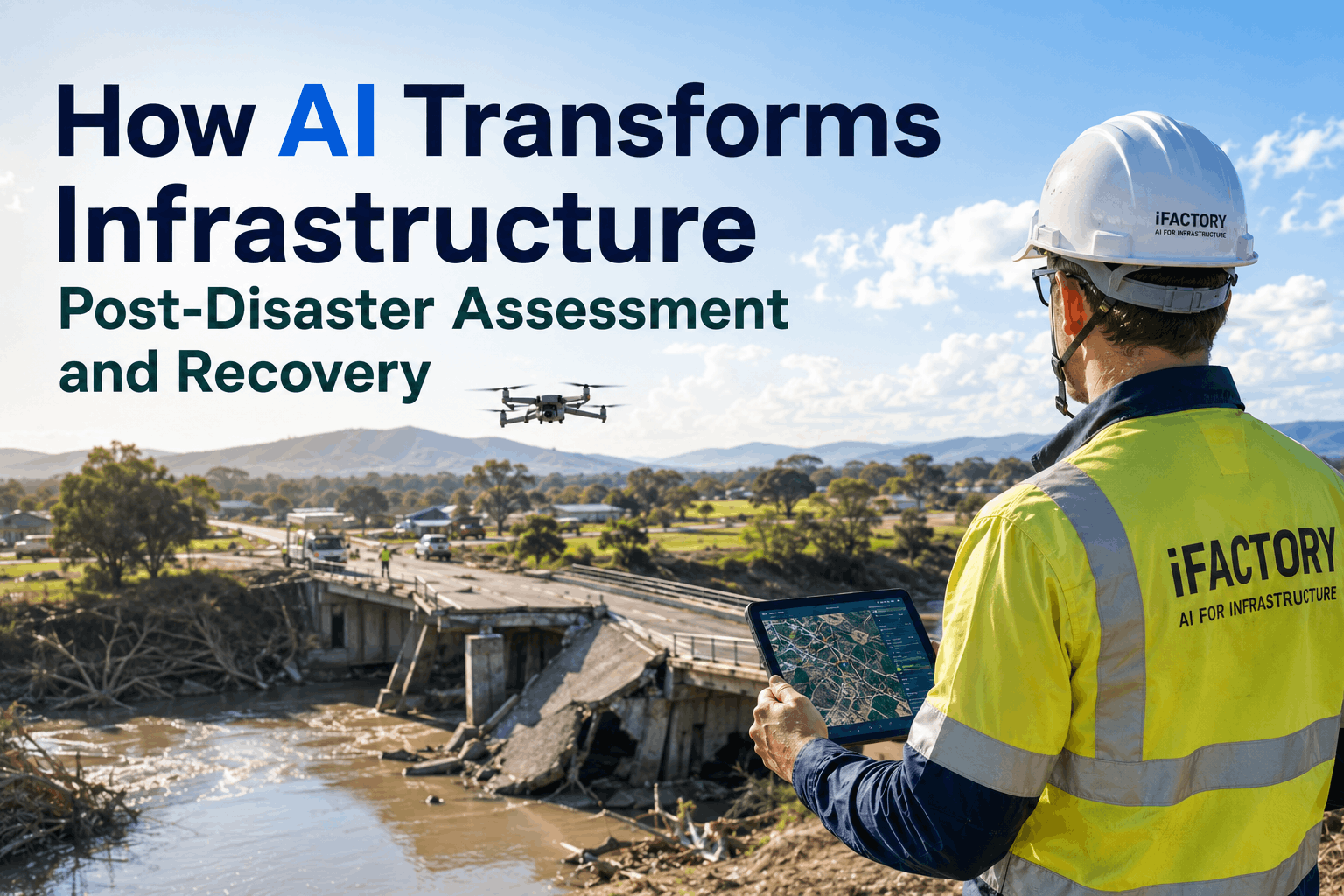
Natural disasters do not negotiate timelines. When a hurricane makes landfall, when a seismic event crosses a metropolitan fault line, when a 100-year flood event overwhelms a municipal water network — infrastructure owners face an immediate, mission-critical decision with incomplete information: which assets are safe to operate, which have been compromised, and which represent an active threat to public safety. Traditional post-disaster infrastructure assessment processes — sequential visual inspections conducted by engineering teams working from paper checklists — typically require 4 to 12 weeks to deliver a complete damage picture for a mid-sized municipal network. In that gap, public works directors make irreversible service restoration decisions based on incomplete data, frequently missing compromised assets that appear undamaged to the human eye but have crossed structural failure thresholds invisible without sensor analysis. AI infrastructure post-disaster assessment closes this intelligence gap from weeks to hours. To see how iFactory's post-disaster assessment platform operates in a live infrastructure scenario, schedule a demonstration with our infrastructure intelligence team today.
Why Traditional Post-Disaster Infrastructure Assessment Fails at the Moment of Maximum Need
The Intelligence Gap Between Disaster Event and Safe Service Restoration
The failure mode of traditional post-disaster assessment is not incompetence — it is information architecture. Visual inspection by a qualified engineer walking a bridge deck or a roadway corridor provides a surface-level damage picture that misses the subsurface and structural conditions most predictive of imminent failure: micro-fractures in steel reinforcement, void formation below asphalt from soil liquefaction, pier movement at millimeter scale, internal delamination in concrete decks. These conditions are invisible to the naked eye and detectable only through sensor-based analysis — vibration signature comparison, acoustic emission monitoring, ground-penetrating radar, and InSAR satellite displacement measurement. A 2024 MDPI Buildings review of 370 post-disaster assessment studies over the past decade found that machine learning applied to remote sensing data — satellite imagery, LiDAR point clouds, UAV aerial footage, and acoustic sensors — consistently outperformed manual inspection methods for identifying structural compromise, particularly in high-severity damage categories where human inspectors most frequently under-assessed actual risk. For infrastructure organizations that want to understand how AI-assisted assessment would change their post-disaster response protocol, schedule a scenario walkthrough with iFactory's disaster response team.
How iFactory's AI Platform Accelerates Post-Disaster Infrastructure Assessment
Multi-Layer Sensor Fusion Delivering a Complete Damage Picture in Hours
iFactory's post-disaster assessment capability is not a stand-alone disaster response module. It is the operational consequence of an always-on infrastructure monitoring architecture that maintains a pre-event baseline for every connected asset. Because iFactory continuously records vibration signatures, acoustic profiles, thermal patterns, and structural displacement readings from IoT sensors deployed on bridges, pump stations, retaining walls, culverts, and pipeline infrastructure, a disaster event does not initiate the assessment process from zero — it triggers a comparison between pre-event and post-event sensor states across every monitored asset simultaneously. Within hours of a disaster event, iFactory's AI maintenance platform delivers a network-wide damage assessment scored across four damage severity categories: no significant change detected, anomalous readings requiring field verification, probable structural compromise requiring restricted operation, and critical alert requiring immediate closure and specialist inspection. Recovery crews and engineering teams receive this prioritized damage picture on mobile devices before they leave the operations center — replacing the weeks-long sequential inspection process with an AI-generated triage that directs field resources to highest-risk assets first.
Manual crew deployment
AI sensor comparison
Engineer inspections
AI + targeted field verification
Committee review
AI restoration modeling
Fragmented records
Audit-ready on demand
Sequential, information-limited
AI-sequenced priorities
5 AI Technologies Powering Post-Disaster Infrastructure Assessment
The Sensor and Intelligence Stack That Replaces Manual Inspection for Damage Detection
Post-Disaster Assessment Failure Modes and Their Consequences
What Happens When Infrastructure Organizations Restore Services Without Complete Damage Data
| Assessment Failure Mode | Infrastructure Risk | Consequence Category | Regulatory / Liability Exposure |
|---|---|---|---|
| Missed Subsurface Structural Compromise | Delayed Structural Failure Post-Restoration | Public Safety Incident / Fatality Risk | Extreme — Federal and Civil Liability |
| Incomplete Bridge Deck Assessment | Premature Traffic Restoration on Compromised Structure | Load-Induced Secondary Failure | High — FHWA Inspection Violation |
| Missed Pipeline Damage from Soil Movement | Service Contamination or Pressure Failure | Public Health Event / Service Outage | High — EPA / State Regulatory Action |
| Suboptimal Recovery Sequencing | Extended Service Outage Beyond Necessary Duration | Economic Loss / Community Impact | Medium — Political and Audit Exposure |
| Incomplete FEMA Documentation | Federal Reimbursement Disallowance | Budget Gap on Recovery Spend | High — Federal Audit Findings |
The FEMA Documentation Advantage: How AI Assessment Creates Audit-Ready Disaster Records
Protecting Federal Reimbursement Eligibility Through Automated Damage Documentation
Every dollar spent on disaster recovery infrastructure is potentially reimbursable through FEMA's Public Assistance program — but only if the damage documentation meets federal requirements for completeness, timestamping, and asset-level specificity. Traditional post-disaster assessment processes generate fragmented records: paper inspection sheets, email-chain damage reports, manually compiled photographs without GPS coordinates, and spreadsheet damage estimates assembled under operational pressure without audit trail integrity. iFactory's AI assessment platform generates a fully timestamped, GPS-linked, sensor-validated damage record for every assessed asset automatically as the assessment process runs. Engineers reviewing an iFactory post-disaster damage report see asset-level condition scores, pre-to-post event sensor comparison data, AI damage classification with confidence intervals, and field technician inspection notes — all consolidated in a single queryable record that satisfies FHWA, FEMA, EPA, and state DOT documentation requirements without post-hoc compilation. For infrastructure organizations that have experienced the painful FEMA audit process following major disasters, the documentation quality difference alone justifies the platform investment. To see iFactory's post-disaster documentation output in a scenario walkthrough, contact our infrastructure team.
iFactory's Unique Advantage: Pre-Event Baselines That Make Post-Event Assessment Faster
Why Continuous Monitoring Before a Disaster Makes AI Assessment Possible After One
The infrastructure organizations that extract the greatest value from iFactory's post-disaster assessment capability are not those that deploy the platform in response to a disaster. They are the organizations that deployed iFactory for predictive maintenance and infrastructure health monitoring before a disaster occurred — and discovered that the always-on sensor baseline they built for maintenance optimization became an extraordinary asset for post-disaster assessment when the event arrived. This is the compound value proposition of iFactory's infrastructure monitoring software: every IoT sensor deployed for predictive maintenance generates the pre-event structural fingerprint that powers post-disaster comparison. An organization that has operated iFactory for 18 months before a major seismic event has 18 months of normal operating signatures for every connected asset — the richest possible reference dataset for post-event anomaly detection. Organizations that want to build this pre-event baseline before a disaster tests their assessment capability can schedule an infrastructure readiness assessment with iFactory's team today.
Frequently Asked Questions
How does AI speed up post-disaster infrastructure damage assessment?
AI accelerates post-disaster infrastructure assessment by replacing sequential manual inspection workflows with simultaneous, sensor-based analysis across entire asset networks. iFactory's platform continuously monitors infrastructure assets with IoT sensors and maintains pre-event structural baselines. When a disaster event occurs, the AI engine performs an immediate comparison between pre-event and post-event sensor readings across all connected assets simultaneously, delivering a network-wide damage triage within hours rather than weeks. Machine learning models applied to satellite imagery, UAV footage, acoustic data, and structural sensor readings classify damage severity across entire bridge, road, pipeline, and utility networks at speeds and geographic scales no field inspection team can replicate.
What types of infrastructure damage can AI detect that visual inspection misses?
AI sensor-based assessment consistently detects categories of infrastructure damage that are invisible to visual inspection: internal micro-fractures in concrete and steel identified through acoustic emission signature analysis; foundation movement and pier displacement at millimeter scale through InSAR satellite monitoring; subsurface void formation from soil liquefaction or erosion detected through ground-penetrating radar and acoustic sensors; delamination in bridge decks and tunnel linings identified through vibration response analysis; and pipeline damage from soil movement detected through acoustic monitoring before pressure failure occurs. The 2024 MDPI Buildings review of decade-long post-disaster assessment research specifically identified high-severity structural damage as the category where machine learning most significantly outperformed manual inspection methods.
How does AI prioritize infrastructure recovery sequencing after a disaster?
iFactory's AI recovery prioritization engine uses graph neural network modeling to analyze the damaged infrastructure network as an interdependent system rather than a list of individual assets. The model considers damage severity, asset criticality to network service delivery, restoration interdependencies (where repairing Asset A enables access to repair Asset B), available crew resources, material lead times, and geographic constraints to generate an optimal recovery sequence. Research published in 2025 validated that AI-generated restoration sequences achieved 84.2% alignment with optimal outcomes in large urban infrastructure networks with 3,500+ components. Field crews receive prioritized work orders on mobile devices immediately — replacing the 1 to 3 week committee review cycle that characterizes conventional disaster recovery planning.
Can iFactory generate FEMA-compliant post-disaster documentation automatically?
Yes. iFactory's assessment platform generates fully timestamped, GPS-linked, sensor-validated damage records for every assessed asset as the assessment runs. Every damage finding includes pre-to-post event sensor comparison data, AI classification with confidence scoring, field inspection notes from mobile crews, and condition photographs — all consolidated in a single queryable record that satisfies FHWA, FEMA, and EPA documentation requirements. Infrastructure organizations using iFactory have consistently submitted federal damage documentation packages faster and with fewer disallowances than their pre-iFactory baseline, because the documentation is built as an integrated output of the assessment process rather than compiled manually after the fact.
Does iFactory require pre-event sensor installation to provide post-disaster assessment?
Pre-event IoT sensor deployment is not strictly required for all assessment capabilities, but it is what enables the most powerful assessment function: pre-to-post event structural comparison. Organizations without pre-event sensors can still use iFactory's AI Vision platform applied to post-event UAV imagery and satellite data for surface damage classification and road network assessment. However, organizations that have operated iFactory's IoT monitoring network for 12+ months before a disaster event receive the full assessment advantage: instant network-wide triage based on sensor state comparison, rather than initiating assessment from zero. Pre-event deployment is the highest-ROI investment an infrastructure organization can make for disaster response readiness.
How does AI handle assessment of infrastructure without existing digital records?
iFactory's implementation team supports infrastructure organizations through a rapid asset digitization process that can be prioritized before disaster risk season — converting paper drawings, inspection reports, and field-collected condition data into a structured digital asset registry. For infrastructure without historical inspection records, iFactory's AI establishes a new condition baseline from initial sensor deployment and UAV survey, which begins providing comparative value as soon as the first monitoring cycle is complete. iFactory also supports mobile offline inspection capability, allowing field crews to capture GPS-linked damage records in areas without network connectivity during disaster response operations.
What is the typical timeline from disaster event to first AI damage assessment output with iFactory?
For infrastructure organizations with iFactory's IoT monitoring network in pre-event operation, the initial network-wide triage — identifying which assets show post-event sensor anomalies requiring priority field verification — is typically available within 2 to 6 hours of the disaster event, depending on sensor network coverage and data connectivity restoration. The complete preliminary damage assessment covering all monitored assets, including AI-generated severity classifications and recovery prioritization sequence, is typically delivered within 24 to 72 hours. For infrastructure organizations deploying iFactory's assessment capability post-event using UAV imagery and satellite data, the first surface damage classification output for a mid-sized road network is typically available within 18 to 36 hours of imagery capture.
How does iFactory's post-disaster AI assessment compare to hiring external engineering inspection teams?
External engineering inspection teams remain essential for structural engineering judgment calls — particularly for assets classified by iFactory as probable compromise or critical alert, which require qualified engineer sign-off before restoration or closure decisions. iFactory's AI assessment function is not designed to replace structural engineering expertise; it is designed to direct that expertise to exactly the right locations, eliminating the weeks of sequential inspection that occurs when engineers must assess an entire network without prior data to guide their priorities. Organizations using iFactory typically reduce external inspection scope by 40 to 65% following a disaster event, deploying specialist engineers to AI-flagged high-risk assets while field technicians handle AI-verified low-risk segments — compressing the total assessment timeline and total assessment cost simultaneously.