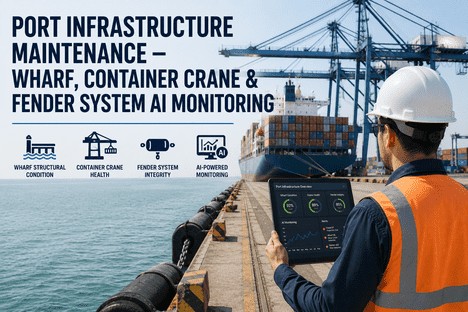
Port and harbor infrastructure operates in the most punishing environment in civil asset management — saltwater corrosion, tidal cyclic loading, 24/7 crane duty cycles, and the constant threat of storm-driven structural shock. Roughly 90% of the world's goods move by sea, and a single unplanned outage on a quay crane can hold up a vessel worth millions per day in demurrage. That is why port operators are rapidly moving from reactive and calendar-based maintenance to AI-driven predictive platforms. Industry case studies report over 50% reductions in emergency maintenance events, 10–20% lower overall maintenance costs, and 20–30% gains in gross crane rate (GCR) at terminals that have fully deployed AI. But choosing the right platform for a port is not the same as choosing one for a factory or utility — the asset mix, environmental data needs, and integration requirements are fundamentally different. This guide walks through what to look for, what to test, and how to shortlist AI maintenance platforms that are genuinely built for port and harbor infrastructure. Book a Demo to see how iFactory is deployed across cranes, conveyors, quay walls, and berths today.
Buyer's Guide · Port & Harbor AI Maintenance
Built for Salt, Tides, and Throughput — Not for Generic Factories.
iFactory's AI maintenance platform monitors cranes, conveyors, quay walls, breakwaters, RTGs, AGVs, and berth structures with port-specific models trained on marine corrosion, cyclic loading, and 24/7 duty profiles.
50%+
Reduction in emergency maintenance events at AI-enabled container terminals
20-30%
Gain in Gross Crane Rate (GCR) at fully automated terminals
10-20%
Cut in overall maintenance costs reported across industry deployments
~90%
Of global goods that move through port and harbor infrastructure
Why Ports Need Port-Specific AI — Not a Generic Maintenance Platform
Generic predictive maintenance platforms were built for factories and process plants. Port assets are different in ways that materially change the AI requirement.
Difference 01
Marine Environment
Saltwater spray, tidal cycles, and humidity drive degradation models that have no equivalent in inland industrial settings. Corrosion forecasting needs environmental inputs that generic platforms do not ingest.
Difference 02
Mixed Asset Classes
A port simultaneously runs rotating equipment (cranes, conveyors), civil structures (quay walls, breakwaters), and mobile fleets (AGVs, reach stackers). One AI engine must handle all three.
Difference 03
Underwater Inspection
Submerged piles, footings, and revetments cannot be sensor-instrumented like surface equipment. Photogrammetry, sonar, and ROV scan data must feed the AI model.
Difference 04
24/7 Duty & Storm Shock
Ports do not have planned downtime windows the way factories do. Storm events, vessel impacts, and overload incidents produce sudden state changes the AI must classify in real time.
The 8-Capability Evaluation Framework
When shortlisting AI maintenance platforms for port and harbor infrastructure, score each vendor against these eight capabilities. Anything below 6/8 will struggle to deliver on the ROI cases that drove the procurement.
01
Multi-Asset Class Coverage
Native support for cranes, conveyors, AGVs, civil structures, and berths — not a single equipment type extended sideways.
Foundational
02
Marine Environmental Inputs
Tide, wave, salinity, wind, and storm forecast feeds integrated into the degradation models — not retrofitted as a side dashboard.
Port-specific
03
Corrosion & Fatigue Modelling
Physics-informed ML for saltwater corrosion rate, fatigue life under cyclic tidal loading, and concrete spall progression.
Port-specific
04
Digital Twin & BIM/GIS Integration
Live digital twin that mirrors quay cranes, yard blocks, gate flows, and hinterland links — with bidirectional BIM and GIS sync.
Foundational
05
CMMS & TOS Integration
Direct API connectivity with port TOS (Navis N4, TBA), CMMS (IBM Maximo, SAP PM), and ERP — work orders auto-generated and tracked.
Foundational
06
Underwater & Photogrammetry Support
Ingestion of multibeam sonar, ROV inspection video, drone imagery, and laser scans for above- and below-water condition modelling.
Port-specific
07
Edge Inference for 24/7 Operations
On-device anomaly detection for cranes, AGVs, and conveyors — no cloud dependency for safety-critical alerts.
Resilience
08
OT/IT Cyber Hardening
IEC 62443 compliance, Purdue Model segmentation, and IMO maritime cybersecurity alignment built in from day one.
Compliance
What Port Assets a Good AI Platform Should Actually Cover
A platform pitching "AI for ports" should give you a clear yes/no on every asset class in your estate. Use this matrix in vendor conversations.
Asset Class
Key Failure Modes Monitored
Primary Sensors / Inputs
Typical AI Lead Time
STS & Quay Cranes
Trolley motor wear, gearbox failure, hoist degradation
Vibration, temperature, current, load cycles
2–6 weeks
RTG / RMG Yard Cranes
Wheel wear, drive motor faults, structural fatigue
Accelerometer, torque, drive telemetry
2–4 weeks
Conveyors & Bulk Systems
Belt mistracking, idler failure, motor overload
Vibration, thermal imaging, current
1–3 weeks
AGVs & Terminal Trucks
Battery degradation, tyre wear, motor torque drift
Battery telemetry, GPS, drive telemetry
Days to 2 weeks
Quay Walls & Berths
Corrosion, settlement, fender impact damage
Strain gauges, photogrammetry, inclinometers
Months to years
Underwater Piles & Footings
Scour, marine growth, structural cracking
Multibeam sonar, ROV video, laser scans
Annual cycle
Breakwaters & Revetments
Armour displacement, toe erosion, crest damage
LiDAR, drone imagery, wave gauges
Seasonal review
The Port AI Maintenance Business Case — Where the Money Actually Comes From
Port deployments justify themselves through three distinct value streams. Most procurement business cases under-count Stream 2 and miss Stream 3 entirely.
Stream 01
Direct Maintenance Cost Savings
10–20% reduction in total maintenance spend
50%+ fewer emergency interventions and call-outs
Lower spare parts inventory through better demand forecasting
Stream 02
Throughput & Vessel Demurrage Avoidance
20–30% GCR uplift at AI-coordinated terminals
Avoided demurrage payments — often $50K–$150K per vessel-day
Higher berth utilisation through predictable crane availability
Stream 03
Asset Lifecycle & Capital Deferral
Extended service life on cranes, conveyors, and civil structures
Deferred capital replacement supported by AI condition evidence
Stronger creditworthiness for green port financing applications
Your Vendor Shortlist Questions
Take these to every demo. Vendors who cannot answer concretely on the spot are still in product-marketing mode — not ready for a working port.
Q1
Show me a live deployment on STS cranes or quay walls — not a demo environment.
Q2
Which marine environmental data feeds are you ingesting today, and from which providers?
Q3
How do your models handle saltwater corrosion forecasting specifically?
Q4
Can you integrate with our TOS (Navis N4 / TBA / Octopi) and our CMMS without custom development?
Q5
What is your fallback when network connectivity drops at the quay or yard?
Q6
How does your platform handle underwater inspection data (sonar, ROV, photogrammetry)?
Q7
Walk me through your IEC 62443 and IMO maritime cybersecurity compliance evidence.
Q8
What is your typical pilot-to-full-deployment timeline for a multi-terminal port?
iFactory AI Maintenance Platform for Ports & Harbors
All 8 Capabilities. One Platform. Already Deployed on Working Ports.
iFactory ships with native multi-asset coverage, marine environmental inputs, corrosion and fatigue modelling, TOS and CMMS integration, edge inference, and IEC 62443 cybersecurity — pre-configured for port deployment from week one.
Trusted by port and harbor operators across the UK, EU, Middle East, and Asia-Pacific.
Frequently Asked Questions
Tap any question to reveal the answer.
Generic predictive maintenance platforms were built for factories and process plants — stable indoor environments with consistent loading and few asset classes. Port platforms must ingest marine environmental data (tide, wave, salinity, wind), model saltwater corrosion and fatigue under cyclic tidal loading, handle a much wider asset mix (rotating equipment, civil structures, mobile fleets, underwater assets), and integrate with port-specific systems like Terminal Operating Systems (TOS). A generic platform pointed at port assets can monitor a crane, but it will not give you quay wall corrosion forecasts or storm-shock classification. Book a port-specific demo to see the difference.
Industry case reports consistently document over 50% reductions in emergency maintenance events, 10–20% lower overall maintenance costs, and 20–30% gains in Gross Crane Rate at fully AI-coordinated container terminals. Tuas Mega Port in Singapore and Yangshan Deepwater Port in China are widely cited as benchmarks for AI-orchestrated terminal operations. Beyond the savings, the largest financial impact is usually demurrage avoidance — a single vessel held at berth costs $50K–$150K per day.
No — modern AI platforms layer on top of your existing systems. iFactory integrates with Navis N4, TBA, Octopi, and other Terminal Operating Systems via standard APIs, and connects to CMMS platforms including IBM Maximo, SAP PM, Infor EAM, and eMaint. Work orders generated by AI flow directly into your existing maintenance workflow. Your operations and maintenance teams continue using the interfaces they know.
Underwater assets cannot be permanently sensor-instrumented in the way surface equipment can. iFactory ingests multibeam sonar surveys, ROV inspection video, drone-based photogrammetry, and terrestrial laser scans — building a high-resolution 3D condition model that updates with each survey cycle. The AI compares scans across time to detect scour, marine growth, structural cracking, and toe erosion. Industry examples include 1mm-resolution above-water reality modelling combined with multibeam capture of pile footings and seabed geometry.
For ports with established sensor infrastructure and a functioning CMMS, iFactory enables pilot-site go-live within 6–10 weeks — typically starting with one crane class or terminal block. Full port-wide deployment across cranes, civil structures, conveyors, and AGVs typically completes within 16–24 weeks. Phased rollout is strongly recommended over big-bang deployment — early wins from a single asset class build organisational confidence and unblock funding for wider rollout.
Storm-driven loading and vessel impact create sudden-onset state changes that traditional degradation models miss entirely. iFactory's pipeline includes event-detection models that classify structural shock events in real time and trigger immediate engineering review, while the long-horizon degradation models continue tracking gradual change. After a storm passes, the platform automatically queues affected assets for accelerated inspection — closing the loop between event and field response.
Port AI sits at the OT/IT boundary — the highest-risk surface in maritime infrastructure cybersecurity. iFactory is deployed within Purdue Model Level 3/DMZ segmentation, applies IEC 62443 controls to all OT-facing components, encrypts traffic end-to-end with TLS 1.3, and aligns with IMO maritime cybersecurity guidance (MSC-FAL.1/Circ.3). Penetration testing is performed on every customer deployment before live cutover, and audit trails are maintained for regulator and insurer inspection.