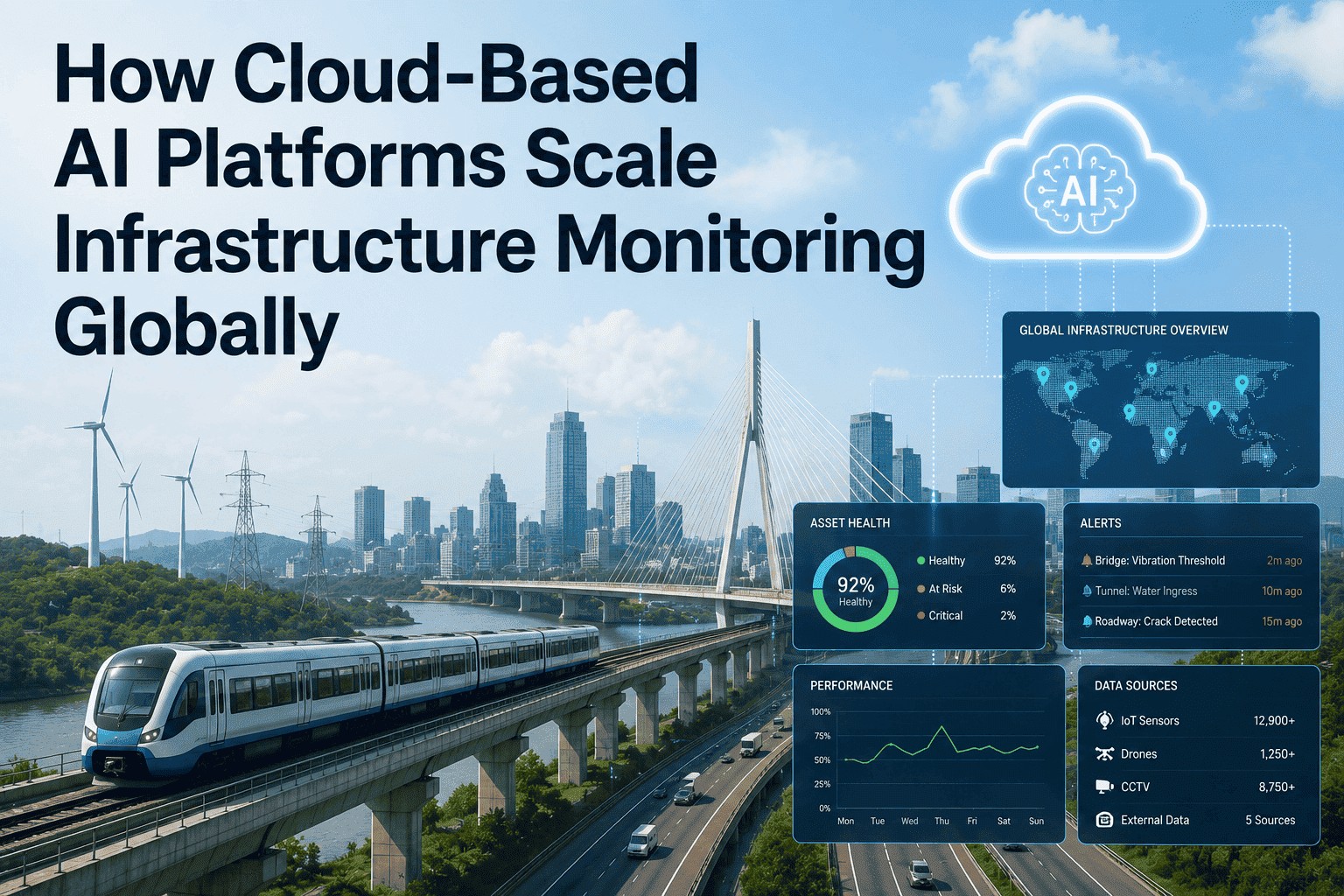
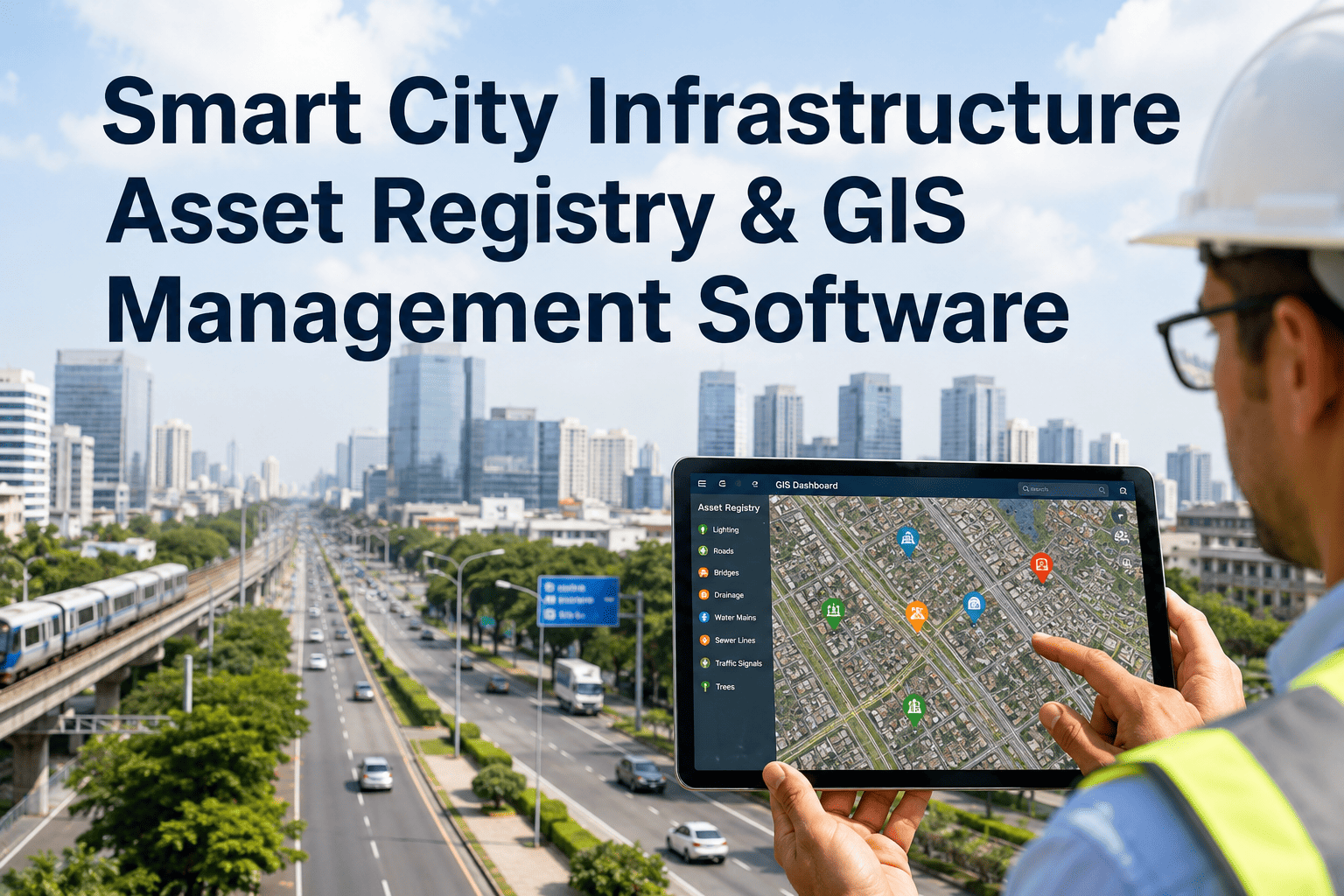
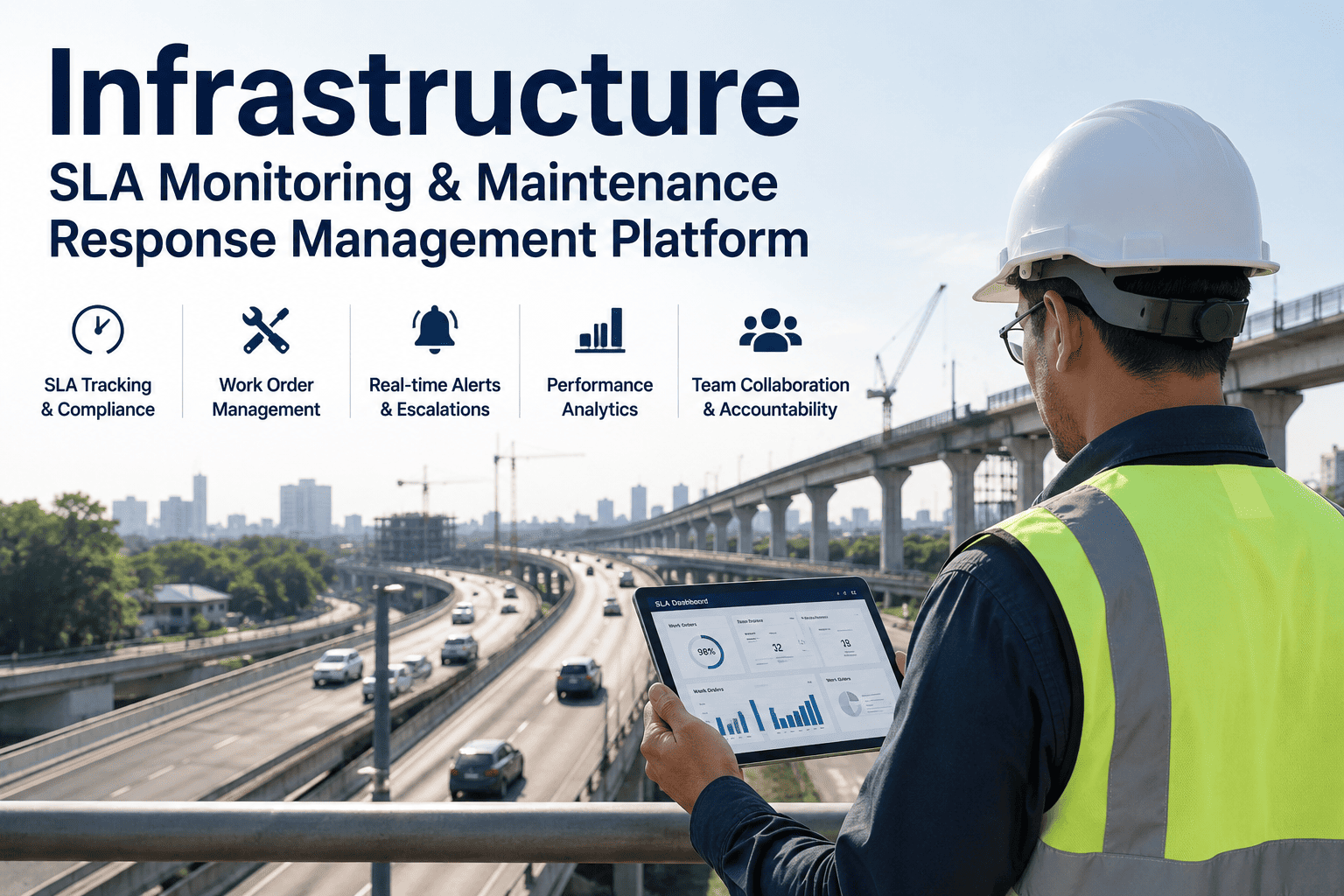
A single infrastructure network might span thousands of kilometres, hundreds of assets, and dozens of operational teams — all generating data simultaneously. For years, monitoring that network meant either accepting blind spots or building expensive on-premise systems that could not keep pace with the scale, or with each other. Cloud-based AI changes the architectural reality entirely. It removes the ceiling on what can be monitored, how fast anomalies are detected, and how many networks a single platform can serve at once — while reducing the upfront capital commitment that historically kept predictive monitoring out of reach for all but the largest operators. This article explains the architecture behind cloud-hosted infrastructure AI, why it scales when on-premise systems do not, and what that means operationally for teams managing assets across multiple geographies.
Cloud AI · Global Monitoring · Predictive Analytics · Scalable Infrastructure
Monitor Every Asset. Across Every Site. From One Platform.
iFactory's cloud-based AI platform connects to infrastructure sensor feeds and asset data globally — scaling from a single corridor to a continent-spanning network without hardware investment or on-site deployment complexity.
Why Infrastructure Monitoring Fails at Scale — and Why the Architecture Is the Reason
Traditional infrastructure monitoring was designed for a single-site, single-team world. As networks expand — more assets, more geographies, more data streams — the architecture that worked at small scale becomes the bottleneck. The problem is not the data volume. It is where the processing happens.
1
Data silos
Each site's monitoring system holds its own data. Cross-network pattern recognition is impossible. Faults appear local when they are systemic.
2
Compute ceilings
On-premise servers process what they were sized for at installation. Adding assets means adding hardware — capital expenditure, lead times, maintenance.
3
Model staleness
AI models trained on-site only learn from one network's data. They do not benefit from failure patterns seen across other networks or geographies.
4
Update friction
Every model improvement, algorithm update, or new detection capability requires manual deployment across every on-site server. Updates lag by months.
$497B
Projected global AI infrastructure market value by 2034, up from $58.78 billion in 2025
Source: Fortune Business Insights
79%
of organisations are already using or experimenting with AI and machine learning cloud services
Source: Flexera 2025 State of the Cloud Report
The Deployment Shift
48%
of organisations acquire AI directly from cloud providers — the fastest-growing deployment model
60%
use private cloud for AI workloads; 48% operate in hybrid environments
68%
use public cloud as the primary location for AI training data
Source: Flexential 2025 State of AI Infrastructure Report
The Architecture Behind Cloud-Based Infrastructure AI: How It Actually Scales
Cloud-hosted AI monitoring is not simply a monitoring system moved to a remote server. It is a fundamentally different architecture — one designed around elastic compute, unified data ingestion, and centralised model training that benefits every connected asset simultaneously.
Cloud AI Platform Architecture — Infrastructure Monitoring
Layer 1 — Edge
Asset & Sensor Layer
Your network, unchanged
IoT sensors
SCADA systems
Smart meters
Inspection cameras
Track geometry data
Environmental feeds
Maintenance work orders
Asset registers
Secure API / encrypted data stream
Layer 2 — Cloud
Ingestion & Normalisation
Data unified at scale
All incoming data streams — regardless of source protocol, format, or geography — are normalised into a unified schema. Timestamps are aligned, units standardised, and data quality checks applied automatically. Missing or anomalous readings are flagged before they enter the analytics layer. This is where multi-site data becomes a single, coherent dataset.
Layer 3 — AI Core
Model Execution
Elastic compute, always current
Anomaly detection
Real-time comparison against learned baselines across all connected assets simultaneously
Failure prediction
Degradation models running per asset — updated continuously as new sensor readings arrive
Cross-network learning
Failure patterns seen on one network improve prediction accuracy for all connected networks
Risk scores, alerts, maintenance recommendations
Layer 4 — Output
Control Room & Teams
Actionable, not just informational
Live risk dashboards
Prioritised inspection lists
Maintenance work order triggers
Executive reporting
API integration to existing systems
Cloud Architecture · Multi-Site Monitoring · Predictive Maintenance
How Many Assets Are Currently Outside Your Monitoring Visibility?
iFactory connects to your existing asset systems and sensor feeds — no new hardware required — and brings every asset into a single cloud-hosted monitoring layer within weeks, not months. Book a Demo to see the coverage map.
Five Scalability Advantages Cloud AI Delivers That On-Premise Cannot Match
The case for cloud-hosted infrastructure AI is not primarily about cost — it is about what becomes technically possible at scale. These five capabilities are structurally unavailable to on-premise architectures, regardless of hardware investment.
01
Elastic compute — scale instantly, pay for what you use
When a storm event puts 300 sensors into high-frequency polling simultaneously, a cloud AI platform scales its compute allocation automatically to handle the surge — without degrading response time. An on-premise server sized for normal operations hits a ceiling. Cloud infrastructure removes that ceiling entirely, scaling horizontally across distributed compute nodes as demand peaks and releasing capacity when it normalises.
Real-world impact
A network adding 500 new sensor points does not require a new server procurement cycle. Cloud capacity is available within minutes. On-premise lead times for equivalent hardware expansion: 3–6 months.
02
Cross-network model training — every asset teaches the platform
An AI model trained only on your network learns from your data. A cloud-hosted AI model trained across dozens of similar networks learns from failures, degradation patterns, and seasonal effects seen across all of them — and applies that collective intelligence to your specific assets. This is the most significant accuracy advantage cloud architecture creates, and it compounds over time as more networks connect.
Real-world impact
A new network onboarding to the platform immediately benefits from failure patterns learned on networks that have been operating for years — rather than starting from a blank model that takes 12–18 months to calibrate.
03
Continuous model updates — improvements deploy automatically
On-premise AI systems are static between manual update cycles. A cloud platform updates its models continuously — as new training data arrives, as algorithms improve, and as new failure types are identified. Every connected network receives the improved model simultaneously, without any site-level deployment effort. The platform you have today is measurably more accurate than the one you had six months ago.
Real-world impact
Model improvements in anomaly detection reach all connected networks within hours of deployment — versus on-premise update cycles that historically lag by 6–18 months across distributed sites.
04
Geographic redundancy — no single point of failure
Cloud infrastructure distributes monitoring workloads across multiple data centres in different geographic regions. If one region experiences an outage, monitoring continues uninterrupted from another. On-premise infrastructure has no equivalent — a server room failure means a monitoring blackout across every asset connected to it, often at the worst possible time: during the extreme weather events that most demand active surveillance.
Real-world impact
Enterprise-grade cloud platforms routinely deliver 99.9%+ uptime through distributed architecture. On-premise single-server monitoring systems typically cannot match this without expensive redundancy investment.
05
External data integration — weather, satellite, third-party feeds
Cloud-hosted platforms can integrate external data feeds — meteorological services, satellite imagery, geospatial datasets, network traffic models — in real time alongside internal sensor data. This is the foundation of weather-correlated risk prediction: the ability to cross-reference what the atmosphere is about to do with what your specific asset is capable of withstanding, at the asset level, hours before an event.
Real-world impact
Integrating a national weather forecast API with your asset sensor data — for flood risk correlation, heat buckling prediction, or frost scheduling — is a cloud API connection. Replicating this on-premise requires building and maintaining the entire data pipeline locally.
Cost vs Performance: What the Numbers Look Like Over Time
The financial case for cloud AI in infrastructure monitoring is strongest when viewed over a 3–5 year horizon — the period over which on-premise hardware costs, upgrade cycles, and staffing costs accumulate alongside the opportunity cost of monitoring gaps.
High upfront capex: server hardware, installation, on-site configuration, network infrastructure per site. Months to deploy across multi-site networks.
No hardware procurement. API-based connection to existing data systems. Typical deployment time: weeks, not months. Subscription or usage-based pricing.
Each new site requires hardware procurement, physical installation, and configuration. Costs scale linearly — or faster if integration complexity increases.
New sites connect to the existing platform via API. No additional hardware. Compute scales automatically. Cost increases are marginal relative to value added.
Model updates and improvements
Manual deployment per site. Internal IT resource required. Updates lag months behind developments. Older model versions persist across sites.
Delivered automatically. All sites receive improvements simultaneously. No IT resource overhead. Platform provider manages the update cycle.
Hardware refresh cycles (every 3–5 years), ongoing maintenance contracts, IT staffing overhead, and upgrade costs accumulate. High sunk cost creates lock-in.
Subscription costs are predictable. Breakeven vs on-premise typically occurs within 12–18 months at scale. No hardware obsolescence risk. Switch cost remains low.
"
We had been trying to build a monitoring system in-house for three years. The moment we connected the cloud AI platform to our existing SCADA feeds, we had cross-site anomaly detection running across all 23 depots within six weeks. That would have taken another two years on-premise — if we could have done it at all. The cross-network learning was what surprised us most: the platform flagged a bearing degradation pattern on a newer asset type that our own historical data couldn't have caught.
— Head of Asset Technology, Regional Transport Operator — 14 Years Infrastructure Data and Monitoring Systems
What Global Scale Actually Makes Possible: Three Monitoring Capabilities That Only Exist at Cloud Scale
Scaling to cloud is not just about monitoring more assets — it is about categories of intelligence that only become available when the data pool is large enough, and the compute is elastic enough, to generate them.
Cross-asset failure correlation
At cloud scale, the AI can identify that a specific component type — a bearing model, a switch design, a drainage system configuration — fails at predictable rates under specific conditions, across all networks that use it. That insight is invisible at site level but statistically clear at scale.
A single site may see 3 failures of a component type per year. Across 50 networks it is 150 — a pattern with statistical significance that drives a universal alert.
Seasonal and climate-adjusted baselines
Infrastructure behaves differently in summer and winter, in wet climates and dry, at high altitude versus low. A cloud platform trained across geographically diverse networks learns to apply climate-adjusted baselines: what is normal for an asset in Scotland in February is different from what is normal in southern Spain in August, and the anomaly detection threshold adjusts accordingly.
Reduces false positive alerts by applying the correct baseline per geography and season — rather than a single global threshold that flags normal seasonal variation.
Remaining useful life benchmarking
Predicting when an asset will fail requires understanding not just its current condition, but how similar assets in similar conditions have degraded over time. At cloud scale, the platform has the comparison population to benchmark any given asset's degradation trajectory against hundreds of statistically similar assets — generating remaining useful life estimates with genuine evidential grounding.
Transforms maintenance scheduling from fixed-interval to evidence-based: replace when the data says to, not when the calendar says to.
Conclusion
Cloud-based AI platforms do not just scale infrastructure monitoring to more assets — they change what monitoring is capable of producing. The architecture enables elastic compute that handles any data volume, cross-network learning that makes every connected asset smarter, continuous model improvement that requires no on-site effort, and geographic redundancy that keeps monitoring live when it is needed most.
iFactory's cloud-hosted AI platform is built for infrastructure operators who need monitoring that scales with their network, not against it — connecting to your existing asset data systems without hardware investment and delivering real-time risk intelligence across every connected site from a single platform. Book a Demo to see how the platform scales across your network, or Get In Touch to begin connecting your asset data.
Frequently Asked Questions
Every asset on your network should be monitored. Cloud AI makes that possible without the hardware investment that has historically made it impractical.
iFactory's cloud-based AI platform connects to your existing infrastructure data systems — scaling from a single site to a global network without on-site hardware deployment. Book a Demo to see how the platform scales across your asset portfolio.