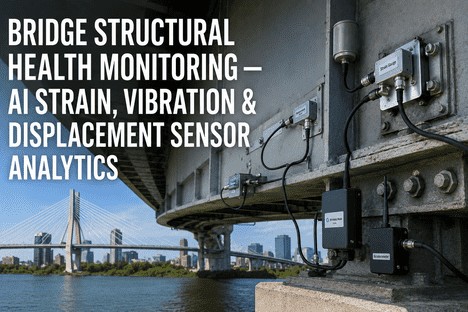
Every infrastructure failure that makes the news — a water main rupture flooding downtown streets, a bridge closure stranding commuters, a pump station outage during a heat event — was preceded by weeks or months of detectable deterioration signals that no one was watching. That is the core problem predictive analytics solves. By continuously analyzing IoT sensor streams, historical maintenance records, climate exposure data, and asset condition trends, predictive analytics platforms identify the specific assets approaching failure thresholds far enough in advance to intervene at planned cost rather than emergency cost. For municipalities and large-scale facility operators facing a $1 billion annual deferred maintenance funding gap, a workforce losing 50% of its experienced technicians to retirement, and climate stress compounding deterioration at 37% annually, predictive analytics is not a future capability — it is the mechanism that makes proactive infrastructure management economically achievable right now. If your organization is still dispatching maintenance crews on calendar schedules rather than condition signals, book a free predictive analytics assessment with iFactory to see exactly where the gaps are in your current program.
Step 1: Understand What Predictive Analytics Actually Replaces
Predictive analytics is not simply better scheduling software. It replaces the fundamental decision architecture of infrastructure management — shifting every maintenance, capital, and workforce decision from calendar-based and anecdotal to condition-based and evidence-driven. Before deploying any predictive platform, infrastructure managers need to clearly map the specific failure modes in their current program that predictive analytics is designed to eliminate.
Calendar-Based Maintenance
Maintains healthy assets unnecessarily while missing deteriorating ones between inspection dates — misallocating 30–40% of maintenance budgets systematically.
Reactive Emergency Response
Emergency repairs carry contractor mobilization premiums, overtime labor costs, and service disruption penalties that planned interventions avoid entirely.
Knowledge-Dependent Decisions
50% of the public works workforce is retiring — taking decades of asset-specific failure pattern knowledge with them unless that knowledge is captured digitally.
Anecdotal Capital Planning
Capital budget submissions without condition evidence are delayed, reduced, or rejected — systematically growing the deferred maintenance backlog that produces Portland's $1B+ annual funding gap.
Not sure which failure modes are costing your organization the most? Book a free predictive analytics gap assessment with our infrastructure management specialists.
Step 2: Select the Right Predictive Analytics Model for Your Asset Classes
Predictive analytics is not a single technique — it is a family of models, each optimized for different asset types, data availability profiles, and failure consequence categories. Matching the right model to the right asset class determines whether your predictive program generates actionable intelligence or just additional data noise.
iFactory AI Engine: iFactory's predictive analytics platform combines all five model types in a single deployment — applying the most appropriate technique to each asset class automatically based on available data, asset type, and failure consequence profile. No separate model selection, configuration, or data science team required.
Not sure which predictive models your highest-risk asset classes require? Talk to our predictive analytics specialists for a no-obligation model-fit consultation.
Step 3: Configure Asset Health Scoring and Risk-Ranked Intervention Queues
The most operationally valuable output of predictive analytics for infrastructure management is not a prediction — it is a prioritized action queue. AI Asset Health Scoring translates continuous predictive model outputs into ranked intervention lists that direct maintenance budgets to exactly where they prevent the most expensive outcomes. Here is how the scoring and queue architecture works in practice.
Define Health Score Weighting Parameters for Each Asset Class
Configure the AI weighting factors that determine how iFactory's Health Score combines deterioration rate, age relative to design life, climate exposure zone, maintenance history, failure consequence severity, and redundancy availability. Bridges in coastal freeze-thaw zones carry different weighting than pump stations in climate-stable inland facilities — the model must reflect these differences to generate actionable rankings.
Set State of Good Repair Thresholds by Asset Class
Generate Risk-Ranked Intervention Queue Across Full Portfolio
With Health Score thresholds active, iFactory generates a continuously updated intervention queue across your entire asset portfolio — ranking every asset by risk-adjusted urgency and estimated intervention cost. This queue becomes the primary input for maintenance budget allocation decisions, replacing the calendar-based scheduling that systematically misallocates resources regardless of actual asset condition.
Connect Predictive Scores to Capital Planning Evidence
Health Score histories and deterioration trend projections are automatically compiled into State of Good Repair documentation — providing the condition-verified evidence base for capital budget submissions to councils, boards, and federal grant programs. The same predictive data that drives maintenance prioritization simultaneously builds the grant application evidence package, eliminating the separate manual data compilation cycle that most infrastructure organizations still rely on.
Step 4: Activate Predictive Alert Thresholds and Automated Work Order Generation
Predictive intelligence without connected action workflows is just an advanced warning system with no dispatch mechanism. Configure iFactory to convert every predictive alert into an automatically generated, skill-matched work order — closing the loop from AI prediction to scheduled field intervention in hours rather than weeks.
Trend Flagged
Automated Response:
- Flag logged to asset record with timestamp
- Monitoring frequency increased automatically
- Trend data added to next inspection brief
Intervention Planned
Automated Response:
- Planned maintenance work order auto-generated
- Skill-matched technician assigned via mobile dispatch
- Asset manager notified with condition evidence attached
Urgent Dispatch
Automated Response:
- High-priority corrective work order generated immediately
- Operations leadership alerted with Digital Twin projection
- Capital plan flagged for emergency budget reallocation
Emergency Override
Automated Response:
- Emergency work order dispatched — bypass normal queue
- Service continuity protocols activated automatically
- Full incident and response documentation auto-generated
Close the Loop: Prediction to Scheduled Intervention in Hours
iFactory connects predictive AI Health Score alerts directly to skill-matched work order dispatch — ensuring every deterioration signal triggers a planned maintenance response before it escalates to an emergency repair at 3–5x the cost.
Step 5: Integrate Predictive Analytics Outputs with Capital Planning and Compliance Systems
The most transformative value of predictive analytics for infrastructure management is not in preventing individual asset failures — it is in changing the quality of every capital allocation, grant application, and sustainability compliance decision across the entire portfolio. Connecting predictive outputs to these downstream systems is where the 400% ROI is actually generated.
Predictive Data Inputs
- IoT sensor condition streams
- AI Health Score histories
- Deterioration rate trends
- Climate risk overlay data
- Digital Twin simulations
iFactory Predictive Platform
Decision-Quality Outputs
- Condition-verified capital requests
- Federal grant evidence packages
- State of Good Repair reports
- Net-zero compliance dashboards
- Council briefing data packages
Predictive Analytics Integration Checklist
Need help connecting iFactory's predictive outputs to your capital planning, grant, or sustainability systems? Book a technical integration session with our implementation team.
Step 6: Establish Predictive Model Performance and Continuous Improvement Protocols
Predictive analytics models improve over time as they accumulate condition data — but only if performance is actively monitored and model parameters are updated as the infrastructure portfolio and operating environment evolve. Building a continuous improvement protocol into your predictive program prevents model drift and sustains the accuracy improvements that generate long-term ROI.
Want a structured performance improvement roadmap built into your iFactory deployment from day one? Our implementation specialists design the full continuous improvement protocol as part of every onboarding engagement.
Expert Perspective
"The infrastructure management organizations achieving the strongest outcomes in 2026 are not the ones with the largest budgets — they are the ones with the best predictive data. The financial case for predictive analytics is not theoretical: emergency repairs cost three to five times as much as planned interventions, 37% of climate stress costs arrive without warning on fixed maintenance schedules, and federal grant programs are increasingly scoring applications on the quality of condition evidence rather than the urgency of need. Predictive analytics does not just reduce costs — it changes which decisions get made, how fast, with what evidence, and at what cost. The compound effect of better decision quality across every layer of the maintenance and capital cycle is where the 400% ROI figure comes from."
Conclusion
Deploying predictive analytics for infrastructure management requires deliberate design across six interconnected areas: understanding what failure modes the analytics replace, selecting the right model types for your asset classes, configuring Health Scoring and risk-ranked intervention queues, activating automated work order generation from predictive alerts, integrating predictive outputs with capital planning and compliance systems, and maintaining continuous model improvement protocols. When these elements align, predictive analytics platforms do not simply prevent individual failures — they transform the entire infrastructure management decision architecture from reactive and anecdotal to proactive and evidence-driven. The technology delivers 50% downtime reduction, 30% maintenance cost savings, 25% extended asset life, and 400% ROI on proactive investment. The implementation pathway is proven and deployable today through iFactory's cloud-native platform, purpose-built for municipalities and large-scale facility operators across the US and Canada.
Schedule your iFactory predictive analytics demo to see AI Asset Health Scoring, Digital Twin Simulation, and automated maintenance dispatch in action — or connect with our infrastructure analytics specialists for a custom program design session.
Turn Deterioration Signals Into Scheduled Interventions — Before They Become Emergency Repairs
iFactory's predictive analytics platform connects IoT sensor data, AI Health Scoring, Digital Twin simulation, and skill-matched work dispatch into a single intelligence system — giving US and Canadian infrastructure organizations the condition-based decision architecture that generates 400% ROI on proactive maintenance.
Deploy iFactory Predictive Analytics — From First Signal to Scheduled Fix
Join municipalities and facility operators across the US and Canada using iFactory to detect failures weeks in advance, allocate budgets to highest-risk assets, and generate the condition evidence that wins federal infrastructure funding.