Infrastructure SCADA Integration & Legacy Modernization — AI Analytics Overlay
By Grace on June 23, 2026
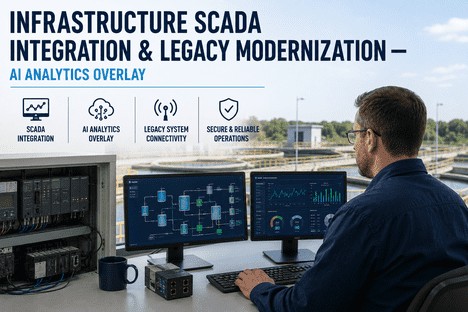
The global SCADA market reached USD 44.6 billion in 2025, yet nearly 90 percent of industrial organisations report being held back by legacy control systems they cannot afford to fully replace and cannot afford to keep running. Reliability engineers face a paradox that no vendor brochure solves: the Siemens S7-300 and Rockwell RSLogix 5 platforms that still control critical infrastructure reached end-of-life in 2024 and 2025 respectively, yet the plants, water networks, and energy facilities they operate were designed for 20-year service lives. A full rip-and-replace of every legacy RTU, PLC, and HMI across a mid-sized industrial site typically runs seven to eight figures and requires 12 to 18 months of phased shutdowns. The alternative — leaving legacy SCADA in place and overlaying an AI analytics layer on top — is not a compromise. It is increasingly the preferred architecture for organisations that want predictive maintenance, anomaly detection, and real-time KPI visibility without the capital cost, operational risk, and multi-year timeline of a full control system replacement. This guide is written for the reliability engineer who needs to bridge the gap between the SCADA systems the organisation has and the operational intelligence it needs.
Don't Replace Your SCADA. Make It Smarter. iFactory Overlays AI Analytics on Any Legacy Control System.
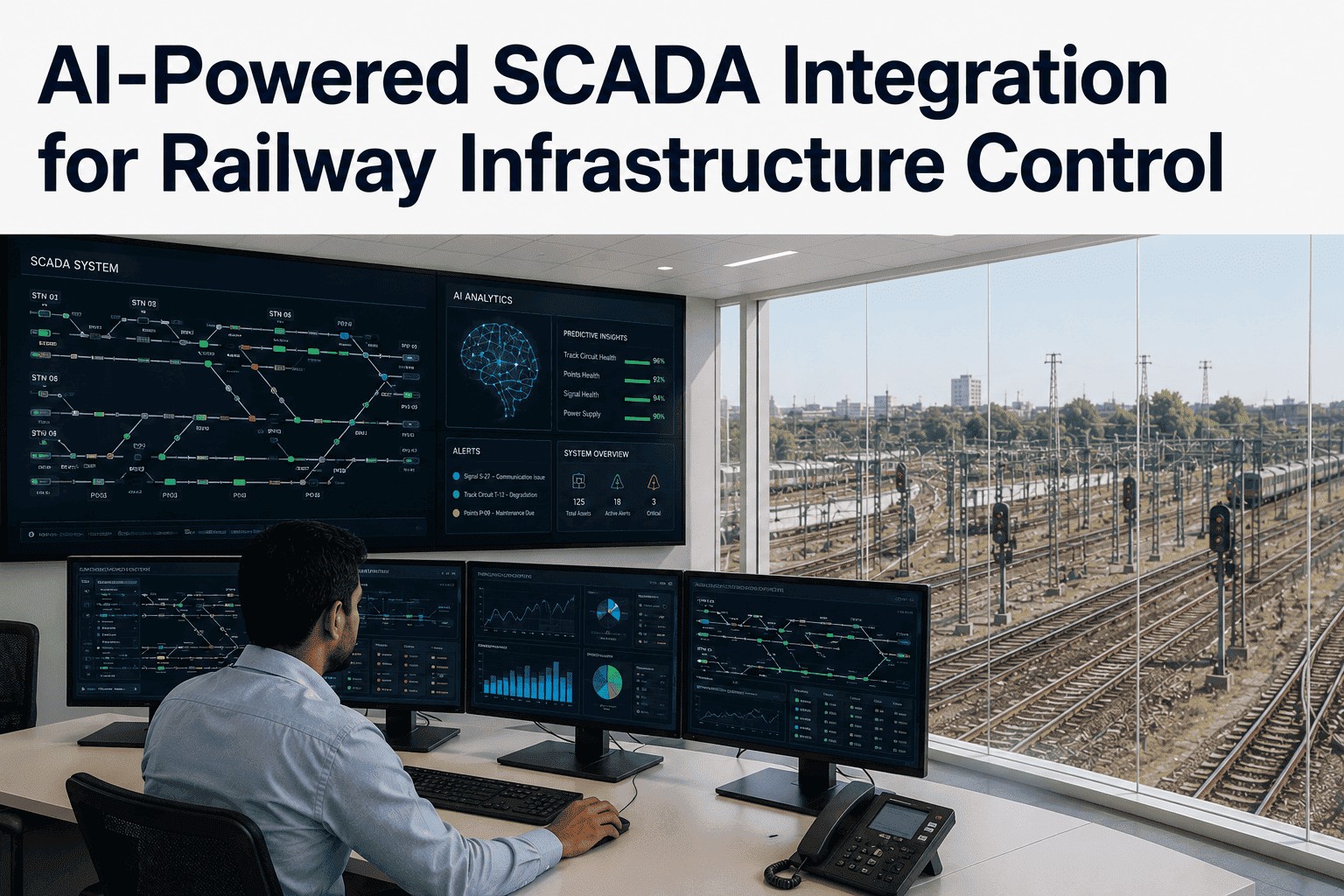
iFactory connects to existing RTUs, PLCs, and SCADA historians — regardless of vendor or vintage — and layers AI-driven anomaly detection, predictive alerts, and tiered KPI dashboards without a single control system replacement.
Global SCADA market size in 2025, projected to reach USD 93.6B by 2034 — driven by the urgency to modernize without full system replacement
88%
Of organisations report being hindered by legacy control systems — yet fewer than 1 in 5 have a funded SCADA replacement programme in place
45%
Increase in cyberattacks targeting industrial control systems in the past two years — legacy SCADA platforms without security patches are primary targets
62%
Of industrial organisations report a shortage of qualified SCADA professionals — AI analytics overlays reduce dependency on scarce control system expertise
The Five Failure Points of Legacy SCADA That an AI Analytics Overlay Solves
Legacy SCADA systems were designed for a different operational era — one where real-time data meant a 15-second poll cycle, alarms were threshold-based, and the operator was expected to interpret trends manually. Modern operational intelligence demands sub-second anomaly detection, predictive failure models, and KPI visibility that spans multiple sites and vendor platforms. The five failure points below describe exactly where legacy SCADA breaks and how an AI analytics overlay addresses each one without touching the control loop.
Reactive Alarms
Legacy SCADA triggers alarms when a value exceeds a fixed threshold — after the failure has started. An AI overlay detects anomaly patterns hours or days before threshold breach by analysing rate-of-change and multivariate deviation.
Siloed Data
RTUs and PLCs from different vendors speak different protocols. Legacy SCADA cannot correlate data across pump house, treatment zone, and distribution network. An AI layer normalises data from any source into a unified time-series model.
No Predictive View
SCADA shows current values and historical logs but does not forecast future states. AI models trained on 12-plus months of historian data predict remaining useful life, time-to-failure windows, and optimal intervention points.
Manual KPI Reporting
Reliability engineers spend 8 to 12 hours per week exporting SCADA data into spreadsheets to calculate OEE, MTBF, and availability. An AI overlay computes and surfaces these KPIs in real time — with trend comparison and automated alerts.
Security Gaps
Legacy SCADA platforms running on Windows 7 or XP have no security patches. An AI overlay read-only layer communicates via unidirectional data diodes or read-only OPC UA — adding intelligence without expanding the attack surface.
Rip-and-Replace vs. AI Analytics Overlay — A Decision Framework for Reliability Engineers
The decision to replace a legacy SCADA system or overlay it with AI analytics is rarely binary. Most organisations need a hybrid approach — replace only the control components that are genuinely end-of-life while overlaying analytics on everything else. The comparison below gives reliability engineers a structured way to evaluate which approach fits each asset class and control zone.
Full SCADA Replacement
Best for: platforms confirmed end-of-life with no security patches and unavailable spares
Capital cost: USD 500K to 3M+ per control zone
Timeline: 6 to 18 months per zone with phased shutdowns
Operational risk: process interruptions during cutover
Operator retraining: 2 to 4 weeks per operator per zone
Long-term: clean architecture, vendor support, full modernisation
AI Analytics Overlay
Best for: functional SCADA with remaining service life but limited analytics capability
Capital cost: USD 40K to 120K per site, no control hardware changes
Timeline: 2 to 6 weeks deployment, zero process disruption
Operational risk: read-only data extraction, no control loop interference
No operator retraining: existing HMI and workflows unchanged
Long-term: legacy hardware still ages out eventually; overlay extends useful life 3-5 years
Your SCADA Has the Data. iFactory Has the Intelligence Layer.
iFactory connects to any SCADA historian, RTU, or PLC — including Siemens, Rockwell, Schneider, Emerson, and GE — and overlays AI analytics, predictive alerts, and tiered reliability KPIs without a single PLC reprogramming or HMI redesign.
The AI Overlay Architecture — Read-Only Intelligence That Preserves Control System Integrity
The architecture that makes SCADA modernization without replacement possible is deceptively simple: extract data from the existing control system at the historian or OPC server layer, process it in a separate analytics environment, and surface intelligence in a parallel dashboard that operators and engineers can use without touching the primary HMI. The control loop remains untouched. The AI layer is additive, not invasive. The diagram below shows how data flows from legacy field devices through the overlay and into operational decisions.
Field & Control Layer
Existing RTUs, PLCs, and sensors continue normal operation. No changes to control logic, no additional field wiring, no process interruptions.
Data Extraction Layer
Read-only connections via OPC UA, Modbus TCP, PI Interface, or SQL historian bridge. Unidirectional data flow prevents any feedback to the control network.
AI Analytics Engine
Time-series data is processed through trained anomaly detection, remaining-useful-life, and predictive failure models. Alerts are generated in real time with asset-specific thresholds.
KPI & Decision Layer
Role-based dashboards surface reliability metrics, predictive alerts, and trend data to engineers, supervisors, and directors — without changing the primary HMI or control workflows.
The Integration Approach Spectrum — Five Levels of SCADA Modernisation Depth
Not every SCADA zone needs the same depth of modernisation. A water treatment plant with a 2018-vintage Rockwell ControlLogix system needs a different approach than a chemical facility running a 2002 Siemens S7-300 with no available spares. The spectrum below gives reliability engineers a framework to assess each control zone independently and assign the appropriate integration depth based on hardware age, criticality, and available budget.
Level
Approach
Best For
Level 1
Read-Only Historian Bridge
Connect iFactory to existing SCADA historian via OPC UA or SQL bridge. AI analytics processes historian data and surfaces predictive insights in a parallel dashboard. No field changes, no downtime.
SCADA under 10 years old with active vendor support
Level 2
Edge Gateway Addition
Install iFactory edge gateway on control network to collect data directly from PLCs and RTUs via Modbus, Profinet, or EtherNet/IP. Gateway provides local edge processing and secure cloud forwarding.
Mixed-vendor sites with no unified historian
Level 3
Sensor Augmentation
Add wireless IoT sensors for parameters not captured by existing SCADA — vibration, temperature, current signature — and feed them into the same analytics dashboard alongside SCADA data.
Assets with limited SCADA instrumentation coverage
Level 4
Selective PLC/RTU Replacement
Replace only the end-of-life controllers in critical zones while keeping the rest of the SCADA architecture intact. New PLCs feed iFactory directly; legacy zones continue via historian bridge.
Zones with confirmed EOL hardware and available spares
Level 5
Full SCADA Modernisation
Complete platform migration to modern SCADA with integrated AI analytics. iFactory serves as the analytics layer from day one. Recommended only for zones where hardware is unsupported and spares are unavailable.
Obsolete platforms with no vendor support path
Reliability Engineer KPI Framework — What to Measure When SCADA Data Meets AI Analytics
When an AI analytics overlay connects to legacy SCADA data, the reliability engineer gains a set of KPIs that were previously accessible only through manual data extraction and spreadsheet calculation. iFactory computes these automatically from the unified data stream and surfaces them in role-specific dashboards with trend history and configurable alert thresholds.
Asset Health
Overall equipment effectiveness by asset — availability, performance, and quality rolled into a single OEE score calculated from SCADA production and downtime data
Remaining useful life estimate — AI model projection based on operating hours, load cycles, and vibration trend data from the analytics overlay
Mean time between failures — rolling 12-month MTBF by asset class, recalculated automatically as new event data enters the historian
Predictive Alerts
Anomaly detection hit rate — percentage of AI-generated alerts that result in confirmed faults, tracked to improve model accuracy over time
Alert lead time — average hours between first anomaly detection and predicted failure threshold, by asset class and severity level
False positive rate — percentage of alerts that did not correspond to actual degradation, reviewed monthly to refine model thresholds
Maintenance Impact
Reactive-to-planned ratio — percentage of maintenance events triggered by unplanned failures vs. condition-based predictions from AI analytics
Mean time to repair by fault type — average hours from alert to corrective action, segmented by predicted vs. unplanned events
Maintenance cost avoidance — USD saved by preventing failures through early detection, calculated against historical average repair costs
System Performance
SCADA data quality score — percentage of polled tags returning valid values, flagging sensor drift, communication drops, and calibration issues automatically
AI model accuracy trend — comparison of predicted vs. actual failure dates, updated monthly to track model reliability across the asset fleet
Integration uptime — percentage of time the analytics overlay successfully receives data from each connected SCADA source
"
We have a 2006-vintage SCADA system across three water treatment plants. The capital request for a full replacement was north of USD 2.8 million with an 18-month implementation timeline. Instead, we deployed iFactory's analytics overlay in six weeks. We connected to the existing OSIsoft PI historian, added 40 wireless vibration sensors in zones the SCADA was never instrumented for, and had predictive alerts running within the first month. In the first quarter, the AI model detected a developing bearing failure on a raw water intake pump that the SCADA threshold alarms had not triggered. The repair cost USD 11,000. A catastrophic failure would have shut down intake for an estimated 72 hours. The overlay paid for itself on that single detection. The SCADA kept running exactly as it always had. We just made it smarter.
— Senior Reliability Engineer, Municipal Water Authority — 16 Years Industrial Operations
Conclusion
The organisations that will outperform on reliability metrics over the next decade are not those that replace every legacy SCADA system — they are those that overlay AI analytics on the control infrastructure they already have. With 88 percent of industrial organisations hindered by legacy systems and 45 percent more cyberattacks targeting industrial control systems every year, the cost of doing nothing is measurable in unplanned downtime, missed failure signals, and expanding security exposure. The AI analytics overlay approach allows reliability engineers to deliver predictive maintenance, real-time KPI visibility, and unified asset health monitoring without the capital intensity, operational risk, and multi-year timeline of a full SCADA replacement programme.
iFactory's SCADA integration platform connects to any legacy control system via read-only OPC UA, Modbus, or historian bridge — and layers AI-driven anomaly detection, remaining-useful-life predictions, and tiered reliability KPIs on top. Book a Demo to see how iFactory overlays on your existing SCADA architecture, or Talk to an Expert to discuss the right integration depth for each zone of your operation.
Frequently Asked Questions
No. iFactory connects to existing SCADA systems at the historian, OPC server, or network level using read-only protocols. No PLC logic modification, no HMI screen changes, and no control loop reconfiguration are required. The integration is designed to be non-invasive — the control system continues operating exactly as it always has while iFactory extracts the data needed for AI analytics and KPI dashboards. For sites without a historian, an iFactory edge gateway can be added to the control network to collect data directly from PLCs and RTUs via read-only Modbus, Profinet, or EtherNet/IP connections. Talk to an Expert to discuss your specific SCADA architecture and connection options.
iFactory supports all major SCADA platforms including Siemens WinCC and PCS 7, Rockwell FactoryTalk and RSView, Schneider ClearSCADA and Citect, GE iFIX and Proficy, Emerson Ovation and DeltaV, and AVEVA System Platform and Wonderware. On the PLC side, the platform connects to Siemens S7 and S1200, Rockwell ControlLogix and CompactLogix, Schneider Modicon and M340, Mitsubishi Q-Series, and Omron CJ and NJ series. Historian support includes OSIsoft PI, Canary Labs, and SQL-based historians. If your system supports OPC UA, Modbus TCP, Profinet, or EtherNet/IP, iFactory can integrate with it. Book a Demo to verify compatibility with your specific control system version and configuration.
iFactory's integration architecture uses unidirectional data flow principles — data is read from the control network but no data or commands are written back. Connections are established via read-only OPC UA, firewall-enforced Modbus TCP, or historian bridge interfaces that prevent any reverse communication. For sites with the highest security requirements, iFactory supports deployment via unidirectional data diodes that physically prevent any signal from travelling back to the control network. All data in transit is encrypted using TLS 1.3, and the platform maintains separate authentication domains from the control system — so a compromise of the analytics layer cannot propagate to the SCADA or PLC network. Talk to an Expert to review your network architecture and define the appropriate security controls for your SCADA overlay deployment.
If the SCADA historian contains 12 months or more of historical data, iFactory's AI models can begin generating baseline anomaly detection alerts within the first week of connection. The models use historical data to establish asset-specific thresholds for vibration, temperature, pressure, flow, and current parameters. Initial alert accuracy typically reaches 75 to 80 percent within the first 30 days and improves to 90 percent-plus as the feedback loop captures confirmed vs. false alerts over the first 90 days. Sites with less than six months of historian data require a 4 to 6 week baseline collection period before predictive models reach similar accuracy levels. All models continue improving over time through automated retraining cycles. Book a Demo to see accuracy benchmarks from similar SCADA overlay deployments in your industry sector.
Your SCADA System Has 20 Years of Data. iFactory Has the AI to Turn It Into Decisions.
No rip-and-replace. No control system changes. No operator retraining. Just a read-only AI analytics overlay that gives reliability engineers predictive alerts, real-time KPIs, and unified asset visibility across every SCADA zone — regardless of vendor or vintage.