Building Automation System Integration — AI Cross-System Optimization & Energy Management
By Grace on June 20, 2026
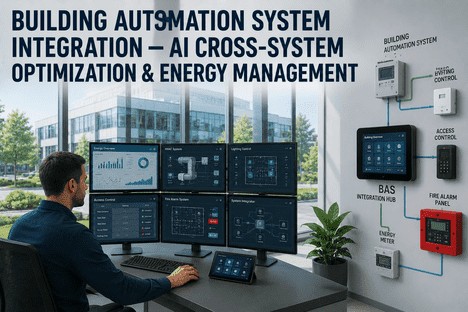
A typical commercial building runs five separate automated systems — HVAC, lighting, access control, fire alarm, and energy metering — each installed by a different vendor, each speaking a different protocol, and each generating data that the other four cannot read. The HVAC system on BACnet does not know the access control system has detected low occupancy on the third floor. The lighting controller on DALI does not receive the schedule update from the building management console. The fire alarm panel operates in complete isolation until an event occurs. This is not a technology failure. It is an integration failure — and it is costing commercial building owners an estimated 20 to 40 percent more in energy consumption than necessary, because each system optimises its own domain without awareness of the others. The global building automation system market reached $101 billion in 2025 and is projected to grow to $191 billion by 2030 at a 13.4 percent CAGR, driven by exactly this recognition: that the value of a building's systems is not in what each can do alone, but in what they can do together when connected through an AI-powered integration layer. iFactory's BAS integration and AI optimization module was built to provide that layer — unifying HVAC, lighting, access control, fire alarm, and energy systems into a single intelligent platform that optimises the whole building rather than each subsystem individually.
BAS Integration · AI Cross-System Optimization · Energy Management · Unified Facility Intelligence
Your Building's Systems Are Smarter Together Than They Are Apart. iFactory Connects Them All — and AI Optimises the Whole.
Unified BAS integration across HVAC, lighting, access control, and fire alarm systems with AI-driven cross-system optimisation, real-time energy management, and automated fault detection from a single dashboard.
Projected to reach $191B by 2030 at 13.4% CAGR — driven by AI integration and cross-system optimisation demand
40%
Buildings' Share of Global Energy Consumption
AI-driven BAS integration can reduce building energy use by 20-40% compared to disconnected manual operations
$359B
AI in Smart Buildings Market by 2034
Growing at 24% CAGR from $41.4B in 2024 — AI is the fastest-growing segment in building technology investment
28%
Maximum Energy Savings with AI Hybrid Methods
Reinforcement learning achieves 22.3% savings; hybrid AI methods reach 28.1% with ROI periods of 2.1 to 5.8 years
The Cost of Disconnected Building Systems
The HVAC Blind Spot
HVAC conditions empty spaces because occupancy data lives in a separate system.
The access control system knows exactly how many people are on each floor at any given time. The lighting system knows which zones are occupied. But the HVAC system — which accounts for approximately 40 percent of a commercial building's total energy consumption — typically operates on a fixed schedule or zone thermostat setpoint that does not adjust based on actual occupancy. The result is that large areas of the building are heated, cooled, and ventilated at full capacity while unoccupied, wasting energy at a rate that compounds across every floor, every zone, every operating day of the year. Trane Technologies reported that AI-driven HVAC controls can reduce heating and cooling energy costs by up to 25 percent and carbon emissions by up to 40 percent by integrating occupancy data into real-time setpoint adjustment.
Energy Waste + Carbon Overhang
The Lighting Disconnect
Lights stay on in unoccupied zones because the lighting system does not talk to the occupancy sensor network.
Modern LED lighting systems with individual zone control can reduce lighting energy consumption by 60 to 70 percent compared to legacy systems — but only when they receive accurate occupancy and daylighting data. When the lighting control system operates on its own scheduling logic without input from the access control system's occupancy detection or the BAS's daylight harvesting sensors, the energy savings potential is cut by half. Integrated AI cross-system optimisation closes this gap by coordinating lighting schedules with actual occupancy patterns, daylight availability, and even meeting room booking data from the building management calendar.
Wasted Savings Potential
The Security Integration Gap
Access control and fire alarm systems operate in isolation until an emergency reveals the gap.
In a fully integrated building, a fire alarm event automatically triggers access control doors to unlock evacuation routes, HVAC dampers to adjust for smoke control, lighting to illuminate egress paths, and the BAS to notify emergency services with floor-level occupancy data from the access control system. Without cross-system integration, each of these responses requires separate detection, separate action, and separate communication — introducing delays measured in minutes when seconds matter. Facilities with integrated BAS report 30 to 50 percent faster emergency response coordination and significantly lower liability exposure from delayed egress
Safety Risk + Liability Exposure
The Management Complexity Burden
Facility teams juggle five separate dashboards to manage what should be one building.
A 2025 industry survey found that 78 percent of organisations have a BMS or BAS installed, but 63 percent report integration challenges between building software platforms. The average facility manager spends 8 to 12 hours per week switching between separate interfaces for HVAC, lighting, access control, energy metering, and fire alarm systems — time that should be spent on strategic optimisation rather than context switching. Centralised BAS integration eliminates this fragmentation by presenting every system's status, alerts, and performance data in a single interface with unified reporting and cross-system analytics.
Operational Inefficiency + Staff Burnout
How AI Cross-System Optimisation Works — From Siloed Subsystems to Unified Building Intelligence
AI-driven cross-system optimisation follows a four-stage architecture that transforms disconnected building subsystems into a coordinated intelligent environment. Each stage builds on the previous one, and the quality of the output at each stage determines the overall optimisation performance.
1
Protocol Bridging & Data Unification
BACnet, Modbus, KNX, DALI, and proprietary protocols are translated into a unified data model through gateway integration. Each device — from chillers to card readers — becomes a visible, addressable data point in a single namespace regardless of its native protocol.
2
Cross-System Correlation & Pattern Detection
AI models analyse data streams from all connected subsystems simultaneously — correlating HVAC zone temperature with occupancy sensor counts, lighting energy consumption with daylight harvesting readings, and access control events with schedule data to identify optimisation opportunities no single system could detect.
3
Predictive Optimisation & Automated Adjustment
Reinforcement learning and hybrid AI models generate optimal setpoints across all systems in real time — adjusting HVAC temperature and airflow, lighting levels, and zone scheduling based on occupancy forecasts, weather data, utility rate structures, and comfort requirements simultaneously.
4
Continuous Learning & Performance Feedback
Each optimisation decision feeds back into the AI model with actual performance data — energy consumption, occupant comfort feedback, equipment runtime — creating a continuous improvement loop that refines future decisions and adapts to seasonal changes, occupancy pattern shifts, and equipment degradation.
15-30%
Energy reduction beyond traditional automation through AI cross-system optimisation across HVAC, lighting, and equipment scheduling
3.4 years
Median ROI period for AI-driven BAS integration across commercial buildings, with implementation costs ranging from $8,000 to $47,000 per facility
47.9%
Demonstrated HVAC energy savings in real-world deployments using AI-driven setpoint optimisation with occupant comfort feedback loops
Multi-Protocol Integration · AI Building Optimisation · Unified BAS Platform · Energy Intelligence
BACnet, Modbus, KNX, DALI — Your Building Speaks Multiple Languages. iFactory Interprets All of Them in One Platform.
A single integration layer that connects every building subsystem regardless of manufacturer, protocol, or generation — with AI analytics that optimise energy consumption, occupant comfort, and equipment life across the entire facility.
The Protocol Bridge — How iFactory Connects Every Major Building Automation Protocol into a Unified Data Environment
Building automation systems were never designed to communicate with each other. HVAC equipment from one manufacturer uses BACnet, lighting controls from another use DALI, access control systems often run on proprietary protocols, and energy meters communicate via Modbus. Integrating these heterogeneous systems is the single most complex technical challenge in BAS deployment — and the most critical prerequisite for AI-driven cross-system optimisation. iFactory's integration engine handles this complexity through a multi-protocol gateway architecture that does not require rip-and-replacement of existing systems.
BACnet/IP & BACnet MSTP
Native BACnet integration for HVAC equipment, chillers, boilers, AHUs, VAV boxes, and building controllers. Full BACnet object discovery and point mapping across all device types.
Modbus RTU & Modbus TCP
Connects to power meters, generator controllers, water meters, variable frequency drives, and third-party sensors that use Modbus as their primary communication protocol.
KNX & DALI
Lighting control and shading system integration through KNX IP gateways and DALI controllers. Group address mapping enables full dimming, scene control, and energy monitoring.
Proprietary & Legacy Systems
API-based integration for proprietary access control, fire alarm, and legacy building management systems. Custom driver development available for systems without standard protocol support.
What Unified Protocol Integration Unlocks
Once all building subsystems are visible in a single data environment, the AI optimisation layer can correlate HVAC zone temperature with access control occupancy data, adjust lighting schedules based on actual space utilisation detected by the security system, and optimise energy consumption across all systems simultaneously. The building transitions from a collection of independent subsystems operating in isolation into a single intelligent facility where every system's data informs every other system's operation. This is the prerequisite for achieving the 20 to 40 percent energy savings that integrated AI building optimisation promises — and it cannot be achieved without solving the protocol integration problem first.
What iFactory's BAS Integration & AI Optimisation Module Actually Does
iFactory is not a bolt-on analytics layer that sits on top of your existing BAS. It is a unified integration and optimisation platform that connects every building subsystem, normalises the data into a single model, applies AI-driven cross-system optimisation, and delivers actionable intelligence through a single dashboard designed for facility managers.
Capability 01
Cross-Protocol BAS Integration Engine
Connects HVAC, lighting, access control, fire alarm, and energy metering systems across BACnet, Modbus, KNX, DALI, and proprietary protocols — translating every data point into a unified namespace without requiring equipment replacement or vendor lock-in.
Capability 02
AI Energy & Comfort Optimisation Engine
Reinforcement learning and hybrid AI models analyse cross-system data to generate optimal setpoints for HVAC, lighting, and zone scheduling in real time — balancing energy consumption with occupant comfort and incorporating weather forecasts, utility rates, and occupancy predictions.
Capability 03
Automated Fault Detection & Diagnostics
AI models continuously monitor equipment performance across all connected subsystems, detecting anomalies such as HVAC efficiency degradation, lighting driver failures, access control communication errors, and power quality issues — with diagnostic context that tells facility staff what is wrong and where to look.
Capability 04
Unified Dashboard & Cross-System Reporting
A single interface showing HVAC zone conditions, lighting status, access control events, energy consumption by subsystem, and fire alarm system status — with configurable dashboards for facility managers, energy managers, and building owners, plus automated reporting for energy benchmarking and compliance.
What the Numbers Show — The Measurable Impact of AI-Driven BAS Integration
Disconnected Systems
40% energy waste
Buildings account for 40% of global energy consumption, and disconnected subsystems are the primary driver of excess consumption. HVAC alone wastes 25-40% of its energy conditioning empty or under-occupied spaces.
AI-Integrated (iFactory)
20-40% savings
AI-driven cross-system optimisation reduces building energy consumption by 20-40% compared to disconnected manual operations. Typical payback period is 2.1 to 5.8 years with median ROI at 3.4 years.
Disconnected Systems
5+ dashboards
Facility teams managing separate interfaces for HVAC, lighting, access control, fire alarm, and energy management — spending 8 to 12 hours per week on context switching between systems.
AI-Integrated (iFactory)
1 unified dashboard
All building systems visible, monitored, and optimised from a single interface. Cross-system reporting generated automatically. Facility teams recover 8+ hours per week for strategic optimisation work.
Disconnected Systems
Reactive maintenance
Equipment failures detected only when they cause visible comfort complaints or system alarms. Average HVAC fault detection lag of 3 to 7 days from onset to awareness.
AI-Integrated
Predictive detection
Automated fault detection identifies HVAC efficiency degradation, lighting failures, and equipment anomalies within 15 minutes of onset. Diagnostic context reduces mean time to repair by 40 to 60 percent.
We manage a 22-story office tower with separate HVAC, lighting, and access control systems from three different manufacturers. Before iFactory, our facility team logged into three different platforms every morning just to check the building's status. If someone on the 14th floor called saying their zone was too warm, we had to open the HVAC interface to check the VAV box, then cross-reference the access control system to see if that zone was occupied, then manually adjust the setpoint. The whole process took 15 minutes per request — and we got dozens per week. After integrating everything through iFactory, the AI model automatically adjusts zone setpoints based on occupancy data from the access control system. If a zone is unoccupied, the temperature floats to a wider setpoint range automatically. Our HVAC energy consumption dropped 23 percent in the first three months, and our occupant comfort complaints fell by 60 percent because the system responds faster than any human could.
— Director of Building Operations, Class A Commercial Office Portfolio — 18 Years Facility Management
Conclusion
The building automation system market is projected to reach $191 billion by 2030, with AI-driven integration as the fastest-growing segment. Buildings consume 40 percent of global energy, and the majority of that consumption is controlled by systems that do not communicate with each other. The HVAC system conditions empty spaces because it does not receive occupancy data. The lighting system operates on fixed schedules because it does not receive utilisation data. The access control system knows exactly where people are in the building, but no other system uses that information to optimise energy consumption. This is not a technology gap. The protocols exist. The sensors exist. The AI models exist. The gap is in the integration layer that connects these systems into a unified optimisation platform — and that is precisely what iFactory provides.
The facility managers who will lead the next decade of building operations are those who stop managing their buildings as a collection of independent subsystems and start managing them as a single intelligent asset — where every system's data informs every other system's operation, where AI optimisation adjusts energy consumption in real time based on actual occupancy and weather conditions, where equipment faults are detected and diagnosed before they cause comfort complaints, and where the building's performance is visible from a single dashboard rather than scattered across five vendor-specific interfaces. iFactory's BAS integration and AI optimisation module delivers this unified operating environment for commercial buildings of any size and any system configuration — without requiring equipment replacement, without vendor lock-in, and without the multi-year implementation timelines that have historically prevented facility teams from pursuing integrated building intelligence.
Every building system in your facility is generating data that could help another system operate more efficiently. The HVAC data can inform lighting scheduling. The access control data can inform HVAC zoning. The energy meter data can inform equipment maintenance prioritisation. The only obstacle is the integration layer — and iFactory provides it. Talk to an expert to discuss your building's current system configuration and integration requirements, or book a demo to see iFactory's AI-driven BAS integration and cross-system optimisation in action on your own building data.
Frequently Asked Questions
No. iFactory's integration engine is designed as an overlay layer that connects to existing BAS infrastructure through protocol gateways and API interfaces. BACnet controllers, Modbus devices, KNX lighting systems, and proprietary building management systems remain in place and continue to operate normally. iFactory reads data from these systems and sends optimised setpoints back through the same protocol interfaces — no controller replacement, no rewiring, no disruption to ongoing building operations. Sensor-level data is collected through existing BAS points wherever possible, with additional IoT sensors deployed only for data types not already covered by the installed system. Talk to an expert to discuss compatibility with your specific BAS configuration and controller make and model.
iFactory's integration architecture follows a defence-in-depth approach with network segmentation as a core design principle. The integration gateway operates on a dedicated BAS network segment with no direct routing to the corporate IT network or the internet. All protocol-level communication is read-only from the BAS network, with write commands (setpoint adjustments, schedule changes) routed through authenticated, encrypted API channels with role-based access control. Multi-factor authentication is required for any administrative action. Security audit logs capture every data access and configuration change, supporting compliance with cybersecurity frameworks including NIST SP 800-82 and ISO 27001. iFactory can provide a detailed network architecture and security review for your organisation's IT and security teams. Talk to an expert to discuss your building's specific cybersecurity requirements and network topology.
No specialised AI or data engineering skills are required. iFactory's optimisation module is designed as a facility management tool, not a data science platform. The AI models are pre-trained on thousands of building operating hours and self-calibrate to each facility's specific systems and usage patterns during the first two weeks of operation. Facility managers interact with the platform through a dashboard that displays current building status, active optimisation adjustments, energy savings metrics, and equipment fault alerts — all presented in plain language with actionable recommendations. The system automatically generates optimisation setpoints and implements them through the BAS integration layer; facility managers monitor the results and can manually override any recommendation through the same dashboard. Most facility managers are fully productive on the platform within half a day of training. Book a demo to see how the dashboard presents optimisation data and controls to facility teams.
For a typical commercial building with existing BAS infrastructure, the deployment sequence covers: week one for site survey, protocol discovery, and point mapping across all connected subsystems; weeks two to three for gateway installation, protocol configuration, and data flow validation; week four for AI model calibration and baseline performance establishment; and week five for dashboard configuration, alert threshold tuning, and facility team training. Full operational status — meaning all subsystems integrated, AI optimisation active, and automated fault detection operational — is typically achieved within five to six weeks. The unified BAS dashboard with real-time visibility across all connected systems is available within the first two weeks. For multi-building portfolios, the deployment scales with a dedicated integration gateway per building, all reporting to a central portfolio-level dashboard. Book a demo to discuss the deployment timeline specific to your building's current BAS configuration and system count.
Yes. iFactory's platform architecture supports multi-site portfolios where each building may have a different BAS configuration, different system vendors, and different protocol landscapes. Each building receives its own integration gateway configured for its specific systems, while all buildings report to a central portfolio-level dashboard that provides cross-site energy benchmarking, portfolio-wide fault detection, and consolidated performance reporting. This is the correct architecture for property management firms, corporate real estate portfolios, and educational or healthcare campuses that have accumulated different BAS systems across different buildings over different construction and renovation cycles. The portfolio-level AI optimisation identifies best-practice strategies from high-performing buildings and recommends deployment across underperforming sites. Talk to an expert to discuss how the multi-site architecture maps to your specific portfolio configuration.
Your Building's Systems Have Been Working in Silos Long Enough. iFactory Connects Them All — and AI Optimises the Whole.
Cross-protocol BAS integration, AI-driven energy and comfort optimisation, automated fault detection, and unified facility intelligence — all in a single platform that works with your existing building systems. No equipment replacement required.