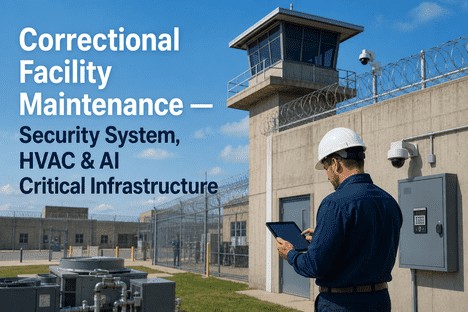
Correctional Facility Maintenance — Security System, HVAC & AI Critical Infrastructure

By Grace on June 26, 2026

correctional-facility-maintenance-security-system-ai

A state correctional facility housing 1,400 individuals operated for 14 months with a known electronic door control fault in Cell Block C. The maintenance work order was deferred three times across two fiscal years — a $24,000 PLC controller replacement that never made it past the capital review committee. In month fifteen, the fault cascade reached the sally port interlock system. Two electronically interlocked doors lost their sequencing logic simultaneously. A transport officer entered the outer door, and the inner door released without authorization. No escape occurred that day, but the incident generated a use-of-force review, a federal PREA compliance filing, a revised DOJ monitoring agreement, and a $2.1 million emergency security electronics replacement programme that included the original $24,000 repair plus integration costs across all five housing units. The Bureau of Prisons carries a deferred maintenance backlog estimated at $3 billion as of 2025, according to congressional testimony. Across state systems, the picture is worse — Minnesota alone reports $781 million in correctional facility deferred maintenance, with 22 buildings in crisis condition and 54 rated poor. In an environment where a single lock failure can cascade into a multi-million-dollar security liability, reactive maintenance is not a budget strategy. It is a security failure waiting for a date to happen.

Correctional Facility Infrastructure · Security Electronics · Life Safety Compliance · HVAC & Environmental Control · PREA & ACA Audit Readiness
$3 Billion Federal Prison Maintenance Backlog. iFactory AI Keeps Security Electronics, HVAC, and Life Safety Systems Operational and Audit-Ready.
AI-powered maintenance intelligence for correctional facilities — predictive monitoring of security electronics, door controls, HVAC, and life safety systems with clearance-gated work order routing, ACA-ready compliance documentation, and capital backlog prioritisation built for the unique security constraints of corrections environments.
$3B+
Federal Bureau of Prisons deferred maintenance backlog — 57% of federal prisons are over 30 years old, with infrastructure funding cut 38% in a single fiscal year
50%
Of correctional facilities report direct lock tampering incidents — 64% deal with locks that do not function as expected under routine operational conditions
71%
Reduction in emergency maintenance spend documented at correctional facilities transitioning from reactive to AI-predictive maintenance scheduling
$1.5B
Projected global prison management systems market by 2030 — driven by compliance mandates, security digitisation, and the accelerating cost of infrastructure failure

The Three Critical Domains of Correctional Facility Maintenance — and Why Each Demands AI-Powered Intelligence

Correctional facility maintenance is not like maintaining an office building, a hospital, or a school. Every system operates under security constraints that do not exist in any other facility type. Clearance-gated access restricts maintenance windows. Tamper-resistant equipment is mandatory, not optional. A system failure in a correctional environment is not simply a repair cost — it is a security incident, a compliance filing, and a potential consent decree trigger. Three domains concentrate the highest risk, and each requires a fundamentally different maintenance intelligence approach.

Domain 01
Security Electronics & Door Controls
94%
Of correctional security depends on electronic locking and access control systems functioning correctly at every cycle. iFactory monitors PLC-based door controllers, sally port interlocks, electronic locking networks, and CCTV infrastructure for degradation patterns — bearing wear on motorised locks, voltage drift in controller boards, communication latency in networked panels. Anomalies are surfaced six to twelve weeks before failure, converting emergency security repairs into scheduled capital events.
Real-time door control system health monitoring
PLC controller degradation detection algorithms
Sally port interlock sequencing verification
Domain 02
HVAC & Environmental Control
3-5x
Cost multiplier when a correctional HVAC failure is handled as an emergency versus a scheduled replacement. Correctional HVAC serves dense populations in sealed environments where ventilation failure creates immediate health and liability exposure. iFactory reads continuous sensor data from rooftop units, boilers, and air handlers — tracking refrigerant pressure, compressor current draw, filter differential pressure, and bearing vibration to predict failure with sufficient lead time for planned intervention.
Tamper-proof vent and filtration monitoring
Compressor and bearing health analytics
Indoor air quality and pressure differential tracking
Domain 03
Life Safety & Compliance
1,300+
Facilities operate under American Correctional Association standards requiring documented compliance across fire suppression, emergency lighting, sprinkler testing, and evacuation systems. A single missed fire alarm certification or undocumented sprinkler flow test creates audit exposure that can affect accreditation status. iFactory automates life safety PM scheduling with tamper-proof inspection documentation and generates ACA-format compliance reports from live work order data.
ACA audit-ready compliance documentation
Automated life safety PM scheduling engine
PREA and DOJ monitoring report generation

These three domains share one critical characteristic: a failure in any one creates immediate cascading consequences across the other two. A failed HVAC system in a housing unit triggers occupant health complaints that generate PREA filings. A degraded electronic lock creates a security breach that forces a life safety evacuation. The maintenance strategy that treats these domains as disconnected work streams is structurally incapable of preventing the cross-domain failures that generate the most expensive outcomes in correctional operations. An integrated AI platform that monitors all three domains simultaneously, correlates anomalies across systems, and routes intelligence to the right clearance level is not a convenience — it is a security requirement for any facility managing a deferred maintenance backlog at the scale now facing state and federal corrections agencies.

Critical System Failure Impact Matrix — What Failure Costs vs. What Prevention Costs

The most powerful argument for AI-powered maintenance in correctional facilities is not the platform feature set. It is the cost comparison between reactive and predictive intervention across the five highest-consequence failure domains. The following matrix quantifies what every maintenance director knows intuitively but has rarely been able to prove with facility-specific data.

Critical System
Failure Consequence in Correctional Context
Emergency vs. Planned Cost Ratio
AI Detection Lead Time
Electronic Door Controls
Sally port interlock failure, unauthorized door release, housing unit lockdown perimeters compromised, DOJ consent decree exposure, escape liability
5-8x
8-12 weeks
HVAC Rooftop Units
Housing unit temperature failure, airborne disease transmission risk, IAQ-related health complaints, heat stress liability in restricted zones
3-5x
6-12 weeks
Fire Suppression & Alarms
ACA accreditation non-compliance, NFPA code violations, facility closure orders, emergency evacuation in secure environment, life safety liability
Not applicable — compliance cannot be deferred
Continuous monitoring
CCTV & Surveillance
Incident recording gaps, camera coverage blind zones, DVR storage failure, evidence chain-of-custody breaks, use-of-force documentation loss
4-6x
4-8 weeks
Plumbing & Water Systems
Cell block flooding, water damage to security electronics, Legionella risk in low-flow lines, lead service line compliance, housing unit relocation
6-10x
3-6 weeks

How iFactory AI Transforms Correctional Facility Maintenance — Four-Stage Intelligence Engine

The gap between a reactive correctional maintenance programme and a predictive, compliance-ready operation is not about adding more staff or increasing the budget. It is about installing an intelligence layer between the physical infrastructure and the maintenance team — a layer that monitors continuously, detects degradation patterns invisible to periodic inspections, routes the right information to the right clearance level, and generates the documentation that turns maintenance data into a fundable capital argument.

01
Stage One
Continuous Condition Monitoring

IoT sensors and AI-driven anomaly detection monitor security electronics, HVAC systems, and life safety equipment 24/7. Every door control cycle, compressor run hour, and sprinkler flow test is tracked against equipment-specific baselines. Degradation patterns invisible to manual inspection — voltage drift, bearing frequency shift, refrigerant loss rate — are surfaced as early-stage alerts before they become system failures.

02
Stage Two
Clearance-Gated Work Order Routing

Work orders are automatically assigned to technicians with the correct security clearance for each facility zone and system type. Electronic security work orders route to vetted personnel only. HVAC work orders in restricted housing units are scheduled around movement protocols. Every escalation is logged with supervisor override tracking for full audit trail transparency.

03
Stage Three
ACA-Ready Compliance Documentation

Every preventive maintenance task, inspection, and repair generates tamper-proof documentation formatted for ACA accreditation standards, PREA compliance requirements, and state DOC audit protocols. Reports are exportable in the format each oversight body requires — eliminating the manual compliance log compilation that consumes weeks of staff time before every audit cycle.

04
Stage Four
Capital Backlog Prioritisation

The entire deferred maintenance backlog is scored across four weighted factors — safety consequence, cost escalation rate, cross-system cascade risk, and compliance exposure — producing a ranked capital project list with five-year cost projections. Security electronics and life safety items are auto-escalated. The output is board-ready capital documentation that turns an unquantified backlog into a defendable funding request.

A Lock Failure Is Never Just a Repair. iFactory AI Keeps Your Correctional Facility Secure, Compliant, and Operationally Continuous.
Continuous condition monitoring across all three critical domains, clearance-gated work order routing, ACA-ready compliance documentation, and capital backlog prioritisation — built for the unique security and operational constraints of corrections environments.

Conclusion

The $3 billion federal correctional maintenance backlog and the hundreds of millions more accumulating across state systems represent more than a funding gap. They represent a structural failure of the tools and processes most facilities use to manage infrastructure. Periodic inspections, reactive work order systems, and disconnected compliance spreadsheets cannot keep pace with the failure cascades that a single degraded electronic lock or malfunctioning HVAC unit can trigger in a correctional environment. The consequences are not budget variances. They are security incidents, consent decrees, and preventable risks to staff and inmate safety.

AI-powered correctional facility maintenance changes the operational model at its foundation. When security electronics, HVAC systems, and life safety equipment are monitored continuously — with degradation detected weeks before failure, work orders routed by clearance level, and compliance documentation generated automatically — the maintenance director's role shifts from chasing emergencies to managing a predictable capital programme. The data that was previously scattered across work order logs, inspection reports, and compliance binders becomes a unified intelligence layer that quantifies risk, prioritises investment, and documents every action in audit-ready format.

iFactory's correctional facility maintenance module gives operations directors and facility managers the AI-powered condition monitoring, clearance-gated workflow engine, ACA-ready compliance documentation, and capital backlog prioritisation that transforms reactive maintenance into a proactive, fundable infrastructure programme. Book a demo to see how iFactory maps to your facility's current systems and generates your first prioritised capital plan, or talk to an expert about your facility's maintenance backlog and how to structure the intelligence layer that prevents the next cascading failure before it reaches your housing units.


Frequently Asked Questions

iFactory integrates with existing electronic security infrastructure through API connections to PLC-based door control systems, CCTV network video recorders, access control platforms, and building management systems. The platform does not require replacement of existing security hardware. Most correctional facilities deploy iFactory's monitoring layer on top of their current electronic security ecosystem within 30 to 60 days, connecting to the equipment already installed across housing units, perimeter zones, and administrative areas. For facilities without IoT-enabled systems, iFactory's intake process captures equipment data through structured entry to establish the initial monitoring baseline. Talk to an expert about your facility's current electronic security architecture and the fastest integration path.

Yes. iFactory's scheduling engine incorporates facility zone security tiers, inmate movement schedules, shift change protocols, and lockdown windows into every work order assignment. Maintenance tasks in restricted housing units are automatically scheduled for approved time windows only. Work orders for security-critical systems — door controls, perimeter sensors, CCTV — carry priority flags that trigger supervisor notification if scheduling conflicts arise. The platform also maintains offline mobile functionality for maintenance staff working in areas where network connectivity is unavailable due to concrete construction or security constraints, with data syncing automatically upon reconnection to the facility network. Book a demo to see how the scheduling engine handles your facility's specific zone configuration and movement protocols.

iFactory's compliance documentation module generates exportable reports aligned with ACA performance-based standards, PREA audit protocols, state DOC inspection frameworks, and NFPA life safety code documentation requirements. Every PM task, inspection result, and repair action is timestamped and stored in a tamper-proof audit trail that maps to specific standard requirements. When an auditor requests documentation for fire suppression testing, electronic lock inspection cycles, or HVAC preventive maintenance records, the relevant data is exportable in the format the auditor requires without staff manually compiling logs from disparate sources. Facilities preparing for initial ACA accreditation or renewal use iFactory's compliance gap analysis feature to identify documentation deficiencies before the audit cycle begins. Talk to an expert about your facility's upcoming audit schedule and the documentation requirements.

A single-facility deployment typically reaches full operational go-live within 30 to 60 days from contract signing. For multi-facility state DOC deployments, the rollout is staged by institution, with the first facility operational within 60 days and subsequent facilities deploying at 30-day intervals. iFactory's mobile application is designed with true offline functionality — maintenance staff working in housing units with thick concrete walls, basement mechanical rooms, and secure perimeter zones can view work orders, access equipment manuals, log inspection results, and scan tool barcodes without an active network connection. All data synchronises automatically when the device reconnects to the facility network. The platform has been deployed in maximum-security facilities where no wireless signal penetrates the cell block core, and the offline mobile workflow has operated without interruption. Book a demo to review the deployment timeline for your specific facility configuration.

Your Correctional Facility Infrastructure Already Generates the Data. iFactory Turns It Into Security Intelligence and Audit-Ready Documentation.
Continuous condition monitoring across security electronics, HVAC, and life safety systems. Clearance-gated work order routing. ACA-ready compliance reports. Capital backlog prioritisation built for corrections — deployed and operational within 60 days.

Share This Story, Choose Your Platform!