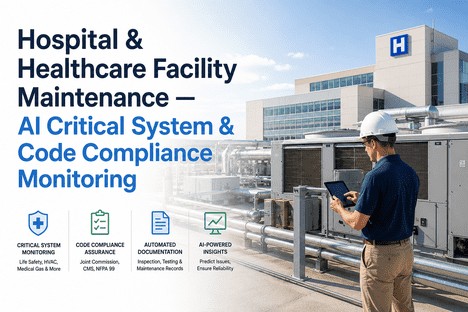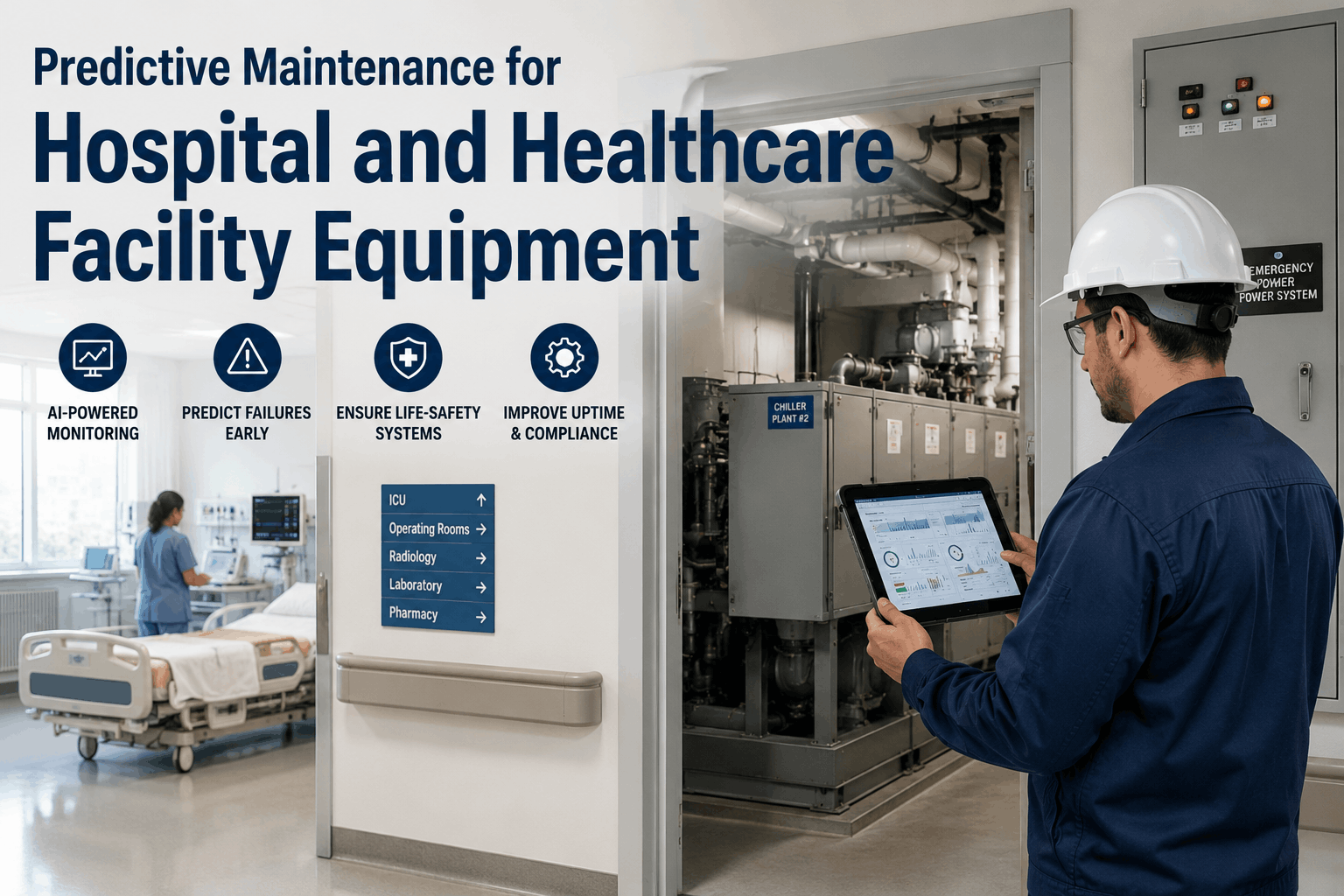
Hospitals depend on HVAC systems, chillers, boilers, elevators, and backup generators to maintain patient safety, infection control standards, and regulatory compliance — AI monitors these critical building systems continuously to prevent comfort failures and life-safety events before they affect patient care environments. Start Trial Free to see how iFactory gives healthcare facility management teams the continuous equipment health monitoring needed to protect patient environments and maintain Joint Commission compliance across all critical building systems.
Protect Patient Safety and Regulatory Compliance with AI Building System Monitoring
iFactory monitors hospital HVAC, chiller plants, boilers, emergency generators, and medical gas systems continuously — detecting developing equipment failures before they cause temperature excursions, pressure failures, or life-safety system outages that affect patient care and Joint Commission standing.
Why Healthcare Facility Equipment Failures Carry Consequences Beyond Production Downtime
Equipment failures in hospitals carry consequences that extend far beyond the cost of repair and lost operational time. An HVAC failure in a surgical suite compromises the pressure differential that prevents airborne contamination and may require procedure cancellations with patient care implications; a chiller failure during summer peak load threatens medication storage temperatures and patient comfort in vulnerable populations; a backup generator that fails to start during utility outage is a life-safety event. These consequences create a reliability obligation that is fundamentally different from production facility maintenance — healthcare facility equipment management must account for patient safety risk, regulatory compliance consequences, and accreditation standing alongside the operational continuity objectives that all maintenance programs share. Engineering teams that Book a Demo with iFactory see how patient-safety-weighted equipment monitoring changes maintenance priority decisions across hospital building systems.
-
Surgical Suite and Critical Care HVAC Monitoring
iFactory monitors air handling unit supply fan bearing condition, filter differential pressure, coil performance, and supply air temperature and pressure — protecting the precision environmental control that infection prevention protocols depend on in operating rooms and intensive care units.
-
Chiller Plant Health Tracking
iFactory monitors chiller compressor vibration and bearing temperature, condenser and evaporator approach temperature trends, refrigerant system performance, and cooling tower condition — maintaining the cooling capacity that protects medication storage, MRI systems, and patient comfort across the facility.
-
Steam Boiler and CSSD Equipment Monitoring
iFactory tracks boiler operating pressure and temperature stability, feedwater system pump condition, blowdown system performance, and steam quality indicators — protecting the sterilization and heating systems that central sterile supply departments and patient comfort systems depend on continuously.
-
Emergency Generator Readiness Monitoring
iFactory monitors emergency generator engine condition between monthly test runs, tracks fuel system temperature and water separator performance, and monitors automatic transfer switch operation — providing the between-test condition picture that monthly surveillance tests cannot produce for infrequently operated standby equipment.
-
Medical Gas System Pressure and Compressor Monitoring
iFactory monitors medical air and vacuum compressor vibration and performance, system pressure trends, and dryer dew point — detecting compressor degradation and dryer deterioration before they affect medical gas system pressure and quality in patient care areas.
-
Elevator and Vertical Transportation Monitoring
iFactory tracks elevator motor drive vibration, door mechanism condition, and hydraulic system pressure trends — protecting the vertical transportation systems that patient movement, supply delivery, and staff access depend on in multi-story hospital buildings.
Critical Healthcare Facility Assets: Life-Safety Priority Monitoring
-
Operating Room and Procedure Suite HVAC: Infection Control Environment Protection
Highest Patient Safety PriorityOperating room HVAC systems maintain the precise positive pressure differentials, high air change rates, and temperature and humidity conditions specified in ASHRAE 170 and facility infection control guidelines — and deviations from these conditions create infection risk for surgical patients. iFactory monitors OR AHU supply fan bearing condition continuously, tracks filter differential pressure as a loading and bypass risk indicator, monitors supply air temperature and relative humidity against ASHRAE 170 design conditions, and tracks room pressure differential against adjacent corridor as the infection control performance indicator. Early supply fan bearing detection prevents the fan failure that would require OR shutdown and rescheduling of surgical procedures — a patient care disruption with clinical and financial consequences that routine bearing maintenance cannot match. Teams that Start Trial can configure iFactory OR HVAC monitoring from existing BAS data inputs with ASHRAE 170 parameter references.
HVAC Standard
ASHRAE 170 temperature, humidity, and pressure differential references
Key Indicators
Fan bearing condition, filter dP, supply conditions, room pressure dP
iFactory Record
Continuous OR HVAC performance trend with ASHRAE 170 compliance tracking
-
Emergency Generator and Automatic Transfer Switch Monitoring
Life-Safety PowerHospital emergency generators are required by NFPA 99 and NFPA 110 to start within ten seconds and carry life-safety loads for the duration of a utility interruption — a performance requirement on equipment that spends nearly all its life in standby. iFactory monitors emergency generator engine condition between monthly NFPA 110 Level 1 test runs — tracking coolant temperature and pressure during any run period, fuel system water separator condition, battery voltage and charging system performance, and automatic transfer switch contact condition. The between-test condition picture enables detection of developing issues (injector fouling, coolant system deterioration, battery degradation) that monthly start-and-run surveillance confirms functionally but cannot assess for trend direction between tests. Joint Commission EC.02.05.07 monthly test records are integrated with iFactory's condition trending — providing a unified document record that supports HFAP and Joint Commission Environment of Care compliance documentation. Teams that Book a Demo can review emergency generator monitoring configuration for their specific engine and transfer switch types.
Regulatory References
NFPA 99, NFPA 110, Joint Commission EC.02.05.07
Between-Test Monitoring
Engine condition, fuel system, battery, ATS contact condition
iFactory Record
Test records integrated with between-test condition trends per generator
-
Hospital Chiller Plant: Medication Storage and Patient Comfort Protection
Critical UtilityHospital chiller plant failures during summer peak load conditions simultaneously threaten medication storage temperatures in pharmacies and patient care units, imaging equipment cooling in radiology, and patient comfort for immunocompromised populations in oncology and transplant units. iFactory monitors chiller compressor vibration against manufacturer alarm levels and tracks bearing temperature trends, condenser and evaporator approach temperature as fouling indicators, refrigerant system performance curves, and cooling tower fan and pump condition — building a chiller plant health picture that identifies developing problems weeks before they reduce cooling capacity. For facilities with multiple chillers, iFactory's cross-unit comparison identifies which chiller is degrading relative to its peers — enabling planned maintenance sequencing that maintains full cooling redundancy while one unit undergoes maintenance during a low-demand period. Teams that Start Trial can connect iFactory chiller monitoring to existing BAS chiller data outputs for immediate performance trend analysis.
Compressor Monitoring
Vibration vs manufacturer limits, bearing temperature trend
Performance Indicators
Approach temperature, kW per ton trend, refrigerant performance
iFactory Record
Chiller health and performance trend per unit with fleet comparison
-
Medical Gas Compressor and Dryer System Monitoring
NFPA 99 ComplianceMedical air and vacuum systems serve patient care areas with the gas quality and pressure required for ventilators, anesthesia equipment, and procedural tools — and compressor failures or dryer deterioration that reduce system pressure or introduce moisture into the distribution system are NFPA 99 reportable events with immediate patient care implications. iFactory monitors medical air compressor vibration signatures with particular attention to valve frequency content — reciprocating compressor valve failures produce vibration spectral changes that iFactory detects weeks before discharge pressure capacity degrades. Dryer dew point trending identifies molecular sieve degradation before moisture breakthrough affects system air quality. For duplex compressor systems, iFactory tracks run hours and start frequency per compressor unit — identifying uneven load sharing that indicates one compressor is starting more than design, signaling developing problems in the standby unit that is cycling off too quickly.
Compressor Monitoring
Valve vibration spectral analysis, run hour and start frequency tracking
Dryer Monitoring
Dew point trend, regeneration cycle timing, sieve performance
iFactory Record
Compressor condition and dryer performance trend per medical gas station
-
Steam Boiler and Central Sterile Supply System Monitoring
Sterilization InfrastructureHospital steam boilers supply the sterilization autoclaves in the central sterile supply department with the temperature and pressure conditions required by AAMI ST79 for instrument sterilization — and boiler instability or loss of steam quality affects every sterile instrument set produced until the boiler issue is resolved. iFactory monitors boiler operating pressure and temperature stability, feedwater pump vibration and performance trends, blowdown system operation, and steam quality indicators from the condensate return system. Boiler cycling frequency tracking detects burner and combustion control problems before they cause pressure instability — identifying overshooting and undershooting patterns in operating pressure that indicate combustion control issues requiring calibration or burner maintenance. Feedwater pump condition monitoring provides advance warning of pump degradation that could compromise boiler water supply continuity during high-demand sterilization periods. Teams that Start Trial can configure boiler monitoring from existing BMS data using iFactory's healthcare facility boiler template.
Boiler Indicators
Pressure stability, cycling frequency, combustion control performance
Feedwater System
Pump vibration and flow performance, blowdown system operation
iFactory Record
Boiler performance and feedwater trend per boiler plant unit
-
Patient Tower Elevator Motor and Door Mechanism Monitoring
Patient and Staff MovementElevator failures in patient towers disrupt patient transport, supply delivery, and staff movement in ways that can delay time-sensitive clinical interventions — particularly in facilities without adequate stairway transport capacity for patients on stretchers or in wheelchairs. iFactory monitors elevator motor drive vibration and current signature, door motor and operator mechanism performance, and hydraulic system pressure and temperature for hydraulic elevators — detecting developing motor bearing problems, door mechanism wear, and hydraulic system degradation before they cause in-service failures that strand patients or staff. Door mechanism monitoring is particularly valuable because door-related failures are the most common elevator malfunction type in healthcare facilities — iFactory tracks door open and close force trends, timing trends, and reversal frequency as indicators of door mechanism wear and adjustment drift that precede failure.
Motor Monitoring
Drive vibration and current signature, bearing defect frequencies
Door Monitoring
Open/close force, timing trend, and reversal frequency
iFactory Record
Motor and door mechanism trend per elevator unit with service history
Healthcare Facility Predictive Maintenance Performance Indicators
Equipment Failure Warning Lead Time
AI multi-system monitoring provides 45 days of equipment failure warning — versus zero lead time for reactive work orders generated when patients or staff report comfort complaints after the failure has already occurred.
Joint Commission Citation Risk by System
Relative Joint Commission EC citation frequency by system
Emergency generator compliance is the highest-frequency source of Joint Commission Environment of Care citations — iFactory's between-test monitoring and test record integration directly addresses the documentation and condition gaps that generate these findings.
Procedure Cancellation Prevention Rate
Healthcare facilities using iFactory reduce HVAC-related surgical procedure cancellations by 55% — enabling planned suite maintenance during off-peak hours rather than emergency repair during the surgical schedule.
PM Compliance and Accreditation Readiness
PM compliance rate for JCAHO-required equipment
iFactory's PM tracking and condition-based scheduling improves Joint Commission-required PM compliance from 71% to 97% over five quarters — directly reducing EC survey citation risk.
Healthcare Facility Equipment Monitoring: Reference Specifications
Scroll for more
| Facility System | Regulatory Reference | Primary Monitoring Parameters | iFactory Detection Method | Patient Safety Consequence |
|---|---|---|---|---|
| OR and ICU HVAC | ASHRAE 170, ANSI/APIC | Fan bearing, filter dP, supply conditions, room pressure | Bearing trend + ASHRAE 170 compliance | Infection control risk, OR closure |
| Emergency Generators | NFPA 99, NFPA 110, JC EC.02.05.07 | Engine condition, fuel system, battery, ATS | Between-test condition trend + test records | Life-safety power failure on outage |
| Chiller Plant | ASHRAE 15, facility standards | Compressor vibration, approach temp, kW/ton | Bearing trend + performance degradation | Medication storage, patient comfort |
| Medical Gas Systems | NFPA 99 Chapter 5 | Compressor vibration, dew point, run hours | Valve vibration analysis + dew point trend | Ventilator and anesthesia gas supply |
| Steam Boilers | AAMI ST79, NFPA 85 | Pressure stability, feedwater pump, cycling | Pressure trend + combustion cycle analysis | Sterilization capability, heating |
How iFactory Supports Healthcare Facility Maintenance Programs
Healthcare facility maintenance exists at the intersection of patient safety, regulatory compliance, and operational continuity — a combination that makes every equipment failure decision more consequential than its counterpart in a production facility. iFactory provides the continuous monitoring infrastructure that enables healthcare facility engineering teams to manage this complexity: OR HVAC bearing condition tracked against ASHRAE 170 performance references, emergency generator engine health trended between NFPA 110 monthly test runs, chiller plant performance monitored for the first signs of capacity degradation before summer peak demand, and medical gas compressor valve condition assessed from vibration spectral data weeks before pressure capacity is affected. When iFactory detects a developing supply fan bearing defect on OR Suite 3's AHU and projects replacement need within eighteen days, the facilities team has the scheduling window to coordinate a planned maintenance window during an overnight low-utilization period — replacing the bearing without disrupting the next day's surgical schedule rather than responding to an emergency fan failure that shuts the suite without notice. Facilities can Start Trial and begin configuring healthcare facility monitoring from existing BAS and BMS data within the first iFactory session.
Clinical Space HVAC Protection
iFactory monitors critical clinical area HVAC equipment against ASHRAE 170 and infection control performance references — detecting developing AHU failures before they create the pressure differential and temperature deviations that require suite closure and procedure rescheduling.
Regulatory Reference Integration
iFactory incorporates NFPA 99, NFPA 110, ASHRAE 170, and Joint Commission Environment of Care references into monitoring alert thresholds — providing patient-safety-weighted severity classifications that align equipment condition with compliance consequence.
Between-Test Standby Equipment Monitoring
iFactory maintains condition trends for emergency generators and standby equipment between regulatory test intervals — providing the between-test degradation picture that identifies developing issues before the next formal surveillance test confirms them.
Accreditation Documentation Support
iFactory generates the timestamped equipment trend records, PM completion histories, and compliance tracking data that Joint Commission and HFAP Environment of Care surveys require — reducing survey preparation burden for the facilities management team.
Deploying Predictive Maintenance in Healthcare Facilities: Implementation Steps
01
Classify Equipment by Patient Safety and Regulatory Consequence
Prioritize monitored equipment by the patient safety consequence of failure and the regulatory citation risk associated with each system — deploying continuous monitoring on life-safety systems first and extending to comfort and operational systems in subsequent phases.
02
Connect Building Automation and Management Systems
Configure iFactory integration with the hospital BAS and BMS — establishing the continuous data feeds for HVAC, chiller, boiler, and generator systems that support between-test condition trending from existing instrumentation without additional sensor installation.
03
Load Regulatory Reference Standards into iFactory
Enter ASHRAE 170 performance parameters, NFPA 99 system pressure requirements, and Joint Commission EC.02 maintenance requirements into iFactory as alert threshold references — ensuring that equipment condition alerts are expressed in regulatory compliance terms that facilities managers and accreditation teams understand.
04
Integrate Regulatory Test Records for Standby Equipment
Configure iFactory to receive and archive NFPA 110 generator test records, NFPA 99 medical gas system test results, and other regulatory surveillance records — creating the unified equipment history database that combines condition trends with formal test compliance records for accreditation documentation.
05
Configure Clinical Impact-Weighted Alert Routing
Define alert routing in iFactory that reflects the patient safety consequence of each system failure — routing life-safety system alerts to both facilities management and clinical leadership, and configuring escalation timelines appropriate for the clinical impact if each monitored failure mode is not addressed promptly.
06
Generate Accreditation-Ready Equipment Reports
Configure iFactory's reporting module to produce the equipment trend summaries, PM compliance histories, and condition monitoring records needed for Joint Commission EC surveys — reducing the manual data compilation that currently occupies facilities management staff in the months before scheduled accreditation surveys. Book a Demo to see the full healthcare facility monitoring and compliance documentation workflow.
Frequently Asked Questions
How does hospital equipment monitoring differ from standard facility management?
Hospital equipment monitoring must account for patient safety consequences and regulatory compliance obligations alongside standard operational continuity goals — equipment failures that would be an inconvenience in a commercial building can become patient safety events in a hospital. iFactory incorporates healthcare-specific regulatory references and patient safety consequence classifications into monitoring alert thresholds and routing decisions.
What regulatory standards does iFactory reference for hospital HVAC monitoring?
iFactory references ASHRAE 170 Ventilation of Health Care Facilities for operating room temperature, humidity, and pressure differential parameters, and incorporates ANSI/APIC infection control guidance for critical environment performance requirements. Alert thresholds for OR and ICU HVAC systems are expressed as deviations from ASHRAE 170 design conditions.
How does iFactory support Joint Commission Environment of Care compliance?
iFactory maintains the equipment trend records, PM completion histories, and surveillance test records that Joint Commission EC.02 standards require for utility systems, medical equipment, and life-safety systems — generating the audit-ready documentation that reduces survey preparation burden and supports the continuous compliance posture that EC surveys assess.
Can iFactory monitor emergency generators between monthly NFPA 110 test runs?
Yes. iFactory integrates with generator monitoring systems to track engine condition parameters between monthly test runs — providing the between-test condition trend that identifies developing coolant system, fuel system, and battery issues before the next formal test confirms them. Monthly test records are archived in iFactory alongside the between-test trending data.
How does iFactory integrate with existing hospital building automation systems?
iFactory connects to hospital BAS through standard protocols (BACnet, Modbus, OPC-UA) and historian data exports — receiving continuous data from HVAC, chiller, boiler, and generator monitoring systems without requiring replacement of existing building automation infrastructure or additional sensor installation in most deployments.
Protect Patients and Maintain Accreditation with Healthcare-Specific AI Monitoring
iFactory gives hospital facilities management teams the OR HVAC performance tracking, emergency generator between-test monitoring, chiller plant health assessment, and accreditation documentation support needed to prevent life-safety events and maintain Joint Commission compliance across all critical building systems.