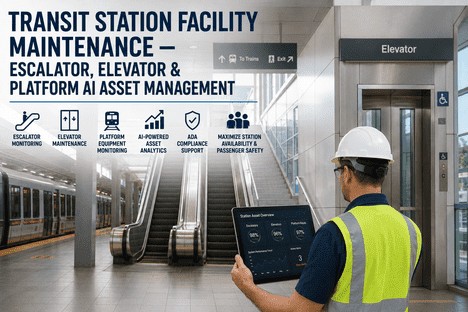
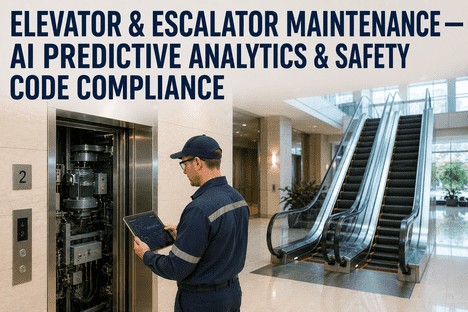
An elevator out of service in a commercial office tower is not an engineering event — it is a tenant relations crisis. A stuck escalator at a peak-hour transit hub generates complaints, accessibility incidents, and maintenance call charges that accumulate faster than the underlying failure could ever be predicted. Building vertical transport equipment runs millions of cycles annually in environments with no tolerance for unplanned stops during business hours, and the tenants experiencing the failure do not care about the mechanical reason — only that the service they depend on has stopped. AI monitoring elevator motors, door systems, brakes, and control boards predicts these failures before they happen, scheduling intervention during off-hours rather than creating disruptions during the workday. Get iFactory Support to deploy AI predictive maintenance across your building's vertical transport systems today.
Predict Elevator and Escalator Failures Before They Create Tenant Complaints
iFactory AI monitors elevator motors, door systems, brakes, and control boards — detecting degradation weeks before service interruptions that damage tenant relationships and generate costly emergency call-outs.
The Six Critical Building Transport Systems AI Monitors
Elevator and escalator systems accumulate wear across mechanical, electrical, and software components simultaneously — and the failure modes that produce service interruptions are rarely the catastrophic structural failures that safety codes address. They are the progressive, gradual degradations of door operators, drive motors, brake systems, and guide rail lubrication that produce nuisance trips, delayed response, and eventually car immobilization. AI monitoring each of these systems provides the early warning that transforms reactive emergency calls into proactive scheduled maintenance. Contact iFactory to configure monitoring for your specific building transport portfolio and tenant service standards.
System 1
Elevator Drive Motors and Machines
Traction elevator hoist motors and gearless machine units accumulate wear in motor windings, bearing systems, and encoder/resolver systems that produce progressive degradation in motor performance and positioning accuracy. Geared machine units have additional gearbox wear components. AI monitors motor current signatures for winding asymmetry, bearing defect frequencies in vibration data, and encoder signal quality — detecting motor and machine degradation 4–10 weeks before it causes nuisance trips or positioning failures.
System 2
Door Operating Systems
Elevator door systems are the leading source of service interruptions in commercial elevator operations — accounting for 40–50% of all unplanned service calls across most elevator fleets. Door operator motor wear, door track wear, vane and lock mechanism degradation, and door timing drift each contribute to door-related trips and entrapment incidents. AI monitors door open/close cycle times, motor current profiles, and reversal event frequency per car — detecting door system degradation with 2–6 weeks of lead time before it produces service failures.
System 3
Brake Systems
Electromagnetic brake systems on elevator drive machines are critical safety components whose degradation — worn brake pads, contaminated brake surfaces, or solenoid coil degradation — affects both safety margin and ride quality. AI monitors brake engagement and release timing, brake coil current signatures, and deceleration profiles at each stopping event — detecting brake wear trends that indicate maintenance is needed before safety margin reduction triggers a regulatory inspection flag or ride quality complaint.
System 4
Guide Rails and Roller Guides
Elevator car and counterweight roller guides running on guide rails require lubrication and rail condition maintenance to provide smooth, quiet ride quality. Dry rails increase vibration and wear on roller guide assemblies. Worn or misaligned roller guides create horizontal car movement that causes ride quality complaints and eventually trips the car's safety circuits. AI monitors horizontal vibration signatures and guide-to-rail contact forces — detecting lubrication deficiency and guide wear before they generate complaints or service trips.
System 5
Escalator Drive and Step Systems
Escalator main drives, step chains, and handrail systems accumulate wear from millions of passenger steps per year. Step chain elongation from wear changes the engagement with the step sprockets, progressively increasing noise and vibration. Main drive gearbox and motor wear reduces reliability at peak throughput periods. AI monitors main drive motor current, chain speed consistency, step level sensor outputs, and handrail speed synchronization — detecting chain elongation, drive degradation, and step misalignment before they produce service stops or safety incidents.
System 6
Control Boards and Safety Circuits
Elevator and escalator control systems contain processor boards, relay systems, and safety circuit components that degrade with thermal cycling and age. Control board component degradation manifests as intermittent faults — trips that cannot be reproduced during inspection — that become progressively more frequent until the system trips under normal operating conditions. AI monitoring controller processor temperature, supply voltage stability, and fault code frequency trends detects control system degradation before intermittent faults become permanent failures.
Elevator Failure Mode Impact: Service, Safety, and Financial Consequences
Different elevator failure modes carry very different tenant and financial consequences. A door timing fault that causes slow door response generates complaints. A car leveling failure that causes step-over gaps generates safety incidents. A motor failure that immobilizes a car with passengers triggers emergency call-out, passenger rescue procedures, and regulatory reporting. AI prioritizes alert urgency based on the consequence profile of each detected failure mode. Book a demo to see iFactory's consequence-weighted alert configuration for building transport systems.
Scroll for more →
| Failure Mode | Service Consequence | Financial Impact | AI Detection Lead Time |
|---|---|---|---|
| Door Motor Failure | Car out of service, tenant complaints, call-back required | Emergency call charge + tenant complaint credit | 2–6 weeks via door cycle time trend |
| Drive Motor Bearing | Car shutdown or intermittent trips during peak hours | Emergency repair + rental escalator/elevator if multi-day | 4–10 weeks via vibration envelope |
| Brake Wear | Leveling errors, ride quality complaints, safety flag | Regulatory inspection, potential mandatory shutdown | 3–8 weeks via brake timing + decel profile |
| Escalator Step Chain | Noise complaints, eventual safety stop from chain elongation | Peak-hour stoppage, passenger delay, emergency call | 4–8 weeks via chain speed consistency |
| Control Board Intermittent | Random trips that cannot be reproduced — tenant frustration | Multiple call charges + diagnostic time + board replacement | 2–4 weeks via fault code frequency trend |
| Roller Guide Wear | Horizontal sway, noise, ride quality complaints | Tenant complaints, possible lease risk in premium buildings | 3–6 weeks via horizontal vibration trend |
AI Monitoring Performance: Building Transport Outcomes
Unplanned Service Calls
65% Fewer Emergency Calls
Door system failures, drive motor faults, and brake issues are the three failure modes accounting for over 80% of unplanned elevator service calls. AI detection of all three failure modes 2–10 weeks before service impact converts the majority of these calls into scheduled maintenance events — at planned maintenance labor rates rather than emergency call-out premiums, and during off-hours rather than peak tenant complaint periods.
Elevator Availability
99.1% vs 94.7% Industry Avg
Commercial elevator availability in buildings without predictive maintenance programs averages 94.7% due to unplanned downtime from door failures, drive faults, and control system issues. iFactory AI monitoring of all primary failure modes drives availability to 99.1% — reducing the hours per year each elevator is out of service from an average of 460 hours to under 80 hours in validated deployments.
Tenant Complaint Reduction
73% Fewer Elevator Complaints
Tenant elevator and escalator complaints in commercial buildings correlate directly with door-related delays, ride quality issues from guide and brake degradation, and out-of-service events. Addressing these failure modes proactively before they affect tenant experience reduces elevator-related complaints by 73% in buildings with iFactory deployed — a measurable improvement in tenant satisfaction scores that affects lease renewal negotiations in competitive commercial property markets.
Maintenance Labor Cost
28% Total Labor Reduction
Emergency call-out labor — at premium rates, dispatched to any failure regardless of time of day — is replaced by planned maintenance labor dispatched during regular business hours to address AI-identified degradation before failure. Buildings with iFactory AI monitoring achieve 28% reduction in total elevator maintenance labor cost from the combination of fewer emergency calls and more efficient planned maintenance scheduling driven by actual condition rather than fixed visit intervals.
Door System Monitoring: The Highest-Frequency Failure Application
Door Cycle Time Statistical Analysis Highest ROI Application
An elevator door in a busy commercial building completes 500–2,000 open-close cycles per day — generating a rich statistical dataset that AI leverages for wear detection. Door open time, close time, reversal count per day, and time-to-close-complete are tracked per car using the elevator controller's door timing data. Statistical drift from a car's own historical baseline — not generic thresholds — detects door operator wear, track friction increase, and mechanical clearance reduction 2–6 weeks before the degradation produces nuisance trips or entrapment events.
Drive Motor Current Signature Analysis
Elevator hoist motor current signatures carry bearing health information, winding condition indicators, and encoder system integrity signals simultaneously. AI performs motor current signature analysis per trip cycle — extracting bearing defect frequencies that develop in the rotor and stator bearing housings, detecting the harmonic signature of partial winding failure before it causes insulation breakdown, and monitoring encoder signal quality for the intermittent position errors that cause leveling problems and door zone faults.
Brake Performance Profiling
Each elevator stopping event produces a deceleration profile — the speed-versus-time curve during the brake application phase — that is highly repeatable for a healthy brake system and deviates in characteristic ways as brake components wear or contaminate. AI profiles the deceleration curve at every stopping event, detecting brake pad wear (slower deceleration), brake surface contamination (initial sharp deceleration followed by slipping), and solenoid coil degradation (delayed engagement) each producing distinct profile signatures.
Escalator Step Chain Elongation Monitoring
Step chain elongation from wear changes the pitch between steps, which affects step-to-skirt gap, step-to-comb engagement, and eventually triggers the chain elongation safety switch that stops the escalator. AI tracks step speed consistency — chain elongation causes subtle speed variation at the drive sprocket that appears as amplitude modulation of the step speed signal at the step passing frequency. This technique detects chain elongation developing over months before it reaches the safety switch activation threshold.
Control Board Fault Code Frequency Trending
Elevator controller fault logs contain trip records, error codes, and reset events that individually appear as isolated incidents but collectively reveal degrading control system components when trended over time. AI analyzes fault code frequency and combination patterns — detecting when a specific error code is appearing at an increasing rate, or when a new combination of previously isolated codes appears that is consistent with a specific control board component degradation signature from iFactory's fault pattern library.
ASME A17.1 Compliance Documentation
ASME A17.1 Safety Code for Elevators and Escalators requires documented maintenance records, test records, and equipment history for every code-compliant inspection cycle. iFactory automatically generates maintenance activity records from AI monitoring data — documenting the condition basis for every maintenance action taken and providing the inspection preparation reports that streamline annual code inspection. Contact iFactory Support to configure ASME A17.1 documentation output for your building's elevator portfolio.
Building Transport Monitoring Infrastructure
Controller Data Integration
iFactory connects directly to elevator and escalator controller CAN bus, serial, or Ethernet interfaces — pulling door timing, fault codes, trip data, and motor parameters without additional hardware at most modern controllers
Multi-Brand Support
Pre-built integration profiles for Otis, Schindler, KONE, ThyssenKrupp, and Mitsubishi controllers — reducing deployment time and ensuring complete data extraction from each OEM's proprietary protocol
Building Management Integration
iFactory alerts integrate with BMS and tenant service desk systems — automatically generating work orders and notifying building management teams without manual alert re-entry
Portfolio Dashboard
Single dashboard showing health status for every elevator and escalator across a multi-building portfolio — prioritized by fault severity and scheduled maintenance urgency
Building Transport AI Deployment: 6-Phase Implementation
01
Fleet Criticality Assessment
Rank every elevator and escalator by consequence of service interruption — elevators serving upper floors of a single-staircase building receive different priority than a low-rise building with multiple stairwells. Single elevators in accessible routes serving mobility-impaired tenants receive maximum priority. This ranking drives sensor deployment and monitoring intensity allocation across the building transport fleet.
02
Controller Data Connection
Connect iFactory to each elevator and escalator controller interface. Most modern controllers installed after 2010 have serial or Ethernet data ports exposing door timing, fault logs, and motor parameters. Older controllers without digital interfaces require supplemental sensors — current clamps on motor supply cables and door timing sensors — to provide equivalent data inputs to the AI models.
03
Baseline Establishment Period
Allow 21–30 days of baseline data collection per elevator before AI anomaly detection activates. During the baseline period, iFactory establishes per-car normal operating parameters for door cycle timing, motor current profiles, deceleration curves, and fault code frequency baselines. Cars known to have existing issues are flagged during baseline establishment for maintenance before clean baseline capture.
04
Vibration Sensor Deployment
Install vibration accelerometers in elevator machine rooms on hoist motor bearing housings for buildings where controller data alone does not provide sufficient bearing health information. Wireless vibration sensors transmit to a machine room gateway — installation in a typical machine room takes 2–4 hours per elevator without disrupting passenger service. Sensor placement follows the guidance in iFactory's machine room installation documentation for each motor/machine type.
05
CMMS and Work Order Integration
Connect iFactory to your building CMMS or facility management platform. AI-generated maintenance recommendations appear as planned work orders with priority classification, description of the detected fault, and recommended action — giving elevator technicians specific information about what to inspect on arrival rather than dispatching to investigate a vague symptom reported by a tenant.
06
Escalator Fleet Expansion
After elevator deployment is operational, extend monitoring to escalator step chain, drive motor, and handrail systems. Escalator monitoring uses the same iFactory IoT infrastructure established for elevators — step chain sensors and main drive current analysis add-on to the existing building gateway installation. Portfolio-wide health visibility covering all vertical transport assets is typically achieved within 60–90 days of starting the deployment. Get iFactory Support to plan your building transport monitoring rollout.
Frequently Asked Questions
What percentage of elevator service calls are caused by door system failures?
Industry data consistently shows elevator door systems accounting for 40–50% of all unplanned service calls and callback complaints. Door operator motor wear, door track fouling, and mechanical lock degradation are the dominant failure modes, and they are precisely the failure modes that AI door cycle time monitoring is most effective at predicting — with 2–6 weeks of detection lead time before the door system produces a service interruption.
Can iFactory work with existing elevator OEM monitoring systems?
iFactory complements rather than replaces OEM monitoring systems. Where an OEM provides proprietary remote monitoring (Otis ONE, KONE 24/7 Connected Services, Schindler Ahead), iFactory can integrate with the data feeds from these systems and apply additional AI analytics for degradation trend detection that the OEM systems do not provide. iFactory also covers non-OEM-monitored assets and provides a single cross-brand dashboard for buildings with mixed elevator fleets.
How does AI elevator monitoring help with ASME A17.1 compliance?
ASME A17.1 requires documented maintenance records showing that required maintenance tasks have been performed at specified intervals and that equipment is maintained in conformance with code requirements. iFactory generates automated maintenance logs documenting every AI-triggered maintenance action with date, condition evidence, and technician completion record. These logs streamline annual inspection preparation and provide the documented evidence basis that inspectors require to verify maintenance compliance.
Does iFactory support older elevator controllers without digital data ports?
Yes. For controllers without digital data interfaces, iFactory deploys a supplemental sensor package: current clamps on motor supply cables (for motor current signature analysis), door timing switches (for door cycle monitoring), and accelerometers in the machine room (for vibration analysis). This hardware package provides equivalent monitoring capability to controller data integration and is compatible with virtually all elevator installations regardless of age or OEM brand.
Can iFactory monitor hydraulic elevators as well as traction elevators?
Yes. Hydraulic elevator monitoring focuses on different failure modes than traction systems: hydraulic pump and motor health via current and vibration analysis, hydraulic fluid temperature and pressure monitoring for valve and cylinder seal condition, and pump starting frequency as an indicator of cylinder seal leakage (increasing start frequency indicates fluid bypass requiring cylinder seal inspection). iFactory supports both traction and hydraulic systems from the same deployment platform with application-specific models for each drive type.
Eliminate Tenant Complaints and Emergency Call-Outs from Your Building Transport
iFactory AI monitors elevator doors, motors, brakes, and control boards continuously — giving your facility team weeks of lead time to fix failures before they strand passengers, generate complaints, or trigger emergency call-out charges.