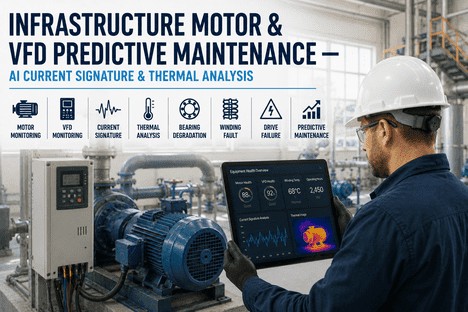
Infrastructure Motor & VFD Predictive Maintenance — AI Current Signature & Thermal Analysis
By Grace on June 23, 2026
Every electric motor in your infrastructure is a diagnostic instrument — drawing current in patterns that reveal exactly what is happening inside its windings, bearings, and rotor bars. A 200 kW water pump motor pulling 5 A more on one phase than the other two is not a measurement anomaly. It is a stator winding beginning to short. A VFD-driven blower motor showing a 3% increase in current at the same speed and load is not a control drift. It is a rotor bar developing a crack. A building fan motor running 8 degrees Celsius above its historical baseline is not a hot day. It is a bearing losing lubrication and heading toward seizure. The data is already there, written into every amp the motor draws and every degree it radiates. The question is whether your maintenance team has the tools to read it before the motor stops.
Motor Predictive Maintenance · VFD Monitoring · Current Signature Analysis · Thermal Imaging · iFactory AI
Every Motor in Your Facility Is Sending Warning Signals. iFactory Reads Them Before They Become Failures.
iFactory's AI-powered motor monitoring platform combines current signature analysis, thermal analytics, and VFD data integration to detect winding faults, bearing degradation, and drive failures across your entire motor fleet — without installing sensors on individual machines.
Of motor failures are detected only after the motor has stopped running — current signature analysis catches them 3-6 months earlier through the electrical waveform the motor already generates
82%
Of winding defects occur in VFD-driven motors — the switching frequencies and shaft currents that make drives energy-efficient also accelerate insulation breakdown
45-70%
Of global industrial electricity is consumed by electric motors — making motor reliability the single highest-impact lever for both uptime and energy cost management
60-70%
Reduction in unplanned motor failures reported by facilities using AI-driven current signature analysis integrated with CMMS-managed predictive programmes
The Five Failure Modes That Shorten Motor Life — and the Analytics Signatures That Expose Them
Every motor failure begins as a detectable signature in current, temperature, or vibration data — often weeks or months before the motor trips. The reliability literature across EPRI, IEEE, and SKF studies consistently identifies five dominant failure modes that account for over 90% of unplanned motor stoppages. iFactory's AI platform detects each one through the monitoring technique best suited to its signature.
Failure Mode 01
Bearing Degradation — 41% of Motor Failures
Detection Method
Vibration envelope analysis for early-stage pitting and spalling. Thermal imaging for bearing housing temperature rise. Current signature analysis detects load-related bearing fault frequencies modulated into the stator current waveform.
iFactory Detection Lead Time
4-8 weeks before functional failure through combined current and temperature trend monitoring
Current signature analysis identifies inter-turn short circuits through negative sequence current increases and harmonic sidebands. Phase imbalance trending reveals developing insulation breakdown before fault current trips the protective relay.
iFactory Detection Lead Time
3-10 weeks before ground fault or phase-to-phase short — significantly earlier than thermal or vibration methods
Rotor Bar and Cage Defects — 10% of Motor Failures
Detection Method
Current signature analysis detects broken rotor bars through specific sideband frequencies around the fundamental supply frequency. The amplitude differential between upper and lower sidebands indicates severity and progression rate.
iFactory Detection Lead Time
5-12 weeks before bar fracture becomes critical — MCSA is the only non-invasive method for rotor defect detection
Root Causes
Thermal cycling from repeated starts, manufacturing stress concentrations, casting voids, fatigue from VFD harmonic content
Failure Mode 04
VFD and Drive Electronics Failure
Detection Method
DC bus voltage ripple monitoring, IGBT temperature tracking, heatsink thermal imaging, output current imbalance detection, fan runtime tracking, and capacitor health trending through ripple current analysis.
iFactory Detection Lead Time
2-6 weeks before drive fault — DC bus ripple and thermal trends are the earliest indicators of capacitor and IGBT degradation
Root Causes
Capacitor electrolyte aging, IGBT thermal fatigue, fan bearing failure, input power quality disturbances, ambient temperature excursions
8-16 weeks before ground fault — partial discharge trending provides the earliest warning for medium-voltage motor windings
Root Causes
Thermal aging per the Arrhenius insulation life model, VFD-induced voltage reflection waves, moisture, chemical contamination, thermal cycling
Why This Matters for Your Maintenance Budget
Unplanned motor failure cost$15K - $50K
Average including lost production, emergency repair, and downstream impact per incident
Planned motor replacement cost$3K - $12K
Scheduled during planned outage with spare motor on hand
Cost multiple: emergency vs. planned3x - 8x
Every unplanned motor failure carries a premium that scheduled maintenance avoids entirely
Motor Fleet Health · VFD Analytics · Current Signature · Thermal Monitoring · iFactory Platform
Your VFD-Driven Motors Fail 2.5 Times Faster on Winding Defects. iFactory's AI Catches the Pattern Before the Insulation Breaks Down.
iFactory's combined current signature, thermal, and VFD analytics platform gives maintenance managers a single view of motor health across water pumps, wastewater blowers, and building HVAC fan fleets — detecting developing faults through the data your electrical infrastructure already generates.
The Maintenance Manager's KPI Framework — What to Measure Across Your Motor Fleet
A motor fleet running 50 to 500 assets across water, wastewater, and building infrastructure generates more data than any maintenance manager can review manually. The following KPI framework connects each metric to a specific decision the manager can act on — transforming raw current and temperature data into a closed-loop reliability workflow that iFactory's platform executes at scale.
Electrical Health
Phase current imbalance trend — a shift above 3% indicates developing stator winding or supply issues before the motor trips on overload
Current harmonic spectrum — sideband amplitude at rotor bar pass frequency tracks crack progression in squirrel cage rotors
Thermal Condition
Motor winding temperature versus baseline at equivalent load — a sustained rise of 8-12 degrees Celsius above normal indicates bearing wear, cooling system degradation, or insulation stress
VFD heatsink temperature trend — IGBT junction temperature correlates directly with remaining drive life
Fleet Reliability
Motor MTBF by class — critical pump motors vs. HVAC fan motors vs. blower motors — separate baselines reveal where the fleet reliability programme needs attention
VFD fault code frequency — repeat fault patterns indicate systemic issues in grounding, power quality, or drive specification
Programme Impact
Reactive motor failure rate — percentage of motor events that are emergency vs. scheduled replacement. Target below 10% for mature programmes
Energy cost variance — kW draw increase in motors approaching failure provides a direct financial case for proactive intervention
How iFactory's AI Platform Monitors Your Motor and VFD Fleet — Without Adding Sensors to Individual Machines
The architecture is designed for the maintenance manager who needs visibility across hundreds of motors and drives without a multi-month sensor deployment project. iFactory reads the data your electrical system already generates.
01
Connect at the MCC
Current transformers or Rogowski coils installed in the motor control centre capture high-resolution current data from every motor simultaneously. No sensors on the motor housing. No production downtime for installation.
02
Integrate VFD Data
iFactory reads Modbus or EthernetIP parameters directly from VFDs — DC bus voltage, output current, IGBT temperature, fault logs, and fan runtime — without additional gateways or protocol converters.
03
AI Spectral Analysis
The platform applies FFT spectral analysis and AI pattern recognition to identify rotor bar pass frequencies, stator winding harmonic signatures, bearing defect patterns, and phase asymmetries — flagging deviations from each motor's established baseline.
04
Automated Workflow
When a parameter exceeds the configured threshold, iFactory generates a CMMS work order with the asset ID, detected fault type, severity classification, and recommended intervention window — closing the gap between detection and action.
We manage 340 electric motors across three water treatment plants and 18 lift stations. Before iFactory, we lost an average of one motor every six weeks to unexpected winding failure — each one costing between $18,000 and $42,000 in emergency replacement and production disruption. We had vibration monitoring on the largest motors, but it never caught the electrical faults. The first month of current signature analysis revealed that four of our 150 kW raw water pump motors had developing rotor bar cracks that vibration analysis had missed entirely. We replaced them on scheduled outages instead of emergency callouts. That single discovery paid for the platform in the first quarter.
— Maintenance Manager, Municipal Water Utility — Managing 340+ Motors and VFDs Across Distributed Infrastructure
Conclusion
The data is not ambiguous: 82% of motor failures are detected only after breakdown. VFD-driven motors account for 82% of winding defects while representing only 37% of the installed base. The cost differential between a scheduled motor replacement and an emergency failure is three to eight times. The maintenance manager who prevents motor failures instead of responding to them does not need more data — they need the right data, from the right source, delivered at the right time to the right decision-maker in the organisation.
iFactory's AI-driven motor and VFD monitoring platform is built for the maintenance manager who manages motors, drives, and electrical infrastructure across water, wastewater, and building facilities. It combines current signature analysis, thermal analytics, and direct VFD data integration to deliver continuous fleet-wide visibility — without installing sensors on individual machines. The platform does not replace the maintenance manager's expertise. It extends it across every motor in the fleet, every hour of every day, so that developing faults become scheduled work orders instead of emergency failures.
Book a Demo to see how iFactory's motor and VFD monitoring platform maps to your fleet's decision architecture, or talk to an expert to discuss a pilot deployment across your most critical motor assets.
Frequently Asked Questions
iFactory's current signature analysis works from the motor control centre using existing current transformers or non-intrusive Rogowski coils — no sensors are required on individual motor housings. This means a fleet of 100 motors can be instrumented in days rather than months, without production downtime. For facilities that also want thermal monitoring, iFactory integrates with existing thermal imaging infrastructure or can deploy wireless temperature sensors at the motor terminal box. Talk to an expert to discuss the best sensor strategy for your motor fleet configuration.
Standard vibration monitoring fails on VFD-driven motors because the variable speed operation shifts the vibration frequencies, making baseline comparison unreliable. iFactory's current signature analysis is inherently speed-independent — it reads fault signatures in the electrical current waveform, which adjusts automatically with the drive output frequency. The platform detects rotor bar cracks, stator winding inter-turn shorts, air gap eccentricity, and bearing defects through harmonic sideband analysis that works across the full speed range of the drive. Additionally, iFactory reads VFD parameters directly via Modbus or EthernetIP — including DC bus voltage ripple, IGBT temperature, and fault logs — providing a combined motor and drive health picture that vibration monitoring alone cannot deliver. Book a demo to see how current signature analysis works on VFD-driven assets in your facility.
Facilities with 50 or more critical motors typically achieve full payback within 6-12 months. The ROI is driven by three factors: prevention of emergency motor failures (one prevented catastrophic failure of a 150 kW pump motor often covers the full platform cost), reduction in reactive-to-planned replacement ratio (moving from 80% emergency to under 10%), and energy savings from early detection of efficiency degradation in motors approaching failure. Most customers report the first prevented failure within 60-90 days of deployment. Book a demo to receive a site-specific ROI estimate based on your motor fleet size, failure history, and energy costs.
Yes. iFactory's platform integrates with major CMMS and EAM platforms including Maintenance Connection, Maximo, Fiix, and UpKeep for automated work order generation. The VFD data integration layer supports Modbus RTU, Modbus TCP, and EthernetIP protocols — compatible with Allen-Bradley PowerFlex, Siemens Sinamics, ABB ACS, Schneider Altivar, Danfoss VLT, and most industrial drive platforms. The sensor-agnostic current signature module works with standard CTs and Rogowski coils. Talk to an expert to confirm compatibility with your specific CMMS and drive brands.
Eighty-Two Per Cent of Motor Failures Are Detected Only After Breakdown. iFactory Reads the Warning Signs Months Earlier Through the Current Your Motors Already Draw.
iFactory gives every maintenance manager continuous visibility into the electrical, thermal, and drive health of every motor in their fleet — with AI-driven current signature analysis, VFD data integration, and automated CMMS workflows that turn raw data into scheduled interventions before unplanned downtime.