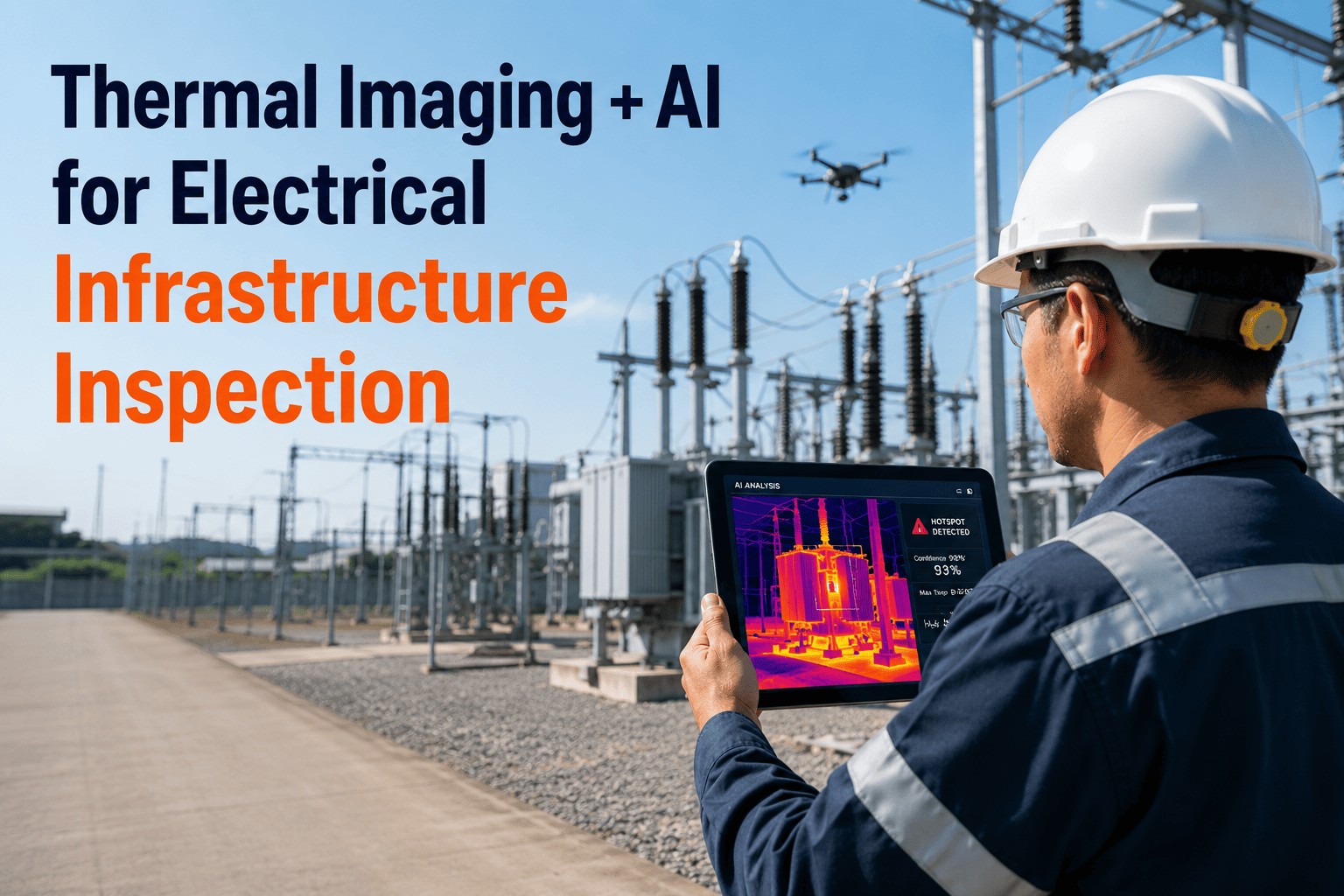
Electrical faults don't appear without warning — they build quietly for weeks, radiating heat signatures that are completely invisible to scheduled inspection teams. A transformer running 28°C above its baseline. A busbar connection degrading toward arc flash. A circuit breaker contact corroding under load. Every one of these faults is physically detectable before it becomes a failure event. Infrared cameras paired with machine learning are now finding them automatically — Book a live demo with iFactory to see AI thermal monitoring mapped to your substation infrastructure.
iFactory Infrastructure AI · Electrical Inspection
Stop Scheduling Inspections.
Start Monitoring Continuously.
Thermal imaging alone gives you a snapshot once a quarter. iFactory's AI layer turns your infrared cameras into a 24/7 fault detection engine — classifying anomalies, scoring severity, and auto-generating work orders before a single failure event occurs.
Live fault detection · Switchgear Room B
94°C
Busbar conn.
CRITICAL
61°C
CB-14 contact
WARNING
38°C
Transformer T2
NORMAL
$1.4B
Annual arc flash cost to US industry · NFPA 2023
6 wks
Avg. fault development window before surface failure
90%+
Fault detection accuracy with AI thermal systems
75%
Faster inspections with AI-assisted thermal analysis
The Core Problem
Your Infrared Camera Sees Everything. Your Inspection Schedule Sees Almost Nothing.
A quarterly thermographic survey is better than nothing — but it leaves a 90-day window during which a fault can originate, escalate, and reach catastrophic failure with zero detection. Aging infrastructure was a contributing factor in 60% of arc flash incidents over 15-year equipment life (NETA 2023). The issue isn't the camera. It's the gap between when the camera is pointed at the asset and when the fault actually develops.
Traditional manual thermography requires a trained technician to walk through switchgear rooms, capture images, interpret temperature anomalies, write reports, and route findings to maintenance — a cycle that takes days and misses anything that develops between visits. iFactory's continuous AI monitoring collapses that cycle to seconds.
Traditional Inspection
Quarterly walkdown · Manual report
✗Technician in arc flash zone during inspection
✗90-day detection gap between surveys
✗Manual image review — hours per survey
✗Report to work order: 3–7 day lag
✗Faults developing at 2 AM remain invisible until next visit
Missed failure → $250K–$2M+ event
iFactory AI Thermal
Continuous · Automated · Always-on
✓Zero technician exposure to live equipment
✓24/7 monitoring — no detection gaps
✓AI classifies anomalies in real time
✓Work order auto-generated at threshold breach
✓Fault detected at 2 AM — alert sent at 2:01 AM
Early intervention → $8K–$25K planned repair
See AI thermal monitoring running on live substation data
iFactory connects to your existing IR camera infrastructure — no rip-and-replace required.
What the AI Detects
Every Electrical Fault Has a Thermal Signature. Here Are the Six iFactory Catches First.
Loose Connections
Resistance at termination points generates localised heat spikes. Classic early-stage fault — detected 3–6 weeks before failure.
Detection accuracy: 91%
Overloaded Circuits
Elevated temperature across full conductor length — AI flags deviation from load-normalised baseline, not a fixed threshold.
Detection accuracy: 87%
03
Creeping hotspot pattern
Insulation Degradation
Progressive hotspot escalation toward arc flash conditions. Temperature trend analysis catches degradation before it becomes a risk.
Detection accuracy: 84%
Phase Imbalance
Uneven thermal distribution across three-phase systems flags current imbalance before it causes motor or transformer damage.
Detection accuracy: 81%
Transformer Thermal Stress
External tank temperature variations reveal internal cooling failure or winding degradation weeks before dielectric breakdown occurs.
Detection accuracy: 79%
06
Contact resistance heat
Breaker Contact Wear
Worn or corroded breaker contacts show elevated contact resistance as heat — identified before the next operation under fault current.
Detection accuracy: 76%
The AI Pipeline
From Infrared Pixel to Closed Work Order: How iFactory Works in 5 Stages
Traditional thermography produces a PDF report. iFactory produces a resolved fault. Here's the difference in how the data flows.
Continuous Thermal Capture
Fixed radiometric IR cameras stream temperature data from switchgear rooms, transformer bays, busbar systems, and MCCs — 24/7, without scheduled visits or technician exposure to energised equipment.
Input: Radiometric IR feed
Per-Asset Baseline Modelling
AI builds a dynamic thermal fingerprint for every monitored component under normal load, ambient, and seasonal conditions. Anomalies are measured against this contextual baseline — not fixed temperature thresholds that trigger false alarms during load peaks.
Output: Component thermal fingerprint
Anomaly Detection & Fault Classification
Deep learning models flag baseline deviations and classify fault type — loose connection, insulation degradation, phase imbalance — automatically. The system distinguishes genuine fault signatures from benign thermal variation caused by normal load changes.
Output: Fault type + asset location
Severity Scoring & Time-to-Critical Projection
Each anomaly receives a live severity score updated every monitoring cycle. Rate-of-change analysis projects the time-to-critical threshold — giving your maintenance team a specific intervention window, not just a notification.
Output: Severity score + intervention deadline
Automated CMMS Work Order
When severity crosses the configured threshold, iFactory auto-generates a CMMS work order with fault type, asset coordinates, recommended corrective action, and an off-peak scheduling window. No dispatcher. No lag. No missed fault.
Output: Scheduled work order · Zero human dispatch
Real Numbers
What Avoiding One Arc Flash Event Actually Pays For
Without AI thermal monitoring
Arc Flash Event
Medical + productivity loss$47,192+
Indirect costs (OSHA est.)$51,911+
Equipment replacement$80K–$400K
Production downtime (11 days avg.)$200K–$2M+
Total exposure: $250K–$2M+ per event
vs
With iFactory AI thermal monitoring
Planned Repair
Planned repair (off-peak)$8K–$25K
Zero emergency premium$0
Production impact$0
Safety incident cost$0
Total cost: $8K–$25K planned repair
"Catching thermal anomalies in our switchgear rooms 4–5 weeks before failure extended our equipment service life and reduced unplanned shutdowns by 65%. The ROI was clear within the first quarter."
— Maintenance Director, Industrial Power Facility (iFactory deployment, 2025)
Implementation
Three Ways to Deploy — Starting From What You Already Have
A
Existing IR Camera Fleet
Connect your current fixed or handheld thermal cameras to the iFactory AI layer via API or direct upload. No new hardware. AI baseline modelling begins from day one using your existing feeds and historical survey data.
Time to value: 1–2 weeks
B
Priority Zone Deployment
iFactory surveys your highest-consequence zones — switchgear rooms, transformer bays, MCCs — and installs fixed radiometric cameras during a scheduled maintenance window. Prioritised by failure cost and inspection accessibility.
Time to value: 2–4 weeks
C
Full Infrastructure Stack
End-to-end deployment across your full electrical infrastructure — substations, switchyards, cable tunnels, generator terminals. Edge servers process thermal feeds on-site; no image data leaves your facility perimeter.
Time to value: 4–8 weeks
FAQ
Questions Teams Ask Before Deploying AI Thermal Monitoring
Does iFactory require replacing our existing thermal cameras?
No. iFactory ingests data from most commercial radiometric IR cameras via API or direct upload — including FLIR, Teledyne, and Optris systems. Your existing handheld cameras can feed findings into the platform through the mobile app. New fixed cameras are only required if you're expanding coverage to zones not currently monitored.
How does the AI avoid false alarms during load peaks?
The AI builds a dynamic per-asset baseline that accounts for normal load cycles, ambient temperature variation, and seasonal changes. Anomaly detection flags deviations from this contextual fingerprint — not fixed temperature thresholds. A transformer running warmer under full load does not trigger a false alarm. A transformer running warmer than its own normal profile under the same load conditions does.
What CMMS platforms does iFactory integrate with?
iFactory auto-generates work orders in SAP PM, IBM Maximo, Infor EAM, Fiix, and other major CMMS platforms via API. Work orders include fault type, asset ID, GPS coordinates, severity score, recommended action, and a suggested off-peak scheduling window.
How quickly does iFactory deliver ROI?
Most deployments reach financial breakeven within 2–4 months. A single avoided arc flash event — at conservative OSHA-estimated direct and indirect costs — typically covers 12–24 months of platform cost. For facilities with high-consequence downtime, the multiplier is significantly larger. Predictive maintenance with thermal imaging can reduce downtime by 30–50% and maintenance costs by 20–40% (IndustryWeek 2025).
Your next arc flash event is preventable
Get a Free Thermal Monitoring Assessment for Your Electrical Infrastructure
iFactory's infrastructure intelligence team will review your current inspection coverage, map your highest-risk zones, and show you exactly what continuous AI thermal monitoring looks like on your facility data.