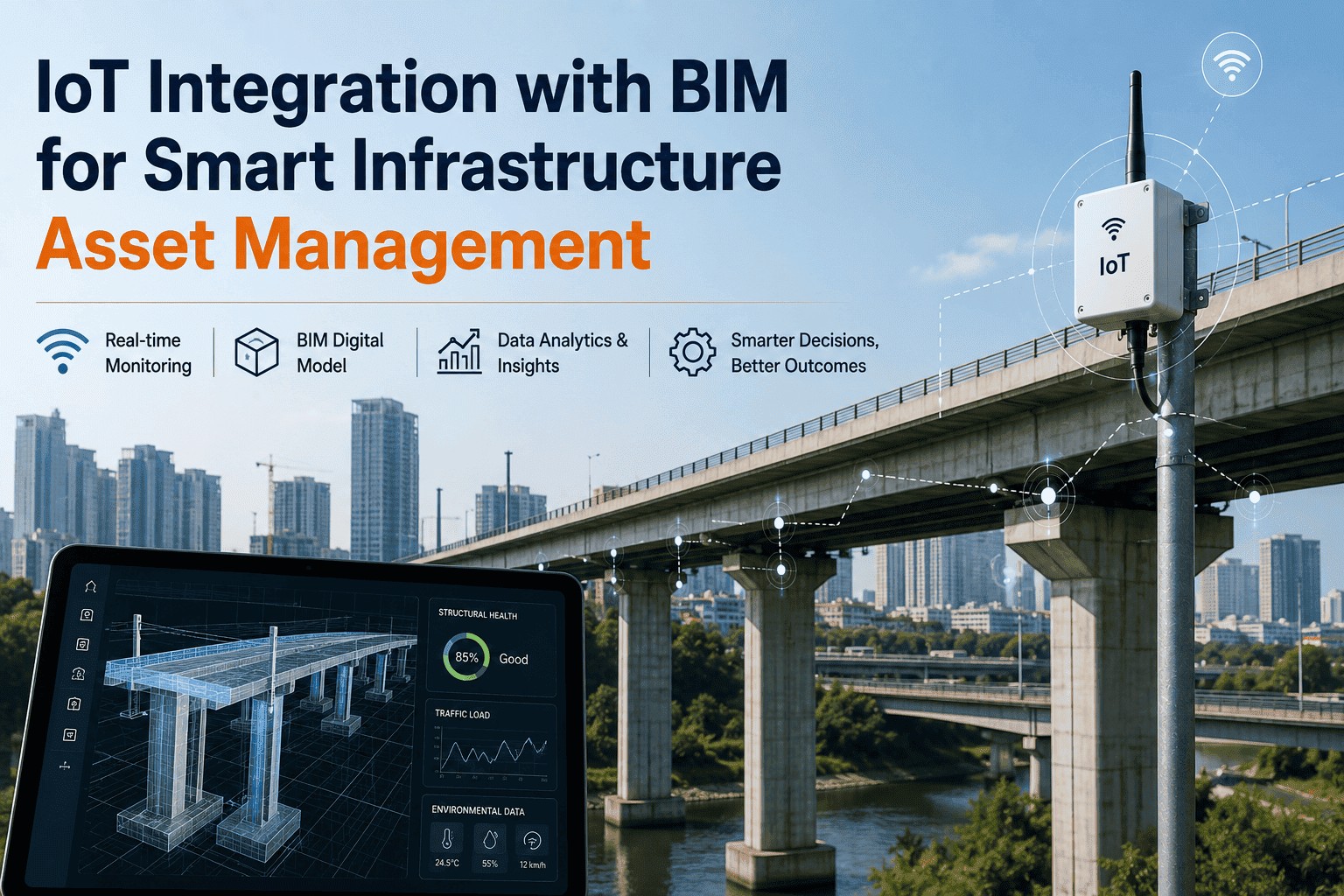
Infrastructure doesn't fail without warning — it sends signals for weeks or months before a problem becomes critical. A bridge bearing shows unusual vibration. A water main wall thins by another millimeter. A structural column endures micro-stress cycles that add up, invisibly, until they don't. The tragedy isn't that these signals are hard to read. The tragedy is that they're not being read at all — because the data that would reveal them lives in disconnected systems that were never designed to talk to each other. Building Information Modeling gave the construction industry a precise, geometry-rich record of every asset. The Internet of Things gave it real-time sensor feeds from those same assets. Combining them creates something neither technology achieves alone: a living, self-updating digital backbone for infrastructure management that turns reactive maintenance into predictive intervention — and turns asset data from a historical archive into an operational tool. iFactory's IoT infrastructure monitoring platform is built precisely for this integration layer — connecting sensor data from physical assets to the digital models that describe them, so your operations team has the right information at the right time.
IoT · BIM · Digital Twin · Predictive Maintenance · Asset Management
Your infrastructure is already sending data. Is anyone listening?
iFactory connects IoT sensor streams to your asset models — giving infrastructure managers the real-time visibility to act before failure, not after.
25–30%
Reduction in maintenance costs with IoT-BIM digital twin integration
35–50%
Reduction in unplanned asset downtime through predictive analytics
$947B
Global IoT market value, with 95% of platforms integrating digital twinning
30%
Equipment downtime reduction from digital twin monitoring per GE Digital
What BIM and IoT Each Bring to the Table — and Why the Gap Between Them Is Costing You
BIM is the map. IoT is the live traffic feed. Neither is enough on its own for modern infrastructure asset management — but together, they form a complete operational picture that neither technology achieves in isolation.
BIM Alone
A perfect model of the past
Contains detailed geometry, materials, specifications, and component history for every asset in the structure.
Tells you exactly what was built and when — but not what condition it's in right now.
Static without IoT: it reflects the design-day state of the asset, not today's operational reality.
IoT Alone
Data without context
Streams real-time temperature, vibration, stress, humidity, and displacement readings from physical assets.
Generates enormous data volumes — but without the asset model, each reading lacks spatial and structural context.
Sensor alerts alone can't tell you what the reading means for the structural integrity of the element it's embedded in.
BIM + IoT Integrated
A living digital backbone
Every sensor reading lands on the precise BIM element it came from — vibration data attached to the exact beam, temperature data attached to the exact slab section.
The model updates continuously, creating a digital twin that reflects the asset's real-time physical condition.
Maintenance decisions are based on actual asset condition — not inspection schedules or guesses from the last survey.
The Integration Architecture: How IoT Data Flows Into a BIM Model
The technical gap between raw sensor data and a populated BIM model has three layers. Understanding each layer is key to evaluating any IoT-BIM integration platform — including what iFactory manages on your behalf.
Data Acquisition Layer — Sensors to Gateway
IoT sensors embedded in or attached to infrastructure elements — concrete, steel, mechanical systems — capture raw readings at defined intervals. Wireless protocols (Bluetooth Low Energy, LoRaWAN, cellular LTE-M) transmit these readings to a gateway that aggregates, timestamps, and forwards them to the cloud. Sensor selection and placement is critical: the data you can act on is only as good as the sensors you deploy and where you put them.
Data Mapping Layer — Sensor ID to BIM Object ID
This is the layer most platforms underinvest in — and where most IoT-BIM integrations break down. Each sensor reading must be mapped to a unique BIM object identifier (GUID in IFC format) so the data lands on the correct element in the model. Without this mapping, you have a stream of timestamped numbers with no structural location. With it, a temperature spike appears not as an abstract alert but as a highlighted element in the model at the exact location the issue is developing.
Analytics & Alert Layer — Data to Decision
Mapped sensor data feeds threshold logic, trend analysis, and predictive models that generate actionable alerts. A vibration reading alone means nothing; vibration trending upward 12% over 30 days on a specific beam element, with that element's material properties and load history from the BIM model included in the analysis — that generates a precise, actionable maintenance work order. This layer transforms the integration from a monitoring system into a decision-support system.
Compliance & Record Layer — Decisions to Documentation
Every sensor reading, alert event, and maintenance action logged against the BIM model creates a permanent, timestamped record that satisfies owner reporting requirements, government asset management obligations (ISO 55001, PAS 55), and insurance documentation. The BIM model becomes the single authoritative record of the asset's operational history — not a collection of disconnected spreadsheets, inspection reports, and maintenance logs scattered across multiple systems.
ISO 55001 · IFC · LoRaWAN · Predictive Analytics · Real-Time Alerts
See the Full IoT-BIM Integration Stack Running on Your Asset Type
iFactory maps sensor placement, BIM object mapping, alert thresholds, and compliance report format to your specific infrastructure asset class before the first sensor deploys.
Five Infrastructure Asset Classes Where IoT-BIM Integration Delivers Measurable ROI
The integration is not theoretical — it produces quantifiable outcomes in specific asset categories. Each class has a distinct set of sensor types, BIM data requirements, and failure modes that the integration is designed to detect and prevent.
Bridge Structural Health Monitoring
Strain gauges, accelerometers, and tilt sensors embedded at critical cross-sections stream real-time load and vibration data into the bridge BIM model. The integration computes dynamic load factors against the design envelope for each structural element — flagging the exact location and magnitude of anomalies before they become visible cracks or bearing failures.
Key Sensors
Strain · Vibration · Tilt · Crack displacement
Water Infrastructure Pipeline Networks
Pressure, flow, and acoustic sensors along pipeline networks feed real-time data into the pipeline network BIM model. Sudden pressure anomalies are immediately geolocated on the model to the specific pipe segment — reducing leak detection time from days to minutes and cutting water loss and road disruption costs that follow an undetected main break.
Key Sensors
Pressure · Flow · Acoustic · Corrosion
Mass Concrete Elements — Foundations and Piers
Temperature sensors embedded during concrete placement stream curing data into the BIM model of the element — enabling real-time maturity calculation, thermal differential monitoring for crack prevention, and automatic ACI 305/306 compliance documentation. The BIM element's strength record is populated with actual, sensor-verified data rather than assumed standard-curing values.
Key Sensors
Temperature · Humidity · Maturity method
Tunnel Lining and Underground Structures
Convergence sensors, water ingress monitors, and structural displacement sensors map deformation and water infiltration events to precise lining ring locations within the tunnel BIM model. Operations teams see which ring segment is moving and by how much — enabling targeted grouting or repair before the deformation exceeds safe operating thresholds.
Key Sensors
Convergence · Water ingress · Displacement
Commercial and Institutional Facility Management
HVAC, electrical, and mechanical systems wired with IoT sensors feed operational data into building BIM models — enabling facility managers to schedule maintenance based on actual equipment condition rather than fixed intervals. Research shows this approach reduces maintenance costs by 25–30% and extends equipment service life by eliminating both under-maintenance and over-maintenance cycles.
Key Sensors
Energy · HVAC · Equipment runtime · Air quality
Reactive vs. Predictive vs. IoT-BIM Integrated: What the Operations Cost Difference Looks Like
Most infrastructure organizations sit in one of three operational postures. The cost difference between them is not marginal — it compounds over the full asset lifecycle into a figure that dwarfs the technology investment required to move up a tier.
| Posture |
Reactive |
Preventive / Scheduled |
IoT-BIM Predictive |
| Maintenance Trigger |
Asset fails or visible defect appears |
Fixed calendar intervals |
Sensor threshold breach — before failure |
| Failure Rate |
High — 100% run-to-failure |
Moderate — over- and under-maintenance |
Low — 35–50% downtime reduction |
| Maintenance Cost Index |
3–5× planned maintenance cost |
1× baseline |
0.6–0.75× baseline — 25–40% below scheduled |
| Asset Visibility |
None until failure |
Periodic inspection snapshots only |
Continuous — every element, 24/7 |
| Documentation Quality |
Incident reports only — no history |
Manual inspection logs — incomplete |
Auto-generated — full sensor history in BIM record |
“
The ROI conversation on IoT-BIM integration is actually straightforward once you've seen one emergency repair bill. A single undetected pipe failure in a distribution main — the 3 AM event that's already cut flow to a district before anyone knows — costs more in emergency response, road reinstatement, and regulatory fines than two or three years of continuous sensor monitoring across the entire network. The technology cost is not the barrier. The barrier is the assumption that failure events are unforeseeable. They are not. They are just unmonitored.
— Infrastructure Asset Manager, Municipal Water Authority — 17 Years — Certified Asset Management Professional (CAMP), ISO 55001 Lead Auditor
From Digital Twin to Decision — What IoT-BIM Integration Actually Enables on the Operations Floor
The term "digital twin" gets used loosely. A true operational digital twin — one that supports maintenance decisions in real time — requires all four of these capabilities running simultaneously. Most organizations have one or two. The integration gap between all four is where asset management value lives.
Capability 01
Real-Time Condition Visibility
Every sensor reading visible on the BIM model in real time — maintenance teams can see the current condition of every monitored element from any device, without waiting for an inspection visit. Condition maps replace manual inspection rounds for routine status checks.
Capability 02
Predictive Failure Detection
Trend analysis on historical sensor data, combined with the element's design parameters from the BIM model, flags degradation patterns before they reach failure thresholds. The system calculates estimated time to failure for at-risk elements — enabling planned intervention on a schedule, not an emergency.
Capability 03
Context-Aware Alerting
Alerts are not raw threshold breaches — they are contextualized against the element's design specification, material properties, and historical baseline from the BIM record. A steel beam with a higher allowable vibration tolerance doesn't trigger the same alert as a concrete element at the same reading. Fewer false positives. More actionable alerts.
Capability 04
Automated Compliance Documentation
Every monitoring event and maintenance action is logged against the BIM element — creating a continuous, auditable asset history that satisfies ISO 55001 asset management requirements, government asset reporting obligations, and insurance documentation needs without manual report preparation.
Conclusion
BIM and IoT are mature technologies individually. The value creation comes from their integration — and the integration gap is where most infrastructure organizations still operate. A BIM model that doesn't receive live sensor data becomes an out-of-date record within months of the project completing. An IoT sensor network that doesn't map its readings to a structured asset model generates data volume without operational insight. The combination — sensor readings landing on the precise BIM elements they came from, with design parameters, material properties, and historical baselines informing every alert and maintenance decision — is what transforms infrastructure asset management from a reactive cost center into a proactive performance management function.
iFactory's IoT infrastructure monitoring platform is built to close this integration gap — delivering the sensor-to-model data flow, context-aware alerting, and automated compliance documentation that infrastructure asset managers need to operate at the predictive tier. Book a Demo to see the integration configured for your asset type and operational requirements.
Frequently Asked Questions
Your infrastructure assets are monitored — or they are guesses. There is no third option.
iFactory connects IoT sensor data to your BIM asset models, closing the gap between what your infrastructure looks like on paper and what condition it's in today — and generating the maintenance decisions and compliance records that follow from that.