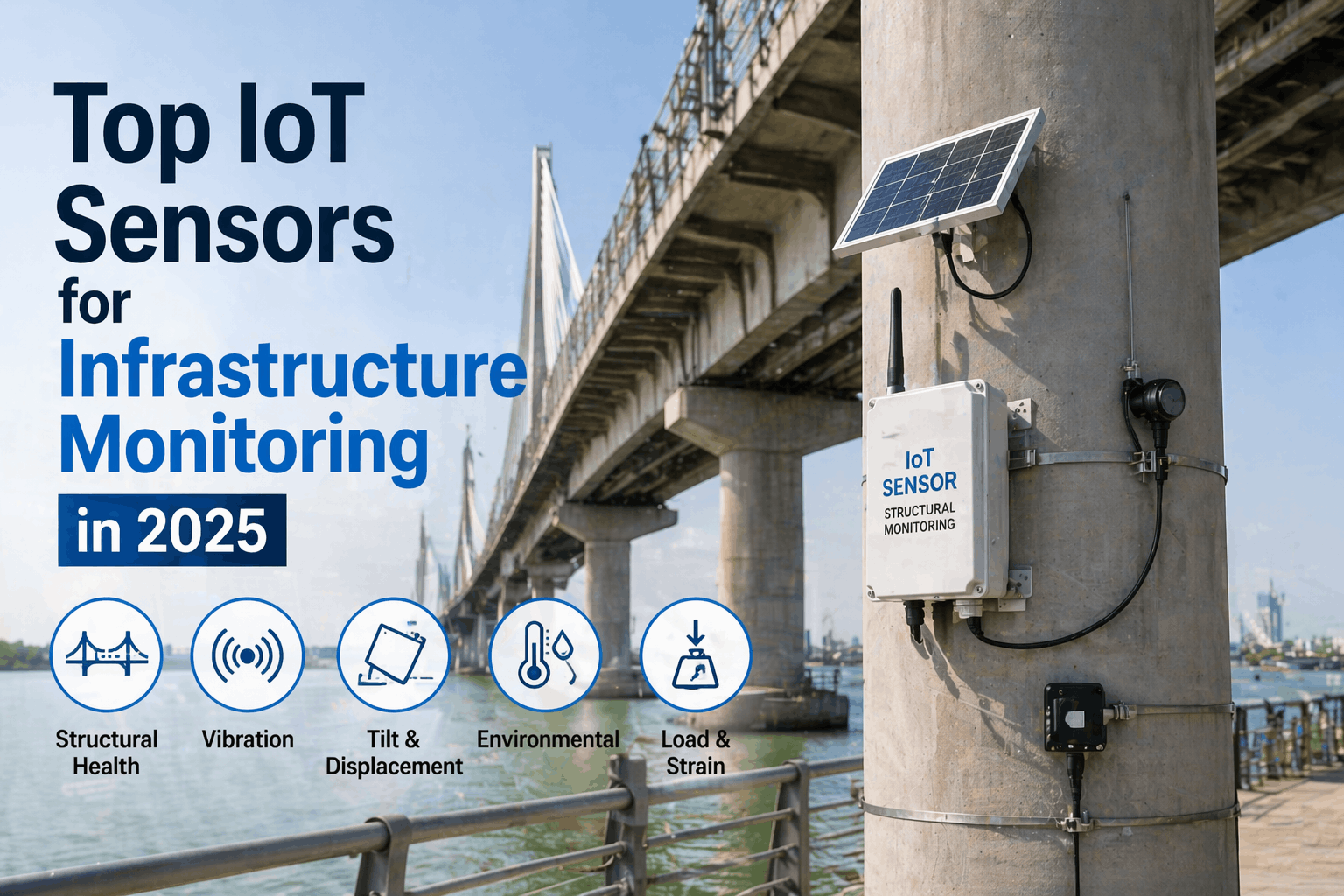
Selecting the right IoT sensors is the single most critical decision in any infrastructure monitoring deployment. The wrong sensor—whether driven by cost-cutting, mismatched accuracy, or poor environmental ruggedization—produces unreliable data that feeds incorrect predictions into your AI asset management platform. For civil engineers and infrastructure asset managers evaluating the top IoT sensors for infrastructure monitoring in 2025, the landscape has matured dramatically. Edge-computing chipsets are shrinking battery demands, MEMS (Micro-Electro-Mechanical Systems) manufacturing has dramatically slashed per-unit costs, and AI-native data platforms like iFactory are purpose-built to ingest multi-vendor sensor streams simultaneously. This guide reviews the leading sensor categories, their accuracy benchmarks, their deployment suitability across asset types, and how to evaluate vendors for long-term intelligent maintenance system partnerships. If you are ready to map a sensor strategy to your portfolio, schedule a free infrastructure consultation with our team.
Connect Every Sensor to a Single AI Intelligence Layer
iFactory's infrastructure AI platform is hardware-agnostic — ingesting data from all major IoT sensor vendors to deliver predictive analytics across your entire asset portfolio.
The 6 Core IoT Sensor Categories for Civil Infrastructure in 2025
Infrastructure monitoring is not a one-sensor discipline. A high-performing intelligent maintenance system for a bridge, dam, retaining wall, or highway viaduct requires a layered ecosystem of complementary sensors, each measuring a specific physical dimension of structural health. Understanding the role of each category is the prerequisite for building a specification that delivers actionable predictive analytics intelligence — not just a warehouse of noise. Asset managers who book a demo with iFactory begin their sensor strategy with a guided risk-based asset mapping session.
MEMS Accelerometers
Measure dynamic vibration and seismic response. Used to construct a structure's modal frequencies — the "fingerprint" that changes when the structural integrity is compromised. Sub-1mg resolution sensors now cost under $80 per node.
Fiber Bragg Grating (FBG)
Optical fiber sensors embedded in structural materials to measure strain, temperature, and crack propagation with microstrain-level accuracy. Immune to electromagnetic interference, making them ideal for steel-heavy environments.
Crack Displacement Gauges
Monitors both the width and propagation rate of existing cracks in concrete or masonry. Essential for retaining walls, tunnels, and historic viaducts where crack growth is the primary failure mode.
Electrochemical Corrosion Sensors
Monitor chloride ion concentration and rebar half-cell potential. Predict spalling and delamination 3–5 years before visual evidence appears, making them the highest-lead-time sensors in any infrastructure toolkit.
Tiltmeters & Inclinometers
Detect foundational settlement, retaining wall rotation, and bearing pad deterioration. Arc-second resolution devices measure sub-millimeter displacements critical for slope stability and pier integrity monitoring.
Environmental / Scour Sensors
Sonar transponders and turbidity probes mounted on underwater pier foundations to continuously monitor bed-level scour depth. Critical for bridges over rivers and estuaries exposed to flood-induced foundation erosion.
Sensor Accuracy, Battery Life & Deployment Cost Benchmarks
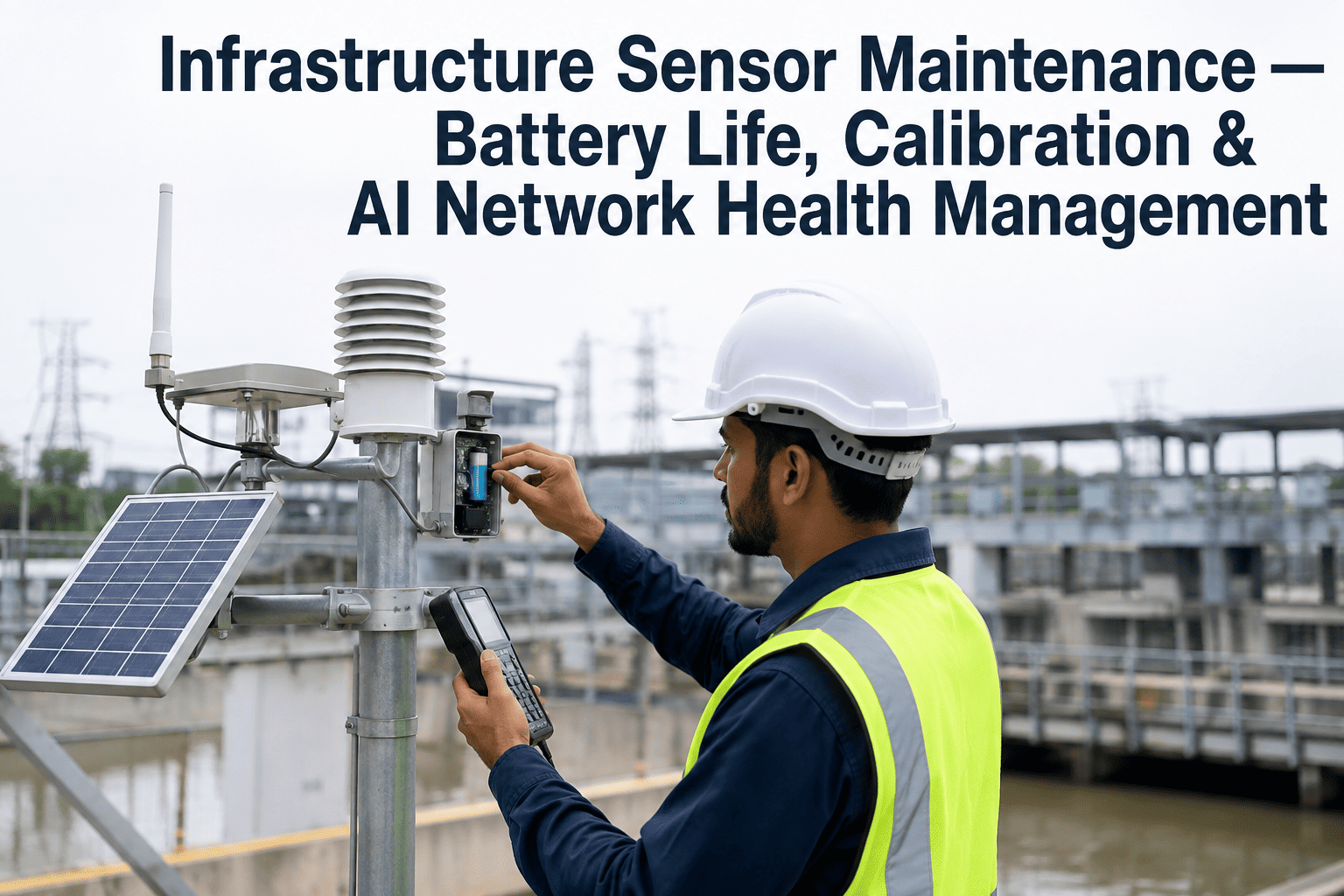
Selecting between sensor types requires balancing three competing variables: measurement precision, power consumption, and total lifecycle cost. High-frequency vibration sensors demand high bandwidth and drain batteries rapidly; electrochemical corrosion sensors send small data bursts infrequently and run for a decade on a single cell. The goal of a well-architected iot predictive maintenance infrastructure is to match each sensor's data cadence to the actual rate of physical change in the asset it is monitoring. For detailed guidance on your specific asset mix, schedule a technology selection call with our engineering team.
| Sensor Type | Accuracy Benchmark | Battery Life | Avg. Unit Cost (2025) | Best Deployment Asset |
|---|---|---|---|---|
| MEMS Accelerometer | ±0.5 μg | 6–18 months | $60 – $200 | Bridges, Towers, Dams |
| FBG Fiber Optic Strain | ±1 microstrain | Passive (No Battery) | $150 – $600/metre | Girders, Tendons, Slabs |
| Crack Displacement Gauge | ±0.001 mm | 2–5 years | $120 – $400 | Retaining Walls, Tunnels |
| Corrosion / Chloride Probe | ±2% Cl⁻ concentration | Up to 10 years | $200 – $800 | Concrete Decks, Piers |
| Tiltmeter / Inclinometer | ±0.001° | 3–7 years | $180 – $700 | Piers, Slopes, Abutments |
| Scour / Sonar Probe | ±50mm depth | Hardwired / Solar | $500 – $2,000 | Submerged Bridge Piers |
Why Raw Sensor Data Alone Is Not Enough: The AI-Driven Intelligence Layer
Many infrastructure teams make the critical mistake of selecting excellent sensors and then routing their data into simple threshold-alarm dashboards. In 2025, the actual competitive advantage lies in connecting that sensor network to a purpose-built predictive analytics infrastructure platform. Raw data streams from 50 accelerometers on a aging viaduct generate tens of millions of data points per day. Without machine learning models that understand the physics of that specific bridge — how it resonates under a 60-tonne HGV fleet versus a 30-tonne flow — static alarm thresholds create an environment of "alert fatigue," where real anomalies are buried in hundreds of daily false positives. iFactory's infrastructure AI platform solves this by building an asset-specific Digital Twin for each monitored structure on day one.
Matching IoT Sensors to Your Infrastructure Asset Class
Not all sensors are suitable for all infrastructure types. A 100-year-old masonry arch viaduct has fundamentally different failure modes than a modern cable-stayed bridge, and the sensor specification must reflect those differences. The matrix below provides asset-specific deployment guidance based on primary failure risk modes in 2025 infrastructure portfolios. For a bespoke risk-based sensor specification for your project, request a free consultation.
| Infrastructure Asset | Primary Risk Mode | Priority Sensor Package | Monitoring Cadence |
|---|---|---|---|
| Highway Bridge (Steel) | Fatigue cracking, bearing seizure | MEMS Accelerometers + FBG Strain + Tiltmeters | Continuous (Hz-level) |
| Concrete Overpass | Rebar corrosion, deck spalling | Corrosion Probes + Crack Gauges + Accelerometers | Hourly burst / Continuous |
| River Bridge / Pier | Scour, foundation erosion | Scour Sonar + Tiltmeters + MEMS | Continuous during flood events |
| Retaining Wall | Rotation, crack growth, drainage failure | Inclinometers + Crack Displacement + Piezometers | Daily burst |
| Road Tunnel | Lining deformation, water ingress | Crack Gauges + FBG Strain + Humidity Sensors | Hourly burst + event trigger |
| Cable-Stayed Bridge | Cable fatigue, tower drift | Accelerometers + FBG (cables) + Tiltmeters (tower) | Continuous high-frequency |
"Choosing the right sensor mix was the pivotal decision in our network-wide SHM rollout. After integrating MEMS accelerometers, FBG strain sensors, and corrosion probes into iFactory's AI platform, we stopped guessing about asset condition and started managing infrastructure with genuine statistical confidence. Our board had zero tolerance for reactive patching — this system gave us prophylactic capabilities we didn't think were affordable."
— Head of Infrastructure Asset Management, Regional Transport Authority
Measured Impact: IoT Sensor + AI Platform Deployment KPIs
The performance results from deploying modern IoT sensor networks alongside a dedicated smart infrastructure management AI layer are measurable and consistent. The benchmarks below are drawn from active iFactory infrastructure deployment data across road authority, rail, and DOT portfolios.
Top IoT Infrastructure Sensors 2025 — Frequently Asked Questions
Which single IoT sensor type delivers the highest ROI for bridge monitoring?
MEMS Accelerometers typically deliver the fastest and widest ROI, as their data enables Structural Identification (St-ID) — the science of detecting changes in the bridge's structural stiffness and damping. This catches the widest range of structural changes (fatigue cracking, settlement, scour onset) from a single sensor type.
What is the difference between a MEMS accelerometer and a Fiber Bragg Grating sensor?
MEMS accelerometers measure dynamic motion (vibration and acceleration), while FBG sensors measure static and quasi-static strain (how much the material is being stretched or compressed). Both are complementary — accelerometers detect events dynamically; FBG sensors measure the cumulative stress that events are generating.
How do battery-powered IoT sensors survive for years underground or underwater?
Modern infrastructure IoT nodes are designed with deep-sleep duty cycles governed by LoRaWAN or NB-IoT protocols. The sensor "wakes up," takes a measurement burst, transmits a compact data packet, and reverts to ultra-low-power sleep. This cycle uses microwatts of power, enabling 5–10 year battery lifespans.
Can we use our existing SCADA system alongside new IoT sensors?
Yes. iFactory's infrastructure AI platform supports standard SCADA OPC-UA and Modbus integration. IoT sensor data can be layered alongside existing SCADA telemetry, creating a unified analytics environment without requiring SCADA hardware replacement.
How does AI differentiate between sensor drift and a real structural event?
iFactory continuously monitors the statistical "health" of each sensor against its peer array. If one accelerometer begins drifting relative to its three neighbors, the AI flags sensor malfunction (not a structural event) and triggers a replacement work order automatically. This is called Sensor Validation Analytics.
Is wireless IoT reliable enough for mission-critical structural safety applications?
Yes, with appropriate redundancy design. Modern LoRaWAN and 5G networks for civil infrastructure operate with 99.5%+ uptime. Critical monitoring nodes are configured with dual-path transmission (primary 5G + backup LoRaWAN) and local edge-storage buffers, ensuring zero data loss even during connectivity interruptions.
What is the typical payback period for an IoT infrastructure monitoring deployment?
Payback is typically achieved within 18–24 months. The primary ROI driver is a single averted emergency repair event: a proactively identified and patched scour event or fatigue crack can save $2M–$20M in reactive rehabilitation costs compared to discovering the same defect after a serious structural incident.
Should we standardize on one sensor vendor or use a multi-vendor ecosystem?
A multi-vendor approach is strongly recommended for resilience and best-in-class performance per asset type. With iFactory's hardware-agnostic AI layer, you can use specialized vendors for each sensor category (e.g., HBK for strain, Resensys for wireless MEMS) while maintaining a single unified analytics platform.
Connect Your Sensor Network to AI-Powered Structural Intelligence
iFactory's infrastructure monitoring platform is hardware-agnostic and ML-native — converting raw sensor telemetry from any vendor into actionable predictive intelligence for your entire asset portfolio.