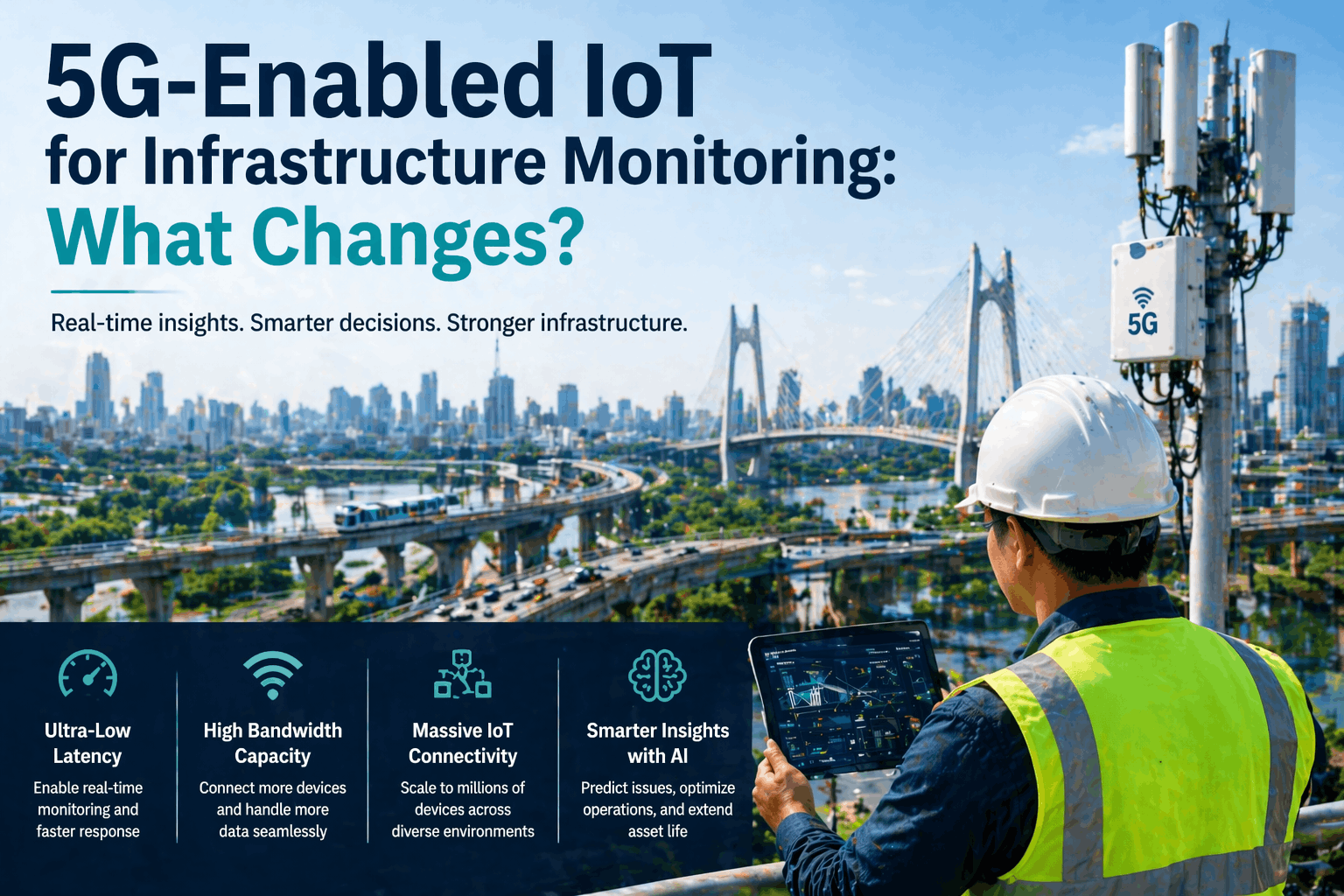
The connectivity layer has always been the quiet constraint on what IoT infrastructure monitoring can deliver in practice. Sensor coverage, AI model sophistication, and platform analytics have scaled rapidly over the past decade — but the communications architecture connecting remote sensors to data platforms has remained a limiting factor, particularly for high-density, wide-area civil infrastructure monitoring where wired connections are impractical and cellular LPWAN protocols impose hard limits on data volume and latency. 5G-enabled IoT infrastructure monitoring changes this constraint fundamentally — not incrementally. With peak downlink speeds of 10–20 Gbps, sub-1ms latency in ultra-reliable low-latency communication (URLLC) configurations, and network slice architecture that enables dedicated, prioritized connectivity for critical infrastructure sensor networks, 5G opens infrastructure monitoring use cases that were technically impossible on 4G LTE or LPWAN networks. This article examines what specifically changes — for bridges, energy grids, water networks, tunnels, and construction monitoring — when 5G becomes the connectivity substrate for infrastructure IoT. For infrastructure operators evaluating 5G private network investment for monitoring programmes, schedule a 5G connectivity assessment with iFactory's infrastructure AI team.
5G Connectivity Is Rewriting What Infrastructure IoT Monitoring Can Deliver. Are You Ready?
iFactory's infrastructure AI platform is architected for 5G connectivity — supporting high-frequency sensor arrays, real-time video analytics, edge-cloud integration, and millisecond-latency alert protocols across bridges, energy grids, water networks, and transport infrastructure.
Why 5G Is a Step-Change — Not Just an Upgrade — for Infrastructure IoT Monitoring
Every previous generation of mobile connectivity improved on speed and capacity while fundamentally remaining a best-effort network — one where all devices shared bandwidth without priority differentiation. Infrastructure monitoring on 4G LTE, NB-IoT, and LoRaWAN works within these constraints by accepting low data rates, high latency, and contention-based channel access as fixed parameters of the monitoring design. 5G introduces three architectural capabilities that break these constraints entirely: network slicing (dedicated virtual network segments for infrastructure monitoring with guaranteed quality of service), URLLC (Ultra-Reliable Low-Latency Communication for sub-1ms, 99.999% reliability communication), and mMTC (massive Machine Type Communication supporting 1 million devices per km²). Together, these capabilities enable monitoring architectures that would have required dedicated fibre to replicate on previous networks.
| Capability | LoRaWAN / NB-IoT | 4G LTE | 5G (URLLC + mMTC) | Impact for Infrastructure IoT |
|---|---|---|---|---|
| Latency | 1–10 seconds | 30–70ms | <1ms | Critical |
| Peak Bandwidth | 0.3–50 kbps | 150 Mbps | 10–20 Gbps | Critical |
| Device Density | Up to 1M/km² | ~100K/km² | 1M+/km² | High |
| Network Slicing | Not available | Not available | Dedicated QoS slices | Critical |
| Reliability (URLLC) | ~99% | ~99.9% | 99.999% | Critical |
| Real-Time Video | Not feasible | Limited (HD only) | 4K/8K multi-stream | High |
| Edge Computing Support | Minimal | Limited MEC | Native MEC integration | Medium |
What 5G Specifically Changes for Infrastructure Monitoring by Asset Class
The operational impact of 5G connectivity on infrastructure monitoring is not uniform across asset types — it depends on which specific constraint of the previous connectivity layer was limiting monitoring capability. Understanding the constraint that 5G removes for each asset class is essential for prioritizing investment in 5G-enabled monitoring infrastructure. To map the specific 5G connectivity upgrade path for your infrastructure portfolio, book a 5G infrastructure planning session.
High-Density Structural Arrays + Real-Time Video
Bridge SHM on 4G was limited to 50–100 sensors per structure due to data rate constraints. On 5G, thousands of MEMS accelerometers can transmit at 1,000 Hz continuously — enabling full modal analysis in real time. Simultaneously, 4K structural inspection cameras stream live for AI crack detection without latency-induced frame loss.
Sub-1ms Fault Detection and Automated Switching
Grid protection relay operations require communication latency under 4ms to comply with IEC 61850 GOOSE message timing for distributed protection. 5G URLLC delivers sub-1ms latency with 99.999% reliability — enabling wireless distributed protection schemes that previously required dedicated fibre, dramatically reducing substation connectivity costs.
Ultra-Dense Sensor Deployment Without LPWAN Contention
Large water distribution networks with 5,000+ acoustic loggers and pressure sensors exceed the practical channel capacity of LoRaWAN gateway networks in dense urban areas. 5G mMTC supports this device density without contention-induced packet loss — enabling synchronised minimum night flow monitoring across all DMAs simultaneously for the first time.
Distributed Sensor Arrays + Emergency Communication
Tunnel monitoring requires both dense sensor coverage and emergency communication capability. 5G enables a unified connectivity layer for structural sensors (air quality, vibration, fire), passenger safety systems (emergency phone, video), and operational control (ventilation, lighting automation) — reducing the infrastructure required for tunnel connectivity significantly.
Real-Time Machine Telemetry + AI Vision at Scale
Construction monitoring on 4G required selecting between sensor coverage and video quality — bandwidth forced a trade-off. On 5G private networks, full-site sensor telemetry from hundreds of assets runs concurrently with multi-camera AI vision monitoring streams — enabling complete digital twin synchronisation at the construction site level.
Vehicle-to-Infrastructure (V2I) Safety Integration
Road and rail infrastructure monitoring on 5G integrates structural sensor data with vehicle telemetry through V2I protocols — enabling dynamic speed advisories based on real-time bridge structural response, tunnel air quality conditions, or road surface condition data, communicated to approaching vehicles within milliseconds of detection.
New Infrastructure Monitoring Use Cases That 5G Makes Possible for the First Time
Beyond improving existing monitoring capabilities, 5G enables a set of new infrastructure monitoring use cases that were not feasible on any previous wireless technology. These are not incremental improvements — they represent new operational capabilities that change the economics and risk profile of critical infrastructure management.
Real-Time AI Vision Monitoring at Infrastructure Scale
Computer vision-based structural inspection — detecting cracks, corrosion, displacement, and deformation from continuous camera feeds — requires sustained high-bandwidth, low-latency connectivity that makes it impractical over 4G at scale. On 5G, multi-camera AI vision arrays can be deployed at bridges, dams, retaining walls, and construction sites with continuous 4K streaming to edge AI processors — enabling real-time crack propagation tracking and automated structural condition assessment without periodic inspection visits. iFactory's AI vision module processes 5G-streamed camera feeds continuously, flagging condition changes for engineering review within minutes of detection rather than months after the next inspection cycle. To understand how this applies to your specific infrastructure asset, discuss AI vision monitoring for your assets.
Wireless Distributed Protection and Control for Power Infrastructure
Electrical protection schemes that coordinate fault isolation across multiple substations and switching points have historically required dedicated optical fibre communications — because the IEC 61850 GOOSE and Sampled Values message timing requirements (sub-4ms, 99.999% reliability) exceeded what any wireless technology could reliably deliver. 5G URLLC meets these requirements wirelessly for the first time — enabling wireless distributed protection architectures for substations, renewable energy plants, and medium-voltage distribution networks that are currently uneconomic to wire with dedicated fibre. This is particularly impactful for offshore wind farm interconnection and remote substation protection schemes.
Continuous Full-Waveform Seismic and Acoustic Monitoring at 1000Hz+
High-frequency seismic and acoustic monitoring — capturing the full waveform of vibration events at sampling rates of 500–4,000 Hz from arrays of 50–200 sensors — generates data volumes (gigabytes per hour per structure) that completely exceed the capacity of 4G cellular or LPWAN. On 5G, this data volume is handled continuously without local buffering or data reduction — enabling continuous full-waveform monitoring that captures sub-threshold seismic events, acoustic emission from fatigue cracking, and traffic-induced vibration signatures with the resolution needed for advanced structural health assessment and remaining fatigue life estimation.
Live Digital Twin Synchronisation at Asset Scale
Infrastructure digital twins synchronized with real-time sensor data require continuous, high-frequency data streams from potentially thousands of sensors on a single asset — demanding bandwidth levels that make real-time digital twin operation impractical on 4G. 5G enables continuous digital twin state updates at simulation-grade temporal resolution — allowing the digital twin to reflect the current structural health state of a bridge or dam in near real time, running parallel load simulations against actual measured traffic and environmental loads and flagging when the simulated stress state approaches design performance limits.
Autonomous Inspection Robot and Drone Integration
Autonomous inspection robots and drones require real-time command-and-control communication with sub-10ms latency — otherwise the control loop is unstable in dynamic environments. On 4G, autonomous inspection operations in infrastructure environments (inside tunnels, under bridges, along transmission line corridors) were constrained by control latency and video streaming bandwidth. 5G enables full-autonomy operation of inspection robots in complex structure environments with real-time 4K video streamed to remote operators, dramatically reducing the cost and frequency constraints of physical infrastructure inspection programmes.
"We deployed a 5G private network across our main port terminal as part of a digital infrastructure programme, and the difference in what we could monitor versus our previous 4G-LPWAN hybrid was immediately apparent. We went from 120 sensors reporting every 30–60 seconds to 1,400 sensors reporting continuously at 100Hz — the data granularity change transformed our predictive maintenance capability entirely. The AI model's ability to detect early-stage gantry crane rail wear degradation improved from a 3-week leading indicator window to a 9-week window simply because it was seeing the full vibration signature rather than an aggregated average. We also deployed AI vision on 22 camera positions that had previously been unusable over 4G due to compression artefacts. The entire investment paid back within 14 months."
5G Infrastructure Monitoring Deployment: Private Network vs. Public Network Slicing
Infrastructure operators evaluating 5G connectivity for monitoring programmes face a fundamental design choice: deploy a 5G private network (on licensed, shared, or unlicensed spectrum) or use network slicing on a public 5G operator's shared infrastructure. The right answer depends on the security requirements, geographic coverage area, device density, and budget profile of the specific monitoring programme.
A 5G private network (using CBRS in the US, shared spectrum in Europe, or licensed mmWave/sub-6GHz spectrum) gives the infrastructure operator full control over the network architecture, security zones, QoS configuration, and data routing. All sensor data remains on dedicated infrastructure that never traverses the public internet. Best suited for: large single-site deployments (ports, airports, large substations, major bridge structures), critical national infrastructure with data sovereignty requirements, and sites with very high sensor density (>500 IoT endpoints).
Network slicing on public 5G infrastructure — where a dedicated logically isolated network slice is assigned to the infrastructure monitoring programme with guaranteed QoS — is typically lower capex and enables faster deployment across geographically distributed assets (linear infrastructure: roads, railways, pipelines, power transmission corridors). Best suited for: distributed infrastructure networks, monitoring programmes that need to cover assets across wide geographic areas, and programmes where cell tower coverage areas sufficiently overlap the monitored corridor.
A hybrid architecture combines a private 5G network at the highest-priority, highest-density monitoring site with public 5G network slicing for secondary or distributed assets. This delivers maximum performance where it matters most while maintaining cost efficiency for distributed lower-density monitoring. iFactory's platform supports seamless ingestion from both private and public 5G network sources, unifying all sensor data on a single infrastructure analytics platform regardless of the underlying connectivity architecture.
5G's Multi-Access Edge Computing (MEC) capability enables AI inference and analytics processing to be deployed at the network edge — within the 5G infrastructure itself — rather than requiring round-trip data transmission to a cloud data centre. For time-critical applications (structural alert triggering, fault isolation command execution), MEC reduces total processing-to-alert latency to under 5ms. iFactory's edge analytics modules are deployable on 5G MEC nodes, enabling threshold-based alert triggering and local AI inference independent of cloud connectivity.
Is Your Infrastructure Ready for 5G IoT Monitoring? A Readiness Framework
Not all infrastructure monitoring programmes need 5G today — and understanding which specific monitoring objectives are genuinely constrained by connectivity (rather than by sensor, analytics, or budget limitations) determines whether 5G investment is the right priority for the programme's next phase. The readiness framework below helps infrastructure operators identify whether 5G connectivity is the binding constraint on their monitoring capability. For a structured readiness assessment for your specific infrastructure portfolio, schedule a 5G readiness review with iFactory's infrastructure connectivity team.
| Monitoring Objective | Connectivity Constraint on 4G/LPWAN | 5G Upgrade Benefit | Priority |
|---|---|---|---|
| High-frequency structural monitoring (>100 Hz, 100+ sensors) | Data volume exceeds bandwidth; aggregation required | Full-resolution continuous transmission — high | Upgrade Now |
| AI vision structural inspection (4K continuous) | Not feasible on 4G at production quality | Full 4K stream + real-time AI inference — enables new use case | Upgrade Now |
| Wireless grid protection (GOOSE, <4ms) | Not achievable wirelessly; fibre only | 5G URLLC meets IEC 61850 timing — enables wireless protection | Upgrade Now |
| Dense urban sensor deployment (>1,000 endpoints per site) | Channel contention on LPWAN above ~200 devices | 1M+ device density — full fleet simultaneous transmission | Upgrade Now |
| Standard environmental and condition monitoring (<1 Hz) | No significant constraint — LPWAN adequate | Marginal — retain LPWAN for battery life economics | Defer |
| Autonomous robot / drone inspection control | Control loop unstable >10ms — unsafe autonomy | Sub-5ms via MEC — enables full autonomy safely | Upgrade Now |
| Distributed remote sensors on linear infrastructure | 4G coverage gaps on remote corridors | Public 5G slicing extends coverage — moderate benefit | Evaluate |
Ready to Move Your Infrastructure Monitoring to a 5G-Native Architecture?
iFactory's infrastructure AI platform is designed for 5G connectivity — scaling from LPWAN baseline monitoring through 5G private network deployment as your connectivity infrastructure evolves. One platform. All connectivity layers.
Frequently Asked Questions: 5G-Enabled IoT for Infrastructure Monitoring
Do all infrastructure IoT monitoring applications actually need 5G, or is 4G/LPWAN sufficient for most use cases?
Most existing infrastructure IoT monitoring use cases — environmental sensing, low-frequency condition monitoring, standard pressure and flow measurement — are adequately served by 4G LTE or LPWAN (LoRaWAN, NB-IoT) from a connectivity standpoint. The transformative impact of 5G is concentrated in applications that were previously impossible or severely constrained: high-frequency structural monitoring at sensor densities above 100+ nodes, continuous AI vision monitoring, wireless grid protection at sub-4ms latency, autonomous inspection robot/drone control, and real-time digital twin synchronization. For infrastructure operators evaluating 5G investment, the question is not "should we upgrade everything?" but "which of our monitoring objectives are currently constrained by connectivity?" The answer to that question determines the 5G investment priority.
What is 5G network slicing and how does it benefit infrastructure monitoring specifically?
Network slicing is a 5G capability that allows a single physical 5G network to be divided into multiple logically isolated virtual networks — each with guaranteed, dedicated quality of service parameters (bandwidth, latency, reliability) tailored to a specific application. For infrastructure monitoring, a dedicated network slice means that sensor data transmission from critical infrastructure assets is guaranteed a defined minimum bandwidth and maximum latency — regardless of what other traffic is competing for the shared physical network. This is fundamentally different from 4G, where all devices compete for shared spectrum on a best-effort basis. A network slice for a bridge SHM programme might guarantee 50 Mbps bandwidth with 5ms maximum latency, ensuring continuous sensor data flow even during peak network congestion periods.
What is a 5G private network and when does infrastructure monitoring require one?
A 5G private network is a dedicated 5G infrastructure deployment — with private base stations (gNBs), core network, and spectrum — operated exclusively for a single organisation's use. Unlike public 5G networks where spectrum and infrastructure are shared, a private 5G network gives the infrastructure operator complete control over security architecture, data routing (all data stays on-premises), QoS configuration, and spectrum management. Private networks are typically required when data sovereignty regulations prohibit sensor data from traversing public networks (applicable to defence, national security infrastructure, and some regulated utilities), when the monitoring site has predictable, very high device density (>500+ endpoints in a defined area), or when the monitoring application requires guaranteed performance that network slicing SLAs cannot contractually deliver.
How does 5G improve AI-based structural inspection compared to 4G-connected camera systems?
Current 4G-connected structural inspection camera systems are limited by three constraints: resolution (H.264/H.265 compression at 4G data rates introduces artefacts that reduce AI crack detection accuracy), frame rate (bandwidth limitations force reduced frame rates that miss dynamic structural events), and processing location (AI inference must run locally on expensive edge hardware or suffer cloud round-trip latency). 5G removes all three constraints: uncompressed or minimally compressed 4K/8K video streams are supported by the available bandwidth, full 60fps frame rates are feasible, and 5G MEC enables AI inference at the network edge with sub-5ms total latency — combining the quality of local processing with the scalability of cloud AI infrastructure.
Can 5G connectivity replace the fibre connections required for IEC 61850 substation communication?
For specific IEC 61850 message classes, yes — 5G URLLC can meet the communication requirements. IEC 61850 GOOSE messages (used for protection relay tripping) require transmission latency under 4ms with 99.999% delivery reliability — requirements that 5G URLLC can meet. Sampled Values (SV) messages used for differential protection require even tighter timing but are equally achievable in 5G URLLC configurations. This means wireless 5G can replace dedicated fibre for distributed protection schemes in substations and between substations at sites where fibre deployment is expensive or impractical (offshore wind platforms, remote substations, temporary protection arrangements during construction). However, for high-availability utility-grade applications, a fibre primary with 5G backup architecture is typically recommended rather than wireless-only protection, until 5G URLLC track records are more extensively documented in utility regulatory frameworks.
What spectrum options are available for infrastructure operators deploying 5G private networks?
Spectrum availability for 5G private networks varies by country. In the United States, the CBRS (Citizens Broadband Radio Service) band (3.5 GHz) provides shared licensed spectrum specifically designed for private network use — accessible to any licensed user through a Spectrum Access System (SAS) without spectrum auction costs. In Germany, the Federal Network Agency (Bundesnetzagentur) has allocated the 3.7–3.8 GHz band for local private 5G licenses at industrial sites. The UK, Japan, and Australia have similar local spectrum frameworks. Millimeter wave (mmWave, 24–40 GHz) spectrum is increasingly available for private network licensing in urban and semi-urban areas, offering very high capacity but with shorter range and greater sensitivity to obstruction.
How does Multi-Access Edge Computing (MEC) in 5G reduce alert latency for infrastructure monitoring?
In a conventional cloud-connected IoT architecture, sensor data travels from the sensor to the cloud data centre, where AI inference is performed and an alert is generated, and the alert then returns to the operations platform — a round-trip that might take 50–200ms or more depending on cloud region proximity. 5G Multi-Access Edge Computing deploys AI inference capability at the base station or local network edge — physically close to the monitored structure — reducing the cloud round-trip to a local process that completes in under 5ms. For threshold-based structural alerts (seismic threshold exceeded, partial discharge level critical, grid fault passage detected), this latency reduction translates directly into faster automated response — whether automated barrier closure, protection relay operation, or emergency service notification.
What is the expected total investment for a 5G private network deployment for a large infrastructure asset?
5G private network deployment costs have declined significantly since 2022 as the ecosystem has matured. For a large single-site deployment (a major bridge, a port terminal, a substation complex, or a section of linear infrastructure), a 5G private network supporting 500–2,000 IoT endpoints, multi-camera AI vision, and edge computing typically costs $500K–$3M for hardware (base stations, core network, edge compute nodes) plus ongoing spectrum licensing and operational costs of $50K–$200K annually. Shared public 5G network slicing arrangements typically cost $20K–$100K per year for a defined connectivity SLA — significantly lower capex but with less control and data sovereignty assurance. iFactory provides connectivity architecture advisory as part of platform engagement — request a 5G investment model for your specific site parameters.