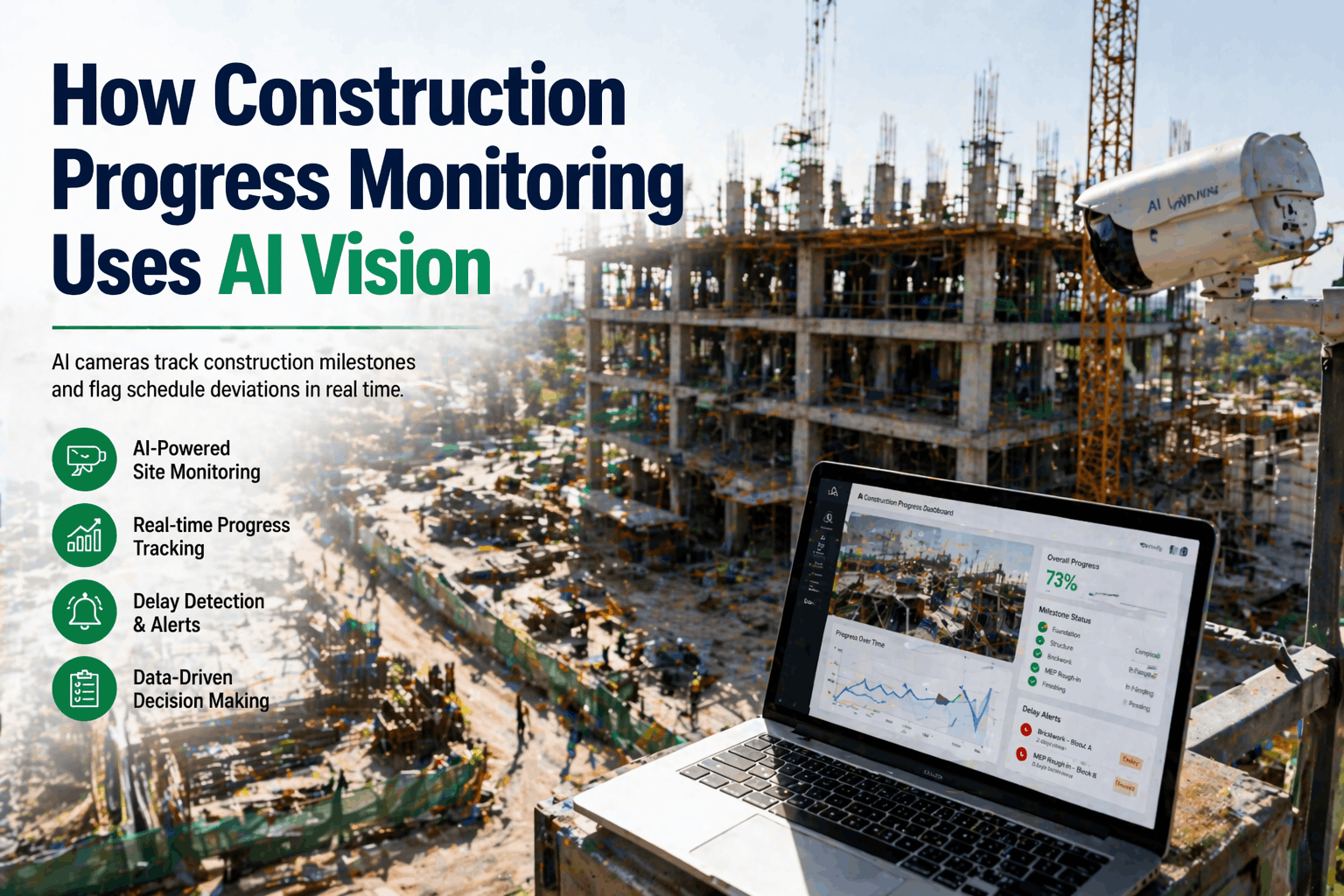
Construction progress monitoring using AI vision is fundamentally rewriting how general contractors, developers, and project managers track milestones across large-scale commercial and infrastructure projects. By deploying intelligent Computer Vision (CV) models across fixed site cameras, drones, and crane mounts, an AI-driven platform can automatically compare physical site reality against Building Information Modeling (BIM) data and projected Gantt chart schedules. For construction firms battling razor-thin margins, supply chain unreliability, and persistent labor shortages, adopting AI progress monitoring is no longer a futuristic experiment. It is the operational foundation that separates on-time, highly profitable builds from perpetually delayed, over-budget projects. This deep-dive explores how computer vision models track structural milestones, flag schedule deviations in real-time, and seamlessly integrate into your project management software to multiply the capacity of your site superintendents.
Automate Your Milestone Tracking with Computer Vision
iFactory's AI vision platform delivers real-time schedule tracking, automated deviation alerts, and seamless integration with your BIM and project management systems.
How AI Vision Models Track Construction Milestones
Traditional construction progress monitoring relies on subjective, manual site walks where superintendents document completion percentages using clipboards and disconnected photos. In 2026, construction progress monitoring AI vision reverses this model. Advanced computer vision algorithms parse live camera feeds to identify specific construction elements—such as poured concrete columns, erected steel beams, HVAC ductwork, and drywall framing. When the AI detects that 80% of the second-floor steel has been placed, it automatically registers this event against the master schedule. Firms that book a demo with iFactory frequently discover that automated milestone tracking eliminates the reporting lag that typically obscures critical-path delays.
BIM-to-Reality Alignment
The AI vision system continuously compares real-time site captures (3D point clouds and 2D video) against the project's 4D BIM design model to calculate precise completion percentages.
Automated Element Counting
Computer vision models automatically count installed components—from rebar grids and precast panels to windows and piping—reducing manual quantity surveying time by days.
Schedule Deviation Flagging
If the AI detects that the foundation pour is 4 days behind the baseline schedule, it instantly flags the deviation, highlighting downstream impacts on subsequent trades.
Subcontractor Verification
Objective AI tracking verifies the "work in place" (WIP) claimed by subcontractors, creating unbiased documentation that accelerates draw requests and payment approvals.
Flagging Schedule Deviations Before They Compound
The hidden cost of construction delays is the compound effect: a two-day delay in concrete curing shifts the steel erection schedule, which in turn disrupts the entire MEP (Mechanical, Electrical, and Plumbing) timeline. Intelligent maintenance systems and AI tracking act as an early warning radar. By flagging a schedule deviation on day one rather than at the end-of-month review, project managers can reallocate labor, sequence tasks concurrently, or adjust material deliveries before the critical path is irreversibly broken. Contractors utilizing iFactory report that deploying AI vision intercepts over 60% of cascading delays while they are still solvable.
Deploying the AI Site Camera Setup
An effective infrastructure monitoring software deployment relies on multi-angle data capture. The iFactory AI platform is hardware-agnostic, meaning it ingests video arrays from whatever visual sensors best fit the project profile. A mature site camera setup blends persistent macro-tracking with high-fidelity micro-inspections. This multi-layered approach ensures that whether you are tracking the rising core of a skyscraper or the fine details of interior finishing, the AI has the visual data required to map reality against the blueprint.
| Camera / Sensor Type | Primary Tracking Role | AI Vision Processing | Operational Benefit |
|---|---|---|---|
| Fixed PTZ Site Cameras | Continuous macro-progress | Time-lapse element counting & safety compliance | 24/7 unblinking site overview |
| Crane-Mounted Arrays | Top-down logistics tracking | Material delivery mapping & laydown yard tracking | Zero blind spots on high-rises |
| Autonomous Drones | High-fidelity 3D modeling | Photogrammetry to point-cloud conversion | Sub-centimeter structural auditing |
| 360° Helmet Cameras | Interior finishing & MEP | Room-by-room completion percentage scanning | Hands-free indoor reality capture |
| Laser Scanners (LiDAR) | Quality assurance (QA) | Slab-flatness and spatial deviation detection | Eliminates physical rework |
Integration With Project Management Tools
AI vision data must live where project managers already work. The architectural distinction between a standalone camera system and a genuine smart infrastructure management platform is seamless integration. The iFactory AI engine features bi-directional sync with industry standards like Procore, Autodesk Construction Cloud, and Primavera P6. When the AI detects that structural steel on zone B is complete, it doesn't just create an alert; it automatically updates the completion status in the master schedule and generates an RFI (Request for Information) if an anomaly is detected. For enterprise contractors managing dozens of sites simultaneously, this automated reporting pipeline effectively multiplies the administrative capability of every site supervisor. A quick system demonstration is the fastest way to see how AI syncs with your specific tech stack.
"Implementing AI construction progress monitoring was the turning point for our mega-project margins. We stopped relying on subjective 'we are 80% done' reports and started managing via mathematically verified AI reality captured directly against our BIM models. It eliminated schedule inflation overnight."
— Senior Project Executive, National Commercial General Contractor
Monitoring Impact Across Schedule and Budget KPIs
The measurable impact of AI tracking scales across every facet of construction management—from administrative efficiency to critical path protection. The chart below benchmarks the average improvements achieved within 6 months of deploying iFactory's construction progress monitoring AI vision, based on cross-fleet construction data.
Construction Progress Monitoring AI — Frequently Asked Questions
How accurately can AI vision determine completion percentage?
When integrating 3D point clouds (via drones or LiDAR) with 4D BIM models, the AI calculates "Work in Place" (WIP) with 98% structural accuracy. It removes subjective human estimates, replacing "I think we're 80% done" with mathematical volume and element counts.
Does the AI system require us to install new, proprietary cameras?
No. iFactory’s AI vision engine is generally hardware-agnostic. It can ingest RTSP feeds from your existing fixed site cameras, GoPro/360 helmet footage, and third-party drone data. You can upgrade camera hardware for better resolution, but it is rarely a strict requirement.
How does the platform handle interior work where drones cannot fly?
For interior environments like MEP installations and drywall, superintendents conduct regular site walks wearing 360° helmet cameras or using handheld LiDAR scanners. The AI automatically stitches this footage into the interior BIM model to update finish schedules.
Can AI progress monitoring integrate with Procore or Autodesk Build?
Yes. Bi-directional API integrations with Procore, Autodesk Construction Cloud, and scheduling tools like Primavera P6 are standard. Visual progress data directly updates the schedule fields and attaches visual evidence to RFI submissions.
Will my subcontractors push back against AI tracking?
While there is often an initial learning curve, most subcontractors quickly embrace the technology once they realize it accelerates their draw requests. AI provides objective visual PROOF that their work is complete, bypassing slow approval bureaucracy.
Does the platform also track site safety and PPE compliance?
Yes. Computer vision models run multiple algorithms simultaneously. While one model maps structural progress, another continuously monitors the live feed for hardhats, high-vis vests, exclusion zone breaches, and elevated fall risks.
How does the AI flag a 'schedule deviation'?
The system references your baseline Gantt chart. If the schedule mandates that 100% of Level 3 columns must be poured by Tuesday, and the AI counts only 60% completion on Wednesday morning, it immediately generates a red-flag deviation alert to the project manager.
What is the typical ROI on AI progress monitoring software?
ROI is typically realized within 3 to 6 months. It is primarily driven by the prevention of cascading delays (which incur liquidated damages) and a massive reduction in the gross hours spent on manual reporting, quantity surveying, and payment verification.
Build Faster with Unbiased AI Visual Reality
iFactory's AI vision platform compares actual site reality against your structural blueprints, ensuring your construction project stays on time, on budget, and fully documented.