The shift quality report shows fired pellet compressive strength dropping below 2,000 N for the fourth consecutive batch on line 2. The operator checks the obvious suspects: binder feed rate is within range, disc moisture is on setpoint, kiln temperature profile looks normal. The investigation begins. The quality engineer pulls DCS trends from the last 8 hours. The maintenance technician checks the disc scraper wear. The process engineer reviews the feed chemistry from the upstream concentrator. Three hours pass. Twelve more batches have been produced — some marginal, some below spec. The team finally identifies the root cause: a worn spray nozzle on disc 2 that was delivering inconsistent droplet size, causing micro-variations in green pellet growth that only became visible as a compressive strength deficit after firing. The nozzle cost 140 dollars. The throughput lost during the investigation — 3 hours at 600 tonnes per hour with a scrap rate of 11% — exceeds 2,300 dollars in unrecoverable material cost. The real cost is not the scrap. It is the three-hour gap between the first symptom and the correct diagnosis. This is the investigation gap that AI root cause detection closes.
Multivariate Root Cause · Automated RCA · Causal Correlation · Throughput Recovery
Every Hour Spent Searching for Root Cause Is an Hour of Throughput You Cannot Recover. AI Finds It in Minutes.
iFactory's AI root cause detection engine correlates 100+ process variables across disc pelletizers, induration furnaces, and feed systems — pinpointing the true source of every quality deviation in minutes, not days. Operators sustain throughput 15-25% higher by eliminating the investigation gap between symptom and corrective action.
100+
Process variables correlated simultaneously by the AI root cause engine — across disc, furnace, feed, and quality data — to identify the true source of every deviation
90%
Reduction in investigation time — from days of manual data correlation to minutes of automated analysis — enabling same-shift corrective action instead of next-week RCA reports
2-6 hrs
Time window between first process deviation and quality failure — the period during which AI root cause detection identifies the source and recommends corrective action before scrap is produced
15-25%
Throughput increase achieved when AI root cause detection eliminates the investigation gap — converting hours of diagnostic downtime into productive operating time
The Investigation Gap: The Hidden Cost That Drains Pellet Plant Throughput
When a quality deviation appears in a pelletizing plant — a rising oversize fraction, a compressive strength drop, a crack rate increase — the operator and quality team enter an investigation cycle that follows a predictable pattern. Check the most common causes first (moisture, binder, feed rate). Pull DCS trends for the affected time window. Cross-reference with laboratory results. Consult the maintenance log for recent repairs. Interview the previous shift operator. Each step consumes time, and every hour that passes before the true root cause is identified, the process continues producing material that may be marginal or off-spec. The industry average for root cause investigation in pellet plants ranges from 2 to 8 hours for simple single-variable causes to 2 to 5 days for multi-variable interactions involving feed chemistry, equipment condition, and process parameter drift. During that investigation window, throughput is compromised — either because the operator reduces feed rate as a precautionary measure, or because the undiagnosed condition continues generating scrap. AI root cause detection eliminates this gap by correlating every available variable simultaneously and presenting a ranked causal diagnosis within minutes of the first deviation.
The Three Root Cause Categories That Manual Investigation Misses — and How AI Finds Them
Category 1
Equipment Degradation Hidden in Process Trends
The most common root cause that manual investigation misses is gradual equipment degradation that masquerades as a process parameter shift. A worn disc scraper produces a slow increase in oversize fraction that looks like a moisture drift. A fouled spray nozzle creates inconsistent green pellet growth that appears to be a feed chemistry change. A kiln burner tip erosion shifts the flame profile over weeks, causing a gradual compressive strength decline that operators compensate for by increasing fuel consumption. The human investigator sees the symptom and checks the most recent variable change. AI root cause detection correlates the symptom with every variable over the preceding hours and days — identifying that the moisture sensor reading has not changed, but the spray nozzle flow pattern has been degrading for 72 hours, which is the true root cause.
Equipment wear vs. process drift correlation
Gradual degradation trend detection
Component-level root cause attribution
Category 2
Multi-Variable Interactions Across Process Stages
Pelletizing is a serial process: disc output feeds the grate, grate output feeds the kiln, kiln output feeds the cooler and screen. A quality deviation at the final screen — high fines content — could originate in any preceding stage or in a combination of stages. Manual root cause investigation typically checks each stage in sequence, starting at the screen and working backward. This sequential approach is time-consuming and misses cross-stage interactions: a small moisture increase at the disc combined with a minor temperature drop in the preheat zone can produce a compressive strength deficit that neither cause alone would create. AI multivariate correlation analyses all variables from all stages simultaneously — detecting that the interaction between moisture at time T and preheat temperature at time T+45 minutes is the causal combination driving the final quality deviation.
Cross-stage variable interaction mapping
Time-shifted cause-effect correlation
Stage-specific root cause ranking
Category 3
Feed Chemistry Variability With Delayed Quality Impact
Changes in iron ore concentrate chemistry from the upstream concentrator are one of the most difficult root causes to identify manually because the quality impact is delayed by 2 to 4 hours — the time required for the feed to travel through the balling and induration stages before the fired pellet quality is measured. When a compressive strength drop appears at 14:00, the manual investigator checks what changed at 14:00 and sees nothing. The actual root cause — a silica spike in the concentrate at 11:00 — is buried in the feed chemistry data from three hours earlier. AI root cause detection automatically time-shifts all variables relative to the quality outcome, correlating feed chemistry at time T-3 hours with fired pellet quality at time T. This time-aware correlation is impossible to perform manually across a 100-variable dataset but takes the AI model seconds to compute.
Delayed-effect feed chemistry correlation
Time-shifted correlation engine
Upstream concentrator data integration
Equipment Wear Detection · Multi-Variable Correlation · Time-Shift Analysis · Causal Ranking
The Root Cause of Today's Quality Deviation Was in the Data 3 Hours Ago. Manual Investigation Found It After the Shift. AI Finds It Before the Next Batch.
iFactory's AI-driven root cause engine correlates 100+ process variables simultaneously, applies time-shifted causal analysis across all pelletizing stages, and delivers a ranked root cause report with confidence scores — enabling operators to act on the true cause within minutes, not days.
How AI Root Cause Detection Recovers Throughput in a Pelletizing Line
The system operates as a continuous causal analysis layer over the pelletizing line — ingesting DCS data, quality measurements, and equipment condition signals in real time, and producing a ranked root cause report within minutes of any quality deviation. The output replaces the manual investigation workflow that consumes 2 to 8 hours per event with an automated causal diagnosis that operators can act on immediately.
Continuous Anomaly Detection Across All Process Variables
The AI engine monitors every process variable in the pelletizing line simultaneously — 100+ parameters from disc rotation speed and moisture content to windbox temperatures, fuel flow, grate speed, binder feed rate, and feed chemistry. Each variable has a dynamic baseline that adapts to the current operating regime and pellet grade. When any variable deviates from its expected range, the system records the deviation as a potential causal signal. The detection is multi-dimensional: a single variable exceeding its control limit is flagged, but so is a combination of variables that individually remain within limits but collectively form a pattern that historically precedes quality deviations. This pattern-based detection catches the root causes that conventional single-variable alarms miss entirely.
Multivariate Causal Correlation With Time-Aware Analysis
When a quality deviation is detected — a compressive strength drop, an oversize fraction increase, a crack rate spike — the correlation engine automatically assembles a causal analysis dataset. This dataset includes every process variable from the preceding 8 hours, time-shifted to account for process lag: disc parameters are correlated with fired pellet quality at time T+3 hours, grate parameters at T+2 hours, kiln parameters at T+1 hour. The engine applies multivariate statistical correlation and machine learning-based causal inference to identify which variable or combination of variables is the statistically likely root cause. The output is a ranked list of candidate root causes, each with a confidence score and the direction of the required corrective adjustment.
Ranked Root Cause Report With Actionable Recommendation
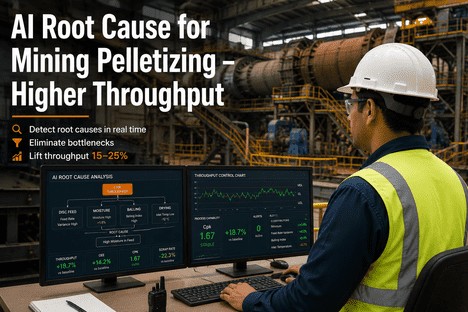
The diagnosis is delivered to the operator as a structured report on the control screen. The report states the quality deviation detected, the top-ranked root cause with its confidence score and the evidence supporting it, the secondary contributing factors if any, and the specific corrective adjustment recommended. The report format is designed for immediate action: "Compressive strength deviation detected on line 2. Primary root cause: moisture content on disc 2 trending 2.1% above optimal for current binder rate — confidence 94%. Secondary contributor: feed silica increased by 0.8% at 09:00. Recommended action: reduce disc water spray by 15% and adjust binder feed by +3% to compensate for silica shift. Estimated throughput recovery: 180 tonnes per shift if corrected within 30 minutes."
Continuous Learning — Every Investigation Improves the Model
Every root cause analysis generated by the system is recorded as a labelled event. When the operator acts on the recommendation and confirms whether the root cause was correctly identified, the outcome is fed back into the model. Correct diagnoses reinforce the causal correlation weights for the future. Incorrect or partially correct diagnoses update the model's causal graph to improve accuracy. Over 8 to 12 weeks of operation, the model's root cause accuracy typically exceeds 90% as it learns the specific causal relationships that govern the pelletizing line's unique equipment configuration, ore blend characteristics, and operating regime. The system also identifies recurring root cause patterns — the same equipment degradation mode appearing across multiple lines or shifts — enabling proactive maintenance scheduling before the next quality deviation occurs.
The Operator Playbook: Four Ways AI Root Cause Detection Changes How You Recover Throughput
Operators who use AI root cause detection do not investigate quality deviations differently — they stop investigating altogether. The AI model delivers the diagnosis. The operator's role shifts from detective to decision-maker: evaluating the recommended corrective action, authorising it, and confirming the recovery. Here are the four changes that define the new operating model.
1
Quality Deviation Becomes a Diagnosis, Not a Mystery
In conventional operations, a quality deviation triggers a sequence that begins with uncertainty. The operator checks the most recent few variables, calls the quality engineer, waits for trend data, and begins a process of elimination that consumes hours before the corrective action is clear. During those hours, the line continues producing at a compromised quality level or the operator reduces feed rate as a precaution — both outcomes reduce throughput. AI root cause detection replaces the uncertainty with a diagnosis delivered to the control screen within 2 to 5 minutes of the deviation being detected. The operator reads the ranked root cause report, evaluates the confidence score, and decides whether to act. The decision-making time collapses from hours to minutes. The throughput that was previously lost to the investigation gap is recovered.
Before: Investigate for 2-8 hours to find the cause. After: Read the AI diagnosis in 2-5 minutes and act immediately.
2
Recurring Causes Are Identified and Eliminated at Source
The most expensive root cause in any pellet plant is the one that recurs. A binder feed pump that drifts every three weeks, a disc scraper that wears at an accelerating rate after 500 operating hours, a kiln burner that develops an asymmetric flame pattern after each maintenance cycle — each recurring cause produces the same quality deviation, the same investigation, and the same throughput loss, repeated every cycle. Manual root cause analysis rarely connects separate events across weeks or months because the investigation focuses on each event in isolation. AI root cause detection automatically compares every quality deviation event against the historical database of all previous events. When the same root cause pattern appears multiple times — even if separated by weeks — the system flags it as a recurring cause with a recommendation for a permanent corrective action: schedule the binder pump for rebuild, replace the disc scraper at a shorter interval, or adjust the burner maintenance procedure.
Before: Each event investigated separately — recurring causes never connected. After: The model correlates every event against history — recurring patterns surfaced automatically.
3
Maintenance and Process Actions Are Connected by Shared Root Causes
Pellet plant quality deviations often have root causes that sit at the intersection of process operations and equipment maintenance. A compressive strength decline may be caused by a burner condition that is maintained, not operated. An oversize fraction increase may be caused by a scraper wear condition that is maintained, not operated. In conventional operations, the quality deviation triggers a process investigation that involves the operator and quality engineer, and only later — if at all — involves the maintenance team. The AI root cause engine correlates process data with equipment condition signals — motor current trends, vibration data, maintenance records — identifying root causes that span the boundary between operations and maintenance. The root cause report identifies not only which parameter to adjust but which equipment component to inspect, creating a unified action plan that eliminates the handoff delay between operations and maintenance teams.
Before: Process investigation and maintenance investigation happen in sequence, separated by handoff delays. After: AI correlates process + maintenance data — single diagnosis with both operational and maintenance recommendations.
4
Investigation Time Becomes Production Time
The most direct throughput impact of AI root cause detection is the conversion of investigation time into production time. In a typical pellet plant, a quality engineer spends 8 to 15 hours per week on root cause investigations across all quality events. A process engineer spends 5 to 10 hours per week. An operator spends 3 to 6 hours per shift on investigation-related activities. These hours are not productive — they are diagnostic. When the AI model delivers root cause diagnosis in minutes, these investigation hours are reclaimed. The operator applies more time to optimising the process instead of troubleshooting it. The quality and process engineers direct their expertise to process improvement projects instead of event response. The cumulative throughput recovered from converting investigation time to production time across a full year typically contributes 3 to 5 percentage points of the total 15-25% throughput increase documented in AI root cause deployments.
Before: 15-30 hours per week of engineering and operator time spent on root cause investigation. After: AI diagnosis in minutes — investigation hours converted to production hours.
"
We had a recurring compressive strength issue on line 1 that we investigated four times over three months. Each time, we found a different single cause — moisture, binder, feed silica, kiln temperature — and made the adjustment. The issue came back every 2 to 3 weeks. The AI root cause model correlated all four events in its first week of operation and identified the actual root cause: a worn burner tip that was producing an asymmetric flame profile that gradually shifted the kiln temperature distribution. The degradation was slow enough that operators and engineers never connected the weekly temperature drift to the monthly compressive strength drops. We replaced the burner tip. The compressive strength issue stopped. That single diagnosis saved us approximately 600,000 dollars a year in recurring scrap and investigation time.
— Quality Manager, Iron Ore Pellet Plant, Grate-Kiln Operation, 5 Mtpa
AI Root Cause Detection vs. Manual Investigation: The Throughput Impact Across a Year
The difference between AI-driven and manual root cause analysis compounds over time not only because each investigation is faster, but because the AI model learns from every event — getting progressively faster and more accurate as it accumulates causal knowledge that no single human investigator could retain across weeks, shifts, and personnel changes.
Performance Dimension
Manual Investigation
AI Root Cause Detection
Investigation time per event
2-8 hours for single-variable causes; 2-5 days for multi-variable interactions
2-5 minutes from deviation detection to ranked root cause report with confidence score
Variables analysed
5-15 variables — limited by human capacity to review trends and correlate manually
100+ variables — every parameter across disc, furnace, feed, and quality data simultaneously
Root cause accuracy
Estimated 60-70% — wrong diagnosis in 30-40% of cases, leading to recurring events
90%+ within 8-12 weeks — improves continuously through active learning from each event
Recurring cause detection
Rare — separate events weeks apart are rarely connected; pattern recognition depends on same investigator
Automatic — every new event is compared against all historical events; recurring patterns surfaced automatically
Throughput impact
8-15% of capacity consumed by investigation-related downtime, precautionary feed reduction, and scrap
15-25% throughput increase — investigation time converted to production; scrap prevented by faster corrective action
Conclusion
Every quality deviation in a pelletizing plant tells a story. The symptom — a compressive strength drop, a size distribution shift, a crack rate increase — is the visible outcome of a causal chain that began earlier in the process, often at a different stage, involving variables that the operator cannot see simultaneously. Manual root cause investigation attempts to reconstruct this chain by examining one variable at a time, one process stage at a time, one shift report at a time. The time required for this sequential reconstruction is the investigation gap — the interval during which the process continues producing material that may be off-spec while the team searches for the cause.
AI root cause detection closes this gap by reading every variable from every stage simultaneously, applying time-shifted causal correlation that accounts for process lag, and delivering a ranked diagnosis with confidence scores within minutes of the first deviation. The operator who previously spent hours investigating now spends minutes confirming the diagnosis and authorising the corrective action. The throughput that was lost to investigation time is recovered. The recurring root cause that evaded detection across multiple events is surfaced and eliminated. The causal knowledge that was trapped in individual operators' experience becomes a permanent organizational capability that improves with every event the model analyses.
iFactory's AI root cause detection platform is purpose-built for pellet plant operators and quality leaders — delivering multivariate causal analysis across 100+ process variables, time-shifted cross-stage correlation, automatic recurring cause identification, and ranked root cause reports that enable same-shift corrective action instead of multi-day investigations. Book a Demo to see the platform analysing root causes on a live pelletizing line, or talk to an expert about a free root cause assessment for your operation.
Frequently Asked Questions
The Root Cause of Last Month's Throughput Loss Took 3 Days to Find. The Data Contained the Answer From Hour One. AI Finds It in Minutes. Get a Free Root Cause Assessment.
iFactory's AI root cause detection platform correlates 100+ pelletizing variables in real time, delivers ranked causal diagnoses within minutes of any quality deviation, identifies recurring root causes across weeks and months, and converts investigation time into production throughput — all without adding headcount or requiring new sensors.