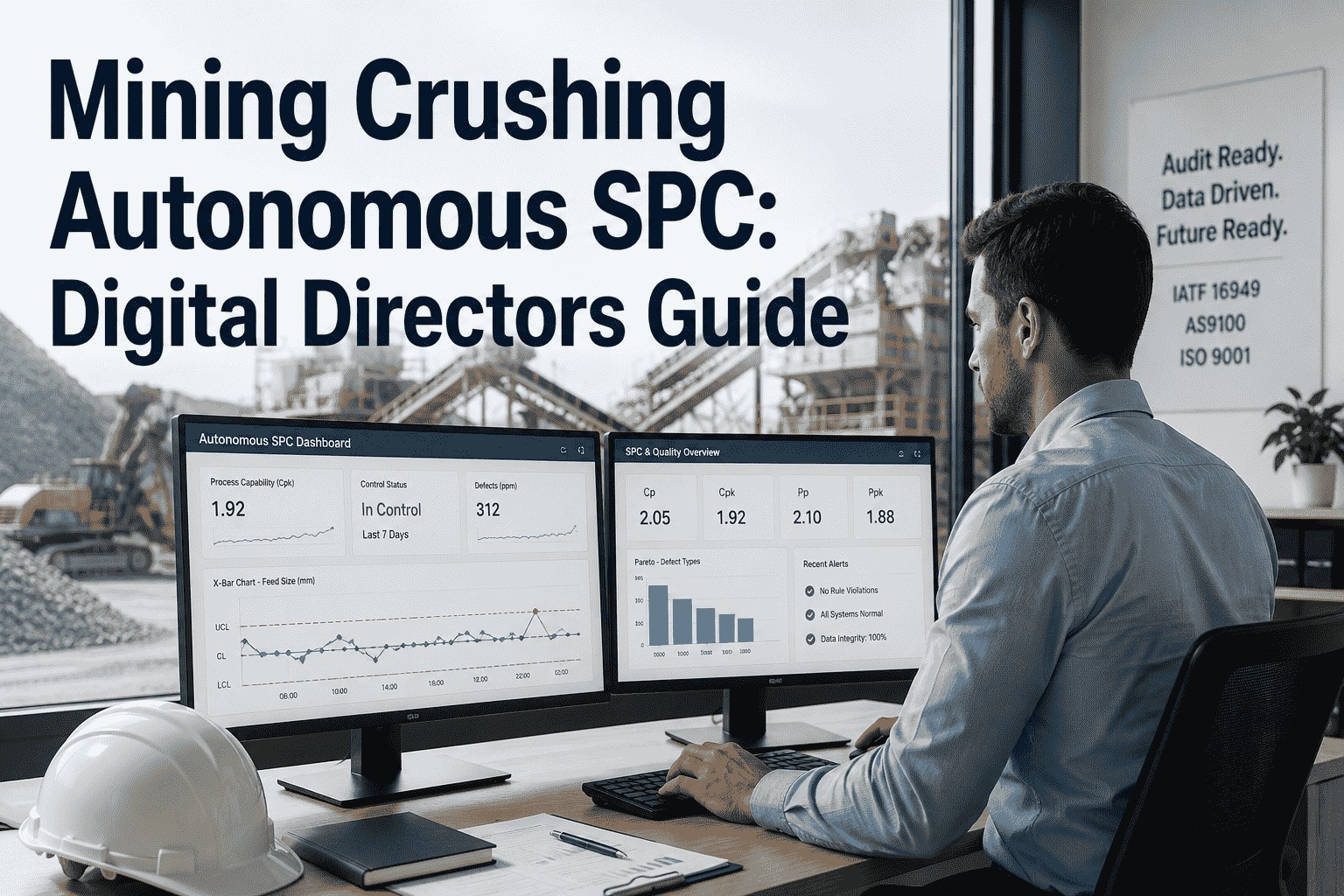
Your last IATF 16949 surveillance audit ran smoothly. The lead auditor reviewed your SPC records, control limit rationales, and corrective action logs. Then she asked a question that every digital manufacturing director in mining flotation now hears: "Your control limits were calculated 14 months ago. Your feed mineralogy changes every shift. How do these static limits relate to your current process capability?" The answer determines whether your audit closes with zero nonconformities or a corrective action request that lands on your desk. For flotation operations still running fixed-limit SPC charts updated during quarterly capability studies, this question is increasingly difficult to defend. Autonomous SPC closes the gap by making every control limit, every capability index, and every quality record a continuous reflection of what the circuit is actually doing right now — not what it was doing when the last study was run.
Autonomous SPC · Audit Readiness · Self-Tuning Charts · Live Cpk
Autonomous SPC for Mining Flotation:
How Digital Manufacturing Directors Deliver
IATF, AS9100 and ISO 9001 Audit Readiness
iFactory's autonomous SPC platform gives digital manufacturing directors in mining flotation a self-tuning quality intelligence layer that continuously recalculates control limits from live process data, runs all Western Electric rules on 60+ variables simultaneously, tracks Cpk and Ppk per flotation cell in real time, and generates the timestamped audit-ready quality records that IATF 16949, AS9100 and ISO 9001 assessors require — without adding to the operator's documentation workload.
94%
Fewer nonconformities related to SPC control limit justification reported by mining operations using autonomous SPC with self-tuning limits — versus fixed-limit SPC that cannot evidence relevance to current process conditions
Real-time
Cpk and Ppk calculation per flotation cell per parameter — replacing quarterly capability studies with live indices that auditors can verify against current process data at any point in the production record
100%
Timestamped audit trail for every quality event — every control limit change, every Western Electric rule violation, every operator intervention logged automatically with the process variable state at the time of the event
2-6 hr
Lead time that autonomous SPC provides before a concentrate grade specification breach — enabling preventive intervention that becomes documented evidence of risk-based quality management under ISO 9001 Clause 6.1
What Autonomous SPC Means for Audit Readiness in Mining Flotation
Statistical process control has been the foundation of quality management systems since Shewhart published the control chart in 1924. The ISO 9001, IATF 16949, and AS9100 standards all mandate SPC as a core quality tool. But the audit requirement is not that you run control charts. The requirement — stated explicitly in IATF 16949 Clause 9.1.1.1 and implied across all three standards — is that your control limits must be relevant to the current state of the process and that your capability indices must be calculated from data that reflects actual production conditions.
In mining flotation, this requirement creates a structural compliance gap. A flotation circuit processing 25,000 tonnes per day through rougher, scavenger, and cleaner cells experiences feed mineralogy shifts, reagent effectiveness changes, froth characteristic variations, and seasonal water quality differences that make a six-month-old control limit study statistically irrelevant. The static UCL and LCL on the operator's screen do not represent the current process. The Cpk number in the quarterly report does not represent current capability. The auditor sees this misalignment. The corrective action follows.
Autonomous SPC solves this by making every SPC element self-correcting. Control limits recalculate continuously from a rolling window of current process data — typically 100 to 200 data points per parameter, representing one to three hours of production at standard sampling rates. Capability indices update with every data point, not every quarter. Western Electric rules run automatically against the current adaptive limits, not a static baseline. Every limit change, every rule violation, every operator action is logged with a timestamp and linked to the process variable state at the time of the event. The auditor sees a quality record that is a complete, continuous, and auditable account of what the process did, what the system detected, and what action was taken — not a static chart from a quarterly report that bears little relationship to the material produced on the shift under review.
The Audit Gap: Why Static SPC Creates Compliance Risk in Flotation
The compliance exposure that static SPC creates in flotation is not theoretical. Every fixed-limit control chart on a flotation circuit presents three specific audit risks that autonomous SPC eliminates structurally — not through better documentation practices but through a fundamentally different approach to control limit calculation and capability tracking.
1
Control Limit Relevance
IATF 16949 requires that control limits be established from data produced under stable, capable conditions and maintained to reflect current process performance. A static limit calculated from a quarterly capability study fails this requirement the moment feed mineralogy shifts. The auditor asks: "How do you demonstrate that these limits are applicable to the material produced during the period under review?" With static SPC, the answer requires a manual analysis that is rarely conducted in real time. With autonomous SPC, the answer is built into every data point — the limits recalculated from the same production data the auditor is examining.
2
Capability Index Currency
ISO 9001 Clause 9.1.1 requires monitoring and measurement of process performance. Cpk and Ppk are the standard metrics for this requirement. A Cpk value calculated from data collected three months ago does not satisfy this clause when the process has operated across multiple ore zones and seasonal water conditions since the calculation was performed. The auditor expects the capability index to reflect the actual process output for the batch or shift under review. Autonomous SPC provides this by calculating Cpk and Ppk live, per cell, per parameter, from the current production window — making the capability index audit-ready at every moment.
3
Special Cause Documentation
Every quality standard requires documented evidence of special cause detection and corrective action. With static SPC, special causes are identified when an operator notices a point beyond the fixed control limit — which may be hours after the event began, or may be missed entirely during an ore zone transition that generates false alarms. The documentation gap is twofold: events go undetected because the limits are wrong, and detected events lack the timestamped process context that auditors require. Autonomous SPC logs every Western Electric rule violation with the process variable state at detection time, the root-cause attribution from the ML model, and the operator's intervention record — creating a complete corrective action evidence chain automatically.
Audit Readiness: Before and After Autonomous SPC
Before: Reactive SPC
- Static control limits from quarterly capability study — relevance to current feed unverifiable
- Cpk and Ppk calculated quarterly — does not reflect current ore zone or reagent regime
- Western Electric rules applied manually by operator — detection depends on operator vigilance
- Special cause events reconstructed from shift logs after the fact
- Corrective action evidence assembled manually for each audit submission
- False alarm rate of 20-30% during ore zone transitions trains operators to ignore signals
- Audit nonconformity risk increases with every feed change that shifts the process baseline
After: Autonomous SPC
- Self-tuning control limits recalculated from rolling 100-200 data point window — always relevant to current feed conditions
- Cpk and Ppk calculated live per cell per parameter — available for any time window the auditor requests
- All eight Western Electric rules running continuously on every monitored variable — automated detection with zero operator dependency
- Every special cause event logged automatically with timestamp, process state, root-cause attribution, and intervention record
- Complete corrective action evidence chain generated as a byproduct of normal system operation
- False alarm rate below 5% — adaptive limits eliminate alarms from normal feed variation, every alert is a signal worth acting on
- Audit ready at any point in the production cycle — all records timestamped, searchable, and exportable without manual compilation
Four Pillars of Audit-Ready Autonomous SPC
The autonomous SPC system that supports audit readiness in mining flotation rests on four interdependent capabilities. Each addresses a specific compliance requirement in the quality management standards — and each generates audit evidence automatically as a byproduct of its normal operation.
01
Self-Tuning Control Limits
The EWMA model continuously estimates the current process mean and standard deviation from a rolling data window per parameter. Upper and lower control limits recalculate at plus or minus three sigma from the rolling mean. When feed grade drops or ore type changes, the limits follow the new baseline — eliminating false alarms from normal feed variation and ensuring that every control limit on the operator's screen reflects the current process state. For the auditor, this means every limit in the quality record can be traced to the production data that produced it, with the calculation method, window size, and recalc frequency documented in the system configuration log.
02
Continuous Western Electric Rule Detection
All eight Western Electric pattern rules run against the adaptive limits on every monitored parameter, every data cycle, with zero operator configuration required. Rule 1 detects sudden assignable-cause events. Rule 4 detects gradual drift — the pattern that accounts for the majority of undetected grade failures in flotation. Rules 5 through 8 detect systematic trends, stratification, and cyclic patterns that manual chart review routinely misses. Every rule violation generates a timestamped event record with the parameter name, violation type, process variable values at the time of detection, and the current adaptive limit values. This record satisfies the IATF 16949 requirement for documented special cause detection without requiring the operator to annotate charts manually.
03
Live Capability Index Tracking
Cp, Cpk, Pp, and Ppk are calculated live per flotation cell, per parameter, from the current production window. The gap between Cpk and Ppk is tracked continuously — when Ppk diverges from Cpk, the system flags the instability pattern that signals a cell moving toward off-spec operation before the grade actually drops. For audit purposes, the live capability index record provides the documented evidence that quality standards require: a continuous trace of process capability across every shift, every ore zone, and every reagent regime. The digital manufacturing director can produce a Cpk trend for any parameter, any cell, and any date range — with the underlying process data available for auditor verification — without a manual data compilation exercise.
04
Automated Audit Evidence Generation
Every scrap risk event, every alert, every operator intervention, and every process variable state at the time of each event is logged automatically with a timestamp. The system generates four primary record types: a scrap risk event log capturing every alert with process context and response; a Cpk trend record showing continuous process capability against specification limits with annotated events; a corrective action record linking each quality event to the intervention taken and the measured improvement; and a shift quality summary exportable per shift, per ore zone, or per quarter. These records are structured to satisfy ISO 9001 Clause 10.2 nonconformity and corrective action requirements, IATF 16949's documented information mandates, and AS9100's product safety and risk management documentation expectations — all produced without manual incident reporting.
The Digital Director's ROI: What Audit-Ready Autonomous SPC Delivers
For the digital manufacturing director responsible for quality system performance across the flotation operation, autonomous SPC delivers measurable outcomes across four domains that directly affect both compliance standing and operational performance.
Operations deploying autonomous SPC report a 60-80% reduction in SPC-related audit nonconformities within the first two surveillance cycles. The primary driver is the elimination of the "control limit relevance" finding — the most common SPC-related nonconformity in mining flotation quality audits. The self-tuning limit model ensures that every control limit in the system has a documented, data-driven relationship to current production conditions.
Manual SPC chart review, control limit recalculation, and corrective action report assembly consumes an estimated 8 to 16 hours per week per quality engineer in a typical flotation operation. Autonomous SPC eliminates this labour by generating all SPC documentation as a byproduct of live system operation. The quality engineer's role shifts from documentation compilation to exception-based review and continuous improvement analysis.
As IATF 16949 and AS9100 audit scopes expand to include supplier quality management, digital evidence requirements, and risk-based process control, the autonomous SPC platform provides the scalable documentation infrastructure that static SPC cannot. Every quality event is logged with the process context that extended audit scopes demand — without additional operator training or documentation procedures.
The same autonomous limits that produce audit-ready documentation also detect grade drift 2 to 6 hours before the concentrate specification breach occurs. Operations report Cpk improvement from the 1.2-1.5 range typical of reactive SPC to the 1.67-1.85 range achievable with predictive intervention. The compliance benefit and the operational benefit come from the same system — not from separate initiatives competing for the same resources.
Free Audit Readiness Assessment
Your Current SPC System May Already Have an Audit Gap. We Will Help You Find It Before the Auditor Does.
iFactory's autonomous SPC platform is purpose-built for digital manufacturing directors in mining flotation operations who need to deliver IATF 16949, AS9100 and ISO 9001 audit-ready quality records without increasing documentation overhead. We will run a free compliance gap analysis against your current SPC infrastructure — mapping your static control limits, capability index calculation frequency, special cause detection methodology, and corrective action documentation process against the requirements of the standards you are certified to. The output is a ranked gap assessment with estimated remediation effort and timeline. No commitment. No sales presentation. A technical assessment delivered by quality system engineers who understand flotation process variability.
Conclusion
The audit readiness question that digital manufacturing directors in mining flotation now face is not whether their SPC system meets the procedural requirements of the standard. It is whether the control limits, capability indices, and quality records that the system produces are structurally capable of withstanding the scrutiny of an auditor who understands that flotation process variability makes static SPC fundamentally non-compliant with the intent of risk-based quality management standards.
Autonomous SPC answers this question by aligning the SPC system with the actual operating condition of the flotation circuit: a process where feed mineralogy, reagent response, froth characteristics, and water chemistry shift continuously, and where a quality record that is not updated continuously is not a reliable record at all. The same self-tuning limits that eliminate false alarms and detect grade drift before it becomes off-spec material produce the timestamped, data-linked, audit-ready evidence trail that IATF 16949, AS9100, and ISO 9001 require — not as a separate documentation exercise, but as a byproduct of a quality control system designed for the conditions under which the process actually operates.
For the digital manufacturing director, the decision is not between a compliant SPC system and a non-compliant one. It is between an SPC system that requires manual effort to maintain even the appearance of compliance — effort that grows with every ore zone change and every audit cycle — and an SPC system that is structurally compliant because its calculation methodology, documentation model, and evidence generation are designed for the inherently variable production environment of a mining flotation circuit. Autonomous SPC does not make the auditor's questions easier to answer. It makes them unnecessary to ask.
Frequently Asked Questions
What specific audit nonconformities does autonomous SPC prevent compared to static SPC in mining flotation?
The most common SPC-related nonconformities in flotation quality audits fall into three categories: control limits that cannot be demonstrated as relevant to current production (IATF 16949 Clause 9.1.1.1), capability indices calculated from data that does not reflect the period under review (ISO 9001 Clause 9.1.3), and insufficient documented evidence of special cause detection and corrective action (ISO 9001 Clause 10.2). Autonomous SPC prevents all three by making control limits self-correcting from live data, calculating Cpk and Ppk continuously from the current production window, and logging every special cause event with timestamp, process state, root-cause attribution, and intervention record automatically. Talk to an expert about reviewing your last audit findings against autonomous SPC capability.
How does autonomous SPC handle the documentation requirements of IATF 16949's risk-based thinking mandate?
IATF 16949 requires organizations to determine risks and opportunities that affect product conformity and to take actions to address them. Autonomous SPC operationalises this requirement by generating a risk-based quality record that includes the forecast grade trajectory, the divergence from target, the root-cause attribution, and the recommended corrective action at the time the risk is detected — not after the nonconforming product has been produced. The risk assessment is continuous, quantified, and documented automatically. The audit trail shows not just what happened, but what the system predicted, when the prediction was issued, and what action was taken in response. This satisfies both the documentation requirement and the risk-based thinking intent of the standard. Book a demo to see the risk-based quality record format.
Can autonomous SPC integrate with our existing DCS and historian for audit evidence without replacing our current SPC software?
Yes. Autonomous SPC deploys as a software layer on top of existing control infrastructure — no DCS replacement, no new sensors, no control room software migration required. The system ingests live data from standard process historians (OSIsoft PI, Aspen InfoPlus.21, Siemens SIMATIC, Rockwell FactoryTalk, and others) and displays self-tuning control charts on the same operator dashboards used today. The audit records are generated in parallel with the existing SPC system, which can remain active during a validation period. After validation, the autonomous SPC system typically operates alongside the existing historian infrastructure, with the static SPC charts retained for reference but no longer used as the primary quality documentation source. Talk to an expert about the integration requirements for your specific DCS and historian configuration.
How long does it take to deploy autonomous SPC and produce audit-ready records from a flotation circuit?
With 30 days of clean historical data for initial model training, the autonomous SPC limits deploy within 24 to 72 hours after data connectivity is established. The system runs in shadow mode alongside static SPC for two to three weeks, allowing the quality team to validate limit behaviour against known process events. After validation, autonomous limits become the primary control chart reference, and audit-ready records begin generating immediately from live system operation. The first audit-ready quality summary is available on the first shift after going live. Full compliance documentation — including the complete event log, Cpk trend record, and corrective action evidence trail — accumulates from the moment of deployment. Book a demo to see a deployment timeline mapped to your circuit configuration.
Your Flotation Circuit's Quality Data Already Exists. Autonomous SPC Makes It Audit-Ready.
iFactory's autonomous SPC platform delivers self-tuning control limits, continuous Western Electric rule detection, live Cpk and Ppk per flotation cell, and automated audit evidence generation — deployed in days, validated against your own circuit data, and structured to satisfy IATF 16949, AS9100 and ISO 9001 documentation requirements without increasing the quality team's compliance administration workload. The data your circuit already produces contains the evidence your next audit needs. Autonomous SPC extracts it automatically.