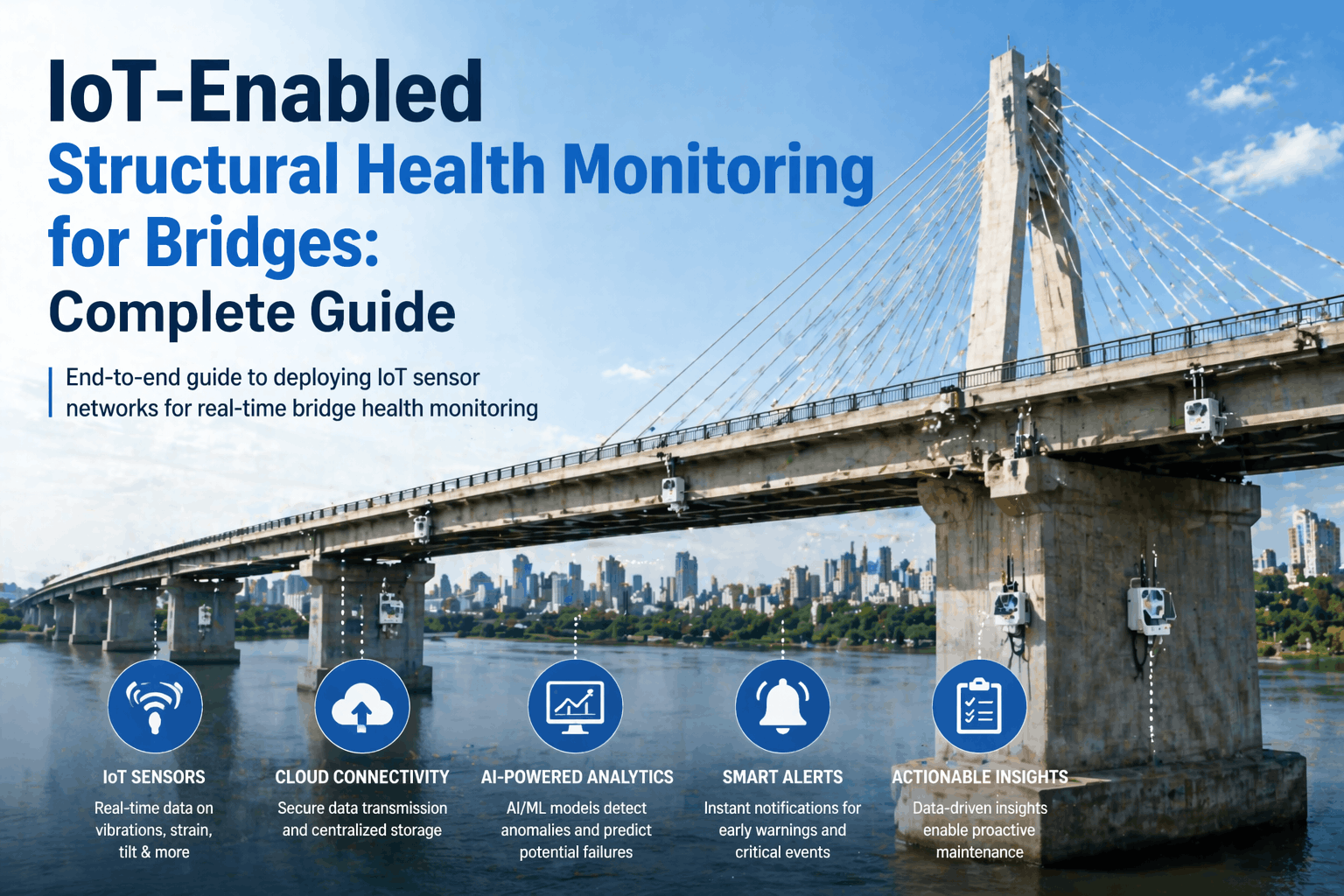
The era of relying solely on biennial visual inspections to guarantee the safety of critical infrastructure is ending. As global bridge networks face escalating traffic loads, extreme weather events, and natural material degradation, engineering firms and Departments of Transportation (DOTs) are accelerating the transition to continuous, real-time telemetry. IoT structural health monitoring for bridges deploys embedded sensor networks that measure micro-strain, vibrational anomalies, and corrosion rates continuously, transmitting data to AI-driven digital twins. For asset managers responsible for public safety, adopting an intelligent maintenance system is no longer a luxury. It is the operational mandate that prevents catastrophic failures, optimizes limited repair budgets, and extends the viable lifespan of legacy structures. This complete guide details how to build an IoT sensor network, integrate predictive machine learning models, and successfully transition to continuous structural health monitoring.
Continuous IoT Telemetry for Critical Infrastructure
iFactory's infrastructure AI platform delivers high-fidelity sensor integration, real-time load analytics, and predictive alerting built specifically for bridge management.
Designing an IoT Sensor Toolkit for Bridge Environments
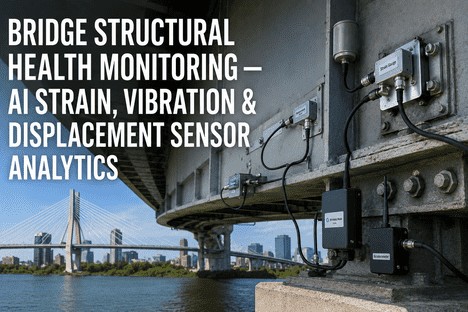
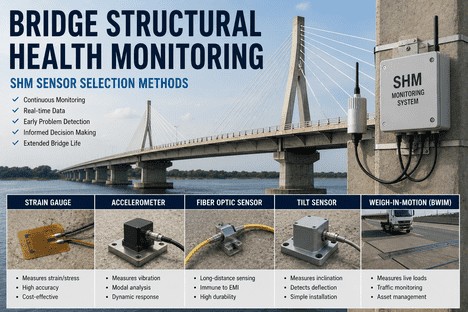
Effective structural health monitoring begins with high-fidelity, ruggedized data capture. Unlike controlled manufacturing environments, bridges endure violent thermal expansion, moisture ingress, and the constant dynamic loading of heavy freight traffic. The modern iot sensor infrastructure relies on a distributed array of specialized edge devices that capture both the dynamic responses and long-term static changes of the structure. When these sensor arrays are layered into a unified infrastructure monitoring software, they eliminate the "blind spots" between manual inspections. Asset managers who book a demo with our team quickly realize that selecting the right sensor mix is the first step toward verifiable predictive maintenance.
Accelerometers & Tiltmeters
Continuously measure the dynamic vibrational frequency and rotational displacement of bridge decks and piers. Crucial for detecting shifts in structural stiffness or scour-induced foundation settling.
Fiber Optic Strain Gauges
Embedded within concrete or welded to steel girders to measure micro-strains caused by live traffic loads and thermal expansion. Determines if the bridge is operating within its designed load rating.
Linear Displacement Sensors
Monitors the behavior of expansion joints and bearing pads. Alerts engineers immediately to seized bearings or joints that fail to accommodate seasonal temperature fluctuations.
Electrochemical Corrosion Probes
Embedded next to internal rebar matrices to measure moisture ingress, chloride concentration, and active corrosion rates—providing a predictive window into spalling years before it occurs.
Machine Learning Diagnostics: Finding the Signal in the Noise
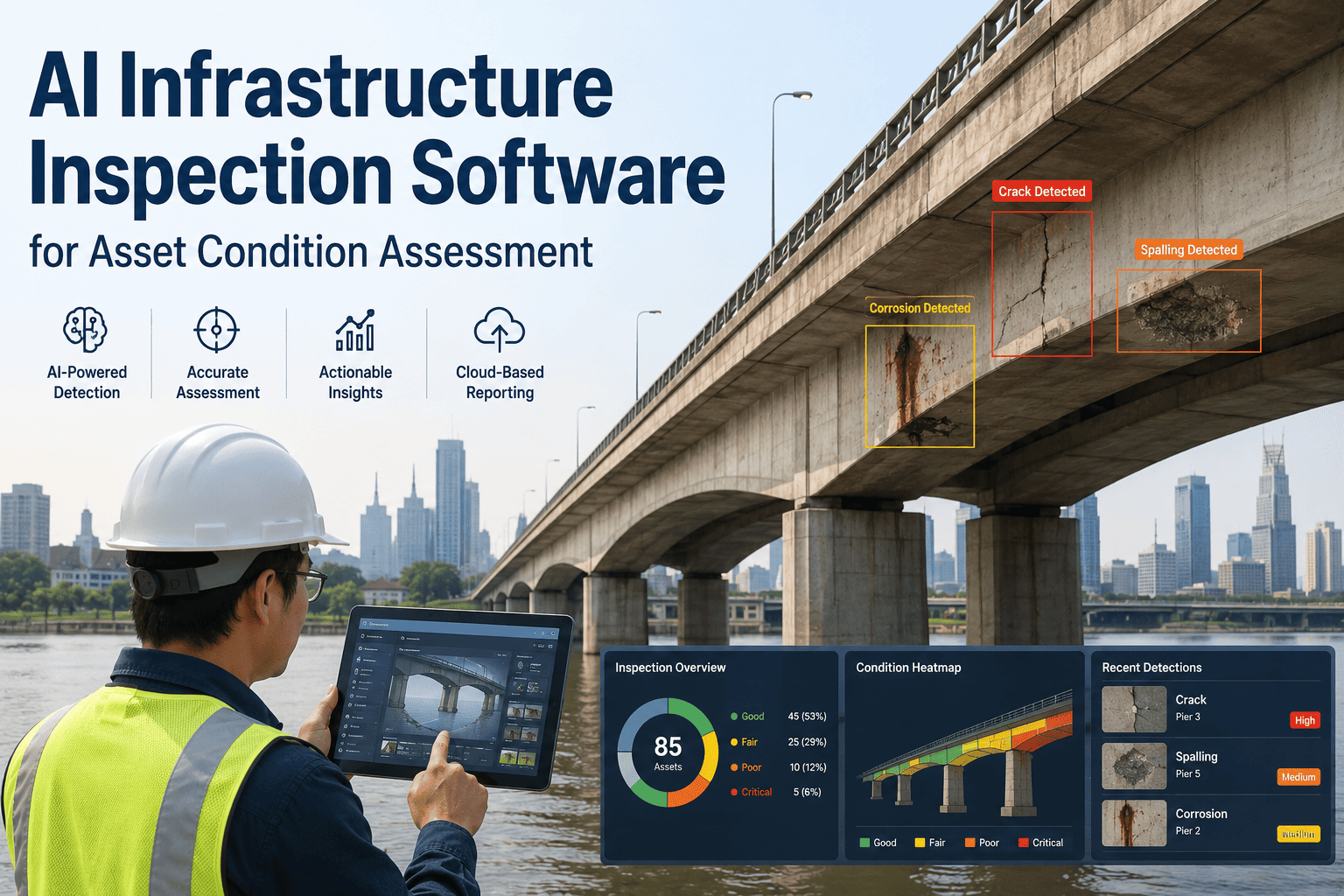
A fully instrumented suspension or cable-stayed bridge can generate terabytes of raw data per month. Without an ai asset management layer, this data creates "alert fatigue" rather than actionable intelligence. Modern intelligent maintenance systems utilize edge-computing ML (Machine Learning) models to filter out the "noise" of daily traffic and temperature swings, isolating the subtle, slow-moving anomalies that indicate true structural distress. When a crack begins to propagate in a steel box girder, it shifts the resonant frequency of that segment slightly. iFactory’s AI detects this shift by comparing current telemetry against the bridge's baseline "Digital Twin." Contracting authorities deploying iFactory report that deploying AI analytics reduces false-positive alarms by over 90% while accelerating actual defect discovery.
Connecting the Sensor Network: Data Transmission Protocols
For bridges located in remote rural areas or spanning wide waterways, running hardwired network infrastructure is financially prohibitive. A comprehensive IoT structural health monitoring strategy requires flexible, low-power data transmission protocols. The infrastructure must securely stream continuous kinematic and environmental data back to the centralized infrastructure monitoring software without constant battery replacements.
| Transmission Standard | Optimal Bridge Application | Range & Bandwidth | Operational Benefit |
|---|---|---|---|
| LoRaWAN (LPWAN) | Battery-powered corrosion & temp sensors | High Range (10km+) / Low Bandwidth | 5-10 year battery life per node |
| 5G / Cellular Edge | High-frequency accelerometers & AI Cameras | Medium Range / High Bandwidth | Supports real-time HD video processing |
| Fiber Optic (FBG) | Embedded critical load-strain measurement | Cable Bound / Massive Bandwidth | Immune to electromagnetic interference |
| Point-to-Point Wi-Fi | Inter-pier communication arrays | Short Range / High Bandwidth | Consolidates mesh data to a single uplink |
| Satellite (LEO) | Remote highway / extremely isolated bridges | Global Range / Varies | Complete connectivity in off-grid locations |
Deploying a Bridge SHM Network: The Phased Approach
Securing budget for a smart infrastructure initiative requires demonstrating immediate value while building the foundation for long-term artificial intelligence integration. Deploying a structural health monitoring solution follows a structured sequence that moves from establishing baseline reality to achieving predictive autonomous intelligence. Attempting to deploy higher-level AI features without a validated, high-quality data stream often results in "garbage in, garbage out" scenarios. A solution mapping call helps map this precise phased strategy for your specific bridge portfolio.
Sensor Calibration & Baseline Acquisition
Install physical IoT sensors on critical zones (fracture-critical joints, massive piers, main cables). For the first 30-60 days, the platform ingests data passively to establish the structural "baseline"—learning how the bridge normally behaves under varying traffic loads and seasonal temperature gradients.
Threshold Alerting & Data Integration
Activate static threshold rules (e.g., alert if expansion joint displacement exceeds 40mm). Integrate SHM telemetry with your existing CMMS or enterprise asset management tools (IBM Maximo, SAP) so that structural anomalies automatically trigger inspection work orders.
Predictive AI Digital Twin Activation
Transition from threshold alerting to predictive forecasting. The machine learning models analyze continuous multi-variate data to forecast the Remaining Useful Life (RUL) of specific components and simulate future structural degradation under increased freight load projections.
"Transitioning to continuous IoT health monitoring completely shifted our bridge management strategy. We no longer rely on 24-month manual inspection cycles to tell us a joint has failed. The AI platform provides a daily, verifiable health score, allowing us to intervene prophylactically before minor stress fractures threaten public safety."
— Chief Bridge Engineer, State Department of Transportation
Measuring the ROI of Predictive Infrastructure Maintenance
The Return on Investment for a continuous bridge monitoring system is calculated through both direct operational savings (reduced manual inspections) and the massive deferred capital expenditure of extending the structure's lifespan. The chart below benchmarks the average improvements achieved across managed infrastructure portfolios adopting iFactory's predictive analytics.
IoT Bridge Structural Health Monitoring — Frequently Asked Questions
Does IoT continuous monitoring replace federally mandated manual inspections (e.g., NBIS visual inspections)?
Currently, IoT SHM does not legally replace mandated comprehensive visual or hands-on inspections. However, it operates alongside them, guaranteeing structural safety during the 24 months between manual inspections and often allowing authorities to safely request extensions on certain manual inspection cycles.
How do embedded sensors survive the harsh environment underneath a bridge deck?
Sensors selected for SHM deployments are inherently industrial-grade. They are typically IP67/IP68 rated against water ingress, shielded against heavy electromagnetic interference (EMI), and utilize housings resistant to severe temperature variations and de-icing salt corrosion.
Can a digital twin differentiate between normal heavy traffic and a structural anomaly?
Yes. The core function of the Machine Learning (AI) layer is filtering. It understands the "normal" resonant vibration caused by a fleet of heavy freight trucks. Anomaly detection only triggers when the structural response to that traffic deviates fundamentally from the established historical physics baseline.
How is power supplied to these IoT networks on bridges without accessible grid electricity?
The sensor ecosystem heavily utilizes low-power network protocols (like LoRaWAN), allowing edge nodes to run for 5-10 years on lithium batteries. Central gateways often use paired solar-and-battery arrays, entirely divorcing the SHM system from local electrical grids.
What happens if a sensor breaks or drifts out of calibration? Will we get false alarms?
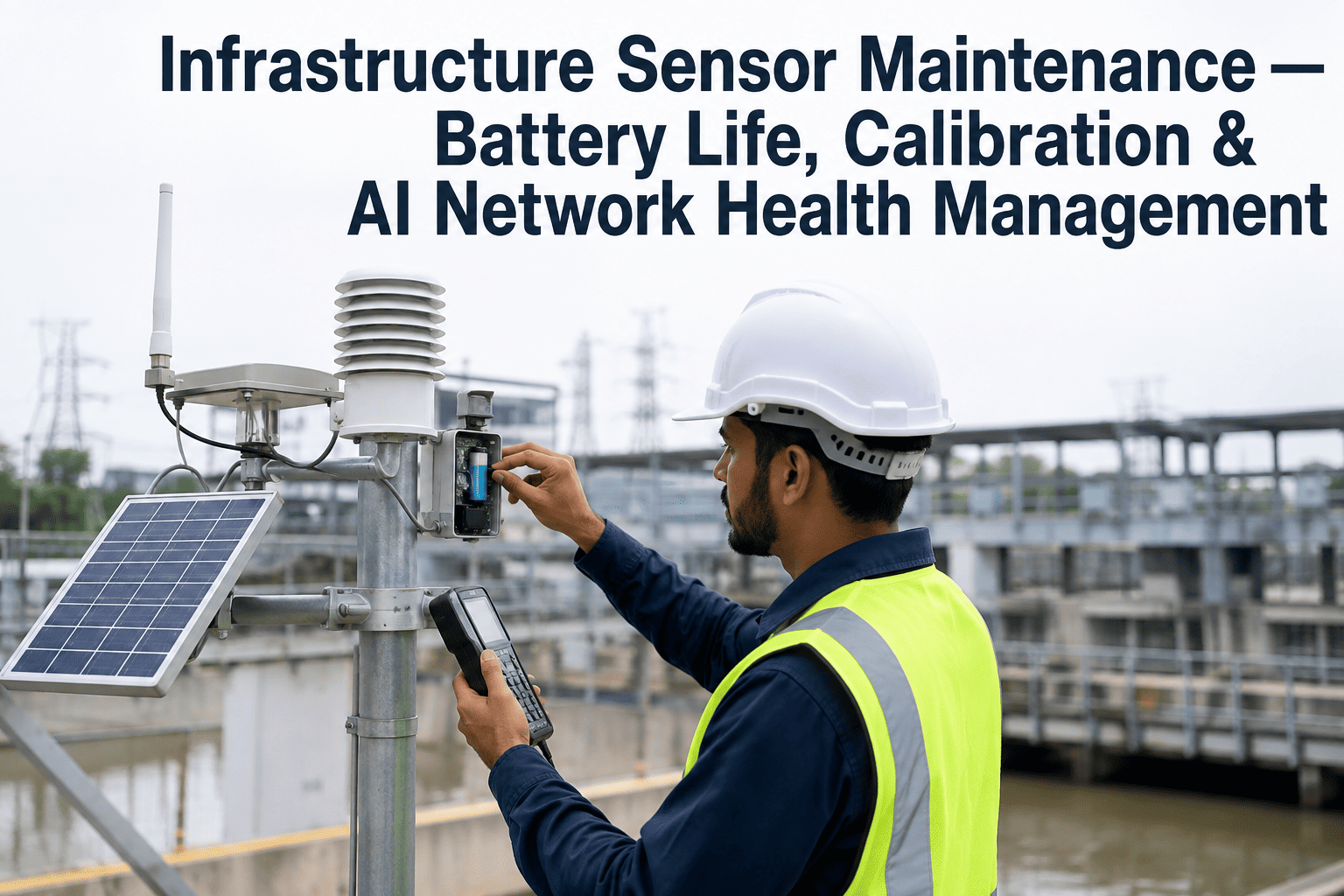
iFactory’s intelligent maintenance system constantly monitors the "health of the health monitors." If an accelerometer begins reporting mathematically impossible data gradients, the AI flags the sensor itself for maintenance rather than triggering a false structural emergency.
How do you retro-fit sensors onto a legacy bridge built in the 1960s?
Sensors are non-destructively mounted using high-strength industrial epoxies, magnetic mounts, or welded brackets attached to non-critical structural steel. Fiber optics can be surfacemounted along main girders to capture continuous strain without altering the original structural engineering.
Can this system monitor scour underneath bridge piers in the water?
Yes. The IoT ecosystem integrates sonar depth sensors and specialized tiltmeters on the lower pier columns. If rapid river currents begin eroding the foundation soil (scour), the resulting microscopic tilt is detected immediately—long before visible deck settling occurs.
What is the ROI driver for deploying an AI SHM platform across a DOT network?
The primary ROI driver is "Rehabilitation Deferment." By identifying and repairing a micro-crack immediately using continuous data, DOTs prevent the localized failure from compounding into a full deck-replacement scenario, saving millions of public dollars and extending the asset life by 10-20 years.
Protect Your Critical Infrastructure with Continuous AI Monitoring
iFactory's infrastructure SHM platform deploys intelligent IoT sensors and predictive ML models, ensuring the continuous safety and optimization of your bridge networks.