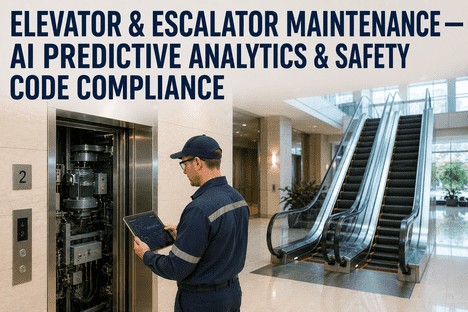
Elevator & Escalator Maintenance — AI Predictive Analytics & Safety Code Compliance
By Grace on June 20, 2026
Every elevator in your building makes roughly 250,000 trips per year. Every start, every stop, every door cycle generates data that could tell you exactly when a component will fail — but most facility managers never see that data until the car stops moving and the calls start coming. The global elevator maintenance market has reached $39.8 billion in 2025, with an installed base of over 18 million elevators worldwide and 1.2 million new units added annually. Yet the majority of commercial buildings still operate on calendar-based maintenance schedules set when the building opened — not condition-based programmes driven by what is actually happening inside the hoistway. When a motor bearing that has been overheating for six weeks finally seizes during morning rush hour, the emergency service call costs 3 to 5 times more than a planned intervention, tenant complaints compound in the property manager's inbox, and the next scheduled inspection is still three weeks away. iFactory's AI predictive maintenance module was built to close this gap — converting elevator maintenance from a calendar-driven expense into a data-driven asset protection strategy that keeps units running, keeps tenants satisfied, and keeps every elevator compliant with ASME A17.1 code requirements without the premium cost of reactive service.
Stop Reacting to Elevator Breakdowns. Start Predicting Them — With iFactory's AI-Powered Maintenance Module.
Real-time motor health monitoring, door operation analytics, safety device tracking, and automated compliance documentation for every elevator in your portfolio — accessed from a single dashboard designed for facility managers, not data scientists.
Global elevator maintenance services market in 2025, growing at 6.1% CAGR toward $62.7B by 2033
Global Installed Base
18M+
Elevators operating globally, with 1.2 million new units installed each year across commercial and residential buildings
Predictive AI Growth
12.8%
CAGR of the elevator predictive maintenance platform market — from $4.8B in 2025 to $14.2B by 2034
Annual Passenger Trips
18B
Elevator passenger trips per year in the United States alone — every trip depends on functioning safety systems
The Real Cost of Calendar-Based Elevator Maintenance
The Calendar Trap
Scheduled PM visits do not know what condition the equipment is actually in.
A quarterly PM visit checks the same items regardless of whether a door operator is at 12,000 cycles or 180,000 cycles — because the calendar does not track component wear. The result is that critical components approaching end-of-life are serviced identically to components that were replaced last month. The inspection interval provides a false sense of coverage while failure risk accumulates silently between visits. ASME A17.1 Section 8.6 requires a documented Maintenance Control Programme, but the standard does not prescribe condition-based logic — leaving most facilities compliant on paper while running equipment past its optimal service window.
The Reactive Premium
Emergency call-outs cost 3 to 5 times the rate of planned maintenance.
After-hours emergency repairs for traction elevators typically command premium labour rates, parts are sourced under time pressure at list price rather than negotiated contract rates, and every hour of unplanned downtime in a commercial tower generates tenant dissatisfaction that compounds into lease renewal risk. A building with six elevators averaging twelve emergency calls per year can save $40,000 to $80,000 annually by converting those calls to planned events — and that is before counting the extended component life, reduced tenant complaints, and avoided compliance violations that come with a predictive programme.
The Parts Inefficiency
Parts are replaced on schedule, not on condition — generating unnecessary cost and waste.
Time-based replacement schedules treat all components identically regardless of actual wear state, utilisation rate, or environmental conditions. A door operator in a low-traffic office building receives the same replacement interval as one in a busy hospital — wasting capital on components with remaining useful life while other components fail before their scheduled replacement because load conditions exceed the design assumptions baked into the calendar interval. Predictive maintenance eliminates this mismatch by triggering replacement based on measured condition data rather than elapsed time.
The Skills Shortage Multiplier
Fewer qualified technicians make every reactive call more expensive and slower.
The elevator industry is facing a skilled labour shortage as experienced technicians retire and the pipeline of new entrants fails to keep pace with安装 growth. When every reactive call consumes technician hours that could have been deployed on planned work, the scarcity premium escalates. Predictive analytics reduces the reactive burden by 40 to 60 percent, freeing the available workforce to focus on planned maintenance and modernisation projects — improving both service quality and technician job satisfaction.
Calendar-Based Maintenance Tells You When to Visit. Predictive Maintenance Tells You What Is Actually Wrong — Before It Becomes an Emergency.
iFactory's AI module monitors every elevator's motor temperature, door cycle performance, vibration signature, and safety device status in real time — scheduling interventions based on component condition rather than the calendar. The result is fewer callbacks, longer equipment life, and a documented compliance trail that satisfies ASME A17.1 inspection requirements automatically.
How AI Predictive Maintenance Transforms Elevator Operations — From Sensor to Service Decision
Predictive maintenance for elevators follows a five-stage data pipeline that converts raw sensor readings into actionable maintenance decisions. Understanding this pipeline is essential for facility managers evaluating predictive platforms — because the quality of the output depends entirely on the rigour of each stage.
01
Sensor Acquisition
IoT sensors on motor, door operator, governor, brake, and car frame capture temperature, vibration, door cycle count, current draw, and brake pad thickness at sub-second intervals.
02
Edge Processing
On-controller edge processors filter noise, normalise signals across different sensor types, and transmit structured data to the cloud platform every 60 seconds — preserving bandwidth while maintaining real-time visibility.
03
Pattern Recognition
Machine learning models compare current readings against baseline performance profiles for each unit — flagging anomalies such as rising motor temperature trends, increasing door reopen time, or vibration pattern shifts that precede component failure.
04
Risk Scoring
Each detected anomaly is scored by severity and projected time-to-failure. Components with critical risk scores trigger automated work orders. Moderate-risk items are queued for the next planned visit. Low-risk trends are logged for periodic review.
05
Action & Documentation
Work orders are dispatched with component-specific diagnostic data attached. Completed repairs are documented and the updated condition data feeds back into the model — creating a continuous improvement loop that refines future predictions for every unit.
The outcome of this pipeline is measurable: KONE reported 70 percent more fault detection and 40 percent fewer equipment issues after deploying IoT sensor analytics across its global elevator fleet. Buildings with six or more elevators implementing predictive analytics report $75,000 to $200,000 in annual savings through reduced emergency calls, extended component life, and avoided tenant penalties.
Escalator-Specific AI Monitoring — Detecting Step, Handrail, and Drive System Failures Before They Escalate
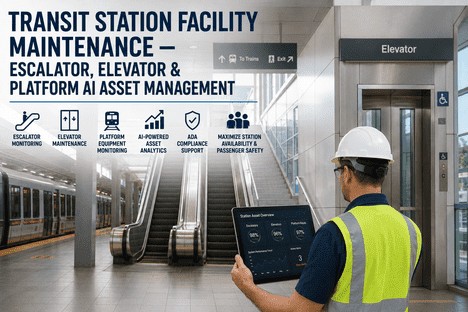
Escalators present a different set of maintenance challenges than elevators — higher mechanical wear rates, continuous operation during building hours, and safety-critical components that must function correctly on every cycle. The ASME A17.1 code applies equally to escalators, with specific requirements for step-to-riser clearance, comb plate engagement, handrail speed synchronisation, and brake system testing. iFactory's AI module extends predictive monitoring to every escalator in your facility, covering the failure modes that generate the highest service call frequency and the greatest safety risk.
Step & Chain Monitoring
Vibration sensors on the step chain detect roller wear, chain elongation, and step misalignment before they cause combplate strikes or step gaps. Tension monitoring on the step chain tracks elongation rates and predicts replacement timing within 95 percent accuracy, eliminating unexpected step failures that require full escalator shutdown and manual inspection of every step.
Handrail Speed & Tension
Handrail speed synchronisation with the step band is monitored continuously. ASME A17.1 requires handrail speed to remain within 0 to 2 percent of step speed — deviation beyond this threshold is a compliance violation and a passenger safety risk. iFactory detects handrail lag or over-speed conditions in real time and generates a corrective work order before the deviation triggers an inspection citation or contributes to handrail damage requiring replacement.
Drive & Brake System
Escalator drive motor current draw, gearbox temperature, and brake stop distance are monitored on every operational cycle. When brake stop distance increases beyond the code-required limit or gearbox temperature trends upward over consecutive days, the AI model schedules inspection and intervention before the escalator must be taken out of service for emergency repairs — preserving both passenger safety and operational availability.
The impact of predictive monitoring on escalator reliability is substantial: facilities that implement AI-driven escalator monitoring report a 50 to 65 percent reduction in unplanned escalator downtime and a 30 to 40 percent reduction in service call frequency — with the sensor investment typically recovered within 12 to 18 months through reduced emergency repair costs and extended overhaul intervals.
Compliance Timeline
ASME A17.1 Code Requirements — What Every Facility Manager Must Track, and How Predictive Analytics Automates the Documentation
ASME A17.1-2025 — the Safety Code for Elevators and Escalators adopted across all 50 US states — sets mandatory requirements for design, installation, operation, inspection, testing, maintenance, alteration, and repair. The 2025 edition introduced cybersecurity requirements for networked control systems for the first time, alongside strengthened emergency communication mandates and flood detection provisions. Every building is legally required to maintain a documented Maintenance Control Programme per Section 8.6. Non-compliance can trigger stop-operation orders, fines, and liability exposure that far exceeds the cost of a compliant predictive maintenance programme.
Category 1
Annual Inspection
Visual and functional check of all safety devices, doors, controls, machine room, and car top. ASME A17.1 8.11. Certificate must be posted inside the car.
Category 5
5-Year Full-Load Test
Full-load safety test with governor trip, buffer test, and car and counterweight safeties. Witnessed by QEI-licensed inspector. ASME A17.1 8.10.
MCP
Monthly Maintenance Control
Per ASME A17.1 Section 8.6, a documented programme covering car and hoistway, safety devices, machine room, drive system, and emergency communications.
How iFactory Automates ASME A17.1 Compliance Documentation
iFactory's predictive maintenance module generates timestamped digital records for every sensor reading, every anomaly detection, and every completed work order — creating an audit-ready compliance trail that maps directly to ASME A17.1 inspection requirements. The Maintenance Control Programme documentation is auto-populated from sensor data and technician activity logs, eliminating the manual record-keeping that consumes an estimated 8 to 12 hours per month per building. Inspection certificates are tracked with automated renewal reminders 90 days before expiration. When a Category 1 or Category 5 test is due, the system generates the required work order package with the specific checklist items defined in ASME A17.1 Section 8.11 — ensuring no inspection requirement is missed.
What iFactory's AI Predictive Maintenance Module Actually Does — Capabilities That Convert Sensor Data into Maintenance Savings
Motor Health & Drive System Monitoring
Continuous monitoring of motor winding temperature, current draw, vibration spectrum, and drive system harmonics. The AI model detects early indicators of bearing wear, insulation degradation, and drive misalignment — the three most common failure modes that cause unplanned escalator and elevator shutdowns. When temperature trends exceed baseline by 15 percent or vibration amplitude shifts by more than 20 percent, a predictive work order is generated automatically, typically 14 to 28 days before failure would occur under continued operation.
Door systems account for approximately 60 percent of all elevator service calls. iFactory's door analytics module tracks cycle count, open and close times, reopening device activation frequency, and motor current draw at each stage of the door cycle. When door close time increases by 0.3 seconds above baseline or reopening device activations exceed 5 percent of cycles, the system flags the door operator for inspection before it fails during peak traffic — eliminating the single largest source of passenger complaints and callback costs.
Cycle Count TrackingTiming Deviation AlertsMotor Current Monitoring
Safety Device & Brake Condition Monitoring
Brake pad thickness sensors, governor overspeed switch status, car-top and pit safety device continuity, and emergency communication system functionality are monitored continuously. When brake pad wear reaches 70 percent of service limit, the predictive model generates a replacement work order with sufficient lead time to schedule the intervention during low-traffic hours — eliminating the need for emergency brake replacements that typically require after-hours labour rates and disrupt building operations for an entire day.
Brake Pad Wear TrackingGovernor Switch StatusEmergency Comms Testing
Compliance Documentation & Audit Readiness
Every sensor reading, anomaly detection, work order, and technician action is logged with a timestamp and digital signature — creating a complete compliance record for every elevator unit. When an ASME A17.1 inspector arrives, the facility manager can generate a full audit package — MCP documentation, Category 1 inspection records, Category 5 test reports, emergency communication test logs, and firefighter service test records — in under 15 minutes. No paper files, no missing records, no compliance citations for incomplete documentation.
What the Numbers Show — The ROI of Transitioning from Calendar-Based to AI Predictive Maintenance
Calendar-Based (Traditional)
$80K+
Annual emergency call-out cost for a 6-elevator building at 12 reactive calls per year at 3 to 5 times planned labour rates. Does not include tenant penalty clauses or lease impact from extended downtime events.
AI Predictive (iFactory)
$75K–$200K
Annual savings reported by buildings with 6+ elevators using predictive analytics — from reduced emergency calls, extended component life, and avoided tenant penalties. Sensor hardware costs recovered within 12 to 18 months.
Calendar-Based
8–12 hrs/month
Manual compliance documentation time per building — maintaining MCP records, inspection certificates, test reports, and emergency communication logs in paper or spreadsheet format.
AI Predictive
14-minute audit
Time to generate a complete ASME A17.1 audit package from iFactory's digital compliance records — including MCP, inspection reports, test certificates, and maintenance history for every unit.
We manage a portfolio of 14 commercial towers with 42 elevators across three cities. Before iFactory, we were running calendar-based PMs that gave us a false sense of control — the quarterly visit happened on schedule, but we were still getting 10 to 15 emergency call-outs per month across the portfolio. The first month on iFactory's predictive module, the system flagged a door operator on a high-traffic unit that was showing a 0.4-second close-time degradation. Our technician replaced the door rollers during a scheduled visit the next day. Two days later, that door operator would have failed during morning peak traffic — we would have had a car out of service for four hours and a lobby full of frustrated tenants. That single intervention paid for the sensor hardware on that building. Across the portfolio, we have reduced emergency call-outs by 62 percent in the first year.
— Director of Facility Operations, Commercial Real Estate Portfolio — 20 Years Building Management
Conclusion
The elevator maintenance industry is projected to reach $62.7 billion by 2033, with over 18 million elevators already installed globally and 1.2 million new units coming online each year. Elevators worldwide break down an average of four times annually, generating 272 million hours of lost service each year that affects tenants, compliance status, and building liability exposure simultaneously. The average commercial building spends 15 to 25 percent of its total maintenance budget on elevator and escalator servicing — and the majority of that spend is still allocated to reactive repairs that cost 3 to 5 times more than planned interventions. This is not a technology problem. The sensors, the connectivity, and the AI models exist today. The gap is not in the capability to predict failures — it is in the deployment of that capability at a scale that covers every unit in a facility manager's portfolio.
The facility managers who thrive in this environment will be those who stop treating elevator maintenance as a calendar-driven compliance exercise and start treating it as a data-driven asset management discipline — where every motor temperature reading, every door cycle, every brake pad measurement, and every escalator step chain vibration informs a maintenance decision that prevents failure rather than reacting to it. The technology exists. The sensors are cost-effective. The ASME A17.1 code already requires the documentation that predictive systems generate automatically. The building owners who have already made the transition are reporting 60 to 70 percent reductions in emergency call-outs, 40 percent fewer equipment issues, and six-figure annual savings across their portfolios. The only missing piece is the platform that connects the sensor data to the maintenance decision — and that is what iFactory provides.
iFactory's AI predictive maintenance module gives facility managers real-time visibility into every elevator's motor health, door operation performance, safety device condition, escalator step chain integrity, and ASME A17.1 compliance status — with automated work order generation, digital compliance documentation, and the kind of data-driven maintenance intelligence that transforms vertical transportation operations from a reactive cost centre into a proactive asset protection programme. Every elevator and escalator in your portfolio can be monitored. Every component failure can be predicted 14 to 28 days before it happens. Every ASME A17.1 compliance requirement — from the Maintenance Control Programme to Category 5 full-load testing — can be documented without manual effort. The only question is whether you want to discover component failures through an emergency call at 3 PM on a Tuesday with a lobby full of frustrated tenants, or through a predictive alert 28 days before they happen with a scheduled intervention already planned. Talk to an expert to learn how the platform maps to your specific building portfolio and elevator configuration, or book a demo to see predictive elevator and escalator maintenance in action on your own equipment data.
Frequently Asked Questions
iFactory's sensor and edge-processing layer is designed to work with any elevator controller make and model — Otis, KONE, Schindler, Thyssenkrupp, Mitsubishi, Hyundai, and independent systems. Retrofit sensors are installed on the motor, door operator, governor, brake assembly, and controller cabinet without requiring modifications to the existing control system. The edge processor connects to the controller's diagnostic port or to independently mounted sensors, transmitting data to the iFactory cloud platform over the building's existing network infrastructure. No elevator controller replacement is required, and installation of the sensor suite for a typical unit takes two to three hours during a scheduled maintenance visit. Talk to an expert about your specific elevator make and model compatibility.
iFactory's AI models are trained on equipment-type-specific baselines. Traction elevators are monitored for motor winding temperature, brake pad wear, governor overspeed status, and rope tension variation. Hydraulic elevators are monitored for oil temperature, pressure fluctuations, cylinder seal condition, and valve block performance. Machine-room-less elevators — which account for the majority of new installations — are monitored for controller cabinet temperature, door operator performance, and brake system condition, with the additional constraint of limited machine-space access that makes predictive alerting especially valuable. The platform supports mixed portfolios with all three types under a single dashboard. Book a demo to see how the dashboard handles mixed-equipment portfolios.
No data science expertise is required. iFactory's predictive module is designed as a facility management tool, not a data science platform. The AI models are pre-trained on thousands of elevator operating hours across all major equipment types and are calibrated to each specific unit during the first two weeks of operation — a process that happens automatically as the system learns the unit's baseline behaviour. Facility managers interact with the platform through a dashboard that shows current equipment status, active alerts, scheduled work orders, and compliance documentation status. Alerts are presented in plain language: Door operator on Elevator 3 showing degradation — schedule inspection within 7 days. No complex data analysis, no model training, no data science skills required. Facility managers are typically fully productive on the platform within two to three hours of training.
For a portfolio of 10 to 20 elevator units, the typical installation sequence covers: week one for site survey and sensor specification per unit type; weeks two to three for sensor installation across the portfolio at a rate of two to three units per day; week four for system calibration and baseline establishment on each unit; and week five for dashboard configuration, alert threshold tuning, and facility team training. Full operational status — meaning all units actively monitored with predictive alerts flowing to the facility team — is typically achieved within five to six weeks for a portfolio of this size. The dashboard with basic monitoring and compliance documentation is available within the first two weeks. Book a demo to discuss the installation timeline specific to your building portfolio and elevator configuration.
iFactory's platform architecture was designed with ASME A17.1-2025 cybersecurity provisions as core requirements, not afterthoughts. All sensor-to-edge and edge-to-cloud communications are encrypted using TLS 1.3. The edge processor operates on a segmented network with no direct connection to the elevator control network — sensor data is read-only, with no capability to send commands to the elevator controller. Multi-factor authentication is required for all platform access. Security audit logs are maintained automatically and are available for AHJ review as required by the new cybersecurity provisions in ASME A17.1 Section 2.28. iFactory maintains SOC 2 compliance documentation and can provide a detailed cybersecurity architecture review for your organisation's security team. Talk to an expert to discuss your organisation's specific cybersecurity requirements.
Your Elevators Are Telling You What They Need. iFactory Lets You Hear It Before the Breakdown.
AI predictive maintenance, ASME A17.1 compliance automation, motor health monitoring, door operation analytics, safety device tracking, and automated compliance documentation — all in a single platform designed for facility managers, not data scientists.