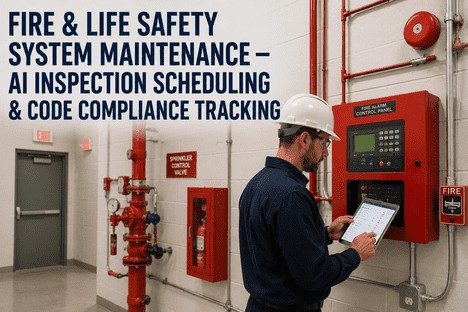
Fire & Life Safety System Maintenance — AI Inspection Scheduling & Code Compliance Tracking
By Grace on June 20, 2026
A fire alarm panel that was last tested ninety-three days ago. A sprinkler system whose last flow test documentation was filed in a binder that the new facility manager does not know exists. An emergency lighting inspection log kept on a spreadsheet shared by email every quarter — when someone remembers to send it. This is not an edge case in building fire and life safety system maintenance. It is the operating reality for a significant portion of commercial and industrial facilities worldwide, and it persists not because facility managers neglect safety — but because the tools they have been given to manage inspection schedules, track code compliance, and document test results were designed for a paper-based era that regulators, insurers, and safety professionals have already moved beyond.
AI Fire Safety Compliance · Automated Inspection Scheduling · Code Tracking · Life Safety Systems
From Paper Logs to AI-Driven Compliance: How iFactory Automates Fire Life Safety System Maintenance Across Every Building in Your Portfolio.
iFactory centralises fire alarm, sprinkler, fire pump, emergency lighting, and exit system maintenance into one platform with AI-driven scheduling, automated code compliance tracking, and real-time documentation for NFPA, IFC, and local code frameworks.
Projected global fire and life safety services market by 2029 — inspection, testing, and maintenance services alone represent over half of this market
95%
of fire and life safety professionals surveyed by NFPA in 2025 see a direct role for AI in their daily inspection and compliance work
1,504,500
Fires responded to by US fire departments in 2022 — with $18 billion in structural property damage, much of it preventable with working fire safety systems
64%
of skilled trades professionals report improved workflows after adopting digital tools — yet most facility managers still manage fire life safety compliance with spreadsheets and paper logs
The Real Cost of Managing Fire Life Safety Systems Without a Centralized Platform
Fire life safety system maintenance is not like other building maintenance domains. When an HVAC filter goes unchanged, the consequence is discomfort and higher energy costs. When a sprinkler valve is left closed or a fire alarm panel goes untested for six months, the consequence is measured in liability, insurance premiums, regulatory penalties, and — in the worst case — loss of life. The compliance framework that governs these systems — NFPA 72 for fire alarm systems, NFPA 25 for water-based systems, NFPA 101 for life safety code, IFC Chapter 9, and local jurisdiction amendments — is layered and evolving. Each code mandates inspection frequencies, documentation standards, and deficiency remediation timelines that differ by system type, occupancy classification, and building size. Managing this complexity across multiple buildings with manual processes is not merely inefficient. It is structurally incapable of producing the consistency that regulators and insurers now require.
Four Failure Modes of Manual Fire Life Safety Compliance — and Why They Persist
The Scheduling Blind Spot
Inspections run on calendar reminders that nobody set up for the new building you acquired last quarter.
When inspection schedules are managed across separate spreadsheets, email reminders, and paper logbooks, the gap between scheduled and actual inspection dates widens with every personnel change and portfolio expansion. NFPA 25 requires weekly fire pump tests, monthly sprinkler valve inspections, quarterly alarm system tests, and annual full-system flow tests. Missing any single interval creates a compliance gap that grows retroactively — and the documentation to prove when the last inspection actually happened is buried in a filing cabinet or a departed employee's email archive.
Missed Intervals + Documentation Gaps
The Standards Tracking Burden
NFPA updates its codes on three-year cycles. Your inspection forms are still referencing the 2019 edition.
The 2025-2026 NFPA update cycle introduced significant changes to NFPA 72 (fire alarm testing protocols), NFPA 25 (sprinkler system maintenance intervals), and NFPA 101 (means of egress documentation). When inspection checklists are static paper forms or unlinked digital templates, staying current with code revisions requires manually auditing every form, every schedule, and every test protocol — a task that most facility teams do not have the capacity to perform systematically. The result is inspection criteria that reference superseded code language, creating ambiguity in test results and vulnerability during authority having jurisdiction (AHJ) inspections.
Code Reference Lag + AHJ Findings
The Deficiency Follow-Through Gap
The inspection found a failed flow switch. The repair was never logged. Neither was the re-test.
Fire life safety deficiency management has a predictable failure pattern: the inspector identifies an issue, logs it on a paper form, and hands it to the facility manager. The facility manager creates a work order in a separate system. The technician completes the repair but does not update the inspection record. When the AHJ arrives for the next inspection, the deficiency appears unresolved in the inspection log even though it was repaired — because the documentation trail was never closed. Without a unified platform that links inspection findings to work order creation, repair documentation, and re-test scheduling, this documentation fracture is the norm, not the exception.
Open Loops + Audit Trail Breaks
The Multi-Building Visibility Problem
You manage twelve buildings. Each has its own inspection binder, its own schedule, and its own compliance status — visible only to the person holding the binder.
For facility directors overseeing portfolios of five to fifty buildings, the absence of a centralised compliance view means that the question "what is the fire life safety compliance status across my entire portfolio right now?" cannot be answered in real time. It requires collecting binders, spreadsheets, and emails from every building — a process that takes days and produces a snapshot that is outdated before the review meeting. When a building's fire pump test was missed three weeks ago, the director discovers it three weeks later. That three-week gap is the difference between a proactive compliance programme and a reactive one.
Reactive Compliance + Portfolio Blindness
AI Inspection Scheduling · Automated Code Compliance · Centralised Life Safety Management
Spreadsheets and Binders Are Not a Compliance Programme. iFactory Turns Your Fire Life Safety Data Into a Real-Time, Audit-Ready System.
The platform that schedules every inspection by code requirement, documents every test result with attached evidence, tracks every deficiency to closure, and gives you a single dashboard showing the compliance status of every building in your portfolio — updated in real time, without manual consolidation.
What iFactory's Fire Life Safety Module Actually Does
iFactory is not an inspection app bolted onto a general-purpose CMMS. It is a purpose-built fire life safety compliance platform where every system type, every code requirement, every inspection schedule, and every test result is registered, tracked, and documented in a single data environment — with role-based access that gives facility directors the portfolio-wide compliance view they need and gives technicians the field-ready tools that match their daily workflow.
Capability 01
AI-Driven Inspection Scheduling — Every System Tested at the Right Interval, Every Time
Code-Matched Scheduling
iFactory's AI scheduling engine reads the specific code requirements for each fire life safety system type in each building — NFPA 72 weekly alarm panel tests, NFPA 25 monthly valve inspections, quarterly alarm device testing, annual sprinkler flow tests, five-year internal pipe inspections, fire pump churn tests, emergency lighting 30-second and 90-minute tests, and exit system monthly checks — and generates inspection schedules that match the exact frequency required by the adopted code edition for that jurisdiction. When a code edition updates, the schedule adjusts automatically. When a new building enters the portfolio, the system applies the correct inspection calendar based on its occupancy type, system inventory, and local code jurisdiction without manual configuration.
Code-based frequency automation
Multi-jurisdiction scheduling logic
Automatic code edition adjustment
Capability 02
System-Specific Digital Inspection Forms — Pre-Loaded With Current NFPA and IFC Criteria
Code-Embedded Forms
Every inspection in iFactory is conducted using a digital form that is specific to the system type being tested and pre-loaded with the inspection criteria from the current adopted code edition. A fire alarm panel inspection form includes the NFPA 72-required battery load test, alarm verification timing, and communication path checks. A sprinkler system form includes the NFPA 25 flow test calculations, valve position verification, and trip test documentation. Emergency lighting forms capture the 30-second and 90-minute duration test results with pass-fail logic that matches code language. Each form supports photo attachment, signature capture, and timestamped geolocation — so the documentation package for every inspection is audit-ready at the moment the technician closes the form. When code language changes, iFactory updates the inspection criteria in the forms and applies them to the next scheduled inspection cycle. No manual form revision, no version control confusion, no expired checklists circulating in the field.
System-type specific digital checklists
Photo and signature evidence capture
Auto-updating code criteria
Capability 03
Deficiency-to-Closure Workflow — No Inspection Finding Left Unresolved
Closed-Loop Compliance
When an inspection identifies a deficiency — a failed flow switch, a tripped alarm circuit, a burned-out emergency light — iFactory automatically generates a corrective work order linked directly to the inspection record. The technician assigned to the repair receives the deficiency details, the system location, and the required corrective action. When the repair is completed, the system schedules the required re-test and links the passing result back to the original deficiency record. The entire chain — from inspection finding to work order creation to repair documentation to re-test closure — is recorded in a single audit trail that an AHJ or insurer can review without parsing separate systems or paper files. No deficiency falls through the gap between inspection and repair because the documentation pathway is designed to close every loop.
Auto-generated corrective work orders
Linked re-test scheduling
Full audit trail per finding
Capability 04
Portfolio Compliance Dashboard — Every Building's Fire Life Safety Status in One Real-Time View
Director-Level Visibility
The portfolio compliance dashboard aggregates fire life safety inspection status from every building in your portfolio into a single real-time view. Facility directors see which buildings are current on all required inspections, which have overdue tests, which have open deficiencies beyond their remediation deadline, and which are approaching their next scheduled inspection cycle — all without opening a single binder or spreadsheet. The dashboard is configurable by building, system type, code jurisdiction, and compliance status, so the question "which buildings in our portfolio have an overdue fire pump test?" is answered by a glance at the dashboard, not by a three-day data collection exercise. When a building falls below its compliance threshold, automated escalation alerts notify the responsible facility manager and the director simultaneously — so the gap is addressed before it compounds into an AHJ finding or an insurance audit exception.
Real-time portfolio-wide compliance view
Multi-system status filters
Automated escalation alerts
Manual Fire Life Safety Management vs. iFactory AI-Powered Platform — What Changes When You Centralise
Workflow Area
Manual Approach
iFactory AI-Powered Approach
Inspection Scheduling
Calendar reminders, spreadsheet trackers, paper due lists — schedules drift with personnel changes and portfolio growth
AI engine reads NFPA/IFC code frequencies per system type and jurisdiction, auto-generates schedules, adjusts when codes update
Inspection Forms
Paper checklists, static PDFs, generic forms that do not distinguish between alarm and sprinkler test criteria
System-specific digital forms pre-loaded with current code criteria, auto-updated when code editions change
Deficiency Management
Separate log entries in inspection binders, repairs tracked in different systems, re-test results rarely linked back
Auto-generated corrective work orders linked to inspection records, re-test scheduling triggered on repair completion, full closed-loop audit trail
Portfolio Visibility
Binder-to-binder review, manual consolidation for reports, compliance status known only after data collection
Single dashboard showing every building's compliance status in real time, filtered by system type and jurisdiction
Code Compliance Evidence
Binders of paper forms, scanned PDFs in shared drives, email chains with test results — audit preparation takes days
Digital documentation with photos, signatures, and timestamps — inspection-ready reports generated in minutes with all evidence attached
"
Before iFactory, I managed fire life safety compliance for seventeen buildings across three states with a colour-coded spreadsheet that my predecessor built in 2014. Every month, I spent two days calling each building engineer to confirm their inspections were current, then cross-referencing their verbal confirmations against paper logs that I could only review during quarterly site visits. The first month on iFactory, I opened the compliance dashboard and saw in thirty seconds that Building 9 had a sprinkler valve inspection overdue by nineteen days and Building 4 had an emergency lighting deficiency that was logged but not repaired. Previously, I would have discovered both issues at the next quarterly review — seventy days later, with the compliance gaps already documented in the AHJ's inspection report.
— Director of Facilities Operations, Commercial Real Estate Portfolio — 22 Buildings Across 4 States
Conclusion
The fire life safety compliance landscape is becoming more demanding with every three-year code cycle. NFPA updates, evolving IFC requirements, tightening insurance underwriting standards, and rising expectations from regulators and tenants are all converging on the same point: manual, paper-based, disconnected compliance management is no longer adequate for the scale and complexity of modern building portfolios. The organisations that transition to AI-driven inspection scheduling, digital code-embedded forms, closed-loop deficiency management, and portfolio-wide compliance dashboards will operate with lower risk, fewer missed inspections, faster deficiency resolution, and significantly less administrative overhead than those still managing fire life safety with spreadsheets, binders, and email chains.
The data from every inspection, every test, and every deficiency already exists in your buildings. What has been missing is the platform that connects it into a single, real-time, audit-ready compliance system — with AI that schedules the right inspection at the right interval for every system type, forms that encode the current code criteria for every test, workflows that close every deficiency loop, and a dashboard that shows you the compliance status of every building in your portfolio without requiring a single phone call or email request. Book a Demo to see how iFactory maps to your specific portfolio configuration and system inventory, or Talk to an Expert to begin your compliance platform assessment and get your first portfolio dashboard live within thirty days.
Frequently Asked Questions
iFactory allows you to configure jurisdiction-specific code profiles for each building in your portfolio. Each building can be assigned its adopted NFPA edition, IFC year, and local amendment set — and the platform automatically applies the correct inspection frequencies, test criteria, and documentation requirements to every scheduled inspection for that building. When a jurisdiction adopts a new code edition, the building's profile can be updated in minutes, and all future inspections reflect the new criteria. Existing inspection records remain stored under the code edition that was in effect at the time of the test, preserving the historical audit trail. Talk to an Expert to configure jurisdiction-specific code profiles for your portfolio.
Yes. iFactory supports API integration with fire alarm control panels, sprinkler flow switch monitoring systems, and building management systems that provide equipment status data. For systems without direct digital integration, iFactory's mobile inspection app allows technicians to document test results, capture system panel readings via photo, and attach equipment-generated reports to the inspection record. The platform does not require digital integration with every device to deliver value — the inspection scheduling, digital form, deficiency workflow, and compliance dashboard capabilities operate independently of direct system connectivity. Direct integration enriches the data model where available but is not a prerequisite for platform deployment. Book a Demo to walk through the integration options for your specific equipment landscape.
iFactory's standard implementation for an existing portfolio covers: weeks one to two for building profile setup, system inventory import, and jurisdiction code configuration; week three for inspection schedule generation based on current compliance status and code requirements; weeks four to five for mobile app deployment to inspection teams and technician training; and week six for compliance dashboard configuration and director-level reporting setup. Full portfolio go-live — meaning all buildings active on iFactory with scheduled inspections, digital forms, and dashboard visibility — typically occurs within six to eight weeks depending on portfolio size and data readiness. Existing historical inspection data can be imported digitally where available or referenced in the platform as baseline compliance records. Book a Demo to build the implementation plan specific to your portfolio size and current data format.
Yes. iFactory generates comprehensive compliance documentation packages that meet the documentation requirements of NFPA code enforcement, insurance underwriting audits, and AHJ inspections. Each package includes the complete inspection history for every system in each building — scheduled intervals with completion dates, test results with attached photo evidence and technician signatures, deficiency logs with corrective action records and re-test closure documentation, and system inventory lists with installation dates and equipment specifications. The reports can be generated by building, by system type, by date range, or by compliance status — and are available in PDF and digital formats that can be submitted directly to auditors, inspectors, and insurance reviewers without additional formatting or manual compilation. Talk to an Expert to see sample compliance documentation packages for your specific building types and code jurisdictions.
Your Buildings Already Have Fire Life Safety Systems Installed. What They Need Is a Platform That Ensures Those Systems Are Always Inspected, Always Documented, and Always Compliant.
iFactory's Fire Life Safety module — AI inspection scheduling, code-compliance forms, closed-loop deficiency management, portfolio compliance dashboard. The platform that turns your fire life safety programme from a collection of disconnected records into a single, real-time, audit-ready compliance system.