A single runway edge light failure at a major international hub can cascade into 286 cancelled flights, 21,720 stranded passengers, and over $10 million in direct losses — all before the maintenance team finishes troubleshooting the circuit. For facility managers responsible for airfield lighting and NAVAID systems across multiple runways, taxiways, and approach corridors, the margin between a compliant airfield and a NOTAM-issued closure is measured in the reliability of every fixture, every circuit, and every monitoring system. The global airfield lighting control and monitoring market is projected to exceed $10 billion by 2033, driven by FAA Part 139 compliance mandates, LED retrofit programmes, and the accelerating adoption of AI-powered predictive maintenance across airport infrastructure. But the technology that is generating the most impact is not brighter bulbs — it is the intelligence layer that tells facility managers which fixtures are degrading before the pilot sees a dark approach light at 200 feet on a Category III approach.
AI Airfield Monitoring · Predictive Lighting Maintenance · FAA Compliance · NAVAID Intelligence
Every Light on Your Airfield Should Be Visible to You Before It Is Visible to a Pilot. iFactory Monitors Every Fixture, Every Circuit, Every Approach Path.
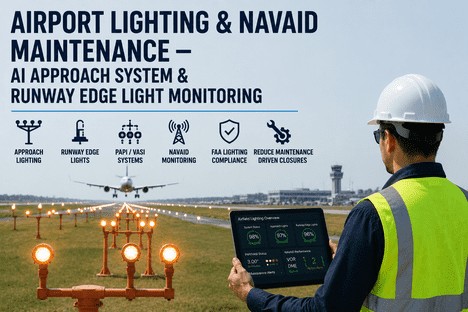
iFactory's AI-driven airport lighting and NAVAID monitoring module gives facility managers a unified real-time view of every approach light, runway edge fixture, PAPI/VASI system, and navigation aid across the entire airfield — with predictive failure alerts, compliance documentation, and intelligent maintenance scheduling from a single platform.
$10B+
Projected global airfield lighting control and monitoring market by 2033 — as airports worldwide invest in intelligent infrastructure over manual inspection regimes
70%
Reduction in airfield lighting maintenance labour costs reported by airports deploying IoT-enabled monitoring versus traditional manual inspection programmes
95%
FAA-required serviceability threshold for runway centreline and Category II/III edge lights — a single undetected circuit failure drops the airfield below compliance
72 hrs
Average advance warning AI-powered monitoring systems provide before a lighting fixture falls below the FAA minimum 70% candela output threshold
The True Cost of Airfield Lighting Failures Is Not Measured in Replacement Bulbs
When a runway edge light fails, the immediate cost is a lamp replacement. What follows is the cost that never appears on the maintenance budget: the diverted flight, the cancelled departure, the 90-minute hold pattern burning fuel at 2,500 pounds per hour, and the FAA inspection that flags the airfield for a serviceability compliance deficiency. For facility managers operating under Part 139 certification, the gap between a compliant airfield and a NOTAM-issued closure is filled entirely by the reliability of the lighting monitoring and maintenance programme.
What Facility Managers Lose When Airfield Lighting Is Managed Without Intelligent Monitoring
The Compliance Blind Spot
Your photometric testing cycle is six months. The FAA can arrive tomorrow.
FAA AC 150/5340-26C mandates specific serviceability tolerances for every category of airfield lighting. In 731 post-installation photometric tests of runway edge lights conducted across US airports, zero runways met the FAA serviceability requirement on first test. Manual biannual photometric testing simply cannot catch the degradation curve — by the time the report lands on your desk, the fixtures have been operating below compliance for months.
Regulatory Exposure + Unknown Liability
The Runway Closure Economy
A single 90-minute runway lighting outage costs more than a year of proactive monitoring.
When approach lighting or runway edge lights fail during active operations, the financial impact compounds by the minute — airline delay penalties, diverted aircraft fuel costs, ATC re-routing workload, passenger compensation claims, and the reputational cost of a closed runway at a major hub. One international airport documented a $10 million single-event loss when primary runway lighting failed for ten hours. The cost of an AI-driven monitoring system that would have detected the developing circuit fault weeks in advance is less than 5% of that single event loss.
Financial Exposure + Operational Disruption
The Manual Inspection Trap
Your team walks the airfield twice a week and still misses 30% of degraded fixtures.
Manual visual inspection of airfield lighting is the industry default and the industry's most persistent failure point. Internal circuit degradation is invisible to the human eye. Rubber deposits, de-icer residue, and UV lens yellowing reduce light output gradually — a fixture at 65% of required candela looks fine to a technician on the ground but fails the pilot's visual cue requirement at 200 feet on approach. Even the most diligent inspection teams miss degraded fixtures at a documented rate exceeding 30%, simply because the degradation pattern is not visually detectable in the early stages.
Hidden Degradation + Inspection Gaps
The NAVAID Calibration Risk
PAPI/VASI alignment drift is invisible from the ground but deadly on approach.
Precision approach path indicators and visual approach slope indicators require rigorous alignment calibration. A PAPI housing shifted by wind, thermal expansion, or ground settlement changes the glide path indication by fractions of a degree — enough to mislead a pilot on a low-visibility approach. Traditional maintenance programmes check alignment quarterly or biannually. In the weeks between checks, the system can drift without any visible sign to the maintenance team. AI monitoring of PAPI/VASI systems detects alignment anomalies through continuous photometric pattern analysis and alerts the facility manager the moment deviation exceeds tolerance.
Safety Risk + Calibration Gaps
AI Approach Lighting · Predictive Fixture Monitoring · FAA Compliance Automation · NAVAID Intelligence
Your Airfield Runs on Lights. Your Lights Should Run on Intelligence. iFactory Monitors Everything from Approach Strobes to Taxiway Edge Lights.
A single platform that ingests data from every airfield lighting circuit, every NAVAID system, and every CCR — delivering predictive failure alerts, automated FAA compliance documentation, and maintenance scheduling intelligence that transforms airfield lighting from a reactive cost centre into a proactively managed infrastructure asset.
How iFactory's AI-Powered Airfield Lighting and NAVAID Monitoring Module Works
iFactory is not a bolt-on alerting system that tells you a light has failed after the pilot reports it. It is a predictive monitoring platform that continuously analyses current draw signatures, photometric output trends, circuit health parameters, and environmental degradation patterns across every lighting category on the airfield — and tells the facility manager which fixture will fail, when it will fail, and what maintenance action is required, all before the failure impacts flight operations.
Capability 01
Real-Time Runway Edge and Approach Lighting Monitoring — Every Fixture Tracked, Every Circuit Analysed
High-Intensity Runway Lighting
iFactory continuously monitors every HIRL, MIRL, and LIRL fixture on the airfield — tracking lamp-level status, current draw per fixture, photometric output degradation, and CCR health parameters. The platform ingests data from existing ALCMS infrastructure and augments it with AI-driven failure prediction models that analyse historical degradation curves against current operating conditions. When a fixture's candela output drops below 85% of the FAA minimum threshold, the system generates a predictive maintenance alert — typically 72 hours to 14 days before the fixture would fail a photometric test. Facility managers see the exact fixture location, circuit ID, degradation trend, and recommended maintenance window on a single airfield map view, with no runway closure required for the diagnostic phase.
Lamp-level degradation tracking
Predictive failure alerts 72+ hours ahead
CCR health and circuit analysis
Capability 02
PAPI/VASI and Approach Lighting System Integrity — Continuous Glide Path and Alignment Verification
Precision Approach Path
Precision approach path indicators, VASI systems, ALSF-2, MALSR, SSALR, ODALS, and REIL installations are each monitored for the specific failure modes that affect their operational integrity. For PAPI and VASI systems, iFactory tracks alignment angles through continuous photometric pattern analysis — detecting the subtle shift in red-to-white light transition boundaries that indicate housing movement or optical degradation. For sequenced flashing approach lighting systems, the platform verifies flash rate timing, sequence integrity, and individual strobe output levels. The system automatically cross-references every approach lighting reading against FAA AC 150/5340-26C serviceability standards and generates compliance documentation that is audit-ready for Part 139 inspections.
Alignment drift detection for PAPI/VASI
Flash rate and sequence integrity monitoring
Automated FAA compliance documentation
Capability 03
Maintenance Intelligence and Runway Closure Optimisation — Schedule Repairs When The Runway Is Already Closed
Closure Intelligence
The most expensive maintenance action on an airfield is the one that requires a dedicated runway closure. iFactory's maintenance intelligence engine analyses predicted failure timelines against scheduled runway maintenance windows, NOTAM schedules, and low-traffic operational periods to recommend the lowest-impact maintenance window for every predicted fixture failure. Instead of dispatching a crew for a single lamp replacement that requires a 45-minute runway closure, the platform groups all predicted work within a maintenance planning horizon and recommends consolidated closure windows. This transforms lighting maintenance from a constant stream of operational disruptions into planned, batched, coordinated infrastructure work that leverages closures already scheduled for other airfield maintenance activity.
Predictive failure timeline forecasting
Consolidated maintenance batching
NOTAM-aligned closure scheduling
Capability 04
Multi-Airfield NAVAID and Lighting Management — One Dashboard for Every Runway at Every Base
Network Visibility
For facility managers responsible for multiple airfields, terminal areas, or heliports, iFactory aggregates every lighting and NAVAID monitoring feed into a single network dashboard. A director managing three airports across different regulatory jurisdictions sees every approach lighting system, every runway edge circuit, and every PAPI/VASI installation in one configurable view — with compliance status, predicted failure timelines, and maintenance activity grouped by airfield, by lighting category, or by criticality level. The platform supports role-based access so each airfield's facility team sees their operational view while the network director sees the consolidated picture. This is the architecture that transforms airfield lighting management from a site-by-site reactive function into a centrally managed, proactively maintained infrastructure network.
Multi-airfield consolidated dashboard
Regulatory compliance cross-referencing
Role-based facility access control
Every Airfield Lighting Category iFactory Monitors — With FAA Compliance Thresholds and AI Detection Capability
Lighting Category
FAA Serviceability Requirement
iFactory AI Monitoring Capability
Runway Edge Lights (HIRL/MIRL/LIRL)
95% serviceability for CAT II/III. No adjacent unserviceable lights. 70% minimum candela per fixture.
Lamp-level current draw analysis, photometric degradation curves, CCR health monitoring, predictive failure alerts 72+ hours in advance
Approach Lighting (ALSF/MALSR/SSALR/ODALS)
If 4+ adjacent bars or flashers obscured, NOTAM required. Flash rate must meet specified timing.
Sequenced flasher timing verification, bar status tracking, REIL sync monitoring, rabbit light operational confirmation
PAPI / VASI Systems
Manufacturer alignment tolerance (typically 0.1 degree). Red/white transition boundary accuracy.
Continuous photometric pattern analysis, alignment drift detection, lamp output tracking, automatic calibration deviation alerting
Taxiway and Apron Lighting
Taxiway edge and centreline lights, stop bars, clearance bars, guidance sign illumination
Lead-on/lead-off light sequencing verification, stop bar status monitoring, apron floodlight coverage analysis
"
Before iFactory, our lighting maintenance was entirely reactive. We walked the airfield twice a week, submitted photometric test reports every six months, and discovered failures when pilots reported them on approach. In our first month with iFactory's monitoring platform, the system flagged a current draw anomaly on circuit 4 of runway 27L — a CCR degradation pattern that manual inspection had missed for at least three weeks. We scheduled the repair during a planned NOTAM closure the following week. Previously, that circuit would have failed during a night operation, triggering an emergency closure, an expedited parts order, and a 4 AM crew dispatch at triple time. The ROI on the first event alone covered the platform implementation cost.
— Director of Airfield Facilities, International Hub Airport — 22 Years Airfield Operations Management
12x
ROI on Predictive Maintenance Investment
Typical three-year return for airports deploying AI-driven lighting monitoring — measured in avoided emergency closures, reduced labour cost, and eliminated premium freight
30-40%
Annual Maintenance Spend Reduction
Airports shifting from reactive to predictive lighting maintenance models report sustained cost reductions as emergency dispatches are eliminated
35%
Unplanned Downtime Reduction
Decrease in emergency lighting-related runway closures achieved through predictive failure detection and proactive maintenance scheduling
Conclusion
Airfield lighting and NAVAID maintenance is not a cost centre that can be optimised by buying cheaper bulbs. It is a safety-critical infrastructure function where the difference between proactive monitoring and reactive crisis management is measured in cancelled flights, diverted aircraft, regulatory exposure, and — in the worst case — the margin between a safe approach and a visual cue failure at decision height. The technology to monitor every fixture, every circuit, and every approach system in real time exists. The airports that deploy it are not spending more on maintenance intelligence — they are spending less on emergency repairs, avoiding the runway closures that erode airline confidence, and generating the compliance documentation that FAA and ICAO inspections demand.
iFactory's AI-driven airfield lighting and NAVAID monitoring module connects every approach lighting system, runway edge circuit, PAPI/VASI installation, and taxiway guidance fixture into a single predictive intelligence platform — with real-time degradation tracking, automated FAA compliance reporting, consolidated maintenance scheduling, and the multi-airfield network visibility that facility managers need to move from reactive repair to proactive infrastructure management. Book a Demo to see how the platform maps to your airfield's specific lighting infrastructure, or talk to an expert to begin your airfield lighting intelligence assessment and get your first predictive monitoring dashboard live.
Frequently Asked Questions
Your Airfield Lights Are the First Thing a Pilot Sees. Make Sure They Are the Last Thing You Worry About.
iFactory's AI-driven airfield lighting and NAVAID monitoring module — real-time fixture-level tracking, predictive failure detection, automated FAA compliance documentation, consolidated maintenance scheduling, multi-airfield network visibility. The intelligence layer every airfield infrastructure manager has been missing.