At 14:23 on a dry September afternoon, a B737-800 touched down on Runway 27L at a major European hub. During the landing roll, the nose gear struck a fragment of dislodged pavement edge that had been logged in the airfield inspection system three days earlier as a minor spall — category two, low priority, scheduled for repair within the monthly maintenance cycle. The fragment punctured the nose gear tyre. The tyre disintegrated. Rubber debris entered the number two engine inlet. The engine suffered a contained compressor stall. The aircraft exited the runway under its own power, but the runway was closed for forty-seven minutes for FOD inspection and clearance. Seven arrivals were diverted. Twelve departures were delayed. Total direct cost to the airline and airport operators: approximately EUR 1.8 million in compensation, diversions, slot penalties, and emergency repair. The pavement spall that caused the chain of events could have been sealed with a single crew-hour during the night shift after it was first identified. The maintenance system that logged it was not connected to the scheduling system that could have assigned the repair. This is not a pavement failure. It is a data disconnection failure. And it repeats across runways, taxiways, and aprons at airports worldwide that have invested in inspection programs without connecting them to predictive maintenance workflows.
Pavement AI Condition Assessment · Runway Crack Detection · FOD Prevention · PCI Analytics · Airfield CMMS
Every Pavement Crack Tells a Story. iFactory Makes Sure You Read It Before It Becomes an Emergency.
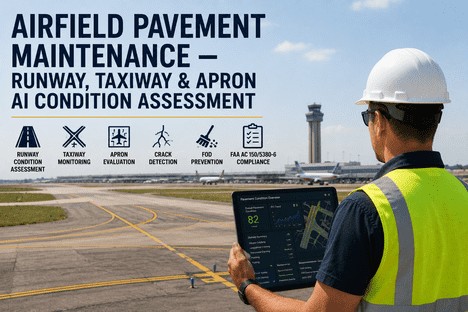
iFactory integrates airfield pavement inspection data, UAV-based crack detection, PCI condition scoring, and automated work order generation into a single platform — connecting your inspection programme to your maintenance execution so a category two spall never becomes a runway closure.
of airport emergencies are related to Foreign Object Debris — most originating from undetected or unaddressed pavement distress that a connected inspection-to-repair system could have prevented
55%
of all FOD is discovered in apron and stand areas — the highest-risk zone where pavement condition is most frequently compromised by jet blast, fuel spillage, and heavy ground service vehicle loading
25%
reduction in pavement inspection and PCI assessment costs achievable through autonomous UAV-based condition surveys combined with AI-powered crack detection and classification
$156B
global MRO market by 2035 — airfield pavement maintenance is a critical line item in that spend, and AI-driven condition assessment is the most underutilised cost-control lever
The Real Cost of Reactive Pavement Management Is Not the Repair — It Is the Runway Closure You Did Not Schedule
The operational challenges of maintaining runway, taxiway, and apron pavements across a busy airport are well understood. What is less discussed is the specific failure cascade that disconnected inspection and maintenance data produces — and why it persists even in airports that conduct compliant PCI surveys, maintain pavement management programs, and invest in regular FOD inspections.
Four Hidden Costs of Disconnected Pavement Inspection and Repair Workflows
The Inspection-to-Repair Gap
A category two pavement spall is logged by the inspection team. The repair crew never receives a work order.
FAA Advisory Circular 150/5380-7B requires federally obligated airports to perform a detailed inspection of airfield pavements at least once per year, with PCI surveys permitted every three years as an alternative. Most airports comply with this requirement. What most do not do is connect the inspection output — crack maps, PCI scores, distress classifications — to an automated maintenance workflow that assigns repair crews, reserves patching materials, and schedules the work during the next available night-time closure. The result is a growing backlog of identified-but-unaddressed pavement distress that accumulates between inspection cycles, each unrepaired crack propagating under traffic and weather until it becomes a category three or four repair requiring a runway closure.
Inspection Data + No Repair Execution = Growing Liability
The FOD Detection Blind Spot
Runway FOD detection systems are increasingly common. Pavement condition data is rarely integrated with them.
Airports investing in radar-based or AI-powered FOD detection systems gain real-time awareness of debris on the runway surface. What these systems cannot detect is the pavement condition that produced the debris — a crack that propagated into a spall, a joint sealant failure that allowed water infiltration and freeze-thaw damage, or an overlay edge that delaminated under traffic. Without integration between FOD detection and pavement condition analytics, the airport removes the debris but does not repair the source. The same fragment-producing crack generates repeated FOD events across successive inspection cycles, each one logged as a separate incident rather than recognised as a recurring symptom of an unaddressed root cause.
Treating Symptoms + Missing Root Causes = Recurring FOD
The PCI Data Utilization Problem
Annual PCI surveys generate valuable data. Most airports use it only for compliance reporting — not for maintenance execution.
The Pavement Condition Index survey methodology per ASTM D5340 is a rigorous, data-rich process that classifies distress types, severity levels, and quantities across every pavement section. A typical PCI survey produces dozens of data points per section — crack lengths, spall areas, patching condition, joint sealant damage, weathering indices. In most airport pavement management programs, this data is stored in a PMS database, used to generate an annual compliance report for the FAA or civil aviation authority, and then consulted when a major overlay or reconstruction project is being planned. What it is not used for is generating specific, scheduled repair work orders for the individual distresses identified during the survey — the sealed cracks, small patches, and joint repairs that would prevent those distresses from propagating into major structural failures before the next reconstruction cycle.
Compliance Data + No Repair Conversion = Lost Prevention Opportunity
The Reactive Repair Premium on Airside Pavement
A planned night-time crack sealing operation costs a fraction of an emergency runway closure for full-depth spall repair.
A preventive crack sealing programme executed during scheduled night-time runway closures costs approximately USD 0.50 to USD 1.50 per linear metre depending on sealant type and application method. An unplanned full-depth spall repair requiring a runway closure during operational hours costs USD 15,000 to USD 45,000 in direct repair costs alone — before calculating airline delay penalties, diverted flight costs, and the operational disruption of closing a runway during a departure bank. When PCI data confirms that crack sealing backlogs are the leading predictor of spall formation, the financial case for connecting inspection to repair scheduling becomes not just compelling but urgent. The data already exists in your PCI surveys. It just has not been translated into work orders.
5x to 30x Cost Multiplier + Unplanned Runway Closures
PCI Integration · UAV Crack Detection · FOD Source Prevention · Automated Work Orders · Airfield CMMS
Your PCI Surveys Already Tell You What Is Breaking. iFactory Is the Platform That Finally Gets It Repaired Before It Breaks.
One platform connecting your pavement inspection data, UAV survey output, FOD detection alerts, and PCI condition analytics to your maintenance execution workflow — turning compliance data into preventive action without the weekly data reconciliation calls between engineering and operations.
What iFactory's Airfield Pavement Intelligence Module Actually Does
iFactory is not an additional pavement inspection tool that duplicates your existing PCI programme or PMS database. It is an integration and execution layer that connects the pavement data you already collect — from manual PCI surveys, UAV crack detection flights, FOD detection systems, and routine airfield inspections — to the maintenance workflow that repairs the identified distress before it becomes a FOD event or a runway closure.
Capability 01
PCI Survey Integration and Automated Work Order Conversion — Turn Compliance Data into Scheduled Repairs
Inspection-to-Repair Automation
iFactory imports PCI survey data from your existing pavement management system or directly from ASTM D5340-compliant survey software — ingesting distress types, severity levels, quantities, and section identifiers for every pavement area inspected. The platform then applies configurable maintenance rules that convert each identified distress into a specific, prioritised work order: a category one sealed crack generates a scheduled crack sealing task for the next night-time closure; a category two spall with moderate severity generates a patching work order with estimated material quantities and crew hours; a category three joint failure with high severity generates an expedited repair order with cross-department notification. The work order includes the precise GPS location of the distress, the PCI distress code, the recommended repair material per FAA AC 150/5380-6C guidelines, and a suggested closure window based on the pavement section's traffic exposure. The inspection data that previously sat in a compliance database until the next overlay planning cycle now drives daily, weekly, and monthly maintenance execution.
PCI data import with distress-level granularity
Configurable distress-to-repair rule engine
GPS-located work orders with material estimation
Capability 02
UAV and AI Crack Detection Integration — Process Drone Survey Output Into Condition Scores and Repair Tasks
Drone-to-Repair Pipeline
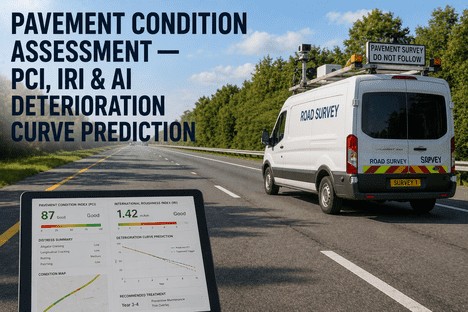
iFactory ingests orthophoto and crack detection output from UAV-based pavement survey systems — including AI-generated crack maps produced by computer vision models trained on airfield pavement distress patterns. Orthophoto tiles with detected crack geometries are imported and georeferenced against the airport's pavement section inventory. The platform calculates crack density, average width, and severity per section using the same methodology as ASTM D5340, producing an automated PCI score that correlates strongly with manual survey results — published studies report agreement within 2 to 3 PCI points between AI-automated and manual PCI determinations for the same runway sections. Each crack cluster exceeding the configurable severity threshold generates a work order with the geolocated crack polygon, estimated sealant quantity, and recommended repair window. The UAV data that previously required hours of manual analysis to translate into maintenance action now produces executable repair tasks within minutes of the drone landing.
UAV orthophoto and crack map ingestion
AI-powered automated PCI calculation
Georeferenced crack polygons with sealant estimates
Capability 03
FOD Event Source Correlation — Link Debris Detection to the Pavement Distress That Produced It
Root-Cause Intelligence
iFactory integrates with radar-based and electro-optical FOD detection systems — Tarsier, iFerret, ADB SAFEGATE AiPRON, and others — ingesting debris detection events with GPS location, debris classification, and timestamp data. Each FOD event is cross-referenced against the pavement section inventory and PCI distress database to determine whether the debris originated from a known pavement distress in the same location — a crack that propagated into a spall, a joint sealant failure that released a fragment, or an overlay edge that delaminated. When a correlation is identified, the FOD event is tagged to the source distress and the work order priority for that distress is escalated. A FOD event caused by an already-identified pavement crack that was awaiting repair triggers an alert to the maintenance manager: the repair window must be advanced. This correlation capability transforms FOD detection from a reactive debris-removal workflow into a proactive pavement condition management system — where every piece of debris found on the runway is also a data point about the pavement section that produced it.
FOD detection system data integration
Debris-to-pavement-distress correlation engine
Automated work order priority escalation
Capability 04
Pavement Deterioration Forecasting and Overlay Timing — Predict When Preventive Maintenance Becomes Reconstruction
CapEx Optimisation
iFactory's machine learning models analyse historical PCI trends, traffic loading data, weather records, and maintenance history to forecast pavement deterioration rates for each section — runway, taxiway, apron, and shoulder. The models, validated against FAA PAVEAIR database analytics using algorithms such as Random Forest and CatBoost, generate section-level PCI projections over a five-to-ten-year horizon, identifying the optimal intervention point where preventive maintenance (crack sealing, slurry seal, thin overlay) can extend pavement life cost-effectively before structural rehabilitation or full reconstruction becomes necessary. When a section's projected PCI crosses the configurable threshold for preventive maintenance, the platform generates a budget planning alert with estimated cost comparisons between preventive treatment and deferred reconstruction. This forecasting capability transforms pavement management from a reactive budget cycle — where reconstruction needs are discovered during annual PCI surveys — into a strategic capital planning function where maintenance and rehabilitation expenditures are optimised across the entire airfield pavement network.
ML-based PCI deterioration forecasting
Optimal preventive intervention timing alerts
Budget planning with treatment cost comparison
Measured Impact of Connected Pavement Inspection and Maintenance Workflows
97%
crack detection accuracy achieved by AI-based pavement distress models compared to manual inspection — with automated PCI scores within 2 to 3 points of manual surveys
25%
reduction in PCI survey costs using autonomous UAV-based data collection and AI-powered crack classification versus manual inspection teams
5x–30x
cost ratio between preventive crack sealing during scheduled night closures and emergency full-depth spall repair during operational hours
0.88–0.93 Kappa statistic for ML-based PCI prediction models validated across 2,505 pavement sections from 89 US airports
7.17% maximum error rate for AI-predicted categorical PCI when trained on balanced multi-year survey datasets
$15K–$45K average cost of an unplanned full-depth spall repair requiring an operational-hours runway closure
We were running a compliant pavement management programme — annual PCI surveys, FOD inspections every shift, a PMS database with ten years of condition data. What we were not doing was converting any of that data into maintenance work orders. Our PCI surveys were generating compliance reports for the FAA, not repair tasks for our airfield maintenance crew. iFactory changed that in the first month. They imported our PCI data, connected it to our existing CMMS, and within two weeks our night shift was executing crack sealing work orders generated directly from the last survey. We sealed 3,800 linear metres of cracks in the first quarter — cracks that had been identified in the PCI survey six months earlier and logged in the database with no action taken. The ROI on that single quarter of connected inspection-to-repair workflow exceeded our annual platform investment.
— Manager of Airfield Pavement and Infrastructure — Major North American Hub Airport — 14 Years Airport Civil Engineering
Why Different Airfield Pavement Zones Require Different Condition Assessment Approaches in the Same Platform
Runways, taxiways, and aprons do not just experience different traffic loads — they require fundamentally different inspection methodologies, different PCI distress weighting, and different maintenance response protocols. A runway crack that would be category two in the touchdown zone may be category four in the same location during wet-season operations. An apron spall that is a minor maintenance issue on a cargo stand is a safety-critical FOD hazard on a passenger boarding stand adjacent to a jetbridge. Managing all three pavement zones in the same condition assessment environment requires a platform that handles zone-specific logic without forcing a one-size-fits-all inspection model across the entire airfield.
How iFactory Applies Zone-Specific Pavement Condition Logic Within a Single Airfield Intelligence Platform
Pavement Zone
Assessment Priority
How iFactory Configures Assessment for This Zone
Runway
FOD source detection, touchdown zone crack sealing urgency, joint spall prevention, friction degradation, grooving and rubber removal timing
Zone-weighted PCI thresholds with expedited repair rules for touchdown zone distress, FOD event source correlation, automated NOTAM coordination for runway closures
Taxiway
Edge cracking from lateral traffic loading, joint sealant degradation, weed and vegetation control at pavement edges, lighting infrastructure interaction
Fuel and chemical spillage degradation, heavy GSE loading, jet blast erosion, stand marking visibility, hydraulic fluid infiltration
Chemical-exposure accelerated deterioration modelling, FOD source correlation with 55 percent of debris originating in apron zones, stand-specific repair scheduling aligned with flight schedules
Shoulder and Buffer
Erosion and vegetation control, pavement edge support degradation, drainage interaction, grading and compaction maintenance
Lower-frequency inspection scheduling with automated storm-event triggered condition checks, erosion repair work order generation integrated with drainage maintenance
Conclusion: Your Pavement Data Already Knows What Needs to Be Repaired. iFactory Makes Sure the Repair Happens Before the Runway Closes.
The PCI surveys are already being conducted. The UAV crack detection flights are already generating data. The FOD detection systems are already identifying debris. The pavement management database is already storing distress records. What has been missing is the integration layer that connects each of these data sources to the maintenance execution workflow — that takes a crack identified in a PCI survey, converts it into a scheduled crack sealing task with material quantities and crew assignment, and tracks the repair completion against the next inspection cycle so the condition trend is accurately recorded.
iFactory provides that layer. It connects your pavement inspection programme, UAV survey pipeline, FOD detection system, and PCI condition database into a single airfield intelligence platform — without replacing your existing PMS, without requiring new inspection hardware, and without the manual data reconciliation processes that currently delay pavement repairs by weeks or months after the distress is identified.
The pavement intelligence gap costs your airport in unplanned runway closures, FOD-related emergencies, accelerated pavement deterioration from untreated cracks, and the capital expenditure of early reconstruction that preventive maintenance could have delayed by years. Book a Demo to see iFactory's airfield pavement intelligence platform mapped to your specific airfield configuration, inspection programme, and existing pavement management infrastructure. Or talk to an expert to begin your pavement inspection-to-repair workflow integration and get your first PCI-generated work order live within thirty days.
Frequently Asked Questions
No. iFactory is an integration and execution layer that connects to your existing pavement management system, PCI survey database, UAV crack detection output, and CMMS — it does not replace any of them. The platform imports PCI distress data from your current survey software or PMS, applies configurable repair rules, generates work orders in your existing CMMS, and tracks repair completion against inspection records. Your inspection methodology, survey frequency, and PMS database remain exactly as they are. iFactory adds the missing link between inspection data and maintenance execution. Book a Demo to see how the integration maps to your current pavement management software and data workflow.
Yes. iFactory accepts georeferenced orthophoto tiles, crack detection GeoJSON output, and processed pavement distress datasets from any UAV survey platform or AI crack detection software. Common input formats include GeoTIFF orthophotos with embedded crack classification layers, GeoJSON feature collections with crack polygon geometries and severity attributes, and CSV exports from PCI survey software with distress type, severity, quantity, and GPS coordinates. The platform georeferences all incoming data against your airfield pavement section inventory, so cracks detected by a drone flight are automatically mapped to the correct runway, taxiway, or apron section for work order generation. Talk to an Expert to review your UAV survey data format and integration requirements.
When a pavement distress repair work order is generated that requires a runway or taxiway closure, iFactory's operations coordination module flags the closure requirement based on the work order's location, duration, and the pavement section's traffic exposure classification. The flag triggers a configurable workflow that can include pre-populated NOTAM draft generation with ICAO-standard closure coordinates and times, automated notification to air traffic control and airport operations, and cross-reference against the scheduled closure calendar to identify conflicts with other planned maintenance activities. For minor repairs that can be executed during existing scheduled night-time closures, the platform groups work orders by closure window to optimise crew utilisation and minimise the number of closure events. Book a Demo to see the airfield operations coordination workflow configured for your specific NOTAM and closure coordination procedures.
iFactory's machine learning models are designed to generate reliable deterioration forecasts even with limited or irregular historical data. The platform uses transfer learning from the FAA PAVEAIR database — which contains PCI data from over 2,500 pavement sections across 89 US airports — to establish baseline deterioration curves that account for pavement type, climate zone, traffic loading profile, and age. As your airport's specific PCI data is ingested across successive inspection cycles, the models calibrate to your local conditions, progressively improving forecast accuracy. For airports expanding their inspection programme, the platform supports variable-frequency data ingestion — annual PCI surveys, biennial surveys, or UAV-based intermediate assessments — and adjusts the confidence intervals on forecasts accordingly. Talk to an Expert to discuss your airport's PCI data history and forecast calibration requirements.
Every Crack in Your Pavement Is a Warning iFactory Makes Sure You Never Ignore.
AI-powered condition assessment for runways, taxiways, aprons, and shoulders — connecting PCI survey data, UAV crack detection, and FOD event correlation into a single airfield maintenance execution platform that turns inspection data into preventive action.