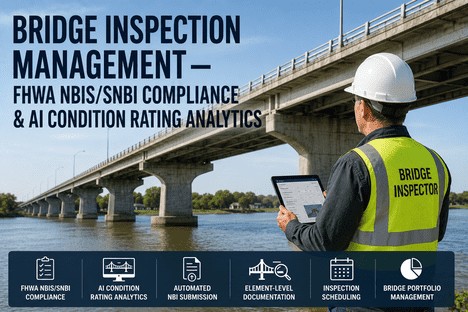
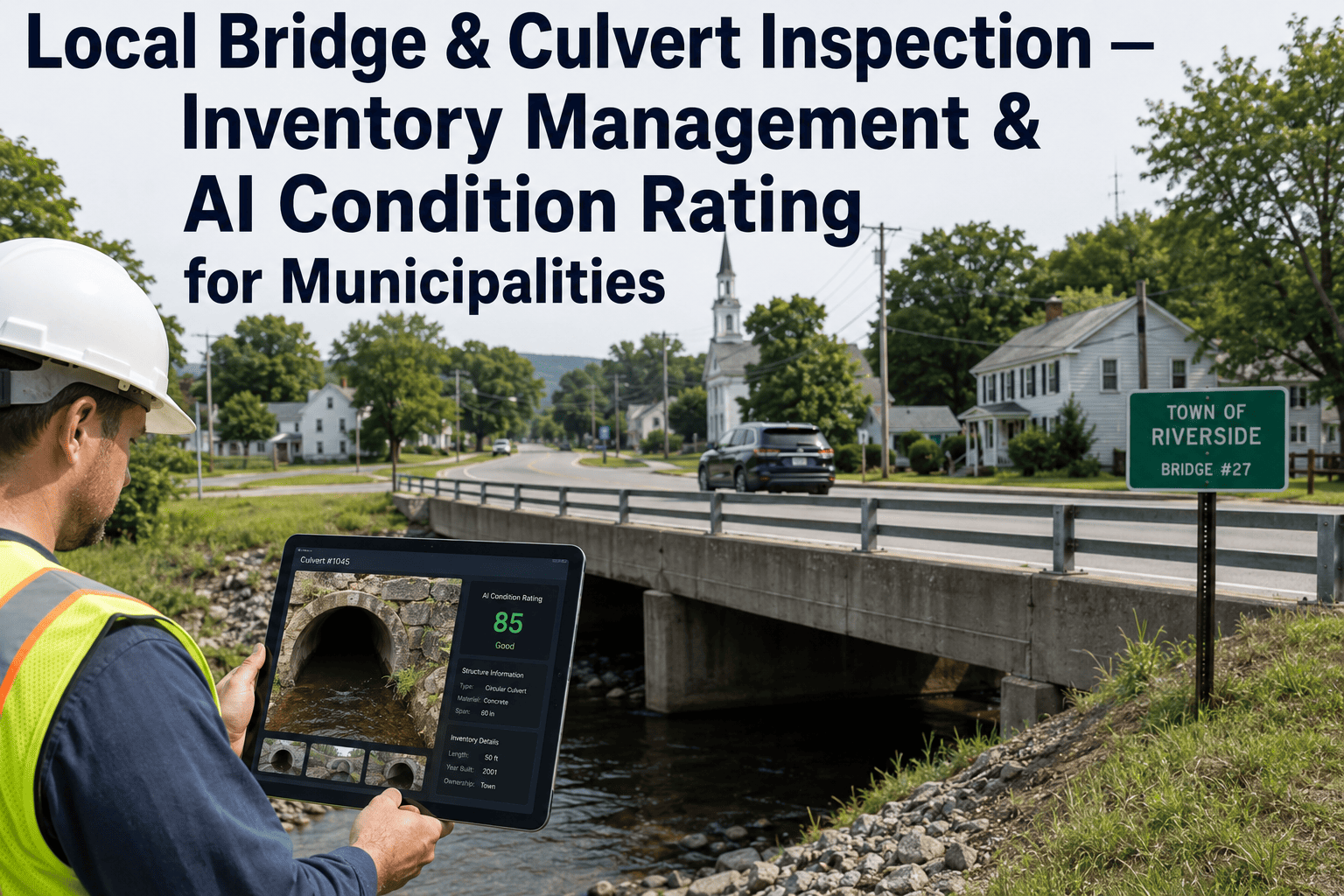
Every state DOT and county bridge agency in the United States is navigating the most significant change in federal bridge inspection reporting since the National Bridge Inspection Standards were first established in 1971. The transition from the Recording and Coding Guide to the Specifications for the National Bridge Inventory — effective with the first SNBI-based NBI data submittal on March 15, 2026 — introduces new data items, element-level condition reporting requirements, a JSON-based submittal schema through NBI NextGen, and a hard deadline of March 15, 2028, for a complete, verified SNBI dataset with no temporary codes permitted. For bridge engineers managing inspection programs across portfolios of 50 to 22,000 bridges, the SNBI transition represents both a compliance mandate and an opportunity to restructure bridge management around condition-based data that actually supports capital planning decisions. This article covers the SNBI compliance framework, the role of AI condition rating analytics in automating element-level assessment, and the inspection management workflow that keeps agencies audit-ready through the transition and beyond.
The SNBI Transition Deadline Is March 15, 2028. Bridge Agencies That Automate Element-Level Condition Rating and NBI Submittal Will Meet It Without the Last-Minute Data Crisis.
iFactory's AI-powered bridge inspection management platform automates SNBI-compliant condition rating, element-level data collection, NBI NextGen submittal formatting, and inspection scheduling across bridge portfolios of any size — with AI condition analytics that detect deterioration trends between inspection cycles.
Highway bridges in the US National Bridge Inventory, with 42% exceeding 50 years of service life — requiring element-level inspection data under the new SNBI framework
Mar 15, 2028
FHWA deadline for 100% populated and verified SNBI dataset across all reportable bridges — no temporary codes permitted, all element-level data must be collected and validated
~7.2 hrs
Average time saved per bridge inspection when digital SNBI-compliant workflows with automated PDF generation and condition rating replace manual data entry and paper forms
100%
NBIS compliance rate achieved by agencies deploying AI-powered inspection management with automated scheduling, inspector qualification tracking, and NBI data validation
The SNBI Compliance Timeline: What Every Bridge Agency Must Know
FHWA's transition from the 1995 Coding Guide to the SNBI is not a voluntary upgrade — it is a regulatory requirement established by the NBIS final rule published May 6, 2022. The transition timeline contains four milestones that every bridge agency must track against its current data readiness. Missing any of these milestones creates a compliance gap that propagates through the entire programme.
Milestone 01
Mar 15, 2026
First SNBI-Based NBI Data Submittal — Transitioned/Hybrid Dataset
All bridges submitted with transitioned data using the FHWA Data Crosswalk logic, except for specified fields required to manage FHWA programmes which must contain collected or verified SNBI data. Temporary codes permitted for items that do not transition cleanly. Agencies continuing legacy Coding Guide data collection must begin SNBI-based collection in parallel. The FHWA Transition Tool remains available through June 2026. NBI NextGen system is live for data submittals with full validation functionality.
Milestone 02
Mar 15, 2027
Second SNBI Submittal — Continued Transition/Hybrid Dataset
Second year of transitioned data submittal. Agencies continue verifying transitioned data and collecting new SNBI-based inspection data. Temporary codes still accepted. This is the last submittal cycle where incomplete or transitioned data will be accepted. Agencies that have not yet deployed SNBI-compliant data collection workflows by this date face an accelerated verification workload in the final year before the hard deadline.
Milestone 03
Mar 15, 2028
Complete SNBI Dataset — 100% Populated and Verified
No temporary codes permitted. Every data item for every reportable bridge must contain collected or verified SNBI data. All element-level condition data, appraisal ratings, and inventory items must pass NBI NextGen validation at the critical and error level. This is the hard deadline — agencies that fail to submit a complete, validated dataset are in NBIS noncompliance and subject to FHWA corrective action procedures. Agencies using automated inspection management and AI condition rating analytics position themselves to meet this deadline without a surge in manual verification workload.
Milestone 04
Ongoing
Continuous Compliance — Annual Submittals and NBIS Metrics
After March 2028, agencies submit SNBI-compliant data annually with full validation. NBIS compliance reviews shift from transition progress assessment to data quality and programme performance metrics. Agencies with AI-driven inspection management maintain continuous compliance through automated scheduling, inspector qualification tracking, critical finding documentation, and real-time NBI NextGen validation — eliminating the pre-submittal data scramble that manual processes create.
SNBI Compliance · Element-Level Condition States · NBI NextGen Submittal · AI Condition Rating
The SNBI Transition Is Not a Data Migration Problem — It Is a Workflow Transformation Problem. AI-Powered Inspection Management Solves It.
iFactory's bridge inspection management platform automates the full compliance lifecycle — from inspection scheduling and element-level data collection to AI condition rating and NBI NextGen submittal — so bridge engineers focus on structural assessment, not data formatting.
The Three Core Compliance Challenges in SNBI Transition — and How AI Condition Analytics Addresses Each
Bridge agencies managing the Coding Guide to SNBI transition face three structural challenges that manual processes and legacy inspection management systems cannot adequately address. Each challenge corresponds to a specific dimension of the SNBI requirement set, and each has a direct AI-powered solution that transforms the compliance burden into a data quality advantage.
Three SNBI Compliance Challenges · Three AI Analytics Solutions
01
Element-Level Data Collection at Scale
The SNBI requires element-level condition data for all NHS bridges using the AASHTO MBEI element catalog with four condition states (CS1 through CS4) plus quantity measurement for each element and state. For a typical steel girder bridge with 30 to 50 elements, inspectors must record element numbers, quantities, and condition state distributions across deck, superstructure, substructure, bearings, joints, and railings. Manual data entry at this granularity across hundreds of bridges produces transcription errors, inconsistent condition state assignments, and quantity measurement variability that cascade into NBI NextGen validation failures. The SNBI JSON submittal schema requires element-level records as multiple records per bridge — each element record linked to the bridge through state code and structure number — and any error in any record can generate a validation rejection.
AI solution: ML-based condition state recommendation from inspection photos and previous element data — inspectors confirm AI suggestion rather than coding from scratch.
02
Condition Rating Consistency Across Inspection Cycles
The 0-to-9 condition rating scale for deck, superstructure, substructure, and culvert depends on consistent application across inspection cycles and between different inspector teams. When inspector A rates a deck as 6 and inspector B rates the same deck as 5 in the next cycle — with no structural change between inspections — the condition trend data becomes unreliable for deterioration modelling and capital planning. SNBI introduces new condition items for bridge railing, transitions, bearings, joints, channel, scour, and NSTM appurtenances that compound the consistency challenge. Agencies with large bridge portfolios and multiple inspection teams experience rating variability that masks genuine deterioration trends and undermines the condition-based asset management that SNBI is designed to enable.
AI solution: Historical condition trend analysis that flags rating inconsistencies between cycles — inspector sees prior rating, photos, and element data for reference.
03
Inspection Scheduling and Qualification Compliance
NBIS requires routine inspections at intervals not exceeding 24 months, with risk-based reduced intervals for deteriorating structures, underwater inspections, and NSTM inspections. Every inspection must be led by a qualified team leader meeting the certification requirements defined in 23 CFR 650.309 — with programme manager qualifications, team leader training, and FHWA-approved alternate training tracked and documented. For agencies managing 200 to 22,000 bridges, tracking inspection due dates across multiple interval types, matching qualified inspection teams to bridge assignments, documenting critical findings within mandated timeframes, and maintaining inspector certification records is a programme management workload that scales linearly with bridge count. Manual tracking systems miss due dates, assign unqualified personnel, and fail to document critical findings — producing NBIS compliance findings in FHWA reviews.
AI solution: Automated inspection scheduling with risk-based interval calculation and inspector qualification matching — certification expiry alerts and auto-assignment.
The AI-Powered SNBI Compliance Workflow: From Field Inspection to NBI NextGen Submittal
The end-to-end inspection management workflow for SNBI compliance follows a five-stage pipeline that begins with inspection scheduling and ends with validated NBI NextGen data submission. AI condition analytics integrate at every stage to reduce manual effort, eliminate coding errors, and ensure data consistency across the bridge portfolio.
S1
Scheduling and Resource Assignment
The platform calculates inspection due dates for every bridge in the portfolio based on the NBIS interval requirements — 24-month routine, risk-based reduced intervals, underwater intervals, and NSTM intervals. Each bridge is assigned a risk score based on condition rating, traffic volume, fracture-critical status, and scour vulnerability. High-risk bridges are prioritised for earlier scheduling. Inspection team assignments are matched to bridge requirements based on inspector certifications — team leader qualifications, NSTM endorsement, underwater inspection certification — and the platform alerts programme managers when certification renewals are approaching.
Inspectors use a mobile-first field app with offline capability and camera integration. The app displays the bridge's element tree from the previous inspection cycle — element numbers, quantities, and condition state quantities — and pre-populates SNBI data items that do not change between cycles. Element-level condition assessment is supported by AI-assisted condition state recommendation: the inspector photographs each element, and the computer vision model analyses the surface condition to recommend a condition state distribution. The inspector adjusts and confirms. Element quantity measurements are recorded with unit verification. Defect photos are georeferenced and linked to the specific element record.
AI input: Computer vision condition state suggestion. Previous cycle data pre-population. Photo-to-element linking.
S3
Condition Rating Review and Validation
After field data collection, the platform performs automated validation against SNBI coding rules — checking that element numbers are valid per the MBEI catalog, condition state quantities sum to total quantities, and no required data items are null. AI-based consistency checking compares the current condition ratings against the historical trend from previous cycles: if a deck rating drops two points with no corresponding element-level defect evidence, the platform flags the discrepancy for programme manager review. The inspector receives an alert with the previous cycle photos and element data for comparison, ensuring rating changes reflect genuine structural change rather than inspector variability.
AI input: Cross-cycle rating consistency check. SNBI validation rule engine. Discrepancy flagging with evidence.
S4
Approval Workflow and Critical Finding Documentation
Approved inspections follow a structured, approval-based workflow — data is submitted only after validation. Critical findings identified during inspection are documented automatically with the finding description, location, element reference, recommended action, and notification timestamp. The platform generates the NBIS-required critical finding notification to the FHWA division office within the mandated timeframe. NSTM appurtenance condition data is linked to the NSTM element records. Load rating triggers are evaluated: if condition data indicates a rating change, the platform generates a load rating request integrated with the bridge management workflow.
The platform generates the SNBI JSON submittal file directly from the approved inspection records — including all inventory items (Section 3 through Section 6), condition and appraisal items (Section 7), and element-level identification and condition records (Section 7.2 and 7.3). The submittal file is run through the NBI NextGen validation module internally before submission, identifying critical errors, error-level findings, and warnings. The programme manager reviews the validation output, resolves any issues, and submits the validated file to FHWA through the NBI NextGen system. Historical submittal records are retained in the platform for trend analysis and compliance audit reference.
AI input: Automated JSON generation. Pre-submittal validation. Historical trend analysis from submittal archive.
End-to-End
From inspection scheduling to FHWA submittal — the entire SNBI compliance workflow runs in a single platform with AI analytics at every stage.
of US Bridges Exceed 50 Years of Service Life — Requiring More Frequent, Data-Rich Inspections
The SNBI element-level framework provides the data fidelity needed to manage aging infrastructure through condition-based asset management rather than reactive replacement. Agencies with AI-powered inspection management convert compliance data into capital planning intelligence.
28%
Reduction in Bridge Maintenance Costs With AI-Driven Condition-Based Prioritisation
Agencies deploying AI-powered bridge inspection management achieve measurable cost reductions through automated scheduling, consistent condition data, deterioration trend detection, and capital planning optimisation based on reliable element-level condition records.
We manage over 22,700 bridges across multiple districts, and before deploying digital inspection management, each district operated independently with its own data formats, its own quality standards, and its own relationship with the NBI submission deadline. The SNBI transition forced us to standardise, but the real value came from the AI condition analytics. Our inspectors now enter the field with the previous inspection data, element trees, and condition state recommendations pre-loaded on their tablets. The AI cross-cycle consistency check catches rating discrepancies that used to slip through until the FHWA validation rejected them. Our first SNBI hybrid submittal passed validation with zero critical errors. That would not have been possible with our legacy paper-and-spreadsheet workflow.
— Bridge Inspection Programme Manager, State Department of Transportation — 22,700+ Bridge Inventory
Conclusion
The SNBI transition is not a data migration exercise — it is a fundamental restructuring of how bridge condition data is collected, validated, and reported across the United States. Agencies that approach the March 15, 2028, deadline as a data conversion task — transitioning legacy Coding Guide records through the FHWA crosswalk and deferring element-level data collection to the final year — will face a verification workload that their inspection teams cannot sustain while maintaining routine inspection cycles. The agencies that emerge from the transition with stronger bridge management programmes are the ones that treat the SNBI as an opportunity to deploy AI-powered inspection workflows that automate condition rating, enforce coding consistency, and generate NBI NextGen-ready submittals from field-collected element-level data.
The industry evidence from early-adopter agencies is clear: AI-powered inspection management with mobile field data collection, computer vision condition assessment, cross-cycle consistency checking, and automated SNBI JSON generation eliminates the manual data processing bottleneck that creates compliance risk. The 7.2 hours saved per inspection through automated PDF generation, PE stamp workflows, and validation is not efficiency for its own sake — it is inspector time redirected from data entry to structural assessment, which is where bridge engineering expertise should be applied.
iFactory's AI-powered bridge inspection management platform is built for state DOTs, county bridge agencies, and federal infrastructure programmes that need to meet SNBI compliance deadlines while building a bridge management data foundation that supports capital planning, deterioration modelling, and audit-ready condition records. Book a Demo to see the platform configured for your bridge inventory and inspection programme requirements, or talk to an expert about a free SNBI readiness assessment for your agency.
Frequently Asked Questions
Agencies that fail to submit a complete, verified SNBI dataset by March 15, 2028, are in noncompliance with the NBIS regulation (23 CFR 650 Subpart C), which incorporates the SNBI by reference at 23 CFR 650.317(b)(1). FHWA addresses noncompliance through the NBIS compliance review process, which can result in corrective action plans, funding implications, and increased oversight. Temporary codes — which are permitted for the 2026 and 2027 submittals — will not be accepted starting with the 2028 submittal. The FHWA has stated that after 2028, business processes and programme oversight will no longer use transitioned data. Agencies that have not completed the transition by this date will need to submit a corrective action plan to their FHWA division office detailing how they will achieve compliance and what interim measures are in place to ensure data quality. The practical impact is that incomplete data undermines the agency's ability to compete for discretionary bridge funding programmes that rely on NBI condition data for project prioritisation. Talk to an expert about assessing your agency's current SNBI readiness level.
AI condition rating analytics is designed to assist — not replace — the inspector's professional judgment. The computer vision model analyses inspection photographs of each element to detect and classify surface defects — cracking, spalling, corrosion, delamination, wear — and maps the extent of each defect type to the AASHTO MBEI condition state definitions (CS1: protected, CS2: minor, CS3: advanced, CS4: severe). The model generates a recommended condition state distribution as a starting point. The inspector reviews the AI recommendation alongside the photographs, adjusts the distribution if needed to account for conditions the camera cannot capture (such as hidden corrosion or internal deterioration), and confirms the final condition state quantities. The critical advantage is consistency: the same defect pattern on two different bridges produces the same AI condition state recommendation, eliminating the inspector-to-inspector variability that degrades trend data quality. Over multiple inspection cycles, the model learns from inspector adjustments and improves its recommendation accuracy for each element type. The inspector remains the final decision authority for all condition state assignments. Book a Demo to see AI condition state recommendation configured for your agency's element catalog.
Yes. The platform supports both component-level (0 to 9 condition rating) and element-level inspection workflows, and the inspection form configuration adapts to the bridge classification. NHS bridges are configured with the full element-level workflow — AASHTO MBEI element catalog, four condition states, quantity measurement, and defect tracking. Non-NHS bridges are configured with component-level rating for deck, superstructure, substructure, and culvert, plus the SNBI condition items for bridge railing, bearings, and joints where applicable. The platform manages both inspection types within the same scheduling and compliance framework, so the programme manager sees the entire portfolio — NHS and non-NHS — in a single condition map. SNBI data items that are only required for NHS bridges are suppressed from the non-NHS inspection forms, reducing field data collection time for the portion of the inventory that does not require element-level reporting. The NBI NextGen submittal generator includes element-level records for NHS bridges only, as required by the SNBI specification. Talk to an expert about configuring mixed-inventory inspection workflows for your agency's bridge portfolio.
The platform supports structured data exchange with AASHTOWare Bridge Management and other BrM systems through standard data formats. For agencies using AASHTOWare BrM, the platform can export inspection data in the BrM-compatible format, including element-level condition data, condition ratings, and appraisal items. New bridges added to the inspection management platform are automatically synced with the BrM system, and once an inspection is approved, the inspection data is seamlessly transferred to BrM. For the SNBI submittal process, the platform generates the JSON submittal file directly, which can be submitted to NBI NextGen independently or imported into the agency's existing submittal workflow. The platform also supports AASHTOWare BrM 7.1.5 and later versions that include SNBI submittal management capabilities. For agencies using the SNBIX transition tool, the platform can exchange transitioned data to maintain continuity throughout the Coding Guide to SNBI migration. Book a Demo to see the BrM integration workflow configured for your agency's enterprise architecture.
The SNBI Deadline Is Fixed. Your Readiness Is Not. Get a Free SNBI Readiness Assessment.
iFactory's AI-powered bridge inspection management platform for state DOTs and county agencies — automated SNBI-compliant element-level inspection workflows, AI condition rating analytics, inspector certification tracking, critical finding documentation, and NBI NextGen submittal generation from a single platform that manages bridge portfolios of any size.