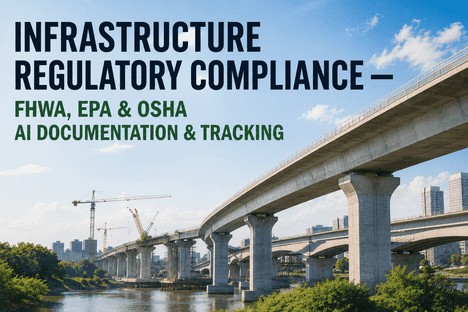
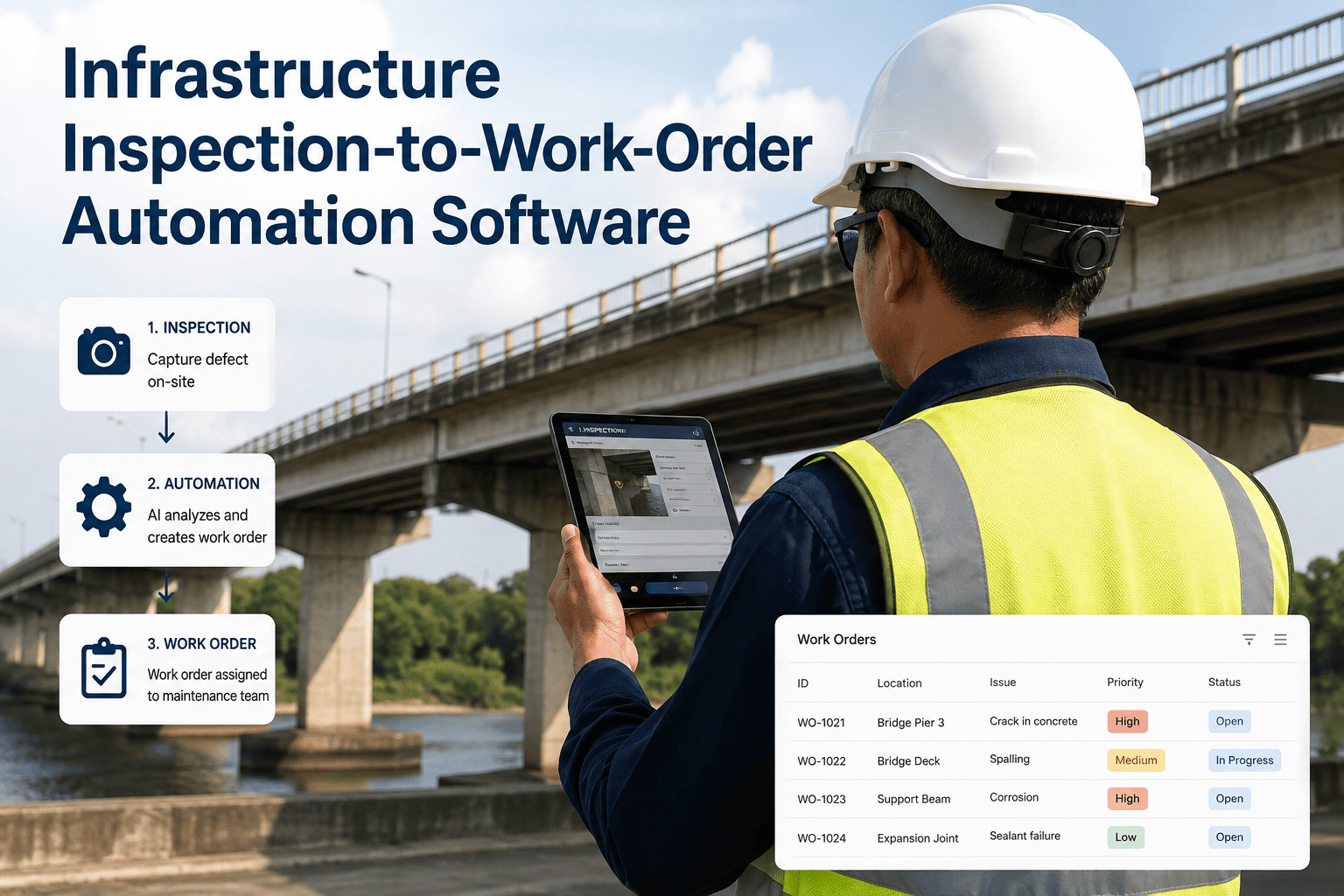
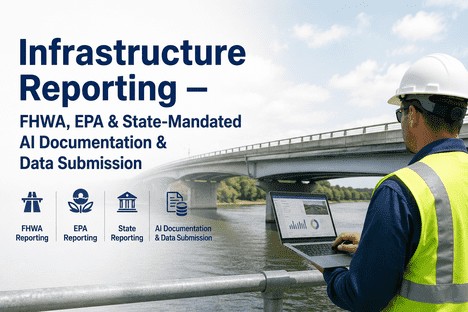
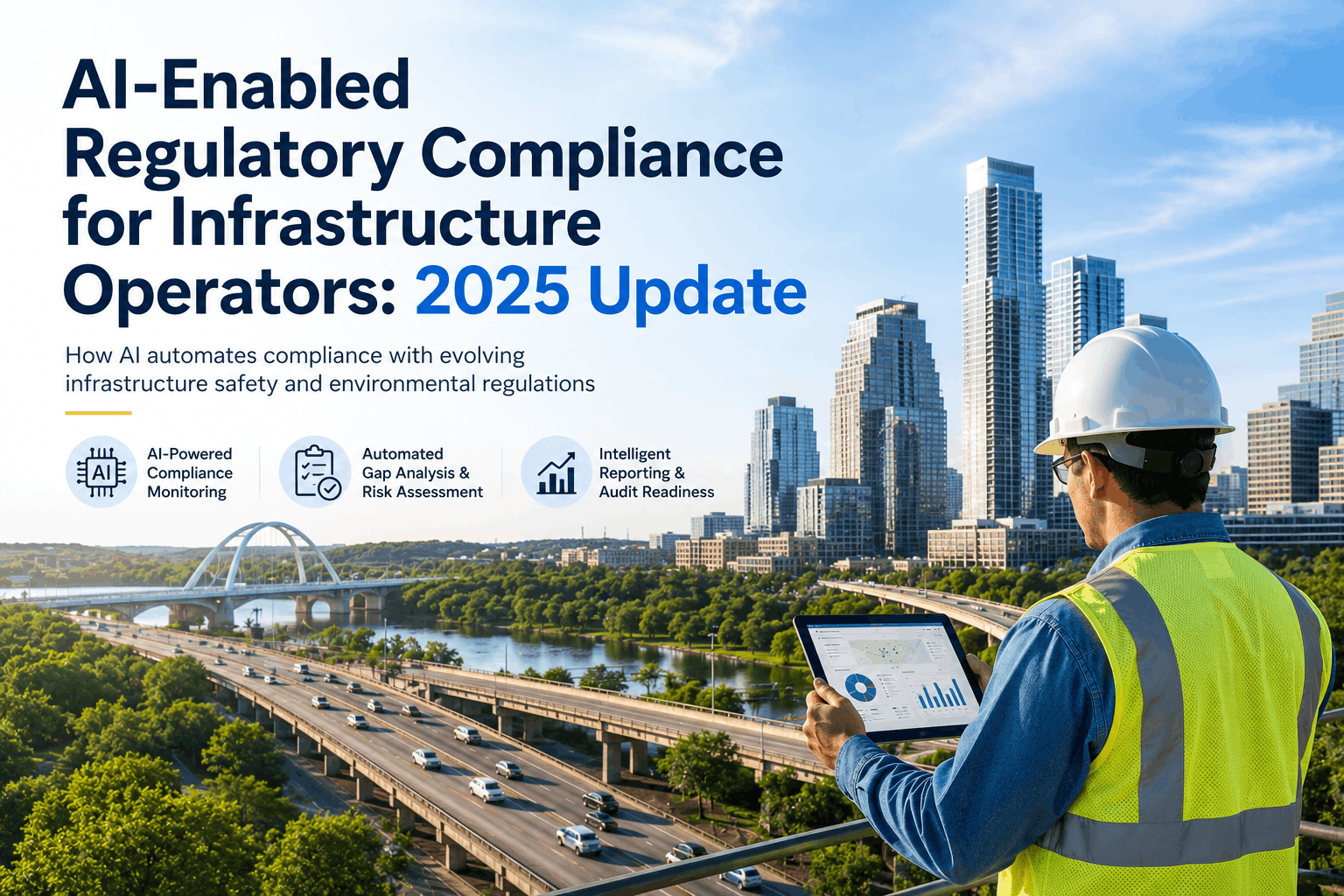
Every dollar of the USD 1.2 trillion in IIJA infrastructure funding flows through a compliance filter. FHWA requires Buy America documentation, EPA demands environmental reporting across the project lifecycle, and OSHA enforces worker safety records with penalties reaching USD 156,000 per willful violation. Infrastructure leaders who manage these three regulatory streams separately are not just burning administrative budget — they are creating audit exposure, delaying project timelines, and leaving competitive advantage on the table. The organisations that close this gap are not working harder on compliance. They are working differently — with AI-driven documentation systems that convert regulatory obligation into operational intelligence.
USD 1.2T
IIJA infrastructure funding requires multi-agency compliance documentation — agencies that automate reporting capture more grant value with less administrative drag
40%
Of infrastructure project delays are linked to compliance documentation gaps — not technical or supply chain issues — according to federal program audits
Sep 2026
FHWA MUTCD 11th Edition deadline requires documented pavement marking retroreflectivity plans — automated inspection is the only scalable path to compliance
14
States now authorise automated speed enforcement in work zones — dual FHWA-OSHA compliance documentation is the new operational baseline for highway contractors
Three Agencies. One Documentation Standard. Zero Compromise.
iFactory unifies FHWA, EPA, and OSHA compliance documentation into a single AI-driven platform — with automated report generation, real-time audit readiness, and threshold-based alerts that turn regulatory tracking into project intelligence.
The Three-Agency Compliance Architecture — Why Infrastructure Documentation Demands a Unified Approach
Infrastructure projects do not report to one regulator. They report to three — and the documentation requirements of each agency operate on different schedules, in different formats, with different enforcement mechanisms. The compliance officer who manages FHWA documentation in one system, EPA records in a second, and OSHA logs in a third is maintaining three separate audit trails that should be one. Here is what each agency requires, why the overlap creates hidden risk, and where AI documentation management closes the gap.
FHWA
Federal Highway Administration — Contract Compliance and Infrastructure Standards
FHWA compliance centres on contract provisions (Form FHWA-1273), Buy America manufacturing documentation, MUTCD 11th Edition retroreflectivity standards effective September 2026, and NEPA environmental review record-keeping. Every federal-aid highway project requires documented proof of material sourcing, work zone safety plans, and pavement condition assessments. The agency enforces through state DOT contract provisions, project engineer inspections, and work stoppage authority for non-compliance.
Key Deadline: Buy America manufactured products final assembly — October 2025 | 55% domestic cost threshold — October 2026
EPA
Environmental Protection Agency — Environmental Review and Hazardous Material Reporting
EPA compliance spans NEPA environmental impact documentation, Clean Water Act discharge monitoring, EPCRA Tier II hazardous chemical inventory reporting aligned with OSHA HCS 2024 standards, and stormwater runoff management during construction. The agency is actively deploying AI for enforcement targeting and scientific review — meaning automated documentation is no longer optional for avoiding elevated scrutiny. EPA's jurisdiction overlaps with FHWA on NEPA reviews and with OSHA on chemical inventory reporting, creating the documentation intersections where manual systems fail most frequently.
Key Update: EPCRA Tier II hazard categories aligned with OSHA HCS 2024 — compliance required by January 2028
OSHA
Occupational Safety and Health Administration — Worker Safety Documentation and Hazard Communication
OSHA compliance in infrastructure projects covers 29 CFR 1926 construction safety standards, Subpart G (signs, signals, and barricades), Subpart O (motor vehicles and mechanised equipment), and the General Duty Clause that can reach hazards not specifically addressed in construction standards. The updated Hazard Communication Standard (HCS 2024) aligns chemical classification with the GHS system, directly affecting EPCRA reporting. OSHA penalties for willful violations reached USD 156,259 per violation in 2026 — and the agency shares enforcement jurisdiction with FHWA in highway work zones, where a single incident can trigger dual-agency investigations.
Maximum Penalty: USD 156,259 per willful violation — dual FHWA-OSHA jurisdiction in work zones magnifies risk
Manual Compliance Documentation Costs You More Than Time. It Costs You Contracts.
iFactory's AI documentation engine generates FHWA, EPA, and OSHA-compliant reports from your operational data — eliminating manual re-entry, closing audit gaps, and giving compliance officers a single source of truth for every regulatory obligation.
The Multi-Agency Compliance Matrix — What Each Regulator Requires, When, and in What Format
The table below maps the core compliance obligations across FHWA, EPA, and OSHA for infrastructure projects. For compliance officers managing multi-agency portfolios, this visual shows exactly where documentation requirements overlap and where a unified AI documentation platform creates the greatest efficiency gain.
Infrastructure Compliance Documentation Matrix — FHWA, EPA & OSHA Requirements at a Glance
Obligation Type
FHWA Requirements
EPA Requirements
OSHA Requirements
Documentation Standard
Form FHWA-1273 contract provisions; Buy America material certifications; MUTCD compliance records
NEPA environmental documents; CWA discharge monitoring reports; EPCRA Tier II chemical inventories
Per project phase; certified payroll weekly; Buy America documentation at procurement and project closeout
NEPA once per project; DMRs monthly or quarterly; Tier II reports annually by March 1
OSHA 300 logs annually; incident reports within 24 hours; SDS updates as chemicals change
Enforcement Mechanism
State DOT contract provisions; work stoppage authority; contract default for non-compliance
Administrative orders; civil penalties; permit revocation; EPA referral to DOJ for criminal violations
Citations with financial penalties; willful violations at USD 156,259 each; stop-work orders
AI Automation Potential
Contract provision mapping; material certification auto-generation; automated inspection documentation
NEPA document drafting assistance; DMR auto-population; EPCRA Tier II report generation from SDS data
OSHA 300A auto-generation; incident documentation workflow; SDS-to-Tier II field mapping
How AI Documentation Management Transforms Multi-Agency Compliance
AI-powered compliance documentation is not a faster version of manual reporting. It is a fundamentally different approach: documentation that is generated from operational data rather than typed from memory, validated against regulatory requirements rather than reviewed for errors after submission, and structured for audit readiness rather than assembled when an inspector arrives. For infrastructure compliance officers managing FHWA, EPA, and OSHA obligations simultaneously, the shift from reactive to proactive compliance is the single highest-leverage change available.
Capability 01
Automated Regulatory Report Generation From Operational Data
Core Feature
iFactory maps operational data fields — work order records, asset inspection logs, material procurement records, safety incident reports, and chemical inventory data — directly to the specific reporting formats required by each agency. FHWA Buy America certifications are populated from procurement records. EPA Tier II reports are generated from SDS data already in the system. OSHA 300A summaries are compiled from incident logs captured at the point of work. The compliance officer does not re-enter data across three systems. They review, validate, and submit — reducing report generation time from days to minutes and eliminating the transposition errors that create audit findings.
Capability 02
Proactive Compliance Risk Detection Before Audit Exposure
Risk Management
The most significant advantage of AI-driven compliance documentation is not speed — it is pattern detection. When documentation data lives in a single platform, the system can identify which material procurement records lack Buy America certifications, which work orders were closed without required safety documentation, and which chemical inventories are approaching their reporting threshold before the EPA deadline triggers a compliance review. iFactory surfaces these gaps as actionable alerts in the compliance dashboard — flagging missing documentation, approaching deadlines, and data quality issues before they become audit findings. For compliance officers managing multi-agency portfolios, this shifts the role from reactive firefighting to strategic risk management.
Capability 03
Single-Source Audit Trail Across All Regulatory Frameworks
Audit Readiness
When an FHWA inspector, EPA reviewer, or OSHA compliance officer arrives, the documentation response is identical: open the iFactory compliance dashboard, filter by the relevant agency and timeframe, and present the complete audit trail. Every work order, material certification, safety incident report, inspection record, and chemical inventory entry is linked to the project phase and personnel involved. The platform logs every documentation interaction — who entered it, when it was reviewed, and when it was submitted — creating a defensible chain of custody for every compliance record. This single-source audit trail eliminates the scramble across spreadsheets, email threads, and filing cabinets that characterises manual compliance documentation.
We were managing FHWA contract documentation in one folder, EPA discharge reports in a second system, and OSHA logs in a third. When a multi-agency audit hit simultaneously on a USD 47 million bridge project, three weeks of cross-referencing revealed seventeen documentation gaps — none of which reflected work that was actually incomplete, but all of which required retroactive reconstruction of records. That experience made it undeniable: manual compliance documentation across three regulatory frameworks is not a process problem. It is an architecture problem. We moved to a single AI-driven platform, and our next audit closed in two days with zero findings.
— Director of Compliance, Regional Transportation Infrastructure Authority — 22 Years Public Sector Compliance Leadership
Stop Managing Three Compliance Systems. Start Managing One.
iFactory unifies FHWA, EPA, and OSHA compliance documentation into a single platform — with automated report generation, proactive risk detection, and an audit-ready record for every regulatory obligation.
Conclusion — Multi-Agency Compliance Is Not a Documentation Problem. It Is a Data Architecture Problem.
The infrastructure organisations that navigate multi-agency compliance most efficiently are not the ones with the largest compliance teams. They are the ones with the best data architecture — systems that capture compliance evidence at the point of operational work, map that evidence automatically to FHWA, EPA, and OSHA reporting formats, and surface documentation gaps before they become audit findings. With USD 1.2 trillion in IIJA funding flowing through federal-aid infrastructure projects, with FHWA Buy America deadlines arriving in October 2025 and October 2026, with the MUTCD 11th Edition retroreflectivity compliance date set for September 2026, and with OSHA penalties at record levels, the cost of fragmented compliance documentation is higher than it has ever been. The infrastructure leaders who invest in unified, AI-driven documentation management now will not just survive the next multi-agency audit. They will outperform their peers on project delivery speed, compliance cost, and grant capture rate.
iFactory's compliance documentation platform gives infrastructure compliance officers the data architecture to manage FHWA, EPA, and OSHA obligations from a single system — with automated report generation, proactive risk alerts, and an audit-ready record that turns regulatory compliance from an administrative burden into a competitive advantage. Book a Demo to see how the platform maps to your agency's regulatory portfolio, or talk to an expert about configuring iFactory for your specific multi-agency compliance requirements.
Frequently Asked Questions
iFactory's documentation engine uses configurable template mappings for each agency's reporting requirements. FHWA Form 1273 contract provisions, Buy America material certifications, and MUTCD compliance records are generated from project procurement and inspection data. EPA NEPA documentation, DMRs, and EPCRA Tier II reports are populated from environmental monitoring data and SDS records. OSHA 300A summaries and incident documentation are compiled from safety logs captured at the point of work. Each template is pre-configured to the agency's current format requirements and updated when regulatory standards change. The compliance officer reviews, validates, and submits from a single dashboard — no data re-entry, no format conversion, no manual cross-referencing. Talk to an expert about configuring agency-specific templates for your compliance portfolio.
Yes. iFactory's integration layer connects with leading ERP platforms (including SAP, Oracle, and Microsoft Dynamics), project management systems (Procore, Bluebeam, Aconex), and IoT sensor networks for environmental and safety monitoring. Data flows from operational systems into the compliance documentation engine without manual export or re-entry. The platform also supports API-based data ingestion from custom systems and legacy databases. For organisations that maintain compliance data across multiple platforms, iFactory serves as the unified documentation layer — ingesting data from existing systems and generating FHWA, EPA, and OSHA reports without requiring migration away from proven operational tools. Book a demo to review your current systems and see how iFactory integrates with your existing technology stack.
FHWA's phased manufactured products compliance deadlines are a significant documentation challenge for infrastructure projects. By October 2025, all manufactured products permanently incorporated in federal-aid highway projects must undergo final assembly in the United States. By October 2026, the cost of U.S.-manufactured components must exceed 55 percent of total component costs. iFactory tracks material procurement records against these requirements, flagging purchases that lack Buy America certifications and generating the compliance documentation required for project closeout. The platform also maintains the audit trail necessary to demonstrate compliance across multiple projects, vendors, and material categories — reducing the administrative burden of Buy America documentation while eliminating the compliance risk of incomplete records. Talk to an expert to configure Buy America compliance tracking for your upcoming federal-aid projects.
State-level environmental agencies, DOTs, and safety regulators often impose documentation requirements that supplement or exceed federal standards. iFactory's compliance framework supports configurable state-specific templates — enabling organisations that operate across multiple jurisdictions to manage both federal and state compliance from a single platform. The documentation engine maps the same operational data to federal and state reporting formats simultaneously, eliminating duplicate data entry and ensuring consistency across regulatory submissions. This is particularly valuable for organisations managing projects funded by both federal IIJA dollars and state infrastructure programmes, where documentation must satisfy multiple regulatory audiences with a single source of truth. Book a demo to discuss how iFactory handles your specific state and federal compliance requirements.
USD 1.2 Trillion in IIJA Funding Is Flowing. Your Compliance Architecture Determines How Much You Capture.
iFactory's AI-powered compliance documentation platform gives infrastructure organisations the data architecture to manage FHWA, EPA, and OSHA obligations from a single system — with automated report generation, proactive risk detection, and an audit trail that turns regulatory compliance into project delivery speed.