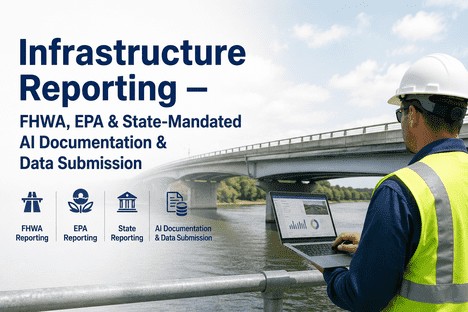
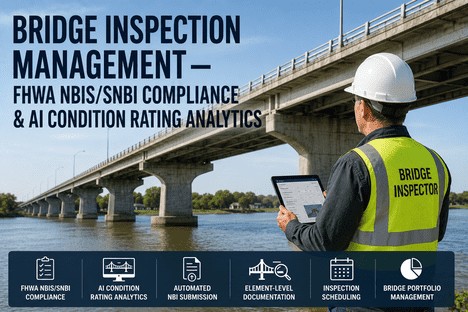
Infrastructure Reporting — FHWA, EPA & State-Mandated AI Documentation & Data Submission
By Grace on June 27, 2026
Every state department of transportation in the United States is required by federal law to develop and maintain a risk-based Transportation Asset Management Plan for the National Highway System. Every state environmental agency that administers a Clean Water State Revolving Fund must submit annual reports to the EPA documenting project activity, financial status, and environmental outcomes. Every bridge owner must report inspection data to the National Bridge Inventory under the National Bridge Inspection Standards. These are not optional activities. They are statutory requirements tied to federal funding eligibility, and they produce a cumulative documentation burden that runs into tens of thousands of staff hours per agency per year. The infrastructure reporting landscape in 2026 is defined by three converging pressures: regulatory expansion under the Bipartisan Infrastructure Law, the transition to new data standards like the Specifications for the National Bridge Inventory, and growing requirements for climate resilience and extreme weather documentation within asset management plans.
Your Agency Already Generates the Data. The Hard Part Is Turning It Into Audit-Ready Reports for FHWA, EPA, and the State.
iFactory's AI-powered infrastructure reporting module automates the documentation lifecycle across federal and state-mandated reporting frameworks — from TAMP condition data aggregation to CWSRF annual report generation to NBI inspection submission — in a single unified platform.
Estimated annual staff hours spent by state agencies on EPA SRF data collection and reporting alone — the equivalent of 90 full-time positions per year
617K
Highway bridges in the National Bridge Inventory requiring periodic inspection and condition reporting under NBIS and the new SNBI data standards by FHWA
50
State DOTs required to submit risk-based TAMPs to FHWA with lifecycle cost analysis, performance targets, and extreme weather resilience documentation
$1.2T
Bipartisan Infrastructure Law investment in infrastructure — with compliance reporting requirements that demand fundamentally better data management than current manual systems can deliver
The Infrastructure Reporting Problem Is Not That the Data Does Not Exist. It Is That the Data Lives in Too Many Places.
Public infrastructure agencies generate vast quantities of data. Pavement condition surveys. Bridge inspection reports. Asset inventories. Work order histories. Financial records. Environmental monitoring data. The data exists across multiple departmental systems, GIS layers, spreadsheets, PDF reports, and legacy databases. When a federal reporting deadline approaches, the asset management team embarks on a manual data collection exercise that involves extracting data from each system, normalising formats, reconciling inconsistencies, compiling narrative descriptions, and building the submission package. This process takes weeks, produces a report that is already outdated by the time it is submitted, and consumes staff time that would be better spent on infrastructure condition improvement.
How Disconnected Reporting Systems Undermine Compliance — and What the Pattern Looks Like
The Manual Aggregation Trap
Your TAMP is compiled from five different data sources that were never designed to speak to each other.
A typical state DOT's TAMP draws data from the pavement management system, the bridge management system, the financial management system, the maintenance work order system, and the GIS asset registry. Each system uses its own data format, asset identification scheme, and update cycle. Producing the TAMP requires manual extraction from each system, field-by-field reconciliation, and narrative compilation that takes engineering staff away from their primary responsibilities. When FHWA requests a mid-cycle update or a consistency review, the extraction process must be repeated in full — creating a cycle of reactive data assembly rather than proactive compliance management.
Scattered Data Sources
The Standard Migration Challenge
Transitioning from the Coding Guide to the SNBI for NBI reporting requires re-mapping your entire bridge inventory data structure.
FHWA's transition from the Recording and Coding Guide to the Specifications for the National Bridge Inventory represents a fundamental change in how bridge condition data is structured, coded, and submitted. Agencies must re-map hundreds of data fields, adopt new element-level condition assessment protocols, and modify their inspection data collection workflows. For agencies managing thousands of bridge structures, this transition is not a simple data migration. It is a systematic change in how inspection data is captured, validated, and reported — requiring months of preparation and significant staff training investment.
Data Standard Transition Risk
The Multi-Agency Coordination Problem
FHWA wants pavement data. EPA wants water project data. The state legislature wants asset condition data. Three reports from one agency.
State agencies rarely report to a single regulator. The same DOT that submits a TAMP to FHWA and NBI data to the federal bridge program may also manage stormwater assets subject to EPA CWSRF reporting, or maintain state-owned buildings subject to state-mandated accessibility reporting. Each submission has its own format, deadline, and data requirements. Without a unified platform that can produce multiple report formats from a single asset register, agency staff must maintain parallel data collections for each reporting obligation — duplicating effort, increasing the probability of data inconsistency, and multiplying the administrative burden with every new regulatory requirement.
Duplicated Effort Across Regulators
The Documentation Continuty Gap
When a key staff member leaves, the institutional knowledge of how to compile the annual report leaves with them.
Infrastructure reporting in many agencies relies on the undocumented expertise of one or two senior staff who know which spreadsheet to open, which query to run, and which narrative adjustments to make. When that knowledge walks out the door, the next reporting cycle becomes a scramble to reconstruct processes that were never formalised. The cost is not just the training time for the replacement. It is the delay in the reporting cycle, the potential for submission errors, and the loss of the historical context that gives the reported data its meaning for regulatory reviewers.
Infrastructure Reporting Is Not a Deadline. It Is a Continuous Process. iFactory Makes It an Automated One.
From asset condition data collection to multi-regulatory report generation to submission-ready documentation — your entire infrastructure reporting lifecycle managed in a single AI-native platform, across every asset class and every regulator.
How iFactory Transforms Infrastructure Reporting from Manual Crisis Mode into Automated Compliance Workflow
iFactory is not a reporting template or a document management add-on. It is an AI-native operations platform where every infrastructure asset, every condition inspection, every work order, and every financial transaction is tracked in a single data environment. The infrastructure reporting module extends this platform to give asset managers, compliance officers, and agency directors the tools they need to meet FHWA, EPA, and state-mandated reporting requirements from a single source of truth — with automated data aggregation, regulatory-specific report generation, and audit-ready documentation every time.
Capability 01
Unified Asset Data Layer — One Asset Register That Feeds Every Report You Need to Produce
Single Source of Truth
iFactory ingests asset data from your existing systems — pavement management, bridge management, maintenance work orders, GIS, financial systems — into a single unified asset register. Every asset is geolocated, categorised by type and regulatory classification, linked to its condition history, inspection schedule, and work order record, and tagged with the reporting frameworks that require its data. When the pavement management system updates a condition score, the iFactory asset register reflects the change immediately. When a bridge inspection is completed with SNBI element-level condition data, the register updates the bridge record and recalculates the NBI submission fields automatically. The asset manager no longer extracts data from five systems to build one report. One register. One source of truth. Every report draws from the same validated data set.
Multi-system asset data consolidation
Regulatory framework tagging per asset
Real-time condition data synchronisation
Capability 02
Regulatory-Specific Report Generation — Produce FHWA TAMP, NBI, and EPA CWSRF Reports from the Same Data Layer
Multi-Regulatory Output
iFactory's reporting module contains pre-configured report templates aligned with the specific data requirements of FHWA TAMP submissions, NBI annual data reporting under the SNBI standard, EPA CWSRF annual reports and intended use plans, and state-mandated asset management reporting frameworks. The asset manager selects the target report, defines the reporting period, and the system generates the document with the required data fields, formatting, and narrative structure — populated from the unified asset register with no manual data entry. For TAMP reports, the system includes lifecycle cost analysis tables, performance gap analysis, risk management documentation, and extreme weather resilience considerations as required by the BIL amendments to 23 U.S.C. 119. For NBI reporting, the system maps element-level condition data to SNBI coding requirements and generates the submission-ready data file. For CWSRF reporting, the system aggregates project-level financial data, environmental benefit metrics, and compliance documentation into the required annual report format.
Pre-configured FHWA-EPA-state templates
Automated lifecycle and gap analysis
SNBI-mapped NBI submission files
Capability 03
Audit-Ready Documentation Trail — Every Data Point Has a Verifiable Source and Timestamp
Defensible Compliance
When FHWA conducts a TAMP consistency review, when an EPA regional office audits a CWSRF annual report, or when a state legislative committee requests supporting documentation for an asset management submission, the agency must be able to trace every data point in the report back to its original source. iFactory's documentation module maintains a complete audit trail for every reported metric — linking the summary value in the submitted report to the underlying asset records, inspection reports, work orders, and financial transactions that produced it. The system timestamps every data change, records the user who made the modification, and preserves the historical state of the data at the time each report was generated. When the compliance question arrives, the answer is not a two-week document search. It is a single export showing the complete evidence chain for the reported figure.
Full data provenance tracking
Historical report state preservation
One-click audit evidence package
Capability 04
Cross-Regulatory Deadline Calendar and Status Dashboard — Never Miss a Submission Window Again
Submission Management
The compliance calendar in iFactory consolidates every reporting deadline across FHWA, EPA, and state requirements into a single view. The asset manager sees the TAMP submission date, the annual NBI data submittal deadline, the CWSRF annual report due date, and any state-specific reporting obligations — all in one place, with automated countdown indicators and milestone alerts. The status dashboard shows the readiness level for each upcoming submission: which data fields have been populated from the asset register, which sections still require narrative input or director review, and which assets have missing inspection data that would create gaps in the report. When a submission deadline is approaching and a required data element has not been updated within the reporting period, the system issues an alert before the gap becomes a compliance finding. The culture shifts from reactive deadline panic to proactive submission readiness.
Consolidated regulatory deadline calendar
Automated submission readiness scoring
Proactive data gap alerts
Mapping Regulatory Requirements to Platform Capabilities — How iFactory Addresses Each Major Reporting Framework
Each federal and state reporting framework has distinct data requirements, submission formats, and compliance timelines. A platform that claims to simplify infrastructure reporting must address the specific requirements of each framework — not provide a generic document generation tool that leaves the asset manager to figure out the regulatory mapping. iFactory's reporting module is built with framework-specific logic for the major reporting obligations that state and local infrastructure agencies face.
How iFactory Maps to Each Major Infrastructure Reporting Framework
Reporting Framework
Key Requirements
How iFactory Addresses This Framework
FHWA TAMP
NHS pavement and bridge condition, lifecycle cost analysis, risk management, investment strategies, performance gap analysis, extreme weather resilience documentation per BIL amendments.
Pre-configured TAMP template with automated condition data aggregation, lifecycle cost modelling tables, performance target tracking, risk register integration, extreme weather impact assessment module with climate data feeds.
FHWA NBI / SNBI
Annual bridge inventory data submission under NBIS, element-level condition inspection data per SNBI coding specifications, critical findings reporting, load rating data.
SNBI-compliant inspection data capture templates, automated field-to-submission data mapping, element-level condition coding with validation against SNBI specifications, critical finding escalation workflow, NBI submission file generation.
EPA CWSRF
Annual program activity report, intended use plan, project-level financial and environmental benefit data, SRF Data System submission, compliance with BABA and AIS requirements.
CWSRF annual report template with automated project data aggregation, financial tracking integrations, environmental benefit calculator, intended use plan generator, BABA/AIS compliance documentation module, SRF Data System export.
State-Mandated Reporting
Varies by state — may include state-level asset management plans, legislative infrastructure reports, maintenance condition assessments, performance measure reporting, capital project tracking.
Configurable report builder with state-specific template libraries, custom data field mapping, flexible narrative and data section assembly, multi-format export PDF, Excel, CSV, XML based on state submission requirements.
"
Before iFactory, our TAMP submission process started three months before the deadline. We pulled data from five different systems, reconciled pavement and bridge condition scores that never quite matched, and produced a report that was already obsolete by the time FHWA received it. The first year on iFactory, we generated the complete TAMP from the unified asset register in four days. The data was current as of the submission date. The lifecycle cost analysis was populated automatically. Our FHWA consistency review came back with zero findings for the first time in my career.
— Director of Asset Management, State Department of Transportation — 20 Years Infrastructure Reporting Experience
Conclusion
Infrastructure reporting is not becoming simpler. The Bipartisan Infrastructure Law added new resilience documentation requirements to TAMP submissions. The transition from the Coding Guide to the SNBI has fundamentally changed how bridge condition data is structured and reported. EPA CWSRF programs face increasing scrutiny on climate adaptation documentation and emerging contaminant project tracking. State legislatures are demanding more granular asset condition data to justify infrastructure funding allocations. The agencies that will meet these rising requirements efficiently are those that invest in a unified data and reporting platform — one that eliminates manual data aggregation, standardises multi-regulatory report generation, and maintains the documentation trail that regulators increasingly expect.
iFactory's AI-powered infrastructure reporting module gives public agencies the platform they need to transition from reactive, deadline-driven reporting to continuous, automated compliance — with unified asset data management, regulatory-specific report generation, full audit documentation, and a cross-regulatory deadline management system that ensures no submission window is missed. Book a Demo to see how the platform maps to your agency's specific reporting obligations, or talk to an expert to begin your reporting workflow configuration and get your first automated FHWA TAMP or EPA CWSRF report generated within thirty days.
Frequently Asked Questions
Yes. iFactory includes an integration layer specifically designed for infrastructure management systems. The platform supports direct API connections with major pavement management systems, bridge management systems, GIS platforms, and financial management systems. Where API connectivity is not available, iFactory provides structured data import templates and automated ETL pipelines that can ingest data from standard database formats, Excel exports, and XML files. For TAMP reporting, the system maps incoming pavement condition data to the required performance measure fields, aligns bridge element-level inspection data with SNBI coding requirements, and integrates financial data for lifecycle cost analysis. The integration configuration is typically completed within the first two weeks of implementation. Talk to an expert to schedule a systems integration assessment for your agency's existing software landscape.
iFactory's NBI reporting module is built on the Specifications for the National Bridge Inventory (SNBI) data standard. The platform includes pre-configured data fields that align with SNBI element-level condition assessment requirements, structural evaluation coding, and inventory data specifications. When bridge inspection data is entered or imported into iFactory using SNBI-compliant inspection templates, the system automatically maps the field-level data to the correct SNBI coding format and generates the submission-ready data file. The platform also supports agencies still transitioning from the legacy Coding Guide, with a data migration module that maps existing Coding Guide fields to their SNBI equivalents and validates the converted data against SNBI requirements before submission. Book a Demo to see the SNBI data mapping workflow configured for your bridge inventory.
The BIL amendments to 23 U.S.C. 119(e)(4)(D) require state DOTs to consider extreme weather and resilience within their lifecycle cost and risk management analyses for the TAMP. iFactory's resilience documentation module integrates with climate data feeds to provide asset-level exposure assessment for extreme weather events including flooding, storm surge, wildfire, and heat. The module links asset condition data with climate risk projections to identify infrastructure segments most vulnerable to extreme weather degradation. For the TAMP submission, the system generates the required resilience narrative section, including asset vulnerability summaries, lifecycle cost adjustments for extreme weather scenarios, and risk management strategies for climate-affected assets. The documentation is updated automatically as new climate data becomes available or as assets are inspected post-event. Talk to an expert to configure the resilience documentation module for your agency's geographic risk profile.
For a typical state DOT or municipal agency managing multiple asset classes and reporting to multiple regulators, iFactory's standard implementation sequence covers: weeks one to two for platform configuration, user role setup, and systems integration architecture design; weeks three to five for data migration from existing pavement management, bridge management, GIS, and financial systems into the unified asset register; weeks six to seven for reporting template configuration across FHWA TAMP, NBI, and EPA CWSRF frameworks; week eight for training sessions with the asset management team, compliance officers, and departmental leads; and weeks nine to ten for go-live and first report generation. Full operational capability with automated report generation across all regulatory frameworks is typically achieved within ten weeks. The first TAMP or NBI submission-ready report is typically available for review within the first thirty days of implementation. Book a Demo to build the implementation plan specific to your agency's asset inventory size, reporting obligations, and current system landscape.
Manual Reporting Is a Cost. Automated Compliance Is an Investment That Pays for Itself.
iFactory's infrastructure reporting module — unified asset data layer, regulatory-specific report generation, audit-ready documentation, cross-regulatory deadline management. The single platform that turns your reporting obligation from a manual burden into an automated workflow.