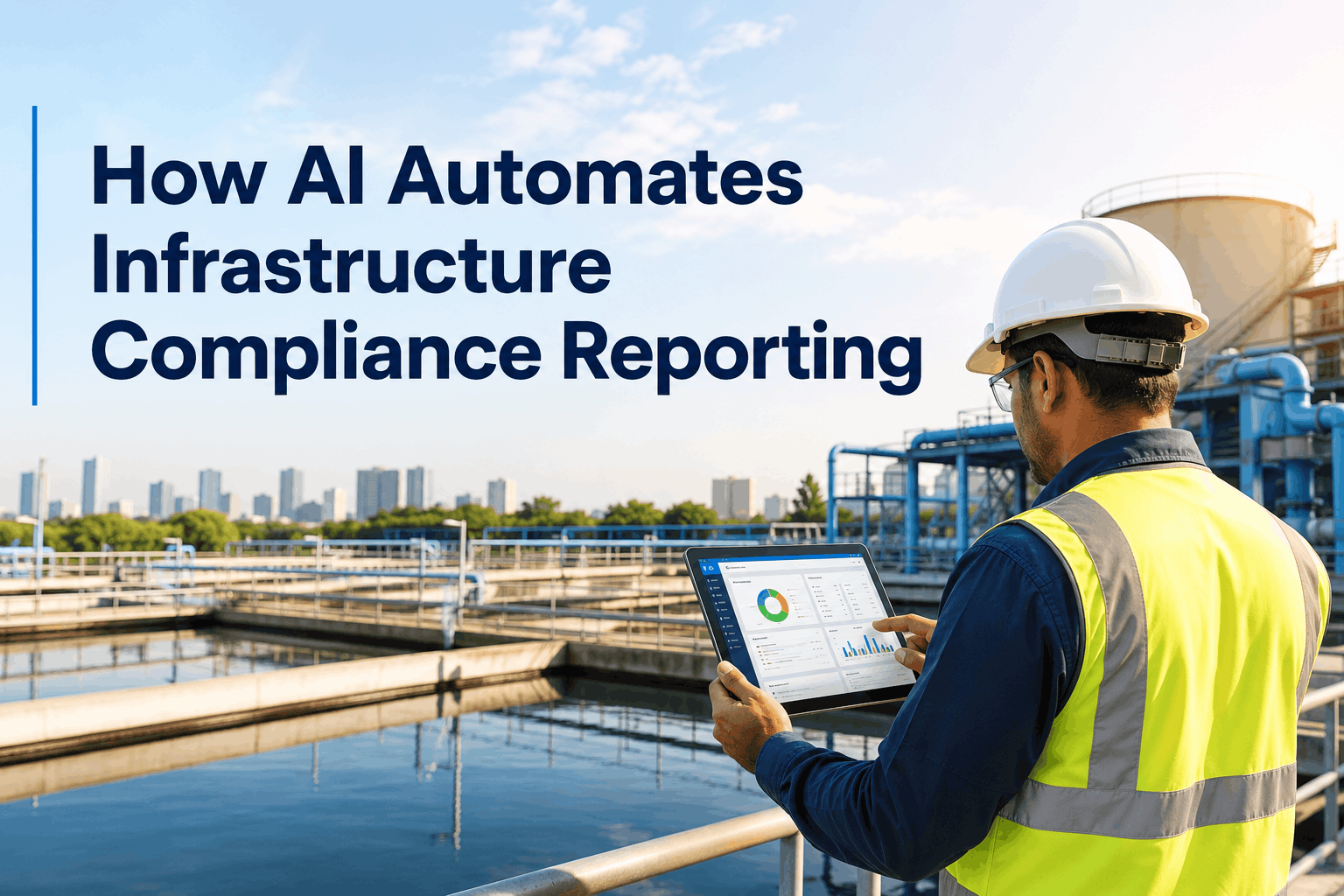
How AI automates infrastructure compliance reporting is becoming the most critical question for organizations navigating the increasingly rigorous landscape of industrial regulation and ESG transparency. For decades, compliance in integrated mills, municipal utilities, and heavy manufacturing has been defined by "Document Sprints"—the frantic, manual effort of reconciling paper logs and fragmented SCADA data just days before an auditor arrives. In 2026, leading organizations are discovering that artificial intelligence can transform compliance from a reactive, high-risk administrative burden into a continuous, autonomous operational state. By integrating real-time telemetry with regulatory frameworks like ISO 55001 and OSHA 1910, iFactory's AI-driven platform generates audit-ready reports as a natural byproduct of daily operations, ensuring that the "Digital Birth Certificate" of every asset is always current and verified. Organizations that schedule a demo are finding they can reduce audit preparation time by up to 90% while simultaneously eliminating the data gaps that create 41% of preventable regulatory violations.
Move to a Permanent State of Audit-Readiness
iFactory's Mobile AI-driven platform unifies asset health, safety permits, and environmental logs into a single automated reporting engine — purpose-built for high-criticality infrastructure compliance.
1. The Crisis of Manual Compliance: Why Legacy Systems Fail in 2026
Traditional infrastructure compliance reporting was built for a world of static assets and slow-moving regulatory cycles. Today, managers must defend against a "Logarithmic Complexity" in data reporting, where thousands of IoT sensors generate billions of data points that must be correlated with specific safety and environmental standards. When a facility relies on manual spreadsheet reconciliation, the data resolution is inherently low, often smoothing out the transients that signal non-compliance. This creates a "Compliance Blind Spot"—a period where an asset is operating outside of its validated safety or environmental envelope, but the violation remains undetected until the next manual review cycle. iFactory's physics-aware AI models eliminate this lag by performing continuous verification against regulatory guardrails, flagging excursions in milliseconds rather than weeks.
Modern regulatory bodies, including the EPA and global ISO auditors, no longer accept "We have a process" as sufficient evidence. They now demand documented proof that the process was followed at the point of execution, with immutable timestamps, geofenced verifications, and digital signatures. The transition to an automated compliance platform is not just a productivity upgrade; it is a legal safeguard against the rising tide of operational litigation. iFactory solves this by embedding compliance logic directly into the mobile workflow, ensuring that every technician is guided by regulatory guardrails while they perform their work, effectively automating the evidence-capture phase of the audit cycle. This ensures that no task can be closed out unless all mandatory safety and environmental checks have been photo-verified and digitally signed at the source.
2. Strategic Framework Mapping: Manual vs. AI-Driven Compliance
A multi-parameter comparison of traditional administrative processes versus iFactory's autonomous digital execution model across global infrastructure standards. This matrix highlights how real-time data streaming converts passive records into active legal defense.
| Compliance Parameter | Legacy Manual Model (Baseline) | iFactory AI Autonomous Model | Operational Impact |
|---|---|---|---|
| Evidence Capture | Paper forms, memory-based notes | Photo/Video + IoT sensor validation | 100% Immutable proof of work |
| Data Latency | Days to weeks (Post-shift reports) | Real-time (0.2s Stream Processing) | Instant intervention on drift |
| Permit Governance | Physical signature runs (30min lag) | Geofenced digital PTW (2min clear) | Zero work without verified LOTO |
| Energy Reporting | Monthly utility-bill averages | Real-time Batch-level SEC (kWh/ton) | ISO 50001 Evidence Automation |
| Audit Readiness | Periodic "Document Sprints" (Weeks) | Permanent continuous audit state | 90% Labor cost recovery |
| Environmental Tracking | Manual off-gas sampling (Periodic) | Predictive AI emission modeling | CBAM/ESG Compliance certainty |
3. The Identity-First Model: Eliminating Human Credential Risk
In high-stakes infrastructure, the most common source of compliance failure is not equipment malfunction, but the "Credential Paradox"—where personnel perform tasks they are no longer certified for due to expired training records. iFactory's AI-driven management system solves this by unifying HR certifications with operational task assignment. If a contractor lead attempts to open a Confined Space Permit but their medical clearance or safety induction expired 24 hours ago, the system autonomously blocks the assignment and alerts the safety officer. This ensures that 100% of personnel on the plant floor are qualified for the specific hazard zone they are operating in at all times.
This level of granularity extends to third-party vendor management, which is often the weakest link in the compliance chain during major mill shutdowns. By providing contractors with a self-service remote enrollment portal, iFactory ensures that every individual arrives on Day 1 already inducted and verified. This eliminates the "Induction Jam" at the gate and provides a complete, auditable history of exactly who was on-site, where they were, and what their qualification level was at every minute of the turnaround. Reliability directors looking to harden their vendor compliance often choose to book a demonstration of our automated identity mesh. This unified approach reduces contractor liability and provides the verified data needed for insurance audits and safety certifications like ISO 45001.
4. ISO 55001 & Asset Integrity: From Passive Records to Active Assurance
ISO 55001 auditors are increasingly shifting their focus from policy review to "Evidence of Performance." They require proof that assets are managed based on actual condition and risk rather than generic calendar intervals. iFactory's AI engine transforms passive maintenance records into active assurance by generating "Asset Health Index" reports. These reports correlate every maintenance action with its impact on theoretical throughput and mechanical stability. This allows organizations to move beyond "Fix-and-Forget" and into a model where every repair is a validated step in the asset's lifecycle management plan, satisfying the most rigorous audit requirements. Every health score is backed by 100Hz telemetry, proving that the asset was returned to its OEM-validated safety envelope after every intervention.
Moreover, the platform's ability to track "Physics of Failure" signatures provides a deeper layer of integrity proof. When a high-pressure pump's vibration signature is analyzed at 100Hz and stored as an immutable digital log, it provides the "Digital Colonoscopy" that auditors need to verify that risk was managed proactively. This level of technical transparency is what separates Level 4 matured organizations from those stuck in Level 2 digital-passive states. By automating the reporting of these health indexes, iFactory ensures that the organization can prove its resilience to bond-rating agencies and insurance underwriters, directly impacting the mill's financial creditworthiness. Maintenance teams exploring this shift often begin by choosing to schedule a strategy session to baseline their current asset integrity data versus ISO 55001 requirements.
5. Environmental & ESG Governance: Automating the Carbon Passport
The rise of the Carbon Border Adjustment Mechanism (CBAM) and integrated ESG reporting mandates has made environmental compliance a front-line financial priority for the steel and infrastructure sectors. iFactory automates the creation of the "Carbon Passport"—a batch-level record that links Specific Energy Consumption (SEC) and emissions data directly to the final product Slab ID or Heat ID. This is accomplished by correlating SCADA energy tags with real-time process physics, identifying exactly how much energy was consumed during every phase of production. This level of granularity is required for premium "Green Steel" certification and for avoiding carbon-intensity penalties in global markets. It transforms energy data from a utility expense into a verifiable quality parameter that can be shared with downstream automotive and energy sector customers.
Beyond electricity and fuel, iFactory monitors and automates the reporting of auxiliary environmental metrics, including water discharge quality and waste recycling volumes. By integrating flow and chemical sensors with AI-driven trend detection, the platform identifies potential "Sill Excursions" before they lead to an EPA violation. This predictive environmental governance ensures that nature-based or high-hazard assets are always operating within their permitted discharge limits. Organizations that utilize our autonomous fuel-air ratio governors report up to a 15% reduction in NOx emissions, with the audit logs generated automatically for regulatory submission, reducing the clerical burden on your site environmental lead by up to 80% while ensuring 100% submission accuracy.
Compliance Tier 1: Real-time Evidence Capture
IoT sensors and mobile photos capture the 'As-Found' state of every asset. This creates the foundational audit trail that proves work was performed according to OEM and regulatory specs without human error. Every entry is time-stamped and geofenced to ensure absolute data integrity and prevent post-dated logging.
Compliance Tier 2: Automated AI Correlation
AI correlates process transients (like a thermal spike) with specific maintenance actions. This proves that the organization is using data-driven logic to resolve risks, meeting ISO 55001's 'Continual Improvement' clause. The system links the 'Why' with the 'How' for every technical intervention performed on-site.
Compliance Tier 3: Autonomous Guardrail Governance
The system automatically identifies missing documentation or expired credentials and blocks high-risk work orders until cleared. This provides a digital 'Safety Net' that prevents non-compliance before it occurs, ensuring that no task proceeds unless 100% of regulatory prerequisites are met and verified by AI.
6. Occupational Health & Safety (OHS): Real-Time Hazard Documentation
Safety compliance during high-intensity events like blast furnace relines or HSM outages is the most difficult audit record to maintain due to workforce density. Traditionally, a safety officer performs periodic walk-arounds, capturing only a fraction of the actual risk profile. iFactory's AI-powered safety module transforms this into a "Continuous Observation" state. By utilizing QR-coded zone checkpoints and geofenced permit-to-work requests, the platform creates a real-time heat map of workforce risk. This ensures that high-hazard work — like scaffolding inside a furnace shell — is only performed when all prerequisite safety controls (LOTO, Gas Test, PPE) are photo-verified and digitally signed in the field-of-view of the technician.
Furthermore, the platform automates the logging of "Near-Miss" events through its mobile interface. Instead of filing a paper form at the end of the shift, a technician can capture a hazard in 60 seconds using their tablet. iFactory's AI categorizes these events by risk-intensity and identifies patterns — such as recurring zone crowding — that signal a systemic OHS failure before an accident occurs. This data-driven approach to safety reporting satisfies the most demanding OSHA 1910 and ISO 45001 requirements, providing the "Record of Control" needed to avoid recordable incident penalties and reduce workers' compensation premiums. Mills that have transitioned to this digital safety mesh report a 50% reduction in safety-related delays and 100% accuracy in their regulatory safety logs. Book a safety demo today.
7. The Future of Audit: 1-Click Digital Closeouts & Exports
The end-goal of automated compliance reporting is the "1-Click Audit." In an iFactory-enabled facility, the week-long document sprint is replaced by a single export command. Whether the auditor is requesting a history of HAGC valve calibrations or the last 12 months of EAF energy intensity, the system pulls the verified, time-stamped records into a formatted PDF or blockchain-ready digital twin. This eliminates the risk of human clerical error and ensures that the organization can respond to any inquiry with absolute technical certainty. By providing a transparent view of operational integrity, iFactory strengthens your position with regulators, insurers, and high-value B2B customers who demand verified supply chain resilience and ESG accountability.
This automation delivers a secondary benefit: it recovers the time of your most valuable people. Your reliability engineers and environmental leads can stop being "Document Clerks" and start being "Process Governors." By delegating the administrative burden to AI, they can focus on high-value optimization tasks that directly improve the mill's bottom line. The transition to autonomous compliance reporting is not just about meeting rules — it is about recapturing operational capacity to lead the Industry 4.0 revolution. To see the full reporting suite and compliance dashboard, book a technical strategy session with our infrastructure team today and begin your journey to a zero-finding audit cycle. Our engineers will demonstrate how our 1-click export logic saves thousands of engineering man-hours annually.
Automated Compliance Reporting — Frequently Asked Questions
How does AI actually automate the creation of an audit report?
iFactory uses 'Compliance Mapping Logic.' We load your specific regulatory frameworks (e.g., ISO 55001) into the system. As sensors track data and technicians complete mobile tasks, the AI automatically tags these events to the relevant regulatory clause, populating the evidence logs in real-time as work happens.
Can iFactory automate reporting for ESG and Carbon intensity standards like CBAM?
Yes. By correlating energy consumption (kWh) directly with Batch IDs and Slab IDs, iFactory calculates the precise carbon intensity per ton. This provides the auditable 'Carbon Passport' required for CBAM compliance and Green Steel certification, eliminating manual estimation errors.
Is the digital audit trail acceptable for OSHA 1910 and EPA inspections?
Absolutely. Our platform generates cryptographically signed, immutable digital logs with photo-verified evidence and geofenced timestamps. These meet or exceed the requirements for electronic record-keeping as defined by OSHA, the EPA, and other global regulatory bodies.
How long does it take to migrate from paper logs to AI-driven reporting?
The transition typically takes 2-4 weeks. We begin by digitizing your current checklists into our mobile-first templates. iFactory's IoT gateways then begin ingesting sensor data, and within the first month, the system establishes the baseline for automated report generation.
Does the system require an active internet connection to maintain the audit log?
No. iFactory features a 'Resilient Offline Mode.' Technicians can capture evidence and sign permits in shielded mill zones or remote pump galleries. The data is cached locally and syncs automatically as soon as the device reaches a signal, ensuring no gaps in the audit history.
Can we customize the reports for different insurance underwriters?
Yes. iFactory provides a flexible reporting engine. You can create custom views that prioritize the specific risk-reduction metrics (like HAGC MTBF or EAF safety clears) that your insurance underwriter requires for premium assessments.
How does the platform ensure that technicians don't skip safety steps?
Our AI-driven workflows utilize 'Mandatory Hold-Points.' A technician cannot proceed to the next task until the prerequisite safety evidence — such as a photo of the LOTO lock or a gas test reading — is captured and validated by the platform's logic.
Does iFactory integrate with enterprise CMMS systems like SAP or Maximo?
Yes. We provide native bidirectional APIs. When an RCA or compliance check is completed in iFactory, the documentation and closure status are pushed directly back to your CMMS, ensuring that your enterprise system of record is always accurate and auditable.
Achieve 100% Data Sovereignty and Compliance Security
iFactory's industrial analytics platform transforms raw operational telemetry into a unified strategic control tower — giving infrastructure executives the real-time visibility and predictive intelligence to lead turnarounds with precision.