Infrastructure Grant Application — Federal & State Funding AI Evidence Package Generation
By Grace on June 26, 2026
The Federal Highway Administration opened $3 billion in Bridge Investment Program grants for FY26 with back-to-back deadlines in June. The EPA WIFIA program has $7 billion in financing available for water infrastructure projects. FEMA's BRIC program released $1 billion for pre-disaster mitigation with applications due in July. Combined across all federal infrastructure grant programs, more than $100 billion in competitive funding is available through the Infrastructure Investment and Jobs Act — yet the majority of applications from state DOTs, municipal public works departments, and utility authorities are rejected lack of need, but because the evidence package submitted with the application does not meet the documentation standards that federal reviewers require. Condition data is outdated. Inspection reports are in inconsistent formats. Benefit-cost analyses rely on estimated rather than measured deterioration rates. The asset management system cannot produce the standardised condition reports, trend analyses, and remaining-life projections that grant review panels have been trained to expect. iFactory's Grant Evidence Package module changes this by connecting the asset register, condition data, inspection history, and deterioration models directly to the grant application workflow — generating the evidence packages that federal reviewers approve.
Grant Application · Federal Funding · State Funding · Evidence Package · BIP · WIFIA · BRIC · Benefit-Cost Analysis · Condition Documentation
Federal Grant Reviewers Do Not Approve Applications Based on Need Alone. They Approve Applications That Submit the Right Evidence. iFactory Generates That Evidence Automatically.
iFactory's Grant Evidence Package module connects your asset condition data, inspection history, deterioration models, and cost estimates directly to federal and state grant application templates — producing submission-ready evidence packages that meet BIP, WIFIA, BRIC, and state funding documentation requirements.
IIJA total enacted budget authority — $508B announced in grants, $384B obligated. Competition for remaining funds intensifies as September 2026 reauthorisation approaches
FHWA Bridge Investment Program
$3B
FY26 BIP funding available — planning grants up to $20M, bridge project grants up to $100M. Requires NBI condition data, benefit-cost analysis, and inspection documentation
EPA WIFIA Financing
$7B
WIFIA financing available for water infrastructure — 154 loans closed, $23B in financing provided, $51B in projects supported. Requires condition assessment and engineering documentation
FEMA BRIC Mitigation
$1B
BRIC FY24-25 funding for pre-disaster mitigation — $757M national competition, $20M max per project. Benefit-cost analysis and hazard mitigation plan required for qualification
Three Major Federal Programs, Three Different Evidence Requirements — and the Common Documentation Gap That Rejects Most Applications
Each federal infrastructure grant program evaluates applications against a specific set of merit criteria, and each requires a different mix of condition data, cost analysis, and supporting documentation. But across every program, the most common reason applications are rejected is not that the project lacks merit — it is that the evidence package does not meet the standard. Condition data that is too old, inspection reports that are not formatted to program specifications, benefit-cost analyses built on assumptions rather than measured data, and missing documentation of the deterioration trajectory that justifies the intervention timing. iFactory's Grant Evidence Package module does not write the grant narrative. It generates the evidence that makes the narrative credible.
FHWA — BIP
Bridge Investment Program
Evidence Requirements
NBI condition data for each bridge, latest bridge inspection report, benefit-cost analysis with quantified safety, mobility, and resiliency benefits, maintenance cost reduction projections, and documentation of how the project addresses bridges in poor or fair condition at risk of falling into poor condition.
Common Evidence Gaps
Aging inspection data past the 24-month cycle, condition scores that do not match the NBI 0-9 format expected by reviewers, benefit-cost ratios calculated without asset-specific deterioration rate data, missing documentation of fair-condition bridges at risk of declining to poor within the grant performance period.
Grant Range: $2.5M to $100M per project
EPA — WIFIA
Water Infrastructure Finance and Innovation Act
Evidence Requirements
Letter of interest with project description, cost estimate, and eligibility demonstration. Full application requires engineering feasibility report, environmental review documentation (NEPA), financial capability assessment, project condition assessment data, and a project timeline with milestone dates and cost phasing.
Common Evidence Gaps
Condition assessment data that is not standardised across the water system, asset registers that do not include age and material data needed for remaining-life projections, financial capability documentation that is not linked to the specific assets being financed, environmental review documentation that requires condition data the utility does not have in a consolidated format.
Financing: $7B available across WIFIA + SWIFIA
FEMA — BRIC
Building Resilient Infrastructure and Communities
Evidence Requirements
Approved local hazard mitigation plan, detailed project scope with design readiness documentation, benefit-cost analysis using FEMA-approved methodology, environmental and historic preservation review documentation, demonstrated technical and managerial capacity, and organisational leadership and governance information.
Common Evidence Gaps
Benefit-cost analyses that rely on national average values rather than asset-specific condition data, design documentation that lacks the detail needed for FEMA's readiness scoring, hazard mitigation plan references that are not linked to specific infrastructure vulnerability assessments, missing documentation of the organisational capacity to administer the grant.
Grant Range: Up to $20M federal share per project
Evidence Package Generation · Grant Application Support · Federal Funding · Condition Documentation
Every Federal Grant Application Needs Condition Evidence. The Agencies That Submit the Best Evidence Win the Funding.
iFactory's Grant Evidence Package module generates submission-ready documentation — condition score summaries, inspection record attachments, deterioration trend graphs, benefit-cost analysis data, and project prioritisation rankings — from the asset data you already maintain.
How iFactory Builds the Evidence Package That Wins Grant Funding — From Asset Data to Submission-Ready Documentation
The Grant Evidence Package module is not a grant-writing tool. It is an evidence-generation engine that connects the asset management system — condition scores, inspection records, deterioration models, maintenance cost history, remaining useful life estimates — directly to the documentation templates that federal and state grant programmes require. The grant writer writes the narrative. iFactory generates the data tables, condition summaries, trend charts, benefit-cost inputs, and appendices that give the narrative its credibility with technical review panels.
Evidence Component 01
Condition Score Summary Report — Standardised Asset Condition Data in the Format Each Grant Programme Requires
Condition Documentation
Every federal infrastructure grant programme requires documented evidence of current asset condition. BIP requires NBI condition ratings and latest bridge inspection reports. WIFIA requires condition assessment data for the water infrastructure assets being financed. BRIC requires vulnerability assessments linked to the hazard mitigation plan. iFactory's Grant Evidence Package module generates a condition score summary report for each asset included in the grant application, formatted to the specific programme's documentation standards. For BIP, the report includes the NBI rating for deck, superstructure, substructure, and culvert, the most recent inspection date, the inspection report attachment, and a condition trend graph showing the rating trajectory over the last three inspection cycles. For WIFIA, the report includes asset age, material, condition score, remaining useful life estimate, and maintenance cost history. Each report is generated directly from the asset register data — no manual data compilation, no format conversion, no transcription errors between the asset management system and the grant application.
Programme-specific condition formatting
Inspection report attachment integration
Multi-cycle condition trend graph
Evidence Component 02
Deterioration Trajectory Analysis — Demonstrating That Without Funding, Condition Will Reach Critical Level Within the Grant Performance Period
Deterioration Evidence
One of the most persuasive elements a grant application can include is a data-driven projection of what will happen to the asset's condition if funding is not awarded. iFactory's deterioration trajectory analysis uses the asset's inspection history — condition scores from multiple inspection cycles, with the interval between inspections recorded — to calculate the deterioration rate for each asset. For a bridge deck that has declined from NBI 7 to NBI 5 over three inspection cycles, the trajectory model projects the number of years until it reaches NBI 4 (poor) and NBI 3 (critical), with confidence intervals based on the scatter in the historical data. This trajectory becomes the centrepiece of the benefit-cost analysis: the cost of intervention now versus the cost of emergency repair or replacement after the asset enters poor condition, calculated using the specific deterioration rate of that specific asset rather than a generic default value. Federal reviewers recognise this as higher-quality evidence than industry-average deterioration assumptions, and applications with asset-specific trajectory data score consistently higher on the merit criteria that evaluate project justification.
Asset-specific deterioration rate calculation
Years-to-critical projection with confidence
Intervention-timing cost comparison
Evidence Component 03
Benefit-Cost Analysis Data Package — Quantified Condition-Driven Benefits That Survive Technical Review
BCA Package
The benefit-cost analysis is the most scrutinised component of any federal infrastructure grant application. iFactory's Grant Evidence Package module generates the quantitative inputs for the BCA directly from the asset management system: current maintenance cost per year, projected maintenance cost without intervention based on the deterioration trajectory, projected maintenance cost with intervention, remaining useful life extension in years, avoided emergency repair probability based on historical failure rates for assets in similar condition, user delay cost reduction from avoided load restrictions or closures, and safety benefit estimates based on accident history at the asset location. The module outputs these values in the format required by each programme's BCA methodology — USDOT's TIGER BCA guidance for BIP applications, the FEMA BCA toolkit format for BRIC applications, or the WIFIA financial capability model format. The grant writer imports these values directly into the BCA model, eliminating the manual data compilation that produces the errors and inconsistencies that technical reviewers flag as application weaknesses.
Programme-specific BCA format output
Condition-driven maintenance cost projection
Emergency avoidance probability calculation
Evidence Component 04
Project Prioritisation and Portfolio Ranking — Demonstrating That This Project Is the Most Cost-Effective Use of Grant Funds
Portfolio Ranking
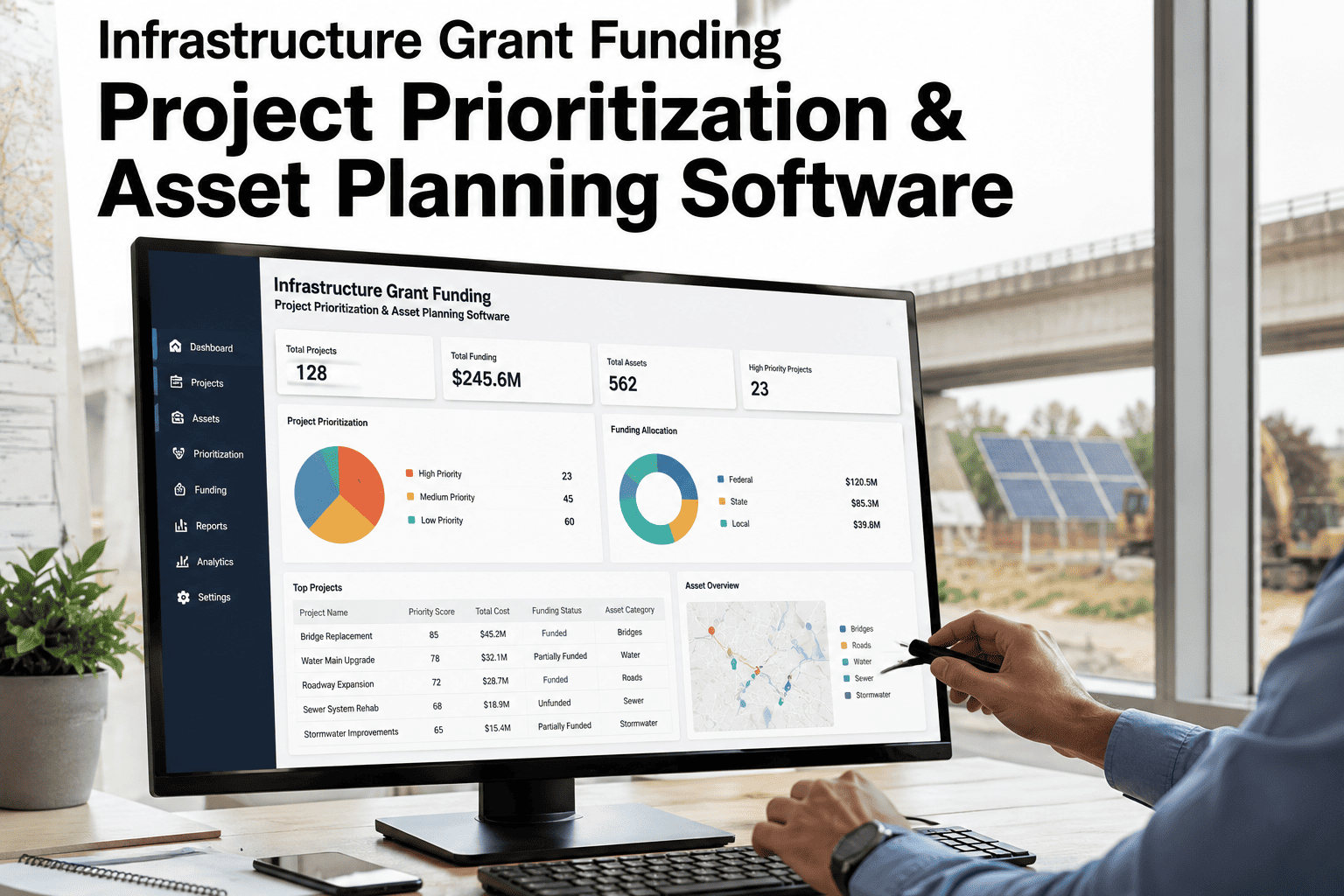
Federal grant reviewers evaluate applications not just on the merit of the individual project, but on whether the applicant has a defensible process for prioritising projects across the portfolio. Applications that include a documented, data-driven prioritisation methodology score higher on the project selection and planning merit criteria than applications that cannot demonstrate how the proposed project was chosen relative to other needs. iFactory's portfolio ranking report shows every asset in the applicant's portfolio sorted by a composite priority score that combines condition severity, deterioration rate, remaining useful life, consequence of failure, and intervention cost-effectiveness. The proposed grant project appears in its rank position with the rationale for selecting it over higher-ranked assets if applicable — for example, a bridge in fair condition with a high deterioration rate may rank higher for preventative intervention than a bridge in poor condition that is already scheduled for replacement through other funding. This documented prioritisation methodology demonstrates to reviewers that the applicant is managing the portfolio systematically and that the proposed grant project represents the optimal use of federal funds within the context of the full asset inventory.
Composite priority score ranking
Project selection rationale documentation
Portfolio context for each grant application
"
Our county had been submitting BIP applications for three consecutive cycles without success. Each application described the same group of structurally deficient bridges and requested funding for replacement. Each application was rejected. After the third rejection, a USDOT reviewer feedback session revealed the problem: our applications included condition data and inspection reports, but we had not demonstrated the deterioration trajectory, we had not quantified the benefit-cost ratio using asset-specific data, and we had not documented how we selected these particular bridges over others in our portfolio. The first application we prepared using iFactory's evidence package module included the condition trend graphs for each bridge, the deterioration trajectory projection showing the year each bridge would reach critical condition without intervention, the BCA inputs calculated from our actual maintenance cost history, and the portfolio ranking showing that these bridges were the highest-priority assets in our inventory. The application was awarded $24 million in BIP funding.
— Director of Public Works, County Government — 20 Years Infrastructure Capital Planning and Grant Administration
Conclusion
The $545 billion Infrastructure Investment and Jobs Act created the largest competitive federal infrastructure grant environment in American history — with the FHWA Bridge Investment Program, EPA WIFIA, FEMA BRIC, and dozens of other programmes distributing hundreds of billions in competitive funding. But the volume of available funding has been matched by the volume of competition, and grant success rates across most programmes remain in the 10-30% range. The difference between a successful and unsuccessful application is increasingly not the merit of the project — it is the quality of the evidence package that supports it. Condition data that is current, formatted to programme specifications, and linked to a documented deterioration trajectory. Benefit-cost analysis inputs calculated from measured asset data rather than industry averages. A portfolio prioritisation methodology that demonstrates systematic asset management rather than ad-hoc project selection.
iFactory's Grant Evidence Package module connects the asset management system directly to the grant application workflow — generating condition score summaries, deterioration trajectory analyses, benefit-cost data packages, and portfolio ranking reports that meet the documentation standards of federal and state infrastructure grant programmes. The module does not replace the grant writer. It provides the grant writer with evidence that survives technical review.
Book a Demo to see your asset data transformed into grant-ready evidence packages for BIP, WIFIA, BRIC, or state funding programmes, or talk to an expert about configuring the Grant Evidence Package module for the specific programmes in your current funding pipeline.
Frequently Asked Questions
iFactory generates the evidence data, condition summaries, deterioration projections, benefit-cost analysis inputs, portfolio ranking reports, and appendix documentation that support the grant narrative. The narrative itself — the project description, the statement of need, the community benefits discussion, the project management approach — is written by your grant writer or applications team. iFactory provides the quantitative evidence that makes the narrative credible to technical reviewers. Most grant writers spend 60-70% of their application development time compiling and formatting condition data, inspection reports, and cost information from disparate sources. iFactory reduces that data compilation time to near zero, freeing the grant writer to focus on the narrative quality that distinguishes competitive applications. Talk to an expert to discuss how the evidence module integrates with your existing grant writing workflow.
The module is currently configured with native evidence templates for the FHWA Bridge Investment Program (BIP), EPA Water Infrastructure Finance and Innovation Act (WIFIA) programme, and FEMA Building Resilient Infrastructure and Communities (BRIC) programme. Additional federal programmes with template support under development include the USDOT INFRA and BUILD discretionary grant programmes, the EPA Clean Water and Drinking Water State Revolving Funds, the FEMA Hazard Mitigation Grant Program, and the Department of Energy grid resilience grants. For state-level infrastructure grant programmes, iFactory's template builder allows your organisation to configure custom evidence package formats matching the specific documentation requirements of your state's department of transportation, environmental protection agency, or emergency management office. The evidence module outputs can also be exported as standard data packages for any programme not covered by a pre-built template — condition data tables in CSV, inspection report attachments in PDF, deterioration graphs in PNG, and BCA inputs in the programme-required format. Book a Demo to review the template library for your specific grant programme pipeline.
Each federal programme uses a different benefit-cost analysis framework with different assumptions, discount rates, benefit categories, and documentation requirements. USDOT programmes such as BIP and INFRA use the TIGER BCA methodology, which quantifies safety benefits, travel time savings, maintenance cost reductions, emissions impacts, and broader economic benefits using standardised dollar values per unit. FEMA's BRIC programme uses the FEMA BCA toolkit, which focuses on avoided future damage costs calculated using replacement value, damage frequency, and mitigation effectiveness percentages. EPA's WIFIA programme uses a financial capability model that evaluates the borrower's ability to repay the loan based on ratepayer affordability and revenue projections. iFactory's Grant Evidence Package module maintains separate calculation engines for each programme's BCA methodology, mapping the same underlying asset data — condition score, replacement value, maintenance cost history, remaining useful life — through the appropriate calculation logic for the target programme. The module outputs the BCA inputs in the format required by each programme's official tools: USDOT's benefit-cost template, FEMA's BCA workbook, or EPA's financial capability model. Talk to an expert about configuring the BCA engine for the specific programmes you are targeting in the current funding cycle.
The module does not fill data gaps with estimated values that would compromise the credibility of the evidence package. Instead, it generates a data completeness report alongside each evidence package, clearly identifying which required fields are populated from asset records and which are missing. For condition scores, the module uses existing inspection data if available, uses projected scores from the deterioration model if the last inspection is older than the programme's recency requirement, and flags assets where no inspection data exists within any usable timeframe. For the benefit-cost analysis, the module defaults to the programme's standard assumption values for missing inputs — such as using FHWA's default benefit values when site-specific data is not available — but clearly labels each value as "measured" (from asset records), "projected" (modelled from historical data), or "default" (programme standard assumption). This transparency allows the grant writer to decide whether to invest effort in collecting the missing data for a stronger application or proceed with the default values and note the data limitation in the narrative. Federal reviewers consistently rate applications higher when data sources and limitations are transparently documented rather than obscured. Book a Demo to see a data completeness assessment for your current asset register and inspection records.
The Grant Applications That Win Are the Ones with the Best Evidence. iFactory Generates That Evidence from the Asset Data You Already Own.
iFactory's Grant Evidence Package module — condition score summaries, deterioration trajectory analyses, benefit-cost data packages, and portfolio ranking reports for BIP, WIFIA, BRIC, and state infrastructure grant programmes.