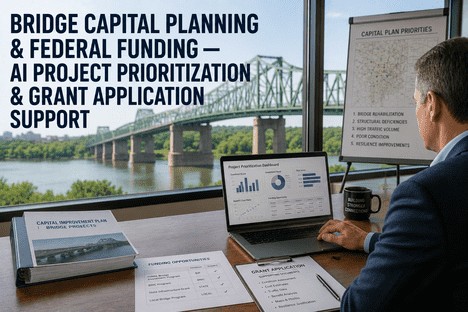
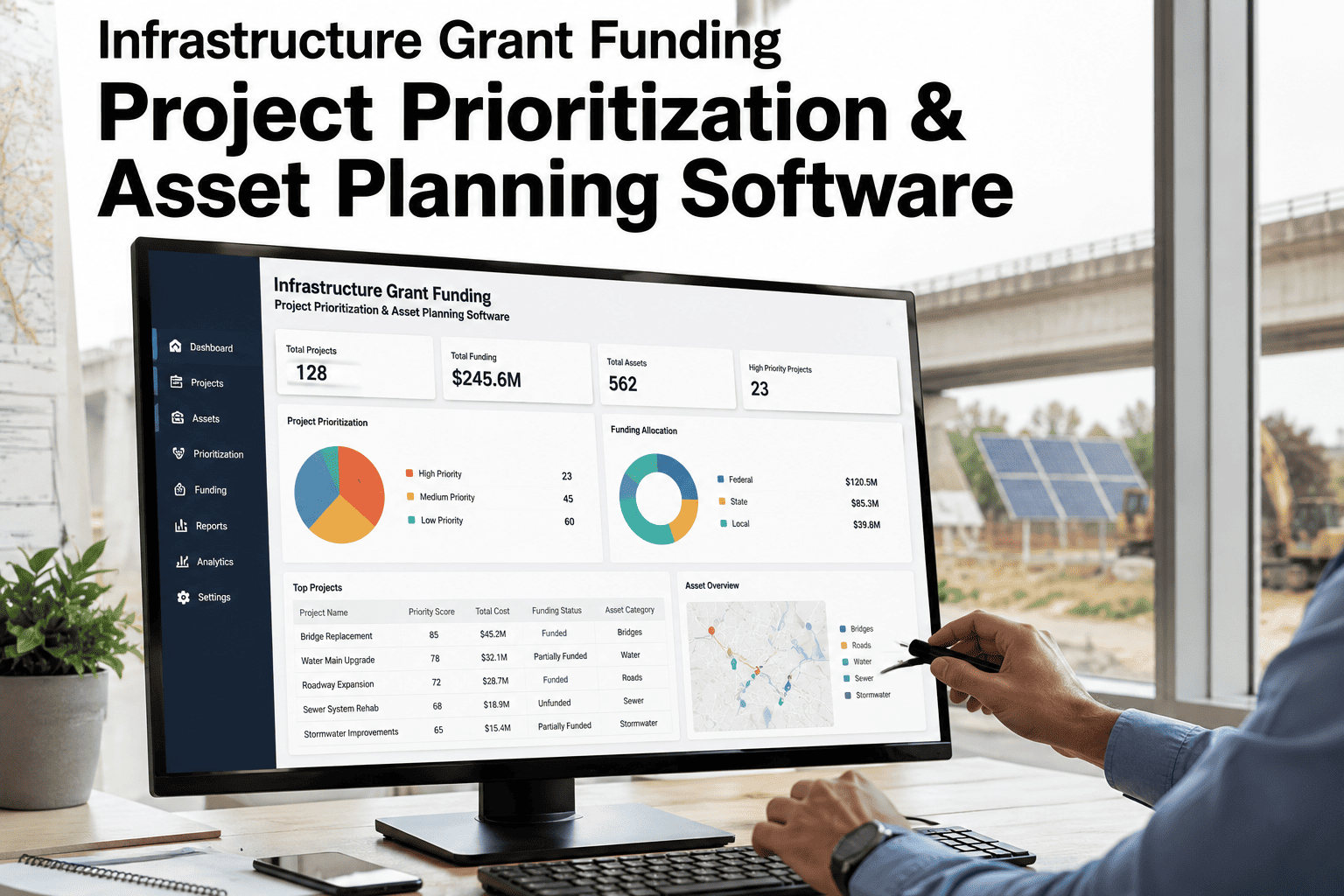
Bridge Capital Planning & Federal Funding — AI Project Prioritization & Grant Application Support
By Grace on June 19, 2026
Every operations director managing a bridge portfolio faces the same structural tension: the capital plan must stretch across a five-to-ten-year horizon, but the data used to build it — condition ratings from the last inspection cycle, cost estimates from a different procurement environment, prioritisation weights set during a prior administration's funding regime — is already losing relevance by the time the plan is approved. The consequence is a capital programme that allocates millions to the bridges that were most critical eighteen months ago, while the bridges deteriorating fastest today wait for the next planning cycle to catch up. The gap between the condition reality and the capital plan grows wider with every inspection update, every funding policy change, and every unplanned closure that reorders priorities overnight. AI-powered project prioritisation eliminates this gap by making the capital plan a live model that recalibrates whenever new condition data, cost changes, or grant opportunities appear — without requiring the operations director to rebuild the plan from scratch.
FHWA BIP · BRIC Grants · AI Prioritisation · Capital Planning
Operations Directors Who Secure Federal Bridge Funding Consistently Have One Tool the Rest Do Not: AI That Prioritises Projects the Way Grant Reviewers Evaluate Them.
iFactory's AI capital planning platform gives operations directors dynamic project prioritisation that aligns with FHWA BIP evaluation criteria, BRIC resilience scoring, and state grant requirements — with automated condition tracking, funding gap analysis, and audit-ready application documentation built in from day one.
Total FHWA Bridge Investment Program funding available across FY2022-2026 for bridge replacement, rehabilitation, preservation, and planning grants nationwide
USD 3 B
BIP funding opened in May 2026 for bridge project and planning grants, with applications due June 15 and June 29 respectively
42,000+
Bridges in the United States rated in poor condition according to the 2025 ASCE Infrastructure Report Card, representing 6.8% of the national inventory
USD 1 B
FEMA BRIC program funding available for pre-disaster hazard mitigation, prioritising shovel-ready infrastructure projects with clear risk reduction metrics
The Operations Director's Core Problem: Why Bridge Capital Plans Lose Relevance Before They Are Approved
A capital improvement plan is approved in June. The condition data used to build it came from inspection cycles ending in December of the previous year. By September, a bridge rated in fair condition during that inspection develops a critical scour exposure during a flood event. The capital plan still shows it as a year-four project. The operations director has no mechanism to reprioritise it into the current funding window without reopening the entire plan — a process that consumes weeks of stakeholder negotiation and produces a new approval cycle that will be outdated before it is finalised. This is not a planning failure. It is a structural limitation of static capital planning models that cannot absorb new information without human-driven rework. AI prioritisation solves this by making the capital plan continuously responsive to every data point the operations director's team already collects.
Five Failure Modes of Static Bridge Capital Planning — and How AI Prioritisation Eliminates Each One
01
Condition Data Ages Faster Than the Planning Cycle
Bridge condition ratings from the most recent inspection cycle are already six to eighteen months old when they enter the capital plan. In that interval, scour, corrosion, fatigue cracking, and deck deterioration continue accumulating. The plan allocates capital based on condition that no longer reflects the current risk profile. A bridge that was structurally deficient at inspection may have deteriorated into a load-restricted or closure-risk state by the time funding is released, but the plan still schedules it according to the older rating.
AI fix: Condition updates ingested continuously → prioritisation model recalibrates within hours of new inspection or sensor data.
02
Grant Application Windows Open Faster Than Plans Can Adapt
FHWA Bridge Investment Program planning applications for FY2026 close June 15, 2026. Bridge project applications close June 29. A new BRIC NOFO may open with a 60-day submission window. Operations directors managing static capital plans must manually identify which projects in their portfolio align with the grant criteria, extract the supporting condition data, and prepare the benefit-cost analysis within the window — often while the capital plan is still being updated for the next fiscal year. The projects that could have been competitive sit unsubmitted because the planning cycle could not respond in time.
AI fix: Grant criteria mapped to project portfolio automatically → eligible projects surfaced with pre-populated application data within the NOFO window.
03
Funding Policy Changes Reshuffle the Priority Landscape
BIP amendments in May 2026 expanded applicant eligibility to metropolitan planning organisations and local governments directly. BRIC's relaunch under the current administration prioritises shovel-ready infrastructure projects with clear risk reduction metrics. These policy shifts change which projects are fundable and how they should be positioned — but static capital plans calibrated to the previous funding regime continue allocating capital as if nothing changed. Operations directors must manually reinterpret every project's funding eligibility against the new criteria, a process that consumes capacity that should go toward application preparation.
AI fix: Funding policy update ingested → portfolio re-scored against new eligibility and scoring criteria within one business day.
04
Unplanned Closures Force Reactive Reprioritisation
A bridge rated in fair condition is closed by an emergency inspection finding. The closure diverts traffic, increases user costs by thousands per day, and shifts community risk exposure. The static capital plan has no mechanism to absorb this event. The operations director convenes an emergency reprioritisation meeting, the team spends two weeks adjusting the plan, and the adjusted schedule is already contested by stakeholders who expected the original timeline. The gap between the event and the response produces a period during which capital continues flowing to bridges that are objectively less critical than the one now standing closed.
AI fix: Closure event logged → model recalculates priority scores for the affected corridor and adjacent assets within the same session.
05
Benefit-Cost Analysis Must Be Rebuilt for Each Grant Application
Every federal grant programme — BIP, BRIC, INFRA, CHBP — requires a project-specific benefit-cost analysis using different methodologies, discount rates, and benefit categories. Operations directors leading medium-to-large portfolios find their teams rebuilding BCA models from scratch for each application because the capital plan stores project cost estimates and condition data in a format that does not map directly to grant BCA templates. The result is that the same project may receive a BCA for a BIP application that bears no resemblance to the BCA for a BRIC application, undermining the consistency of the project's funding narrative.
AI fix: Project data mapped to BCA models for BIP, BRIC, INFRA, and state programmes automatically → consistent analysis across all applications without manual rework.
06
Stakeholder Confidence Erodes When the Plan Keeps Changing
The cumulative effect of all five failure modes above is a stakeholder community — elected officials, funding partners, community boards — that has learned to treat the capital plan as aspirational rather than operational. When project timelines shift every quarter, when grant applications appear unannounced, and when the plan published in January does not match the plan in April, confidence in the planning process itself erodes. Operations directors spend more time defending the plan's credibility than advancing its execution. AI prioritisation restores credibility because every re-prioritisation is traceable to a data event — a new inspection rating, a grant opening, a closure — that any stakeholder can review.
AI fix: Every priority change logged with the triggering data event → stakeholder reports show the evidence chain, not just the updated schedule.
When the Capital Plan Cannot Keep Pace With the Condition Reality, the Operations Director Is Always Explaining the Gap Instead of Closing It. AI Closes It Automatically.
iFactory builds the bridge between inspection data, grant criteria, and capital allocation directly into the prioritisation model — so operations directors submit funding applications backed by current condition evidence, not plans built on last year's assumptions.
The AI Capital Planning Architecture for Bridge Operations Directors
The iFactory AI capital planning platform operates as a three-layer decision intelligence system — live portfolio prioritisation at the asset level, grant eligibility and scoring at the programme level, and stakeholder reporting and audit documentation at the governance level. Each layer serves a distinct operations management function, and all three run continuously without requiring the operations director to rebuild models between planning cycles.
Layer 01
Live Portfolio Prioritisation
Continuous priority scoring across the entire bridge inventory
The prioritisation engine ingests all available bridge data — NBI condition ratings, element-level inspection findings, load ratings, scour evaluations, average daily traffic, detour length, freight significance, and historical cost data — and maintains a multi-criteria priority score for every bridge in the portfolio. Priority scores are recalculated continuously: when a new inspection report is uploaded, when traffic counts are updated, when a bridge closure event is logged, or when a new grant programme with specific eligibility criteria is announced. The operations director sees a single ranked portfolio where every bridge's position is justified by its current data profile — and every change in ranking is traceable to the specific data event that triggered it.
Multi-criteria priority scoring
Live condition data ingestion
Event-triggered recalibration
Layer 02
Grant Eligibility and Scoring
Automated matching of portfolio projects to open grant opportunities
The grant layer maps every active NOFO — BIP planning grants, BIP bridge project grants, large bridge project grants, BRIC mitigation projects, Competitive Highway Bridge Program, INFRA, and state-specific programmes — against the prioritised portfolio. Each project receives an eligibility score linked to the specific grant criteria: project readiness, cost effectiveness, risk reduction impact, community benefit, and alignment with programme priorities. When a new NOFO is published, the system identifies the subset of projects that are eligible and competitive, generates the benefit-cost analysis using the grant programme's methodology, and pre-populates the application template with the project's current data. The operations director reviews, adjusts, and submits — without the team spending weeks determining which projects fit which programme.
NOFO-to-portfolio matching
Automated BCA generation
Pre-populated application templates
Layer 03
Stakeholder Reporting and Audit Documentation
Automated governance reports for elected officials, funding partners, and auditors
Every priority change, grant application submission, condition update, and funding allocation is logged with a timestamp and the triggering data event — creating the traceability chain that governance and audit requirements demand. For elected officials, the platform generates programme-level dashboards showing portfolio condition trends, funding gap analysis, and grant capture rates by programme. For funding partners, the platform produces project-level reports showing the evidence chain behind each priority ranking — the inspection finding, the traffic impact, the risk score — that justifies the allocation decision. For auditors, the platform exports a complete capital planning record: every condition update, every prioritisation recalibration, every grant application, and every funding decision linked to the data that supported it. The operations director never needs to reconstruct the rationale for a decision made six months earlier because the system retained it automatically.
Programme-level dashboards
Audit-ready evidence chains
Grant capture rate tracking
What the AI Capital Planning Dashboard Shows the Operations Director
The operations director's view of the AI capital planning system is not a data management interface — it is a strategic decision platform. The dashboard is designed around the questions that operations directors must answer continuously: Which bridges need capital intervention most urgently today? Which funding programmes are open and which of our projects fit? Is our grant capture rate improving or declining? And when the board or the auditor asks for the rationale behind a funding decision, is the evidence ready?
Decision View 01
Live Portfolio Priority Rank With Condition Trend and Risk Score
Every bridge in the portfolio displayed in a single ranked view with its current condition rating, element-level deterioration trend, traffic-weighted risk score, and funding status. Filters by condition category, functional class, district, or funding programme allow the operations director to isolate any segment of the portfolio in one click. The priority rank updates automatically whenever new inspection data, traffic data, or closure events are ingested — the operations director never needs to ask whether the ranking reflects the latest information because it always does.
Operations director action: Review top-ranked bridges weekly. Investigate any bridge whose priority score jumped by more than one decile since the last review.
Decision View 02
Grant Opportunity Map With Project Fit Scores
All open and upcoming grant opportunities displayed alongside the portfolio's eligibility and competitiveness for each programme. BIP planning grants, bridge project grants, large bridge project grants, BRIC mitigation, INFRA, CHBP, and state programmes — each with a project count showing how many portfolio assets meet the eligibility criteria and a fit score indicating how competitive each project is under the programme's evaluation methodology. When a new NOFO is published, the eligible projects appear automatically and the benefit-cost analysis template is pre-populated with the project's current data.
Operations director action: Review grant opportunities monthly. Authorise application submissions for projects with fit scores above the competitive threshold.
Decision View 03
Funding Gap Analysis by Programme and Time Period
The funding gap view compares currently secured funding against the capital requirements of the prioritised portfolio across the planning horizon. Bridges are grouped by urgency band — immediate intervention required, intervention needed within 12 months, within 24 months, within 60 months — and each band shows the funding shortfall and the grant programmes that could close it. The operations director sees at a glance whether the portfolio is adequately funded for the next year, which gap is growing fastest, and which grant opportunity is best positioned to close each gap.
Operations director action: Monitor funding gap trend monthly. Escalate widening gaps in the immediate and 12-month urgency bands to the executive team with the grant strategy to close them.
Decision View 04
Grant Capture Rate and Application Pipeline Status
Every grant application — submitted, in preparation, awarded, or declined — is tracked in a single pipeline view. The capture rate by programme, by project type, and by fiscal year is calculated automatically, giving the operations director the data to evaluate which programmes the portfolio competes for effectively and where the application strategy needs adjustment. When an application is awarded, the funding is linked to the bridge record and the capital plan updates automatically. When an application is declined, the system flags the project for the next applicable NOFO cycle.
Operations director action: Review pipeline weekly during NOFO windows. Reallocate preparation capacity to programmes with highest capture rates.
Decision View 05
Stakeholder Report Export — Capital Plan in One Click
Every report the operations director needs for elected officials, funding partners, board presentations, and public meetings is generated automatically from the live portfolio data. Priority ranking reports, condition trend summaries, funding gap analyses, grant capture dashboards, and project-level evidence reports — all exportable in a format suitable for presentation without manual data compilation. The report always reflects the current portfolio state because it is generated from the live model, not from a snapshot taken weeks ago. The evidence chain report — showing every priority change linked to its triggering data event — is the single document that demonstrates to auditors and oversight bodies that capital allocation decisions are data-driven and traceable.
Operations director action: Generate quarterly stakeholder report in under five minutes. Include evidence chain appendix for audit readiness.
Decision View 06
Deterioration Forecast and Capital Needs Projection
Using historical condition data, element-level deterioration rates, and traffic loading trends, the platform forecasts each bridge's condition trajectory over the next 5, 10, and 20 years. Bridges projected to cross the poor condition threshold within the planning horizon are flagged with the year of projected transition and the estimated capital intervention cost at that point. The aggregated projection shows the total capital requirement by year, allowing the operations director to compare the funded capital plan against the projected needs curve. When the projected needs curve diverges from the funded plan, the gap represents the unfunded risk exposure that must be addressed through grant applications, budget requests, or alternative delivery strategies.
Operations director action: Review 10-year projection quarterly. Prioritise grant applications for bridges crossing the poor condition threshold within 24 months.
"
Our five-year capital plan was built on inspection data that was already a year old by the time the board approved it. We had USD 180 million in identified needs and USD 62 million in secured funding, and we were allocating that gap manually — which meant we were consistently three to six months behind every grant application cycle. The AI prioritisation platform changed our approach completely. Within 90 days, we had a live ranked portfolio connected to BIP and BRIC criteria. We submitted three grant applications in the first cycle and were awarded USD 14 million for two bridge projects. The key difference was not that we had better projects — we had the same projects we had been trying to fund for two years. The difference was that the platform surfaced them at the right moment with the right data package, and we submitted before the deadline instead of after it. Our capture rate went from zero to two out of three in the first cycle.
— Operations Director, County Bridge Programme — 420 Bridges, 5-Year USD 62 Million Capital Programme
Conclusion
Bridge capital planning is not a budgeting problem — it is a decision timing problem. When the capital plan is built on data that is months or years old, when grant application windows open and close faster than the planning cycle can respond, and when every unplanned closure forces a manual reprioritisation exercise that consumes weeks of operations capacity, the capital programme is structurally unable to keep pace with the condition reality it is meant to manage. AI-powered project prioritisation addresses all three dimensions simultaneously: continuous condition ingestion that keeps the portfolio ranking current, automatic grant matching that surfaces eligible projects within the NOFO window, and event-triggered recalibration that absorbs closures and emergencies without requiring the operations director to rebuild the plan.
The evidence from current federal funding cycles is clear. FHWA made USD 3 billion available through the Bridge Investment Program in May 2026, with planning applications due June 15 and bridge project applications due June 29. FEMA relaunched the BRIC programme with USD 1 billion for pre-disaster mitigation, prioritising infrastructure projects with clear risk reduction metrics. State transportation departments that have adopted AI-driven prioritisation and grant matching are submitting complete, competitive applications within the NOFO window — while operations directors managing static capital plans are still determining which projects in their portfolio qualify. The gap between these two outcomes is not a difference in project quality. It is a difference in decision infrastructure.
iFactory's AI capital planning platform is designed for operations directors who need to convert their bridge condition data into funded projects — not just maintain a plan that grows more outdated with every inspection cycle. Book a Demo to see the AI prioritisation platform configured for your bridge portfolio and funding programme profile, or talk to an expert about a free funding readiness assessment for your bridge capital programme.
Frequently Asked Questions
The platform initialises using NBI condition data, element-level inspection reports, load ratings, and traffic data — the same information the operations director's team already maintains for federal reporting and capital planning. A standard bridge portfolio of 200 to 500 bridges can be loaded, validated, and producing priority scores within two to three weeks from data delivery. Additional data sources — scour evaluations, fracture-critical inspection findings, historical cost data, FHWA BIP benefit-cost templates — are integrated during the same implementation window. The platform deploys alongside the existing capital planning process in parallel mode first, allowing the operations director team to validate the AI priority rankings against their current planning methodology before relying on the AI output for funding decisions. Parallel validation typically runs for four to six weeks. Talk to an expert to confirm your data readiness and receive a project-specific implementation timeline.
The prioritisation engine uses a multi-criteria scoring framework that maps directly to federal grant evaluation rubrics. For BIP applications, the model weights project readiness, cost effectiveness, condition improvement impact, and community benefit — matching the criteria categories in the BIP NOFO merit criteria. For BRIC applications, the model weights risk reduction potential, cost effectiveness, and community lifeline protection — aligning with FEMA's hazard mitigation scoring methodology. The same project data produces scores for both programmes, with the weighting adjusted to reflect each programme's evaluation framework. When a new NOFO is published with updated criteria, the model weights are updated within one business day. The benefit-cost analysis template for each programme is pre-configured with the correct methodology, discount rate, and benefit categories, so the operations director does not need to rebuild the analytical framework for each application. Book a Demo to see the BIP and BRIC scoring alignment configured for your portfolio.
Yes. The platform maintains separate application profiles for each grant programme, allowing the same project to be prepared for submission under BIP and BRIC simultaneously — with the benefit-cost analysis, project narrative, and supporting data configured for each programme's specific template and evaluation criteria. The operations director sees both applications in the pipeline view, with the status of each tracked independently. When a project is awarded funding under one programme, the system flags the other application for withdrawal or re-scoping. This concurrent submission capability is critical during compressed NOFO windows when BIP planning grants, bridge project grants, and BRIC mitigation grants may all be open simultaneously. Operations directors using the platform submit applications for the same project under multiple programmes in the same cycle, maximising the probability of capture without duplicating the data preparation effort. Talk to an expert about configuring concurrent application workflows for your funding programme mix.
Every action in the platform that affects a project's priority score, funding status, or capital plan position is recorded in the evidence chain log with a timestamp, the user who initiated the action, and the specific data event that triggered it. For example, if a bridge moves from position twelve to position four in the priority ranking, the evidence chain shows the exact inspection finding, traffic update, or closure event that drove the score change. This log is exportable in a structured format suitable for direct inclusion in audit documentation and is searchable by project, date range, and event type. For oversight reviews, the evidence chain demonstrates that every capital allocation decision is supported by verifiable data — not by undocumented judgement calls that must be reconstructed after the fact. The platform also generates a quarterly audit readiness summary showing the number of evidence chain entries, the distribution of event types, and any data gaps that could weaken the audit position, allowing the operations director to address documentation deficiencies before the auditor requests them. Book a Demo to see the evidence chain log configured for your audit documentation requirements.
Yes. The platform is designed as an integration layer that connects to existing asset management systems, inspection databases, financial systems, and grant management tools without requiring data migration out of those systems. Standard connectors are available for Pontis/BrM, Agiv3, InspectTech, and common NBI data formats. Condition data flows from the inspection database into the prioritisation model automatically when new inspection reports are submitted. Cost data flows from the financial system to update project estimates and track obligated funding. Grant award data flows from the grants management system to update the funding gap analysis. The platform does not replace existing systems — it connects them into a unified capital planning intelligence layer that the operations director uses for prioritisation, grant matching, and stakeholder reporting. Talk to an expert to confirm integration compatibility with your current systems and data architecture.
BIP Applications Close June 29. BRIC Closes July 23. Your Portfolio Is Ready. Is Your Application Process Ready? Get a Free Funding Readiness Assessment.
iFactory's AI capital planning platform for bridge operations directors — live portfolio prioritisation that recalibrates with every data event, automatic grant matching to BIP, BRIC, INFRA, and state programmes, benefit-cost analysis pre-populated from your inspection data, and audit-ready evidence documentation generated automatically from the decisions your team makes every day.