Infrastructure 10-Year Capital Plan — Lifecycle Cost & AI Investment Scenario Modeling
By Grace on June 27, 2026
A ten-year capital plan is supposed to answer one question: where should we invest limited dollars over the next decade to get the best infrastructure outcome? In practice, most plans answer a different question: which department argued most persuasively for its projects in the last budget cycle? The gap between what capital planning should deliver and what it actually produces is not a failure of effort. It is a failure of methodology. Traditional capital planning relies on static spreadsheets, siloed asset registers, and annual budgeting cycles that freeze decisions twelve months before they take effect. When an Operations Director manages infrastructure across multiple sites, asset classes, and funding sources, the planning process breaks in ways that no amount of spreadsheet discipline can fix. iFactory's AI-powered lifecycle cost and scenario modeling module was built to close this gap entirely.
10-Year Capital Planning · AI Lifecycle Cost Modeling · Investment Scenario Analysis · Infrastructure Intelligence
Traditional Capital Planning Tells You What You Spent Last Year. AI-Powered Scenario Modeling Tells You What to Invest Today for the Best Outcome in 2035.
iFactory's capital planning module gives Operations Directors an AI-driven lifecycle cost and scenario modeling engine that tests every investment strategy against real asset data — so every dollar in the ten-year plan is justified by projected outcome, not historical precedent.
Of infrastructure capital is misallocated annually due to fragmented data and reactive planning — translating to hundreds of millions in avoidable expenditure across mid-to-large portfolios
$223B
Projected global digital twin market by 2034 — the technology powering AI scenario-based capital planning is being adopted faster than any infrastructure technology in history
20-30%
Potential improvement in capital efficiency through AI-driven lifecycle modeling and scenario-based investment planning, per McKinsey analysis of digital twin deployments
50%+
Of industrial sustaining capital is allocated without strategic planning discipline — fragmented across hundreds of site-level expenditures with no portfolio-wide optimization
The Real Problem With 10-Year Capital Plans Is Not the Time Horizon. It Is the Methodology.
The difficulty of building a credible ten-year capital plan is well understood. What is less discussed is the specific failure pattern that traditional planning methodology produces — and why it persists even in organisations that have invested in asset management systems at the operational level.
How Traditional Capital Planning Fails — and Why Spreadsheets Cannot Fix It
The Annual Snapshot Trap
A plan built once per year is outdated the day it is approved because asset conditions change continuously.
Traditional capital planning cycles produce a static document every fiscal year. The plan reflects condition data that was collected six to twelve months earlier, prioritised through a committee process that introduces political weighting, and locked into a budget that cannot respond to mid-year asset failures, funding opportunities, or emerging regulatory requirements. By month three of the new fiscal year, the capital plan is already misaligned with actual infrastructure needs. Operations Directors make decisions based on a reference frame that is increasingly detached from ground truth with each passing quarter.
Static Planning + Stale Data = Misallocated Capital
The Siloed Prioritisation Problem
Each department defends its own projects. Nobody optimises the portfolio.
When capital requests originate from separate departments, each with its own asset data, condition assessment methodology, and scoring criteria, the prioritisation process becomes a negotiation, not an optimisation. The operations team scores a pump station replacement as critical while the facilities team ranks a roof replacement as urgent. Both assessments use different risk models, different cost assumptions, and different definitions of failure consequence. The director cannot compare them on a common scale. The result is a capital plan shaped by organisational advocacy rather than portfolio-level risk and return analysis — a dysfunction that spreads across every infrastructure sector from municipal water to transportation to energy.
One capital plan, one set of assumptions, zero visibility into alternative outcomes.
Conventional capital planning produces a single recommended investment pathway. There is no parallel modeling of alternative strategies — what if we increase preventive maintenance by 30% and defer replacements by two years? What if we accelerate replacements on the highest-risk assets and accept a 10% budget increase in years one through three? What if a federal grant covers 40% of rehabilitation costs in a specific asset class? A single-path plan provides no insight into how sensitive the recommended programme is to changes in funding, timing, or strategy. The director approves one plan without knowing what they are trading away.
No Scenario Comparison + No Trade-Off Visibility = Blind Approval
The Lifecycle Cost Blind Spot
Decisions based on upfront cost ignore the ten-year operating cost that determines the real economics.
In traditional capital planning, the decision to repair, rehabilitate, or replace an asset is often driven by the immediate capital outlay rather than the total cost of ownership over the asset's remaining service life. A cheaper rehabilitation may appear attractive in the current budget cycle, but if it generates escalating maintenance costs and a higher probability of catastrophic failure in years five through ten, the lifecycle economics may favour replacement even at higher upfront cost. Without lifecycle cost modeling integrated into the capital planning process, Operations Directors make repair-versus-replace decisions based on incomplete financial data — systematically underinvesting in strategies that would minimise total cost over the full planning horizon.
Lifecycle Cost AI · Scenario Modeling · Capital Optimization · Infrastructure Intelligence
A Capital Plan Should Not Be a Fixed Document. It Should Be a Living Model That Answers What-If Questions in Real Time.
iFactory's AI lifecycle cost and scenario modeling engine turns static ten-year plans into dynamic investment models — where every strategy can be tested, compared, and optimised before capital is committed.
Three Investment Strategies. One AI-Powered Decision Framework. Which Path Delivers the Best 10-Year Outcome?
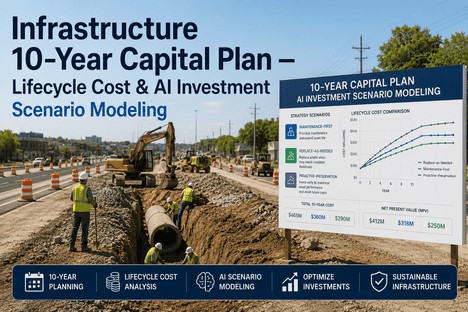
Every infrastructure portfolio faces the same strategic choice: maintain current assets longer, replace them on a fixed schedule, or invest proactively in preservation to extend service life. The optimal strategy depends on asset type, current condition, failure consequences, and funding availability. iFactory's AI scenario engine compares all three strategies across your actual portfolio — generating ten-year lifecycle cost projections, risk exposure forecasts, and capital requirement profiles for each path.
Comparing the Three Core Capital Investment Strategies Modelled by iFactory's AI Scenario Engine
Strategy
Core Approach
AI-Modelled 10-Year Outcome Profile
Maintenance-First Strategy
Maximise preventive and predictive maintenance investment. Defer major replacements. Extend asset service life through intensive care programmes targeting highest-risk deterioration modes.
Lowest year 1-3 capital requirement. Rising maintenance and emergency repair costs in years 5-10. Moderate increase in failure probability for aging assets beyond original design life. Best suited to assets with low failure consequence and high refurbishment potential.
Replace-as-Needed Strategy
Replace assets at or near end of useful life based on condition assessment triggers. No proactive lifecycle extension. Capital deployed primarily for like-for-like replacement with some technology upgrade where justified.
Predictable but lumpy capital expenditure profile. Moderate maintenance costs through year 7, then escalating as a cohort of assets reaches end-of-life simultaneously. Replacement backlog risk if budget constraints force deferrals. Industry baseline scenario for most infrastructure portfolios.
Proactive-Preservation Strategy
Early intervention at the first signs of deterioration. Targeted rehabilitation and component-level renewal to extend asset service life by 40-60%. Condition-based replacement optimisation using AI-predicted failure curves.
Highest capital requirement in years 1-4 driven by catch-up preservation investment. Lowest total lifecycle cost over 10-year horizon. Reduced failure frequency and extended asset service life by 8-15 years for major asset classes. Superior risk profile and lowest unplanned expenditure. Optimal for portfolios with high-consequence assets.
How AI-Powered Scenario Modeling Changes the Capital Planning Conversation
The fundamental shift that AI lifecycle cost and scenario modeling brings to capital planning is not automation. It is the ability to test multiple investment strategies against real asset data before committing a single dollar of budget. An Operations Director using iFactory's scenario engine can define three capital strategies for the coming ten-year horizon, run all three against the current portfolio condition data, and compare the projected outcomes side by side — seeing not just the cost difference but the risk difference, the service life impact, and the failure probability trajectory for every asset under each strategy.
Capability 01
AI Lifecycle Cost Modelling — Every Asset Evaluated on Total Cost of Ownership, Not Just Replacement Cost
Data-Driven Decisions
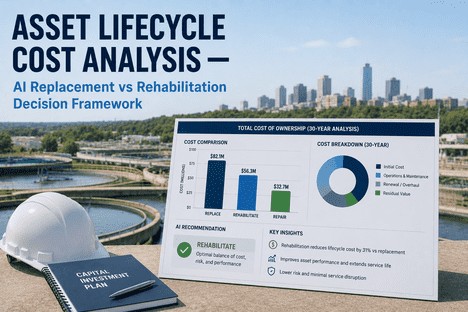
iFactory's AI lifecycle cost module ingests asset condition data, repair history, operating costs, and replacement economics to model the total cost of ownership for every asset in the portfolio. The AI engine projects maintenance cost trajectories, failure probability curves, and remaining useful life under multiple intervention scenarios — producing an optimised repair-versus-rehabilitate-versus-replace recommendation for each asset that accounts for the full ten-year cost profile, not just the current budget cycle. When an Operations Director needs to justify a major capital request to a board or funding body, the lifecycle cost analysis provides auditable evidence that the recommended strategy minimises total ownership cost across the planning horizon.
Total cost of ownership projection per asset
Repair vs rehabilitate vs replace comparison
Remaining useful life forecasting by asset class
Capability 02
Multi-Strategy Scenario Comparison — Test Every Investment Path Before Committing Capital
Strategic Clarity
The scenario engine allows Operations Directors to define and compare multiple capital strategies side by side. Apply a 15% budget reduction and the AI automatically resequences the project list, showing which projects shift out of the planning window and what the long-term cost impact of each deferral will be. Model a federal grant covering 50% of a specific asset class and the engine re-ranks the portfolio to prioritise grant-eligible investments within the funding window. Each scenario generates quantified outputs: remaining useful life distribution across the portfolio, annual maintenance and capital expenditure projections, unplanned event probability, and portfolio-level risk exposure. The comparison dashboard transforms capital budget discussions from advocacy battles into data-driven trade-off conversations. If we reduce the programme by 15%, these four projects defer and the network risk score increases by 8% — is the budget saving worth the risk increase?
Side-by-side scenario comparison dashboard
Automated project resequencing on budget change
Portfolio risk score impact analysis
Capability 03
Capital Optimisation Engine — Thousands of Investment Combinations Evaluated to Find the Highest-Value Portfolio
Optimised Allocation
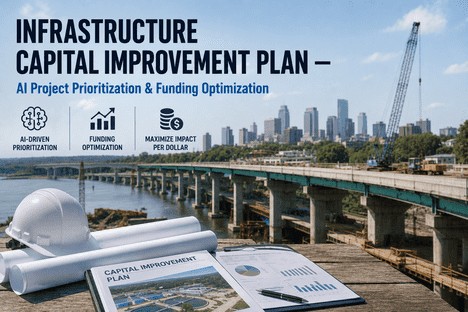
Beyond comparing predefined strategies, iFactory's AI optimisation engine evaluates thousands of investment combinations simultaneously to identify the highest-value capital programme within real-world funding, resource, and regulatory constraints. The engine considers asset condition trajectories, failure consequence scores, maintenance cost projections, and funding availability to generate an optimised multi-year capital plan that maximises infrastructure improvement per dollar spent. Every project in the optimised plan has a defensible score, a clear linkage to asset condition data, and a traceable logic from deterioration model to budget allocation. This transforms the capital planning process from a once-a-year exercise into a continuously updated investment model that adapts as asset conditions change, funding availability shifts, and strategic priorities evolve.
Auditable project scoring and funding traceability
Capability 04
Executive Dashboard and Board-Ready Reporting — Capital Planning Intelligence for Decision-Makers
Governance Ready
iFactory generates capital planning intelligence in formats that both operations and finance teams can use. The executive dashboard shows total replacement value, assets in each economic decision zone, projected capital spend over the next five and ten years by asset class, and the total cost of ownership trend for the full portfolio. Scenario comparison outputs are available as board-ready reports showing the projected outcomes of each strategy on a common scale — cost, risk, service life, and compliance. Both views can be exported for capital planning submissions, budget presentations, and board reporting. The platform also integrates with financial planning systems for capital budget data exchange. Every cost projection is linked to the underlying asset data and assumptions that produced it, providing the defensible, auditable data trail that finance stakeholders and regulators require.
Executive portfolio health dashboard
Board-ready scenario comparison reports
Auditable cost projection with data traceability
"
Before iFactory, our ten-year capital plan was a spreadsheet that took three months to build and was out of date by the time it was approved. Each department submitted its project list with its own scoring methodology, and the prioritisation meeting was essentially a negotiation between department heads. The first time I ran three investment strategies through iFactory's scenario engine, I saw in thirty minutes what would have taken us six weeks to model manually — and the AI-recommended portfolio delivered 18% more infrastructure improvement than our current plan at the same budget level. That conversation changed how our executive team thinks about capital planning.
— Operations Director, Multi-Site Infrastructure Authority — 22 Years Capital Planning Experience
Conclusion
The gap between what a ten-year capital plan should deliver and what traditional planning methodology produces is not narrowing. As asset portfolios age, funding constraints tighten, and regulatory scrutiny intensifies, the cost of static, single-path capital planning grows larger every budget cycle. The organisations that will outperform over the next decade are not those with the largest capital budgets. They are those that deploy AI-powered lifecycle cost modeling and scenario-based investment planning to allocate every dollar where it delivers the maximum infrastructure improvement, risk reduction, and service life extension.
iFactory's AI lifecycle cost and scenario modeling module gives Operations Directors the capability to model maintenance-first, replace-as-needed, and proactive-preservation strategies across their actual asset portfolio — comparing ten-year cost, risk, and performance outcomes side by side before committing a single dollar of capital. With AI-optimised investment recommendations, board-ready scenario reports, and a continuously updated planning model that adapts as conditions change, iFactory transforms the capital plan from a static document into a strategic decision-making engine. Book a Demo to see how the platform maps to your portfolio's specific asset mix and capital planning process, or talk to an expert about configuring AI-powered lifecycle cost modeling for your organisation.
Frequently Asked Questions
Traditional capital planning tools focus on cataloguing asset inventories and projecting replacement costs using standard depreciation curves. iFactory's AI lifecycle cost modeling goes significantly further. It ingests actual asset condition data, repair and maintenance history, operating cost records, and failure event data to build asset-specific deterioration models that predict remaining useful life with greater accuracy than age-based formulas. The AI engine then models multiple intervention scenarios for each asset — continued maintenance, rehabilitation, or replacement — and compares the total cost of ownership across each path over a configurable planning horizon. The result is a capital plan based on each asset's actual condition trajectory and financial profile, not a generic depreciation schedule. Talk to an expert to see how AI lifecycle modeling maps to your portfolio.
iFactory is designed specifically for multi-site, multi-asset-class portfolios. The platform maintains asset registers with configurable attribute schemas that adapt to different asset types — mechanical, electrical, structural, and civil assets each have relevant condition parameters, failure modes, and intervention strategies modelled independently within the same planning environment. The AI optimisation engine evaluates investment trade-offs across all asset classes simultaneously, so the capital plan reflects portfolio-level priorities rather than siloed departmental requests. An Operations Director can see how investing in water treatment assets affects the total portfolio risk score compared to investing the same budget in electrical infrastructure — and make capital allocation decisions based on cross-asset-class comparison rather than separate departmental submissions. Book a Demo to see the multi-asset capital planning configured for a portfolio similar to yours.
iFactory's AI lifecycle cost models are designed to start delivering value with the data most organisations already have. The minimum viable dataset includes an asset register with asset class, installation date, and replacement value; condition assessment data or age-based condition proxies; and maintenance and repair cost history where available. The AI engine fills data gaps using statistical models trained on similar asset populations, so planning can begin before perfect data exists. As more condition data, failure records, and operating costs are ingested, the model accuracy improves continuously. For organisations with limited historical data, iFactory's implementation team conducts a data readiness assessment in the first week of deployment to identify the fastest path to a functional lifecycle cost model. Talk to an expert about your specific data landscape and implementation timeline.
iFactory supports integration with leading CMMS, EAM, GIS, and financial planning platforms through REST APIs, file-based data exchange, and database connectors. In the initial deployment phase, asset registers, condition data, and maintenance history are imported from existing systems to populate the lifecycle cost models and scenario engine. As the platform matures within the organisation, iFactory can operate as the capital planning intelligence layer alongside existing operational systems — receiving continuous data feeds from the CMMS for work order history and from the financial system for budget execution data — while exporting optimised capital plans and scenario reports to financial planning platforms for budget submission and tracking. The integration architecture is designed to complement existing system investments rather than require their replacement. Book a Demo to discuss integration architecture for your specific system landscape.
For a typical infrastructure portfolio, iFactory's capital planning module deployment follows a phased sequence. Weeks one to two cover data readiness assessment, asset register import, and initial lifecycle model configuration. Weeks three to five focus on AI model calibration, scenario engine setup, and validation against historical capital expenditure data. Weeks six to eight are dedicated to dashboard configuration, report template design, and integration with existing financial planning systems. Week nine through ten cover user training, scenario testing with actual portfolio data, and go-live with the first capital planning cycle. The executive dashboard with portfolio health overview and lifecycle cost projections is typically available for director review within the first thirty days. The full scenario modeling and AI optimisation capability is operational within ten weeks. Book a Demo to build the implementation plan specific to your portfolio size, asset mix, and current data systems.
One Static Capital Plan Per Year Is Not a Strategy. A Continuously Updated AI Investment Model Is.
iFactory's AI lifecycle cost and scenario modeling module — ten-year capital planning powered by AI-driven lifecycle cost analysis, multi-strategy scenario comparison, portfolio optimisation, and board-ready reporting. The capital planning intelligence platform your infrastructure portfolio has been missing.