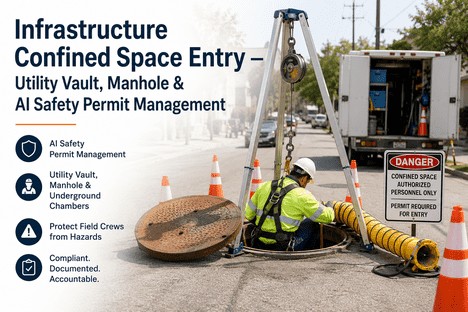
Infrastructure Confined Space Entry — Utility Vault, Manhole & AI Safety Permit Management
By Grace on June 27, 2026
Every year, more than two million workers in the United States enter permit-required confined spaces to perform inspection, maintenance, cleaning, and repair work. They enter underground utility vaults beneath city streets, manholes connecting sewer and stormwater networks, electrical vaults carrying high-voltage infrastructure, water meter pits, telecommunications chambers, and storage tanks at treatment facilities. These are not optional entries. The infrastructure that powers modern society runs through confined spaces, and keeping it operational requires someone to go inside. Between 2011 and 2019, the Bureau of Labor Statistics recorded 1,030 fatal injuries in confined spaces across the United States. Fifty-six percent were caused by hazardous atmospheres — oxygen deficiency, toxic gas exposure, or flammable vapour ignition. Twenty percent involved physical hazards including mechanical equipment, engulfment, and structural collapse. And in a pattern that safety professionals recognise as one of the most tragic in occupational health, sixty-three percent of confined space fatalities are would-be rescuers — coworkers, supervisors, or first responders who entered without proper training, equipment, or atmospheric monitoring, turning a single incident into a multiple-casualty event.
Confined Space Entry · Utility Vault Safety · Manhole Entry Permit · AI Safety Management · Atmospheric Hazard Monitoring
Your Field Crews Enter Confined Spaces Every Day. The Question Is Whether Your Safety System Enters with Them.
iFactory's AI-powered confined space safety module digitises every entry permit, enforces atmospheric monitoring protocols, tracks entrant locations in real time, automates rescue escalation, and creates permanent audit-ready documentation — turning OSHA 1910.146 compliance from a paper burden into a live safety workflow.
Confined space fatalities recorded in the United States between 2011 and 2019 — an average of 115 preventable deaths per year across all industries
63%
Of confined space fatalities are would-be rescuers who entered without proper training, atmospheric monitoring, or rescue equipment — turning single incidents into multiple-casualty tragedies
56%
Of confined space deaths are caused by hazardous atmospheres — oxygen deficiency, toxic gas, or flammable vapour — hazards that continuous monitoring can detect before they become lethal
$156K
Maximum OSHA penalty per willful confined space violation — with average costs exceeding $2.1 million per fatality when litigation, penalties, and operational disruption are included
The Confined Space Safety Gap Is Not a Training Problem. It Is a Permit and Monitoring Problem.
Most organisations that operate confined space entry programmes have conducted the required training. Their workers know what a permit-required confined space is. They understand the difference between atmospheric hazards and engulfment risks. They have attended the classroom session and reviewed the written programme. The gap is not in knowledge. The gap is in the moment-to-moment execution of the permit system — and the absence of real-time visibility into conditions inside the space once entry has begun. When a paper permit is filled out at the start of a shift and posted near the entry point, the atmospheric reading recorded at 8:00 AM becomes the authorisation for entry at 2:00 PM, even though conditions inside the vault may have changed completely. When the attendant cannot see the entrant and relies on radio communication that may fail in an underground structure, the first indication of a problem is silence. When a rescue is needed and the retrieval system has not been tested since the last training exercise, the seconds that determine survival are lost to equipment failure. These are not training failures. They are system failures.
How Confined Space Entry Programmes Fail When Relying on Paper Permits and Manual Monitoring
The Static Permit Problem
A permit issued at shift start is a snapshot. Conditions inside the space change by the minute.
Paper permits capture atmospheric readings, hazard assessments, and authorisations at a single point in time — typically at the beginning of the entry period. But confined space conditions are not static. A utility vault that tested safe for oxygen content at 8:00 AM can develop an oxygen-deficient atmosphere by noon if groundwater infiltration introduces biological activity that consumes oxygen. A sewer manhole that showed no detectable hydrogen sulfide during pre-entry testing can accumulate lethal concentrations when a upstream discharge alters the wastewater chemistry. The paper permit system has no mechanism to detect these changes between the pre-entry test and the actual entry, and no mechanism to alert the attendant or the entrant when conditions deteriorate. The permit becomes a false assurance — a document that says the space was safe at a time that is no longer relevant.
Snapshot Data, Dynamic Hazard
The Communication Blackout
The attendant outside the space cannot see the entrant. The first sign of trouble is silence on the radio.
OSHA 1910.146 requires continuous communication between the attendant and the entrant for the duration of the entry. In practice, this communication relies on radio, voice, or tether signals — all of which can fail inside a confined space. Underground vaults and manholes are radio-frequency shadows. Concrete structures block signals. Metal ladders and pipes create interference. The attendant stationed outside hears nothing, sees nothing, and has no way to distinguish between a radio that has gone silent because the entrant is focused on a task and a radio that has gone silent because the entrant has collapsed from oxygen deprivation. The difference between these two scenarios is the difference between a safe operation and a fatality — and with a paper-based system, the attendant has no data to make that distinction until it is too late.
No Visibility, No Alert
The Rescue Cascade Failure
Sixty-three percent of confined space fatalities are rescuers. The permit system did not protect them either.
The most devastating pattern in confined space incidents is the cascade: an entrant encounters a hazardous atmosphere and loses consciousness. A coworker or supervisor enters to assist — without waiting for the retrieval system, without donning respiratory protection, without checking the atmospheric monitor. The second victim collapses. A third person enters. The single-incident becomes a multiple-fatality event. This pattern accounts for nearly two-thirds of all confined space deaths. It persists because paper-based permit systems provide no real-time alerting mechanism. When the entrant stops responding, the attendant has seconds to decide whether to initiate a non-entry rescue or wait for trained responders. Without continuous monitoring data showing the atmospheric conditions inside the space at the moment of the incident, the attendant cannot make an informed decision — and the rescue cascade begins.
Multiple-Casualty Pattern
The Documentation Gap
When OSHA arrives after an incident, paper permits reveal only what was planned — not what actually happened.
OSHA's confined space standard requires employers to retain each cancelled entry permit for at least one year. In the event of an incident, those permits become critical evidence of whether the employer complied with 1910.146 requirements. But a paper permit can only document what was written before entry began. It cannot show whether atmospheric conditions remained within acceptable limits throughout the entry. It cannot show whether the entrant exited the space within the permit validity period. It cannot show whether the rescue equipment was inspected and functional. After an incident, the paper permit is a record of intent, not a record of execution — and that distinction is often the difference between a finding of compliance and a finding of willful violation carrying penalties of up to $156,259 per instance.
A Confined Space Entry Permit Is Not a Piece of Paper. It Is a Continuous Safety Process. iFactory Makes It a Live One.
From pre-entry atmospheric testing through continuous in-space monitoring to automated rescue escalation and post-entry documentation — your entire confined space entry lifecycle managed in a single AI-powered platform, across every vault, manhole, and chamber in your infrastructure network.
How iFactory Transforms Confined Space Entry from Paper-Based Compliance Into AI-Driven Life-Safety Management
iFactory is not a document management system bolted onto an existing safety programme. It is an AI-native operations platform where every confined space, every entry permit, every atmospheric reading, and every entrant movement is tracked in a single real-time data environment. The confined space safety module extends this platform to give EHS managers, safety supervisors, and field crews the tools they need to execute permit-required confined space entries with continuous monitoring, automated documentation, and live rescue escalation — meeting every requirement of OSHA 29 CFR 1910.146 and the 2025 regulatory updates.
Capability 01
Digital Confined Space Inventory and Hazard Register — Every Vault, Manhole, and Chamber Mapped and Classified
Complete Asset Visibility
iFactory ingests data from your existing confined space inventory, GIS layers, and facility asset registers to build a complete digital register of every confined space in your infrastructure network. Each space is geolocated, classified as permit-required or non-permit under 1910.146 criteria, linked to its specific hazard profile — atmospheric risks based on historical monitoring data, engulfment potential based on contents and configuration, mechanical and electrical hazards based on installed equipment — and assigned the required entry procedures, PPE specifications, and rescue protocols. When a space is reclassified due to changes in use or configuration, the register updates automatically and notifies the EHS manager. When a new vault is added to the network during construction, it is entered into the register before the first entry permit is issued. The EHS manager has a complete, current, and auditable inventory of every confined space in the operation — not a spreadsheet last updated when the previous safety coordinator left.
GIS-integrated confined space register
OSHA-aligned hazard classification
Automatic reclassification alerts
Capability 02
Live Digital Entry Permits with Continuous Atmospheric Monitoring Integration — From Snapshot to Streaming Data
Real-Time Safety Data
iFactory replaces the paper permit with a live digital permit that is generated from the confined space register and updated in real time throughout the entry. Before entry begins, the system guides the entry supervisor through each required permit element: atmospheric test results from calibrated gas monitors, hazard control verification including lockout-tagout and isolation, PPE and equipment checklist, rescue plan confirmation with verified retrieval system testing, entrant and attendant identification and training status verification, and permit validity period with automatic expiration. During the entry, the permit remains live on the attendant's mobile device or tablet, displaying continuous atmospheric monitoring data streamed from Bluetooth-enabled gas monitors inside the space. If oxygen drops below 19.5 percent, if combustible gas reaches ten percent of the lower flammable limit, or if hydrogen sulfide or carbon monoxide levels exceed permissible exposure limits, the permit displays an immediate visual alert and the system triggers an audible alarm on the attendant's device. The permit is no longer a static document. It is a live display of the conditions inside the space, updated in real time, for the entire duration of the entry.
OSHA-compliant digital permit workflow
Continuous gas monitor data streaming
Real-time threshold breach alarms
Capability 03
Automated Entrant Tracking and Rescue Alert Escalation — Eliminate the Communication Blackout
Life-Safety Automation
The most critical gap in confined space safety is the moment when the attendant loses communication with the entrant and cannot determine whether the silence is routine or catastrophic. iFactory eliminates this gap with automated entrant tracking that monitors entry and exit times, entrant identity verification, and man-down detection through integration with wearable motion sensors and harness-mounted devices. When a man-down signal is detected, when an entrant fails to exit within the permit validity period, or when atmospheric monitoring detects a hazardous condition inside the occupied space, the system initiates an automated rescue escalation sequence: a visual and audible alert on the attendant's device, an automated notification to the designated rescue team with the space location and hazard data, and a time-stamped record of the escalation in the permit documentation. The attendant no longer has to decide whether to escalate based on silence and uncertainty. The system provides the data and the alert, and the rescue team arrives with real-time atmospheric readings from inside the space — eliminating the information vacuum that drives the rescue cascade failure that accounts for sixty-three percent of confined space deaths.
Wearable entrant man-down detection
Automated multi-tier rescue escalation
Real-time hazard data to rescue teams
Capability 04
Audit-Ready Compliance Documentation and Programme Analytics — Every Entry Creates a Complete, Defensible Record
OSHA-Ready Evidence
Every confined space entry conducted through iFactory generates a permanent, time-stamped, and unalterable digital record that meets the documentation requirements of 1910.146 and the 2025 regulatory updates. The record includes the complete permit data as authorised, the continuous atmospheric monitoring log for the entire entry duration with every reading time-stamped and attributed to the specific gas monitor, the entrant entry and exit times with identity verification, the attendant's continuous communication log, the rescue equipment inspection and testing verification, and any alerts or escalations that occurred during the entry including the automated response. For programme management, iFactory provides analytics that the EHS manager uses to identify patterns across entries: which spaces generate the most frequent atmospheric alarms, which crews have the highest compliance with permit procedures, where rescue drill participation is falling behind the annual requirement, and whether any spaces are consistently entered on expired permits. The programme is no longer assessed by the last audit finding. It is continuously visible, continuously improvable, and continuously defensible.
Complete 1910.146 digital evidence chain
Continuous permit compliance analytics
Automated annual rescue drill tracking
Infrastructure Confined Space Types — Why Each Entry Environment Requires Specific Safety Protocols Within a Unified System
Infrastructure confined spaces are not a single category. A water utility vault, an electrical manhole, a sewer access chamber, and a telecommunications pit present fundamentally different hazard profiles — different atmospheric risks, different engulfment potentials, different rescue challenges, and different regulatory considerations. A confined space management platform must respect these differences while providing a consistent safety framework across all entry types. iFactory's confined space module is built with asset-type-specific hazard templates, monitoring protocols, and rescue procedures that reflect the real conditions of each entry environment.
How iFactory Handles Each Infrastructure Confined Space Type Within a Unified Safety Framework
Space Type
Primary Hazards
How iFactory Configures This Space Type
Utility Vaults
Oxygen deficiency from biological activity, toxic gas accumulation, electrical arc flash, entrapment from converging walls, flooding from groundwater infiltration.
Pre-configured O2, LEL, H2S monitoring template. Lockout-tagout integration for electrical isolation. Automatic flood alert from water level sensors. Rescue harness and tripod checklist. Non-entry retrieval protocol pre-loaded.
Sewer Manholes
Hydrogen sulfide and methane accumulation, oxygen displacement, engulfment from sudden flow surges, biological pathogens, confined egress through narrow shaft.
Continuous H2S, CH4, O2 monitoring with upstream flow alert integration. PPE template including biological hazard protection. Rescue davit and harness configuration. Attendant communication protocol for vertical shaft entries.
Electrical Manholes
Arc flash and electrocution from energised cables, heat stress in confined unventilated spaces, oxygen deficiency, smoke inhalation from cable faults.
Mandatory LOTO verification step before permit issuance. Arc flash PPE template with voltage-specific ratings. Temperature monitoring integration. Ventilation requirement enforced before entry. Rescue team notified of electrical hazards.
Water / Storage Tanks
Oxygen deficiency from displacement by residual gases, chemical residue exposure, engulfment from loose sediment or residual liquid, confined egress through manway.
Pre-entry confined space cleaning verification. Atmospheric monitoring before and during entry. Ventilation duration timer. Rescue tripod and winch configuration for top-entry tanks. Chemical exposure monitoring if applicable.
"
Before iFactory, our confined space programme ran on three-ring binders at every vault location. Permits were filled out by hand, filed at the end of each shift, and audited once a year when OSHA came through. We had no way of knowing if a crew entering vault 47-B was doing so with a current atmospheric reading or an expired permit from the previous shift. The first week on iFactory, I pulled up the live permit dashboard during the morning safety briefing and saw that a crew had entered a vault without completing the forced-air ventilation step. We stopped the entry remotely. That crew would have gone in with a paper permit that showed ventilation as checked — because someone ticked a box on a clipboard that nobody verified. The system caught it. That was the moment I understood that digital confined space management is not a compliance tool. It is a life-safety tool that happens to produce compliance documentation as a byproduct.
— EHS Director, Municipal Infrastructure Utility — 18 Years Confined Space Safety Management
The Cost of Paper-Based Confined Space Management vs. The Investment in Digital Life-Safety
When municipal safety directors evaluate the investment in a digital confined space management platform, the comparison is often framed as software cost versus the cost of maintaining the current paper-based system. This framing overlooks the largest cost category entirely — the cost of a single preventable fatality. But even setting aside the human and liability costs, the operational inefficiency of paper-based confined space management carries a measurable financial burden that rarely appears in any budget line item.
The Digital Platform Investment
Platform subscription and configurationStarts at $24K/yr
GIS data migration and space register setupOne-time $5-10K
Crew training and onboardingIncluded
Gas monitor integration and connectivityIncluded in subscription
Total Year 1~$34K
The Cost of Paper-Based Gaps
Single confined space fatality average cost$2.1M+
OSHA willful violation penalty per instance$156,259
Staff hours on paper permit management annually$18K-$45K/yr
Litigation and reputational cost per incidentUnquantifiable
Annual Incident Exposure$2.3M+
The question is not whether a utility or infrastructure operator can afford a digital confined space management platform. The question is whether it can afford to send workers into permit-required confined spaces with paper permits, manual atmospheric checks, and no real-time visibility into the conditions that determine whether those workers come home at the end of the shift. The platform investment is a fraction of the cost of a single citation. More importantly, it is the difference between a safety programme that hopes conditions inside the space remain safe and one that continuously verifies that they are.
Conclusion
Confined space entry is not a paperwork exercise. It is a life-safety operation in which the difference between a routine entry and a fatal incident can be measured in seconds and in parts per million. The paper-based permit systems that most infrastructure operators still rely on were designed in an era when digital monitoring technology did not exist and when the leading cause of confined space death — the rescue cascade — was not yet understood as a preventable pattern. That era is over. Continuous atmospheric monitoring is available. Real-time entrant tracking is available. Automated rescue escalation is available. The only remaining question is whether the operators who send workers into confined spaces every day will adopt the technology that turns their safety programme from a document-based hope into a data-driven assurance.
iFactory's AI-powered confined space safety module gives infrastructure operators and utilities the platform they need to transition from paper permits to live safety management — with digital confined space registers, continuous atmospheric monitoring integration, automated entrant tracking and rescue escalation, and audit-ready compliance documentation that turns every entry into a complete, defensible, and continuously monitored safety event. Book a Demo to see how the platform maps to your specific confined space inventory and entry procedures, or talk to an expert to begin your confined space programme digital transformation and get your first live entry permit operational within thirty days.
Frequently Asked Questions
iFactory supports integration with Bluetooth-enabled gas monitors from major manufacturers including Industrial Scientific, Honeywell, MSA Safety, RAE Systems, and BW Technologies. The platform reads real-time data from multi-gas monitors measuring oxygen, combustible gas, hydrogen sulfide, and carbon monoxide — streaming readings directly into the live digital permit displayed on the attendant's mobile device. For organisations using non-Bluetooth monitors, iFactory provides a manual data entry interface that captures pre-entry and periodic readings with time-stamping and entrant attribution. The platform also supports integration with wearable man-down sensors, harness-mounted motion detectors, and retrieval system status sensors for automated entrant tracking. Talk to an expert to confirm compatibility with your current gas monitoring equipment and discuss any hardware requirements for your specific confined space entry programme.
iFactory's confined space module was designed to accommodate the 2025 OSHA regulatory updates. The platform supports expanded classification criteria for permit-required confined spaces, including the broader definition that now encompasses certain crawl spaces and utility vaults that were previously classified as non-permit under earlier interpretations. The digital permit template includes the updated atmospheric testing documentation requirements, with fields for continuous monitoring protocols as specified in the 2025 revisions. The rescue drill tracking module schedules, documents, and verifies the new mandatory annual rescue simulation requirement — maintaining a complete record of drill participation, equipment used, and scenario outcomes for each confined space in the register. When regulatory requirements change, the platform templates are updated centrally and distributed to all permits, ensuring that every entry conducted through iFactory automatically reflects the current regulatory standard. Book a Demo to see how the 2025 regulatory updates are reflected in the digital permit workflow for your specific confined space types.
Yes. iFactory's mobile-first architecture is designed for the reality of field operations where confined spaces are located in areas with limited or no cellular connectivity. The platform supports offline mode on mobile devices — the attendant can generate a digital permit, record atmospheric readings, log entrant entry and exit times, and document the entire entry without an active network connection. When the device returns to connectivity, the permit data synchronises automatically to the central system with all time-stamps preserved. For organisations managing confined space entry programmes across multiple service areas, depots, or municipal districts, the platform provides a consolidated dashboard showing active entries across all locations, with per-location filtering for supervisors responsible for specific geographic areas. Talk to an expert to discuss the connectivity profile of your confined space locations and confirm the offline workflow configuration for your field operations.
For a typical utility or infrastructure organisation managing multiple confined space types across a geographic service area, iFactory's implementation sequence covers: week one for platform configuration and confined space register setup with GIS data migration; week two for space classification and hazard profile configuration across vaults, manholes, chambers, and tanks; week three for digital permit template configuration with OSHA-aligned fields and continuous monitoring integration setup; week four for training sessions with the EHS team, entry supervisors, attendants, and authorised entrants — including hands-on mobile device workflow practice; week five for pilot deployment with live entries and system validation; and week six for full go-live with all crews operating on the digital permit system. Full operational capability with all confined spaces in the digital register, all crews trained, and all entries conducted through live digital permits is typically achieved within six weeks. The first live entry permit with continuous atmospheric monitoring display is typically operational within the first fourteen days of implementation. Book a Demo to build the implementation plan specific to your confined space inventory size, crew structure, and current permit system.
A Paper Permit Is a Record of Intent. A Digital Permit Is a Record of Safety.
iFactory's confined space safety module — digital entry permits, continuous atmospheric monitoring, real-time entrant tracking, automated rescue escalation, audit-ready compliance documentation. The single platform that turns confined space entry from a paper-based procedure into a live safety system.