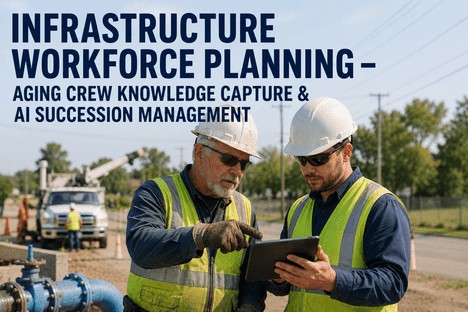
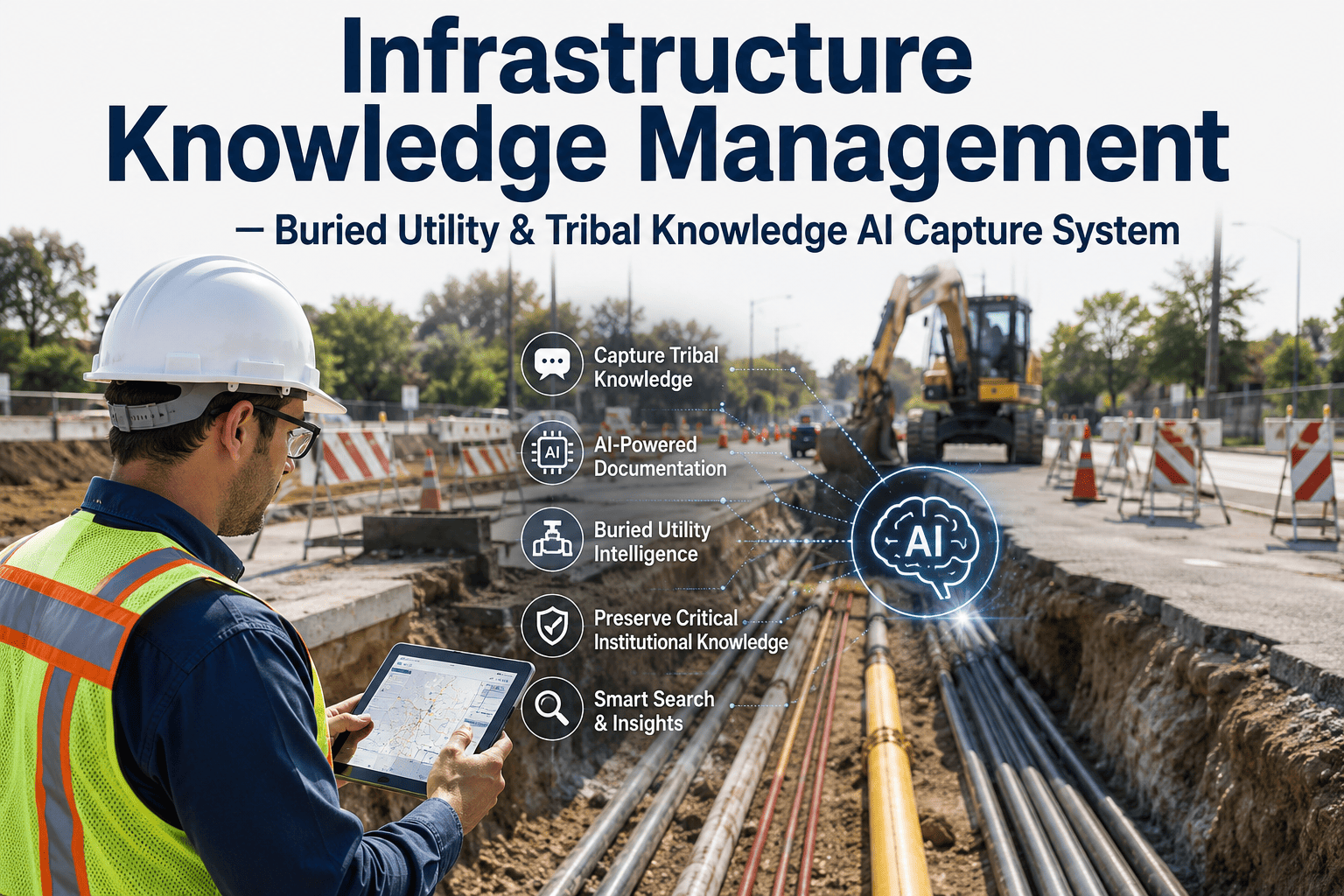
Every day, roughly 10,000 Baby Boomers retire across the United States. In infrastructure organisations — water utilities, power transmission networks, gas distribution, and public works — those retirees are not just leaving jobs. They are walking out with decades of undocumented knowledge: which valve sticks in humid weather, which substation transformer has an intermittent fault that does not appear on any SCADA log, which manhole access point saves a crew two hours on a buried utility locate. The infrastructure sector is facing a workforce transition without precedent. Nearly 53% of the construction and maintenance workforce is projected to retire by 2036. At the same time, 94% of contractors report difficulty filling skilled craft roles. The knowledge walking out the door every shift is not replaceable through hiring alone — it must be captured, structured, and made accessible before it leaves. This guide is written for Operations Directors who are staring at an aging crew demographic curve and know that the succession plan on paper is not matching the knowledge transfer that needs to happen in practice.
Knowledge Capture · AI Succession · Workforce Planning · Infrastructure Operations · Field Crew Retention
The Knowledge Walks Out Every Evening. iFactory Helps You Keep It Before It Leaves for Good.
iFactory's digital operations platform gives infrastructure organisations the structured knowledge capture, AI-powered succession workflows, and field-crew analytics that turn undocumented expertise into an organisational asset that outlasts every retirement cycle.
Of the infrastructure construction and maintenance workforce is projected to retire by 2036 — taking decades of undocumented field knowledge with them
$47M
Estimated annual cost of knowledge loss per organisation — in increased errors, extended training periods, and duplicated problem-solving across teams
94%
Of infrastructure contractors report difficulty filling skilled craft roles — and hiring alone cannot replace the tacit knowledge that leaves with retirees
31%
Of field service engineers and infrastructure technicians are over age 55 — the highest concentration of retirement-eligible expertise in any industrial sector
The Hidden Knowledge Crisis — What Leaves When a Crew Member Retires
The problem most infrastructure organisations face is not that they do not have succession plans. Most do. The problem is that succession plans replace people — they do not replace knowledge. When a senior field crew member with 28 years of experience retires, the organisation hires a replacement and runs them through standard training. What that new hire does not have is the accumulated field intelligence that the retiring worker built through thousands of site visits, equipment failures, weather events, and informal workarounds that were never written down. That knowledge gap is not visible in the first week. It surfaces in the sixth month, when the new crew cannot locate a valve that was never mapped, or spends three hours diagnosing a pump fault that the previous technician could have identified from a sound change in under ten minutes.
Explicit Knowledge — The Small Fraction That Gets Documented
Standard operating procedures, equipment manuals, work order records, and compliance logs. These represent the visible tip of the knowledge iceberg — the formal documentation that survives personnel changes. But SOPs cannot capture the nuance: the exact pressure reading that precedes a valve failure, the specific sequence of steps that clears a recurring blockage faster than the manual suggests, or the informal coordination pattern between the control room and field crews during a storm response. Explicit knowledge is necessary but insufficient for operational continuity.
Tacit Knowledge — The Expertise That Walks Out the Door
The ability to hear a pump cavitating from twenty metres away. The instinct that tells a senior technician which of six possible root causes to check first. The mental map of a buried utility network that was never digitised. The undocumented fix a crew developed five years ago and has been using ever since. This is tacit knowledge — accumulated field intelligence that lives in individual minds and interpersonal networks. It is not captured in any system. It is not transferred during a two-week handover. It is the operational intelligence that keeps infrastructure running during emergencies, and it is the most vulnerable asset your organisation holds.
The Knowledge at Risk Spectrum
Which Types of Institutional Knowledge Does Your Organisation Stand to Lose in the Next Retirement Wave?
Asset Knowledge
Equipment quirks, undocumented modifications, preferred operating ranges, known failure modes, and the maintenance history that lives in a technician's memory rather than the CMMS. This knowledge directly affects mean time between repair and unplanned outage frequency.
Spatial Knowledge
The mental GIS that experienced crews carry — valve locations, access points, easement routes, underground utility positions that were never surveyed, and the seasonal conditions that affect each site. This knowledge dictates response time during emergencies.
Process Knowledge
The undocumented workflows and coordination patterns that keep operations running — how to get a permit expedited, which supplier actually delivers on time, the informal escalation sequence that works faster than the official one, and the troubleshooting sequences that are never in the manual.
Safety Knowledge
The experiential safety intelligence that prevents incidents — which confined spaces require extra ventilation, which weather conditions make a specific access route hazardous, which combination of tasks creates a risk that the JSA does not fully capture. This is the most costly knowledge to lose.
Relational Knowledge
The network of relationships that experienced workers have built with regulators, contractors, suppliers, neighbouring utilities, and internal departments. This knowledge enables fast-track approvals, cooperative problem-solving, and inter-organisational coordination during incidents.
Diagnostic Knowledge
The ability to interpret subtle symptoms — a vibration pattern, a pressure fluctuation, a temperature gradient — and diagnose root cause before failure occurs. This is the most difficult knowledge to document because it is pattern-based rather than procedural, and it typically takes a decade to develop.
Succession Management · Knowledge Capture · AI Workforce · Field Operations
A Retirement Date Is Not a Succession Plan. iFactory Captures the Knowledge That Keeps Infrastructure Running.
iFactory's platform embeds knowledge capture into daily field workflows — so every work order, every inspection, and every repair becomes a structured knowledge asset that outlasts the crew member who created it.
The AI Succession Framework — Four Levels of Knowledge Maturity for Infrastructure Organisations
Most infrastructure organisations operate at Level 1 or Level 2 of knowledge maturity. The distinction between organisations that experience disruptive knowledge loss during workforce transitions and those that maintain operational continuity is not the quality of their people — it is whether they have built the systems and workflows to convert individual expertise into organisational capability. The framework below maps the progression every infrastructure operation must navigate.
Knowledge Maturity Model — Where Does Your Infrastructure Operation Stand?
Level
Knowledge State
Operational Impact
Critical Action
Level 1
Tribal
Knowledge lives entirely in individual minds and informal networks. Nothing is systematically documented. When someone retires or transfers, their knowledge leaves with them.
Every departure creates a knowledge gap that takes 6-18 months to recover — if it is recoverable at all. Response times degrade. Repeat faults increase. Safety incidents correlate with crew composition changes.
Identify the top 10 knowledge holders by criticality to operations. Begin structured knowledge-capture interviews focused on their top 20 most frequent decisions and diagnoses.
Level 2
Documented
Work orders and inspection records are digitised. SOPs exist for standard tasks. Asset history is maintained in a CMMS. But undocumented field knowledge and diagnostic expertise remain unrecorded.
Routine operations continue during staff transitions but diagnostic speed drops sharply. New technicians take 12-18 months to reach full productivity. Tribal knowledge gaps are not visible until they cause an incident.
Embed knowledge prompts into daily work order workflows. Require fault classification, root cause notes, and resolution steps at closure. Build a searchable knowledge base from completed work records.
Level 3
Structured
Knowledge is systematically captured, classified, and linked to specific assets, locations, and fault patterns. Tacit knowledge is actively extracted through structured workflows and field intelligence sessions.
New technicians reach productivity in 4-6 months. Diagnostic consistency across shifts improves measurably. Knowledge gaps are visible in the data before they cause operational disruption.
Implement AI-assisted knowledge retrieval for field crews. Use pattern recognition on work order data to surface repeat fault clusters. Build cross-generational mentoring workflows with knowledge documentation requirements.
Level 4
Predictive
Knowledge is continuously generated, validated, and embedded into operational workflows. AI models surface knowledge gaps automatically. Succession transitions are data-driven and seamless.
Crew transitions cause zero measurable productivity drop. Field intelligence improves over time as AI aggregates patterns across the workforce. Knowledge is an organisational asset, not an individual liability.
Measure knowledge capture rate as an operational KPI. Use AI to predict knowledge gaps before departures. Integrate knowledge maturity into workforce planning, hiring, and training investment decisions.
The Operations Director's Playbook — Five Actions to Protect Institutional Knowledge Before It Retires
Building a knowledge-resilient infrastructure organisation does not require a massive documentation project or an AI transformation programme. It requires deliberate changes in how work is structured, how knowledge is captured at the point of execution, and how succession is measured. These five actions distinguish organisations that sustain operational continuity through workforce transitions from those that lose capability with every retirement.
Action 01
Map Knowledge Criticality Before You Map the Organisation Chart
Foundation Step
Standard succession planning identifies which positions are critical and who might fill them. Knowledge-criticality mapping does something different — it identifies which individuals hold knowledge that, if lost, would degrade operational performance in measurable ways. Start by asking each department head: who are the three people in your team whose departure would create the longest recovery time for full operational capability? Then ask what specific knowledge those individuals hold that is not documented elsewhere — equipment diagnostics, site-specific spatial knowledge, regulatory navigation expertise, or informal coordination networks. The output of this exercise is not a replacement timeline. It is a knowledge capture priority list that tells you exactly where to invest your knowledge retention effort for the highest operational return.
Action 02
Embed Knowledge Capture Into Daily Workflows — Not Separate Documentation Projects
Workflow Design
The most common mistake infrastructure organisations make is treating knowledge capture as a separate activity — a documentation initiative, a video recording project, or an exit-interview programme. These all fail because they rely on finding extra time that does not exist in an operational environment. The only knowledge capture strategy that works at scale is the one that happens automatically within the workflows crews already execute. When a technician closes a work order, the platform should require a fault classification, a root cause note, a resolution description, and an optional voice note or photo annotation. When an inspection is completed, the findings should be linked to the asset record, not filed in a separate report. When a crew diagnoses an unfamiliar fault, the steps they took should be captured as a searchable knowledge asset within the same system where the next crew will look for answers. iFactory's platform is designed around this principle — every operational action becomes a knowledge contribution, without requiring a separate documentation effort.
Action 03
Structure Crew Pairing for Knowledge Transfer — Not Just Task Completion
Crew Management
Most infrastructure organisations pair junior and senior crew members for task efficiency — the senior provides the expertise, the junior provides the labour. The unexamined assumption is that knowledge transfer happens automatically through proximity. Research and operational experience both show it does not. Knowledge transfer requires structured interaction: the senior crew member must narrate their reasoning, explain what they are looking for, describe why they chose one diagnostic path over another, and articulate the pattern recognition that underlies their decisions. Restructure crew pairing so that every shift with a senior technician approaching retirement includes a knowledge transfer objective: document one undocumented asset insight, record one diagnostic pattern, or update one site-specific procedure before the shift ends. Over a six-month pre-retirement period, this approach captures hundreds of knowledge assets that would otherwise be lost in the final wave goodbye.
Action 04
Make Knowledge Capture a Measured and Rewarded Behaviour
Performance Management
What gets measured gets done. What gets rewarded gets repeated. If knowledge capture is not tracked as a performance dimension, it will always be deprioritised in favour of tasks that are measured. Integrate knowledge contribution metrics into individual and team performance reviews — the number of work orders closed with complete root cause data, the number of asset knowledge records updated, the number of undocumented procedures documented. Recognise senior crew members who actively transfer knowledge before retirement. Celebrate the technician whose documentation helped another crew avoid a repeat failure. iFactory's analytics layer makes knowledge contribution visible at the individual, team, and organisational level — so operations directors can see not just whether work is being done, but whether the knowledge created by that work is being preserved for the organisation's future.
Action 05
Audit Knowledge Gaps Annually — Same Rigour as Financial Audit
Continuous Improvement
Infrastructure organisations audit their financial statements, their safety compliance, their asset condition, and their regulatory adherence. Knowledge is rarely audited with the same rigour — yet it is the input that determines performance across every other dimension. An annual knowledge gap audit should answer: which critical knowledge areas have lost their primary holder this year? Which roles have retirement-eligible incumbents with no documented successor knowledge? Which repeat faults in the operational data suggest a knowledge gap at a specific location or on a specific asset class? How does the organisation's knowledge capture rate compare to the rate of workforce turnover? Organisations that treat knowledge as an auditable asset class make workforce transitions predictable rather than disruptive. iFactory's analytics provide the data infrastructure for knowledge audits — surfacing knowledge gaps from operational data rather than relying on self-assessment.
Knowledge Retention KPI Framework
What to Measure at Every Level of the Infrastructure Organisation
Field Crew Level
Work order closure completeness — percentage of tasks closed with fault classification, root cause note, and resolution steps recorded
Knowledge contribution count — number of undocumented procedures documented, asset notes added, and diagnostic logs created per month
Mentorship documentation rate — percentage of paired shifts that produce at least one captured knowledge asset
Supervisor Level
Team knowledge capture compliance — percentage of team members meeting minimum knowledge documentation standards per shift
Repeat fault rate by crew — correlating crew composition changes with changes in repeat fault patterns and diagnostic time
New crew ramp-up time — months to reach average diagnostic speed and first-time fix rate for technicians under supervision
Operations Manager Level
Knowledge retention rate — percentage of critical knowledge domains with documented successor coverage before incumbent departure
Retirement risk exposure — number of critical roles with retirement-eligible incumbents and no documented knowledge transfer in progress
Training ROI trend — correlation between knowledge capture volume and reduction in new-hire time-to-competency
Director Level
Knowledge asset growth rate — month-over-month growth in searchable, structured knowledge assets linked to assets and locations
Operational continuity index — composite score measuring workforce transition smoothness, knowledge gap closure rate, and critical role coverage
Knowledge-related incident trend — incidents attributed to undocumented procedures or unavailable knowledge, tracked quarterly
"
We had a documented succession plan for every critical role in our water utility. Every position had a named successor and a transition timeline. What we did not have was the knowledge those successors needed to actually do the job. In the first year after our senior pump station technician retired, we saw a 40% increase in diagnostic time for station faults and two preventable overflows that the previous technician would have caught from the sound of a pressure fluctuation alone. That was when I understood: succession planning replaces people. Knowledge capture replaces capability. We implemented structured knowledge documentation in our daily workflows through iFactory, and within eight months, our new technician was performing at the same diagnostic speed as the person who had retired. The difference was not the person. It was the knowledge infrastructure we had finally built around them.
— Operations Director, Regional Water Utility — 22 Years Infrastructure Operations Leadership
Conclusion
The infrastructure workforce crisis is not a hiring problem. It is a knowledge continuity problem. With 53% of the infrastructure workforce retiring within the next decade and 94% of contractors struggling to fill skilled roles, the organisations that sustain operational performance through this transition will be those that have systematically captured, structured, and preserved the field intelligence their crews have accumulated over decades of work. The organisations that rely on replacement hiring and assume knowledge transfer happens organically will lose capability with every retirement and spend the next decade in a permanent cycle of rebuilding expertise that was never documented.
The difference is not about technology investment. It is about whether knowledge capture is embedded into daily operations as a standard work practice — the same way safety checks, quality inspections, and compliance sign-offs are embedded. When every work order, every inspection, and every repair generates a structured knowledge asset, the organisation's operational intelligence grows over time rather than depleting with every departure.
iFactory's digital operations platform gives infrastructure organisations the knowledge capture infrastructure to make this transition — with workflow-embedded knowledge prompts, AI-powered knowledge retrieval for field crews, analytics that surface knowledge gaps before they cause operational disruption, and the succession management framework that turns every crew member's departure into a retained asset rather than a lost capability. Book a Demo to see how the platform maps to your organisation's knowledge maturity level, or talk to an expert about building your knowledge retention strategy before your next retirement wave begins.
Frequently Asked Questions
iFactory embeds knowledge capture into the workflows crews already execute — work order closure, inspection completion, and task sign-off. Rather than requiring separate documentation sessions, the platform prompts for fault classification, root cause notes, and resolution descriptions at the natural completion point of each task. Voice notes, photo annotations, and video recordings are captured on mobile devices in the field and automatically linked to the relevant asset, location, or work order record. The average knowledge capture interaction adds less than two minutes to a task closure while generating a structured knowledge asset that is immediately searchable by every other crew member. Talk to an expert to see how iFactory's field workflow interface is designed around the principle that knowledge capture should never feel like documentation work.
The fastest intervention is the knowledge criticality mapping exercise described in Action 01 — identify the top five to ten individuals whose retirement would create the longest recovery time for full operational capability, then begin structured knowledge capture with those individuals immediately. Do not wait for a full knowledge management programme. Start with the highest-risk knowledge domains and build the process from there. Pair the knowledge criticality mapping with a workflow change that requires root cause documentation on every work order closure in the CMMS — this alone will begin building a searchable knowledge base from current operational data. In parallel, schedule structured knowledge transfer shifts where senior crew members nearing retirement work alongside junior crew members with a specific knowledge documentation objective for each shift. These three actions can be implemented within two weeks and will capture the highest-value knowledge before the next retirement date. Book a Demo to discuss how iFactory's accelerated deployment option can have your knowledge capture workflows operational within days, not months.
Knowledge that is captured but not retrievable in the flow of work is knowledge that does not exist operationally. iFactory links every knowledge asset — fault records, diagnostic logs, equipment notes, procedure updates — to the specific asset, location, or task type it relates to. When a field crew opens a work order for a specific pump station or substation, the platform surfaces all related knowledge assets automatically: previous fault records with resolution steps, undocumented equipment quirks documented by other crews, and diagnostic patterns identified from similar assets across the network. AI-powered search allows crews to ask natural-language questions — "what causes pressure drop on the north transmission main?" — and retrieve answers drawn from the organisation's accumulated knowledge base. The platform also surfaces knowledge gaps: when a crew encounters a fault pattern with no documented resolution history, the system flags it for knowledge capture, turning the current diagnostic effort into the organisation's permanent knowledge on that issue. Talk to an expert to see how iFactory's knowledge retrieval interface works in a field environment.
Organisations that begin with the knowledge criticality mapping and structured work order documentation as described above typically reach Level 2 (documented) within four to six weeks of deployment. The transition to Level 3 (structured) requires embedding knowledge capture as a standard workflow practice across all crews — which typically takes three to four months with consistent leadership reinforcement and visible use of captured knowledge in operational reviews. The transition to Level 4 (predictive) depends on the volume of structured knowledge data accumulated and typically occurs after 12 to 18 months of consistent capture, at which point AI pattern recognition on the knowledge base begins surfacing actionable insights that were not visible at lower maturity levels. The speed of progression depends more on leadership consistency — whether directors review knowledge capture metrics in operational meetings — than on any platform configuration variable. Book a Demo to discuss your organisation's current knowledge maturity level and build a phased progression plan tailored to your workforce transition timeline.
53% of the Infrastructure Workforce Will Retire by 2036. The Knowledge They Carry Will Not Walk Back In. iFactory Ensures It Never Walks Out.
iFactory gives infrastructure operations directors the knowledge capture infrastructure, AI-powered retrieval, and succession analytics that turn every crew member's expertise into a permanent organisational asset — accessible to every shift, every location, every generation of the workforce.