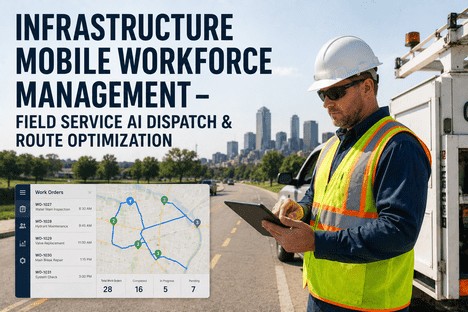
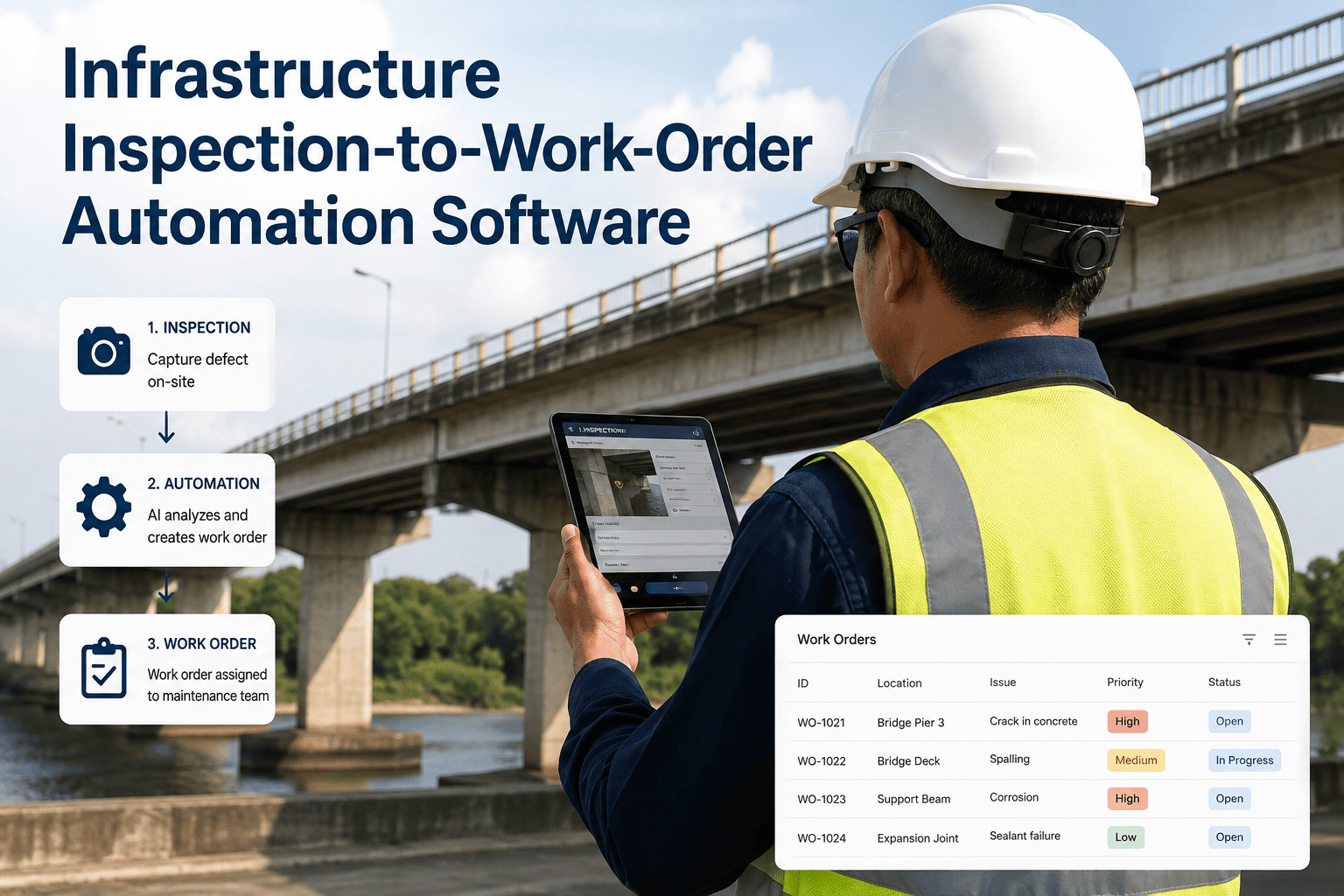
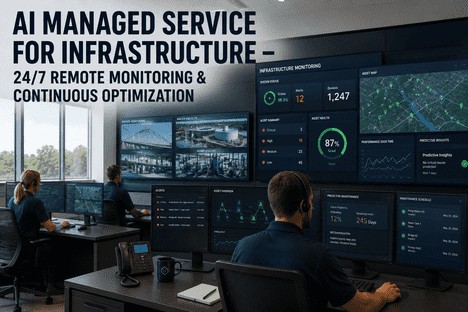
Infrastructure Mobile Workforce Management — Field Service AI Dispatch & Route Optimization
By Grace on June 24, 2026
It is 7:00 AM and the dispatch board is already full. A crew dispatched to the wrong substation because the address in the system was outdated. Another technician stuck in forty-five minutes of urban traffic on a route that could have been avoided. A scheduled maintenance job delayed because the closest available crew is twenty miles away from the asset that needs attention. By midday, three technicians have driven past each other's service locations, two emergency callouts have been reassigned manually through phone calls, and the shift supervisor has spent over two hours on coordination that added no value to any task. This is the operational reality for infrastructure organisations that have not yet integrated AI-driven mobile workforce management into their field operations. For maintenance managers responsible for geographically dispersed crews, aging infrastructure assets, and rising service expectations, the gap between where crews are and where they need to be is not a people problem — it is a coordination problem. And coordination, at scale, is a computation problem that manual methods cannot solve.
Mobile Workforce · AI Dispatch · Route Optimization · Field Service Management · Crew Productivity
Every Hour Your Crew Spends Driving Is an Hour They Are Not Maintaining Infrastructure. iFactory Makes Every Mile Count.
iFactory's mobile workforce platform gives maintenance managers AI-powered dispatch, real-time crew tracking, dynamic route optimization, and field-to-office connectivity that turns scattered field operations into a coordinated, data-driven workflow.
Annual growth rate of the global mobile workforce management market, projected to reach $13.19 billion by 2030 as AI becomes the operational standard
30-40%
Reduction in truck rolls and travel time reported by field service organisations that deploy AI-driven dispatch and remote-first triage workflows
93%
Of field service organisations have implemented AI in operations — with 88% reporting improved asset uptime and 75% seeing higher first-time fix rates
25-40%
Increase in daily job completions with the same number of technicians when AI dispatch replaces manual assignment in field operations
The Hidden Cost of Manual Dispatch — What Poor Coordination Costs Infrastructure Operations Every Day
The cost of inefficient mobile workforce management is not visible on any single budget line. It is distributed across fuel expenses, overtime pay, missed SLAs, deferred maintenance, and the productivity gap between what a crew could accomplish in a well-coordinated day and what they actually complete when dispatch is reactive rather than predictive. Most infrastructure organisations underestimate this cost because they have never measured what an optimised day looks like. The numbers that do exist tell a clear story: organisations that move from manual to AI-driven workforce management consistently report 25-40% more jobs completed with the same headcount, 30% reduction in travel time, and measurable improvements in first-time fix rates because the right technician with the right skills and parts arrives at the right location without a second trip.
01
Lost Technician Hours to Non-Productive Travel
Field crews in infrastructure operations typically spend 20-35% of their paid time travelling between job sites rather than performing maintenance work. For a crew of ten technicians, this means the equivalent of two to three full-time positions are spent on the road rather than on asset maintenance. AI-driven route optimisation compresses travel time by sequencing jobs based on geographic proximity, traffic conditions, skill requirements, and job priority simultaneously — a combinatorial optimisation that human dispatchers cannot perform in real time.
02
Emergency Response Delays That Compound Asset Damage
When an infrastructure asset fails — a water main break, a transformer fault, a gas line disruption — response time determines both repair cost and service impact. Manual dispatch in an emergency scenario relies on the dispatcher's knowledge of which crews are available, where they are located, and whether they have the right equipment. AI dispatch evaluates every variable simultaneously: crew location, skill certification, parts inventory on each vehicle, current traffic conditions, and job priority. The result is a response that is minutes faster in every scenario — and in infrastructure emergencies, minutes translate directly into reduced damage and faster restoration.
03
Coordination Overhead That Scales with Crew Size
The coordination effort required to manage field crews does not grow linearly with crew count — it grows exponentially. A dispatcher managing five technicians can track them mentally or with a basic spreadsheet. A dispatcher managing twenty technicians across multiple service territories requires a coordination system that manual methods cannot sustain. The result is that as infrastructure organisations grow or absorb retiring crews' territories, dispatch quality degrades, travel overlap increases, and the share of non-productive coordination time rises. Mobile workforce management platforms eliminate this scaling penalty by automating the coordination layer.
The Cost Breakdown
Where Does the Waste Go When Crew Coordination Is Manual?
28%
Travel Waste
Average technician time spent driving between jobs rather than performing maintenance work
22%
Admin Overhead
Supervisor and dispatcher time spent on phone coordination, manual scheduling, and status chasing
18%
Repeat Visits
Jobs requiring a second visit because the wrong crew, skills, or parts were dispatched initially
32%
Productivity Gap
Difference between potential daily completions with AI dispatch and actual completions with manual methods
AI Dispatch · Route Optimization · Crew Tracking · Field Mobility · Workforce Analytics
Stop Managing Your Crews by Phone and Spreadsheet. iFactory Puts Every Job, Every Route, and Every Technician on One Screen.
iFactory's mobile workforce platform unifies dispatch, route planning, live crew tracking, and field data collection in a single interface — built for infrastructure maintenance managers who need to coordinate complex field operations without the overhead.
The Four Pillars of AI-Powered Mobile Workforce Management
A complete mobile workforce management strategy rests on four interconnected capabilities. Organisations that implement all four see compounding productivity gains — each pillar amplifies the value of the others. Organisations that implement only one or two see improvement in that specific dimension but miss the system-level transformation that comes from connecting dispatch, routing, field execution, and analytics into a single operational loop.
01
Intelligent Dispatch
AI assignment that considers every constraint before a crew leaves the depot.
AI dispatch engines evaluate technician certifications, real-time location, vehicle parts inventory, job priority, traffic conditions, and labour regulations simultaneously to generate optimal assignments. When a new emergency call arrives, the system reassesses all active schedules and recommends the best reallocation in seconds — without requiring a dispatcher to manually search through spreadsheets or call each crew for status updates. The result is that every technician is assigned to the job that best matches their skills and proximity, every shift, without exception.
02
Dynamic Route Optimization
Routes that adapt to changing conditions in real time, not just at the start of shift.
Route optimisation is the difference between a crew visiting four sites in a shift and visiting six. AI route planning sequences jobs based on geographic clustering, traffic patterns, time windows, and job duration estimates — and re-optimises dynamically when a new job arrives, a completion takes longer than expected, or traffic conditions change. This is not the same as GPS navigation. It is a scheduling and sequencing problem that the AI solves across the entire crew simultaneously, not route by route. The compounding effect across a team of twenty technicians is the equivalent of adding three to five productive crew members without hiring.
03
Real-Time Crew Visibility
Live field intelligence that eliminates the need for phone check-ins and status chasing.
When a maintenance manager can see every crew's location, current task status, and next scheduled job on a single live map, coordination overhead collapses. Supervisors no longer need to call or text crews for updates — the platform surfaces status automatically from the work order lifecycle in the field mobile app. Job start times, completion confirmations, travel status, and delay notifications are visible to the office in real time. This visibility also enables proactive response: when a crew is running behind, the system alerts dispatch before the delay affects the next scheduled appointment, giving time to re-sequence rather than react.
04
Field Performance Analytics
Data that tells you which crews, routes, and schedules are performing and which are not.
Analytics transform field operations from a black box into a measurable system. Which technicians consistently complete jobs faster than estimated? Which geographic zones generate the most travel time per job? Which types of work orders are most likely to require a repeat visit? Which shift patterns produce the highest ratio of productive maintenance time to total paid time? Maintenance managers who track these metrics can make evidence-based decisions about territory boundaries, crew composition, shift structures, and training priorities. iFactory's analytics layer surfaces these patterns automatically from the data generated by every dispatched job and every completed work order.
The Maintenance Manager's Implementation Playbook — Five Steps to Mobile Workforce Transformation
Transforming field workforce management does not require a wholesale technology replacement or a lengthy implementation project. It requires a phased approach that builds capability incrementally, with each stage delivering measurable productivity gains that fund the next. These five steps sequence the transition from manual coordination to AI-powered workforce management in a way that generates visible results within the first thirty days.
Step 01
Digitise the Dispatch Board — Move from Whiteboards and Spreadsheets to a Single Digital View
Foundation
The fastest productivity gain comes from moving every crew, every work order, and every schedule onto a single digital platform. When iFactory is deployed, the first visible change is that the morning dispatch meeting shifts from a verbal coordination session — "who is going where today and what is their status from yesterday?" — to a live dashboard review where every crew's location, assigned tasks, and completion status are visible without anyone having to report verbally. This single change typically recovers thirty to forty-five minutes of supervisor time per shift and eliminates the information gap between what crews are doing and what the office believes they are doing. The data generated by this first step becomes the foundation for every optimisation that follows.
Step 02
Activate Mobile Work Order Management in the Field — Close the Loop Between Office and Crew
Field Enablement
The second step is equipping field crews with mobile work order access on their existing devices. When technicians can view their assigned jobs, access asset history and task instructions, update job status in real time, and capture completion data from the field, the feedback loop between field execution and office planning closes completely. Supervisors no longer need to call crews for status updates. Dispatchers no longer assign the next job based on estimated location but on confirmed completion. The data quality that emerges from mobile field capture — accurate completion times, actual travel durations, and real asset condition notes — becomes the fuel for every AI optimisation that follows. This step alone typically delivers a 15-20% productivity improvement by eliminating status-check calls, reducing idle time between jobs, and ensuring crews are always working from current task priorities.
Step 03
Introduce AI-Assisted Dispatch — Let the System Handle the Assignment Complexity
Intelligent Automation
Once the digital dispatch board is active and mobile work order data is flowing from the field, the AI engine has the data it needs to begin optimising assignments. iFactory's AI dispatch evaluates every open work order against every available crew — factoring in skills, certifications, location, current task status, vehicle inventory, and priority — and generates optimal assignment recommendations. The dispatcher reviews and confirms rather than manually constructing the schedule from scratch. This is not a fully autonomous system out of the gate; it is an assisted model where the AI handles the combinatorial complexity and the human maintains oversight. Most organisations see a 20-30% improvement in jobs completed per crew-day within the first two weeks of AI-assisted dispatch activation.
Step 04
Deploy Dynamic Route Optimisation — Compress Travel Time Across the Full Crew Roster
Efficiency
Route optimisation is the highest-ROI capability in the mobile workforce stack. When iFactory optimises crew routes, the system considers the full set of jobs for the day, the geographic distribution of assets, traffic patterns by time of day, estimated job durations, and technician-specific factors such as skills and parts availability. The optimised route sequence is pushed to each crew's mobile device as a turn-by-turn schedule that adapts as conditions change. If a job runs over or a new emergency is inserted, the system re-optimises the remaining route for the affected crew and, if necessary, rebalances jobs across adjacent crews to absorb the disruption. Organisations that activate dynamic route optimisation typically see travel time reduce by 25-35% and productive on-tool time increase correspondingly.
Step 05
Measure, Adjust, and Scale — Use Field Performance Data to Drive Continuous Improvement
Optimisation
The final step is treating field workforce performance as a measurable system rather than a collection of individual efforts. iFactory's analytics layer surfaces crew-level productivity trends, route efficiency scores, first-time fix rates by technician and job type, travel-time-to-work-time ratios, and schedule adherence patterns. Maintenance managers who review these metrics weekly can identify underperforming routes, training gaps in specific crew members, and geographic zones where asset density justifies a dedicated crew rather than dispatched coverage. Over a six-month period, the continuous improvement cycle driven by field performance data typically yields an additional 10-15% productivity gain beyond the initial optimisation, as managers learn to read the data and adjust crew structures accordingly.
Mobile Workforce KPI Framework
What Maintenance Managers Should Track to Measure Crew Productivity and Dispatch Effectiveness
Dispatch Efficiency
Dispatch-to-arrival time — minutes from job assignment to crew arrival, tracked by job type and geographic zone
Schedule adherence rate — percentage of jobs started within the scheduled time window, measured daily
Emergency response time — average minutes to dispatch and arrival for unplanned callouts, benchmarked by asset class
Crew Productivity
Jobs completed per crew-day — trending week over week, segmented by planned vs. reactive work order types
Travel-to-work time ratio — percentage of total paid hours spent driving versus performing maintenance tasks
First-time fix rate — percentage of jobs completed without requiring a follow-up visit for the same issue
Route & Resource
Average travel distance per job — miles driven per completed work order, tracked by territory and shift
Schedule i>optimisation impact — additional jobs completed after route optimisation, measured as a percentage uplift
Resource utilisation rate — percentage of available crew-hours actually applied to billable or planned maintenance work
"
Before iFactory, my day started with calls to five crew leads asking where they were and what they were working on. That was an hour I could not get back. The first week after deploying mobile dispatch with live crew tracking, I opened the dashboard at 6:30 AM and could see every technician on a single map — their location, their current task, their next job. Within a month, we had reduced travel time by 22% because the route optimisation was sequencing jobs by proximity instead of by the order they came in. Within three months, we had added a full extra job per crew per day without extending anyone's shift. The platform did not make us work harder. It made us stop wasting time on coordination that added no value to the maintenance work we exist to do.
— Maintenance Operations Manager, Regional Power Distribution Utility — 15 Years Infrastructure Field Operations
Conclusion
The gap between what your field crews could accomplish in a well-coordinated day and what they currently complete is not a reflection of their effort or capability. It is a reflection of the coordination systems they are operating within. Manual dispatch, static route planning, and phone-based status tracking were never designed for the scale and complexity of modern infrastructure field operations. They were inherited from an era when the number of crews, assets, and service locations were all smaller and the cost of coordination waste was less visible.
Every metric in this guide — jobs per crew-day, travel time percentage, first-time fix rate, schedule adherence — is an outcome of the coordination system you have in place, not a fixed characteristic of your workforce. When you change the coordination system from manual to AI-powered, the metrics change with it. The crews do not change. The routes change. The dispatch logic changes. The visibility changes. And the results follow.
iFactory's mobile workforce platform gives infrastructure maintenance managers the AI-powered dispatch, route optimisation, live crew tracking, and field analytics that transform scattered field operations into a coordinated, measurable system. Book a Demo to see how the platform maps to your current crew coordination workflow, or talk to an expert about building your mobile workforce transformation plan with a thirty-day foundation phase that delivers measurable productivity gains before full deployment.
Frequently Asked Questions
iFactory connects to existing CMMS, ERP, and work order systems through standard API integrations, synchronising work order data, asset records, and technician information without requiring data migration or system replacement. Work orders created in your existing system appear in iFactory's dispatch dashboard automatically, and completion data captured in the field mobile app flows back to the source system in real time. This means maintenance managers can deploy iFactory's mobile workforce capabilities without disrupting the upstream systems that handle financial reporting, compliance records, and asset lifecycle management. The integration layer handles field-specific requirements such as offline data capture for remote sites, GPS-stamped completion records, and real-time status synchronisation across systems. Talk to an expert to discuss your current system landscape and integration requirements.
iFactory delivers measurable value starting at three to five field technicians and scales to support hundreds. For smaller teams, the primary benefit is the first two pillars — real-time crew visibility and mobile work order management — which eliminate status-check calls, reduce idle time between jobs, and ensure every technician is working from current task priorities. The AI dispatch and route optimisation capabilities become increasingly valuable as crew size increases, since the combinatorial complexity of manual coordination grows exponentially with each additional technician. Organisations with ten or more field crew members typically see the most dramatic gains from AI-assisted dispatch, with route optimisation alone delivering 25-35% travel time reduction. Book a Demo to see how iFactory's mobile workforce capabilities match your team size and operational complexity.
iFactory's field mobile app is designed for the connectivity conditions that infrastructure crews actually work in, not ideal urban connectivity assumptions. The app caches work orders, asset data, and route schedules locally on the device when a data connection is available. When the crew moves into an area with limited or no connectivity, the app continues to function fully — technicians can view assigned jobs, update task status, capture completion data, and log observations. All data is stored locally on the device and synchronises automatically when connectivity is restored. This offline-first architecture means that crews working on remote transmission lines, rural water infrastructure, or underground utility networks experience no interruption in their mobile workflow. The office dashboard still receives updates when the crew returns to coverage, with GPS timestamps recording actual completion times regardless of when the data synchronised. Talk to an expert to discuss connectivity requirements for your specific operating environment.
The foundation phase of iFactory's mobile workforce deployment — digital dispatch board, mobile work order access for field crews, and live crew tracking — can be operational within one to two weeks for most infrastructure organisations, depending on system integration requirements and crew training schedules. Organisations see measurable productivity improvements within the first two weeks of go-live, primarily from reduced coordination overhead and elimination of status-check communication. The AI dispatch and route optimisation capabilities activate after the initial data flow is established, typically in week three or four, and deliver the most significant gains in travel time reduction and jobs-per-crew-day improvement. The full five-step transformation — from digital dispatch through continuous improvement analytics — typically completes within eight to twelve weeks. Book a Demo to discuss a deployment timeline tailored to your organisation's current mobile workforce maturity level.
28% of Your Crew's Day Is Spent Driving Between Jobs. iFactory Turns That Time into Productive Maintenance Hours.
iFactory gives infrastructure maintenance managers the AI dispatch engine, dynamic route optimisation, live crew visibility, and field performance analytics that turn scattered field operations into a coordinated, data-driven workforce — delivering 25-40% more jobs completed with the same crew.