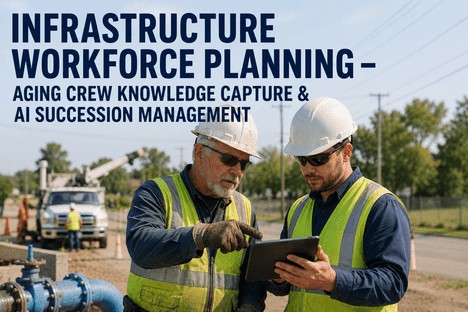
The infrastructure sector is facing a retirement wave that will remove a generation of operators, maintenance supervisors, and plant managers who hold institutional knowledge that cannot be replaced by job postings alone. Operations directors at water utilities, wastewater agencies, and public works departments know the problem exists but often lack a structured method to identify which positions are most vulnerable, what specific skills will walk out the door, and how to build development programs that close the gap before a retirement notice lands on their desk. AI-driven skill gap analysis changes this by mapping the competencies of current incumbents against the competencies required for each key position, calculating the time needed to develop internal candidates, and flagging positions where no viable successor exists months or years before the vacancy actually occurs. The facilities that treat succession planning as a recurring strategic process rather than an annual HR exercise are the ones that maintain operational continuity through leadership transitions instead of scrambling to hire externally at premium salaries. To see how iFactory maps your workforce competencies against key position requirements and tracks development progress in real time, book a 30-minute demo.
Infrastructure Succession Planning — Key Position Risk, Skill Gap Analysis & AI Workforce Development
How to identify which positions create the greatest vulnerability when vacated, quantify the skill gaps between incumbents and successors, and build development programs that close those gaps before retirement notices arrive.
The Retirement Timeline — Why the Window Is Shorter Than It Looks
The standard retirement notice in infrastructure operations is 30 to 90 days, but the development time needed to prepare a successor for a complex operations role typically ranges from 18 to 36 months. The math alone explains why so many succession plans fail — the planning window closes long before most organizations begin building it.
What Makes a Position "Critical" in Infrastructure Operations
Not every position in a utility or public works department requires a formal succession plan, and attempting to build one for every role spreads resources too thin to be effective. The positions that deserve the full succession planning investment share specific characteristics that can be evaluated systematically.
Single-Incumbent Dependency
The position has only one qualified person currently performing the role, and no one else in the organization can step in even temporarily without significant degradation in output quality or safety. In infrastructure operations, this commonly applies to plant operators who hold the only active license for a specific treatment process, maintenance supervisors who are the sole experts on a facility's SCADA system configuration, or engineers who designed and maintain proprietary control logic that is not documented anywhere else.
Long Development Cycle
The competencies required for the position cannot be acquired through a short training course or a quick hire. They require months or years of operational experience, site-specific knowledge, regulatory understanding, or licensure that has lead times measured in years. A Class A wastewater operator license, for example, requires progressively higher license levels, supervised operating hours, and examination — a process that takes a minimum of two to four years depending on the starting point.
High Consequence of Vacancy
An unfilled or under-filled position creates risks that go beyond productivity loss — regulatory compliance risk, safety risk, environmental risk, or significant financial risk. An empty chief operator position at a treatment plant can trigger regulatory scrutiny, an unfilled shift supervisor role can create unsafe staffing levels, and a vacant SCADA administrator position can leave critical control systems without security patching or backup capability.
Scarce External Talent Pool
The position requires skills or credentials that are difficult to recruit for in the external labor market. Infrastructure-specific roles like water treatment operators, collection system maintenance supervisors, and pump station electricians have been experiencing declining applicant pools for years as fewer workers enter the trades and competition from private industry pulls qualified candidates away from public sector wages. When external replacement is difficult, internal development becomes the only reliable strategy.
The Vulnerability Score — Quantifying Position Risk
Assigning a vulnerability score to each key position forces the operations director to move from a gut-feel assessment of risk to a structured, defensible ranking that drives resource allocation decisions. The score combines the four critical position factors into a single metric that can be tracked over time.
| Risk Factor | Low Risk — 1 Point | Moderate Risk — 2 Points | High Risk — 3 Points |
|---|---|---|---|
| Incumbent backup depth | Two or more ready now | One partially ready | Zero identified backups |
| Time to develop successor | Less than 12 months | 12 to 24 months | More than 24 months |
| Consequence of vacancy | Productivity loss only | Compliance or safety exposure | Regulatory violation or safety incident risk |
| External hiring difficulty | Active applicant pool available | Limited pool, longer fill time | Extremely scarce, rarely available |
| Incumbent retirement proximity | More than 5 years | 3 to 5 years | Less than 3 years |
Skill Gap Analysis — Traditional vs AI-Driven Approach
The core of any succession plan is an accurate understanding of the gap between what the successor candidate currently knows and what the target position requires. How that gap is identified and measured determines whether the development program will be targeted and efficient or generic and wasteful.
Manager completes a competency checklist from memory, rating the candidate on each skill area based on general impression rather than specific evidence or recent observation.
Gap identified as a binary present-or-absent judgment with no quantification of how large the gap is or how long it will take to close.
Training recommendations are generic — "send to leadership training" or "assign mentoring" — without specificity about which competencies the training should target or how progress will be measured.
Analysis is repeated annually at best, creating 12-month blind spots where the gap may be widening without any tracking or intervention.
Each key position has a defined competency model with specific proficiency levels, and each candidate is assessed against that model using documented evidence from performance records, training completions, certifications held, and supervisor evaluations.
The gap is quantified as a proficiency distance — the number of levels between current and required proficiency for each competency — producing a weighted gap score that prioritizes which skills need development first.
Training recommendations are mapped directly to the specific competency gaps identified, with estimated development timelines based on the type of learning required and the candidate's learning history.
Gap scores are updated continuously as the candidate completes training, gains experience, and receives new evaluations, creating a live readiness indicator instead of an annual snapshot.
Succession plans built on manager memory and annual checklists fail when the retirement notice arrives and the "ready" candidate is not actually ready.
iFactory builds competency models for each key position, assesses every successor candidate against those models with documented evidence, and produces a live readiness score that tells you exactly how far each candidate is from being able to step into the role — updated as they complete training and gain experience.
Competency Model Framework — What to Measure in Infrastructure Roles
The competency model for each key position defines what "ready" actually means. Without this definition, succession planning degenerates into subjective opinions about who would be good in the role, which produces biased and inconsistent results across positions and departments.
Process knowledge — understanding the treatment processes, collection system hydraulics, or distribution system operations specific to the facility
Regulatory compliance — knowing the permit requirements, sampling protocols, reporting obligations, and regulatory agency expectations for the position's scope
Equipment systems — proficiency with SCADA, PLC programming, motor control centers, chemical feed systems, and other facility-specific technology
Safety systems — knowledge of confined space procedures, lockout-tagout, chemical handling, and emergency response protocols for the facility
Decision making under pressure — ability to diagnose and respond to process upsets, equipment failures, and regulatory events without step-by-step guidance
Workforce coordination — scheduling staff, assigning tasks, managing overtime, and ensuring adequate coverage across all shifts and functions
Budget and resource management — managing operating budgets, procurement processes, vendor relationships, and capital project coordination
Regulatory communication — interfacing with regulatory inspectors, responding to information requests, and representing the facility during compliance meetings
Team development — coaching, mentoring, providing performance feedback, and building the capability of subordinates to handle increasingly complex responsibilities
Change management — leading teams through process changes, technology implementations, organizational restructuring, and new regulatory requirements
Cross-functional collaboration — working effectively with engineering, maintenance, laboratory, finance, and executive leadership to solve operational problems
Strategic thinking — connecting daily operational decisions to long-term infrastructure planning, asset management, and organizational goals
Proficiency Scale — Defining "Ready" with Precision
Each competency in the model is assessed on a proficiency scale that eliminates the ambiguity of terms like "proficient" or "experienced" and replaces them with specific, observable performance levels that both the assessor and the candidate can agree on.
Understands the concept and its relevance to the role but has not performed the task independently. Can describe what needs to be done and why but would require direct supervision and guidance to execute. This level represents the starting point for development, not a readiness indicator.
Can perform the task under supervision with occasional guidance. Has completed relevant training and has limited hands-on experience but is not yet consistent or efficient enough to perform independently in routine conditions. Errors are expected but are caught before they create consequences.
Performs the task independently in routine conditions without supervision. Handles normal variations and minor complications without escalation. This is the minimum proficiency level for a successor candidate to be considered "partially ready" for the target position, though gaps at higher proficiency levels may still exist for other competencies.
Performs the task independently in both routine and non-routine conditions. Can troubleshoot problems, adapt to unexpected situations, and coach others on the same competency. This is the target proficiency level for most competencies in a key position succession plan.
Recognized as the go-to resource for this competency within the organization. Can develop new procedures, train trainers, and handle the most complex or unprecedented situations. Not every competency in a succession plan requires Level 5 — most require Level 4 — but certain specialized competencies like regulatory interpretation or crisis response may need expert-level readiness.
The Development Pipeline — Stages from Candidate to Ready Successor
Successor development is not a single training event but a structured pipeline that moves candidates through progressively more challenging experiences. Each stage builds on the previous one, and skipping stages — such as putting someone into a leadership role without first building their operational decision-making skills — is the most common cause of succession plan failure.
Candidate is assessed against the target position competency model using documented evidence. Current proficiency is recorded for each competency, producing a baseline gap score. This stage also evaluates the candidate's learning style, career interests, and willingness to pursue the target role — because a technically qualified candidate who does not want the position is not a viable successor regardless of skill level.
Candidate completes structured training to close Level 1 and Level 2 gaps — classroom training, online courses, certification programs, and guided reading. This stage addresses the "knowing" component of competency but does not yet build the "doing" component. For infrastructure roles, this typically includes regulatory training, process fundamentals, safety certifications, and equipment operation basics.
Candidate performs target-role tasks under direct supervision of the incumbent or a qualified mentor. This is where Level 2 gaps close and Level 3 competency begins to develop. The candidate handles routine situations with a safety net, builds muscle memory for operational decisions, and receives real-time feedback on performance. Duration varies by role complexity but typically ranges from three to nine months.
Candidate is given responsibilities that extend beyond their current role — leading a project, covering a shift independently, handling a regulatory inspection, or managing a small team. This stage builds Level 3 and begins developing Level 4 competency by exposing the candidate to non-routine situations where standard procedures may not apply. The stretch assignment must be challenging enough to drive growth but not so far beyond the candidate's capability that it creates risk.
Candidate is assessed again against the full competency model to verify that proficiency gaps have closed to the required levels. This assessment must use different evidence than the baseline assessment — not the same training completion records — to confirm that actual capability has developed, not just that training was attended. The candidate is now classified as "ready" or "not ready" with a documented basis for the determination.
Training Program Design — Closing Specific Gaps, Not Running Generic Programs
The most common mistake in succession-related training is sending candidates to generic leadership development programs that address competencies the candidate already has while ignoring the specific technical or operational gaps that will actually determine whether they can perform the target role. Effective training design maps directly from the skill gap analysis to specific learning interventions.
For Knowledge Gaps — Level 1 to Level 2
Classroom training, online learning platforms, certification programs, and workshop attendance address gaps where the candidate lacks foundational knowledge. These are effective for regulatory knowledge, process theory, safety regulations, and management concepts. The limitation is that knowledge acquisition alone does not produce competency — it must be followed by supervised practice to convert knowledge into skill. Every structured course in the development plan should have a corresponding practice activity that requires the candidate to apply what they learned in an operational context.
For Skill Gaps — Level 2 to Level 3
Pairing the candidate with the current incumbent or another qualified person for structured knowledge transfer addresses gaps where the candidate understands the concept but has not yet performed the task. Effective mentoring programs have defined learning objectives for each session, a schedule that ensures all critical competencies are covered, and documented evidence of what was practiced and how the candidate performed. Without this structure, mentoring degenerates into informal shadowing that covers whatever the incumbent happens to be working on that day rather than systematically addressing the gap profile.
For Experience Gaps — Level 3 to Level 4
Assigning the candidate to lead tasks, projects, or operational periods that require independent decision-making builds the advanced competency needed for the target role. Examples include managing a plant shutdown and startup, leading a regulatory compliance audit response, overseeing a capital project through design and commissioning, or acting as the facility manager during the incumbent's vacation. Each stretch assignment should be designed to exercise specific competencies from the gap profile, and the candidate's performance should be evaluated and documented as evidence for the readiness assessment.
For Breadth Gaps — Across Competency Areas
Infrastructure organizations that operate multiple facilities can accelerate successor development by rotating candidates through different sites, processes, and organizational structures. A candidate who has only worked at one treatment plant gains significantly from spending time at a plant with a different treatment process, different regulatory framework, or different organizational culture. Cross-facility exposure builds the adaptability and breadth of perspective that distinguishes a candidate who can only replicate what their predecessor did from one who can improve on it.
Measuring Succession Readiness — KPIs That Drive Action
Succession planning programs that produce reports but do not produce metrics are programs that get filed and forgotten. The operations director needs a small set of key performance indicators that make succession health visible at a glance and that change frequently enough to drive ongoing attention rather than annual review.
The percentage of critical positions that have at least one successor assessed at Level 3 or above across all required competencies. A ratio below 0.5 means the organization is vulnerable to more than half of its key positions becoming unfillable from internal talent. This is the single most important succession KPI because it summarizes the entire program into one number that any executive can understand and act on.
The average proficiency distance across all successor candidates and all competencies, measured on the five-level scale. A declining average gap score over time indicates that development programs are working. A static or increasing gap score indicates that candidates are not progressing, which should trigger investigation into whether the training programs are effective or whether the candidates have the aptitude and motivation for the target roles.
The average time it takes for a successor candidate to progress from initial assessment to verified readiness at the required proficiency level. Tracking this metric over time reveals whether the organization is getting faster at developing successors — which indicates improving development processes — or slower, which indicates bottlenecks in training availability, mentoring capacity, or stretch assignment opportunities.
The number of days until the highest-risk key position — the one with the closest retirement or departure date and the least ready successor — becomes vacant. This is the urgency metric. When this number drops below 365 days, the operations director should be receiving active alerts. When it drops below 180 days, the situation should be escalated to executive leadership because external hiring may be the only remaining option and it carries its own timeline risks.
Common Failures in Infrastructure Succession Programs
Operations directors who have been through failed succession planning efforts recognize the same patterns repeating across organizations. Understanding these failure modes is the first step toward building a program that avoids them.
Confining Succession to Senior Leadership Only
Many organizations build succession plans for the director and deputy director positions but ignore the mid-level operational roles — shift supervisors, lead operators, maintenance foremen, laboratory managers — where the actual institutional knowledge and day-to-day decision-making capability resides. A utility can survive a leadership transition at the top if the operational layer is strong, but it cannot survive losing its mid-level operational expertise even if the executive bench is deep. The most impactful succession programs cover the full operational hierarchy, not just the org chart titles that appear in board presentations.
Treating the Plan as a Document Instead of a Process
A succession plan that exists as a spreadsheet completed once a year and filed in a shared drive is not a succession plan — it is a compliance artifact. The plan must be a living process where gap scores are updated, development activities are tracked, candidates move through pipeline stages, and readiness assessments are conducted on a recurring basis. The document is the output of the process, not the process itself. Organizations that confuse the two are always surprised when the spreadsheet says "ready" but the candidate cannot actually perform the role.
Ignoring Reluctant or Unsuitable Candidates
Not every high-performing operator wants to become a supervisor, and not every technically competent engineer wants to become a manager. Succession plans that designate candidates based on technical performance alone, without verifying career interest and leadership aptitude, consistently produce successors who decline the role when it is offered or accept it and underperform because the role does not match their strengths. Candidate willingness and suitability should be assessed at the baseline stage and re-evaluated periodically, because career interests change over time.
Not Accounting for Knowledge Transfer Lag
Even when a successor is technically proficient, there is a period after the incumbent leaves during which institutional knowledge — the unwritten rules, relationships with regulators, historical context for decisions, and facility-specific quirks that no manual documents — transfers from the incumbent's head to the successor's experience. This lag period typically lasts six to twelve months and is the highest-risk period in any succession transition. Succession plans that do not include a structured knowledge transfer phase — specific topics, scheduled sessions, documented outputs — leave this critical period to chance.
Frequently Asked Questions
How many key positions should an infrastructure organization include in its formal succession plan?
The number depends on the size of the organization, but a practical guideline is to include every position where an unplanned vacancy would create operational risk within 72 hours. For a mid-size water or wastewater utility, this typically ranges from 8 to 20 positions spanning plant operations, maintenance leadership, collection system supervision, laboratory management, SCADA administration, and executive leadership. Attempting to cover more than 25 positions usually dilutes the effort to the point where none of the plans are genuinely actionable. The vulnerability scoring framework helps prioritize which positions make the cut and which can be covered through less intensive cross-training programs rather than full succession plans. Book a demo to see how iFactory scores and ranks your positions by vulnerability automatically.
What happens if a key position has no viable internal successor candidate at all?
This is the reality for many infrastructure organizations, and pretending otherwise by naming an unqualified candidate does not solve the problem. When no internal candidate exists, the organization has three options that should be pursued simultaneously. First, accelerate external recruiting with a realistic timeline — acknowledging that infrastructure roles often take six to twelve months to fill. Second, implement interim risk mitigation such as documented procedures, cross-training for emergency coverage, and pre-negotiated contractor agreements that can activate quickly. Third, start developing a candidate for the longer term by identifying the most promising junior employee and beginning the development pipeline even though the timeline will not align with the current retirement. The worst response is to do nothing because there is no perfect candidate, which guarantees an unmanaged vacancy. Contact support to discuss how iFactory handles zero-candidate positions in the succession dashboard.
How do you measure whether a succession training program is actually working versus just checking boxes?
The most reliable indicator is whether the candidate's proficiency score on the specific competency targeted by the training actually increases after the training is completed. If a mentoring program is designed to close a gap in regulatory communication from Level 2 to Level 3, the candidate should be reassessed on that specific competency after the mentoring period, and the reassessment should use different evidence than the baseline — such as observing the candidate handle a real regulatory interaction rather than reviewing the same training attendance record. Programs that measure completion — "attended 40 hours of training" — rather than competency change — "moved from Level 2 to Level 3 on four of six targeted competencies" — cannot distinguish between effective training and wasted time. The gap score trend over time is the definitive measure of whether the development program is producing results.
How does AI improve succession planning beyond what a skilled HR team can do manually?
AI does not replace the judgment of HR professionals and operations directors — it amplifies it by handling the data processing and pattern recognition tasks that are impractical to do manually at scale. An HR team assessing 15 key positions with 12 competencies each across 30 potential successor candidates is managing 5,400 individual competency assessments. Doing this annually with spreadsheets means each assessment gets a few minutes of attention at best. AI processes all 5,400 assessments continuously, flags changes in gap scores, calculates pipeline velocity across the entire candidate pool, and surfaces the positions and candidates that need attention — allowing the HR team and operations director to focus their limited time on the highest-risk situations rather than reviewing every position equally. Book a demo to see how iFactory automates the data layer so your team can focus on decisions.
Should succession candidates be told they are being developed for a specific role, or should the process be informal?
The candidate should be informed explicitly and early. Informal succession development — where the organization quietly grooms someone without telling them — fails for three reasons. First, the candidate cannot invest personal effort in their own development if they do not know the target. Second, the candidate may make career decisions — taking a different job, pursuing a different certification, relocating — that are inconsistent with the succession plan because they were not aware of it. Third, if the candidate is eventually passed over for the role, the lack of transparency creates resentment and often leads to their departure, which defeats the purpose of the entire investment. Explicit communication should include the target role, the current gap assessment, the development plan and timeline, and the acknowledgment that being a candidate does not guarantee selection — which is honest, respectful, and far more effective than secrecy.
Every month you wait to start succession development is a month removed from the pipeline that your most critical positions need before a retirement notice appears.
iFactory maps your key positions, assesses every successor candidate against competency models with documented evidence, tracks development pipeline progress in real time, and alerts your operations director the moment a position's coverage timeline drops below your threshold.