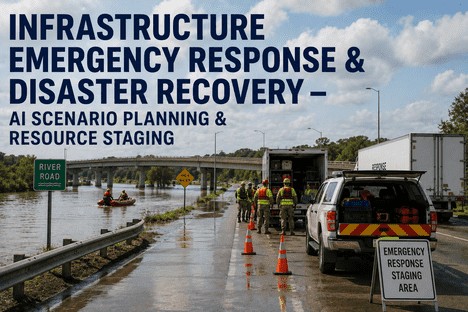
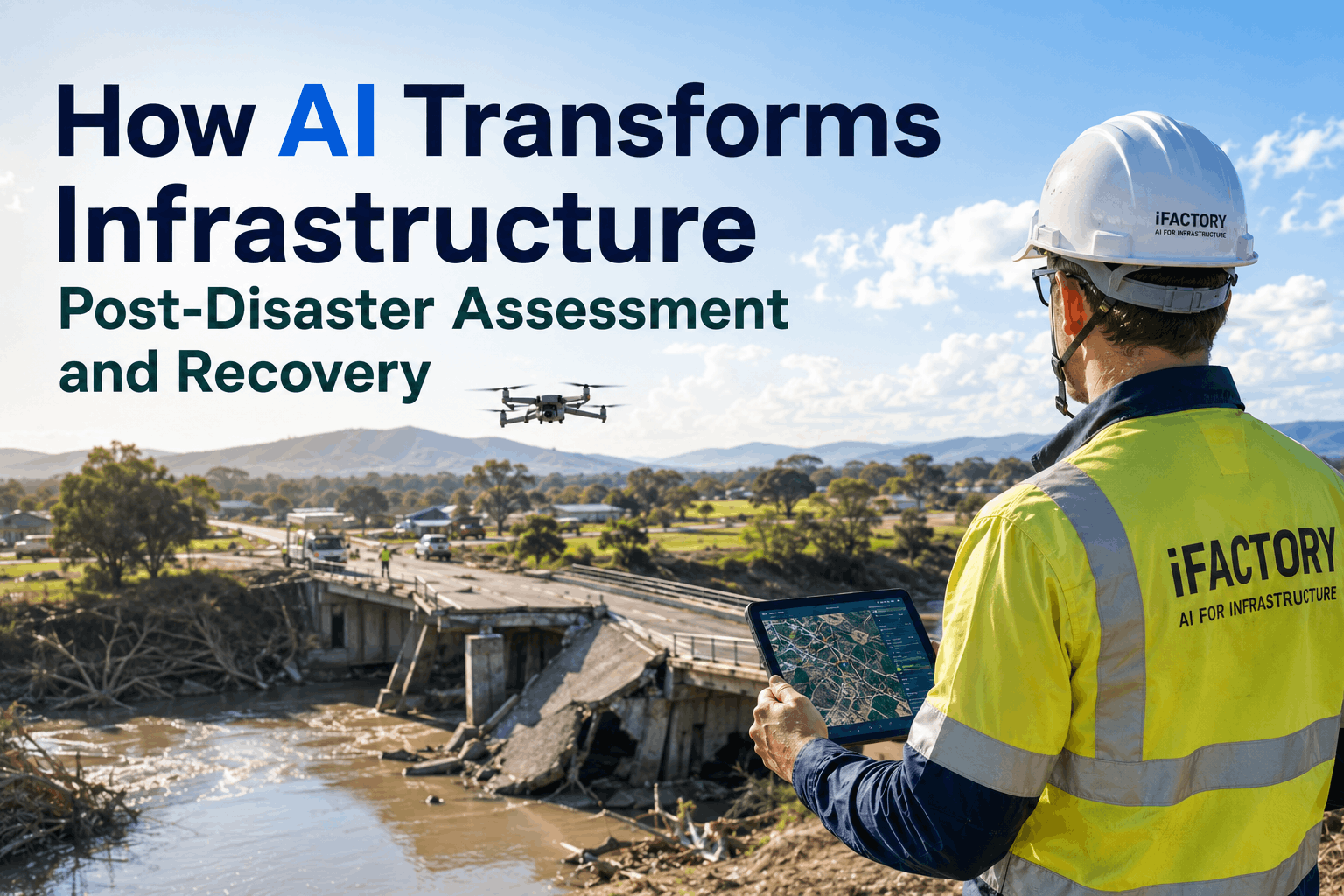
In 2024, the United States endured 27 billion-dollar weather disasters costing $182.7 billion and claiming 568 lives. The total cumulative cost of billion-dollar events since 1980 now exceeds $2.9 trillion. Hurricanes Helene and Milton alone accounted for over $113 billion in damage — catastrophic floods, destroyed infrastructure, and communities cut off for weeks because response assets were not positioned where they were needed most. Globally, the annual cost of disasters exceeds $2.3 trillion when cascading and ecosystem impacts are included. For operations directors responsible for infrastructure resilience, the pattern is unmistakable: extreme events are more frequent, more severe, and more expensive. Traditional emergency response planning — static resource lists, annual tabletop exercises, binders of contact numbers — cannot keep pace with the speed and scale of modern disasters. AI-powered scenario planning, predictive resource staging, and connected response coordination are no longer optional capabilities. They are the new operational baseline for infrastructure organisations that need to protect assets, maintain service continuity, and respond within minutes rather than days. This guide is written for operations directors who need to build emergency response and disaster recovery capability that matches the threat environment their infrastructure faces.
AI Scenario Planning · Resource Staging · Emergency Response · Disaster Recovery · Infrastructure Resilience
Disasters Are No Longer Unpredictable. Your Response Capability Should Not Be Either. iFactory Builds Both.
iFactory's emergency response platform gives operations directors AI-driven scenario simulation, predictive resource staging, real-time coordination dashboards, and post-event recovery analytics — connecting preparedness to response in a single system.
$2.9T
Cumulative cost of 403 billion-dollar weather disasters in the U.S. since 1980, adjusted for inflation to 2024 dollars
27
Billion-dollar disasters in 2024 alone — the second-highest annual count on record, with 568 fatalities and $182.7 billion in damages
20x
Increase in annual billion-dollar disasters from the 1980s (3/year) to the last decade (20/year) — frequency is accelerating
$1:$25
Every dollar not invested in disaster resilience today could cost $25 in lost future economic activity — U.S. Chamber of Commerce
Why Traditional Emergency Response Planning Cannot Match the Threat Environment
The gap between the speed of modern disasters and the pace of traditional emergency response planning is widening. Infrastructure organisations that rely on static plans, annual tabletop exercises, and manual resource coordination face a structural disadvantage: their preparedness reflects the threat environment of last year, while the next disaster will arrive with characteristics they did not anticipate. Four structural limitations explain why traditional approaches continue to produce response gaps.
01
Static Plans Cannot Anticipate Dynamic Conditions
A response plan written six months ago assumes a specific scenario — a Category 3 hurricane making landfall at a predicted point, or a flood event within historical parameters. But climate-influenced disasters routinely exceed historical boundaries. Hurricane Helene in 2024 devastated inland communities in North Carolina that had never experienced flooding of that magnitude. A static plan built on historical data could not have anticipated the scale or location of that impact. AI-driven scenario simulation models hundreds of possible variations simultaneously — landfall point shifts, intensity changes, cascading infrastructure failures — and generates resource staging plans for each permutation, so the operation is prepared for the range of outcomes rather than a single forecast.
02
Resource Staging Is Based on Intuition, Not Predictive Analytics
Where to pre-position generators, pumps, temporary bridges, repair crews, and communication equipment is the single most consequential decision in emergency preparedness. Most organisations make this decision based on past experience and institutional memory — the same locations that flooded last time, the same equipment caches that were used in the previous event. Predictive resource staging uses machine learning models trained on hazard data, infrastructure vulnerability assessments, population density, supply chain dependencies, and historical response times to determine optimal pre-positioning locations for every asset type. The difference between intuitive staging and predictive staging can be measured in hours of response time saved — and in many cases, hours determine whether infrastructure failure becomes a cascading catastrophe or a contained incident.
03
Coordination Relies on Communication Chains That Break Under Stress
The traditional emergency response coordination model depends on phone trees, radio networks, and email distribution lists. When a disaster strikes, the first infrastructure to fail is often communication infrastructure — cell towers are damaged, power grids go offline, internet connectivity drops. Organisations that rely on connected coordination platforms with offline-capable mobile applications, satellite-backup messaging, and real-time status updates maintain operational awareness when traditional communication channels fail. iFactory's response coordination module distributes updates to every responder's mobile device with automatic sync when connectivity is restored, ensuring that no team operates on outdated information during the critical first hours of a response.
04
Post-Event Analysis Is Manual, Delayed, and Disconnected from Future Planning
After every major disaster, after-action reports are written, lessons learned are documented, and recommendations are made. Yet the same response gaps appear in successive events because the learning from one event does not systematically feed into the planning for the next. Connected analytics platforms capture response data in real time — resource deployment times, coordination lag, asset utilisation rates, decision points that caused delays — and feed that data directly into the scenario planning engine for the next cycle. Organisations that close this loop improve their response capability with every event instead of repeating the same lessons year after year.
The AI-Powered Emergency Response Framework — Four Capabilities That Define Modern Infrastructure Resilience
The Infrastructure Investment and Jobs Act has directed unprecedented funding toward infrastructure projects across the United States, but the resilience of those investments depends on the emergency response capability of the organisations that operate and maintain them. The following four-capability framework defines the technology and process layers that distinguish infrastructure organisations capable of rapid, coordinated disaster response from those that remain vulnerable to the accelerating frequency of extreme events.
Capability 01
AI Scenario Simulation — Prepare for the Range, Not the Average
Predictive
Scenario simulation powered by machine learning models the full probability distribution of disaster outcomes — not just the most likely path, but the range of possible landfall points, intensity bands, rainfall totals, storm surge depths, and cascading failure probabilities. For an operations director responsible for infrastructure across a geographic region, this means receiving not one resource staging recommendation but a portfolio of pre-positioning strategies weighted by probability. When forecast data changes — and it will change multiple times in the 72 hours before a landfall event — the AI model updates its scenario portfolio and recommends adjusted staging positions within minutes. iFactory's scenario simulation engine ingests National Weather Service forecast data, historical event records, asset vulnerability profiles, and real-time sensor feeds to generate continuously updated response plans that keep pace with the evolving threat.
Capability 02
Predictive Resource Staging — Position Assets Before the Event
Logistics
The difference between a contained infrastructure disruption and a cascading regional failure is often determined by whether the right equipment, materials, and personnel were in the right place before the event arrived. Predictive resource staging uses optimisation algorithms trained on infrastructure network topology, hazard probability surfaces, transportation route vulnerability, and historical response times to determine the minimum number of staging locations and asset quantities needed to achieve a defined response time target across all probable scenarios. For highway infrastructure, this means pre-positioning temporary bridges, pumps, generators, signage, and repair crews at locations that maximise coverage across the full range of forecast outcomes. For utility infrastructure, it means staging replacement poles, transformers, wire, and line crews at points that minimise restoration time for critical circuits. iFactory's resource staging module integrates with inventory management systems to track asset availability in real time and generate staging recommendations that are feasible given current stock levels and crew capacity.
Capability 03
Real-Time Response Coordination — Common Operating Picture Across Every Team
Command
During the first 72 hours of a disaster response, the operations director needs to know: where are our crews? What assets have been deployed? Which infrastructure segments are damaged? What is the status of each repair task? Traditional coordination methods rely on radio check-ins, paper status boards, and phone calls — each of which introduces delay, ambiguity, and information loss. A common operating picture platform aggregates GPS tracking from every response vehicle, task status updates from every crew lead, damage assessment data from drone and satellite imagery feeds, and real-time weather updates into a single geospatial dashboard that every decision-maker accesses simultaneously. When a bridge closure diverts a repair crew route, the platform updates estimated time of arrival automatically. When a new forecast indicates a threatened substation that was not previously flagged, the operations director can re-route resources in minutes rather than hours. iFactory's response coordination dashboard is designed for the high-stakes decision tempo of the first 72 hours — with offline capability, redundant data paths, and configurable alert thresholds that ensure critical information reaches the right person regardless of communication network status.
Capability 04
Recovery Analytics and Continuous Improvement — Each Event Makes the Next Response Faster
Learning
After-action reports are only valuable if their findings translate into measurable changes in response capability. iFactory's recovery analytics module captures every decision, every resource deployment, every coordination lag, and every communication gap during an event — and correlates that data with outcomes such as infrastructure restoration time, cost per incident, and service continuity metrics. When the next scenario simulation runs, it incorporates the actual performance data from the most recent event, making the staging recommendations more accurate and the coordination models more realistic. Organisations that close this analytics loop see a measurable improvement in response time — typically 15-25% faster resource deployment — with each successive event, because the system learns from every response rather than starting from the same baseline assumptions every year.
The Cost of Inaction — Why Every Dollar in Preparedness Multiplies
The U.S. Chamber of Commerce's 2025 Resilience Report found that every dollar not invested in disaster resilience could result in more than $25 of lost future economic activity. The UNDRR Global Assessment Report 2025 estimates that total global disaster costs now exceed $2.3 trillion annually when indirect and ecosystem impacts are included — nearly ten times the official direct loss figures. For infrastructure operations directors, these numbers translate into a clear business case: investing in AI-powered scenario planning, predictive resource staging, and connected response coordination is not a discretionary safety expenditure — it is a financial imperative that directly protects capital assets, maintains service revenue, prevents regulatory penalties, and preserves the organisation's license to operate in increasingly hazard-prone environments.
Scenario Simulation · Resource Staging · Response Coordination · Recovery Analytics · Infrastructure Resilience
Your Infrastructure Is Exposed to Events You Have Not Planned For. iFactory Closes the Gap Between Threat and Response.
iFactory unifies AI scenario planning, predictive resource staging, real-time coordination, and post-event analytics — giving operations directors the capability to prepare for the range of possible disasters, not just the one that happened last time.
The Infrastructure Resilience Maturity Model — Where Does Your Organisation Stand?
Every infrastructure organisation operates somewhere on the emergency preparedness and response maturity curve. The following model helps operations directors assess their current capability level and identify the specific investments needed to reach the next stage.
Infrastructure Emergency Response Maturity Model
Stage
Response Approach
Planning Characteristics
Priority for Advancement
Response is improvised when events occur. No pre-staged resources. Coordination relies on phone trees and institutional knowledge of who to call.
Paper plans updated annually. Single scenario assumed. No data on resource locations, response times, or asset vulnerability.
Create a digital asset registry with vulnerability classifications. Establish baseline response time targets by infrastructure type.
Response plans exist for the most probable scenarios. Resources are listed but not dynamically staged. Annual exercises validate procedures.
Digital plan documents, contact lists, equipment inventories. Plans are scenario-specific and updated after annual exercises.
Introduce multi-scenario planning. Establish resource staging protocols. Digitise response coordination with mobile-enabled platforms.
AI-powered scenario simulation generates multi-outcome plans. Resource staging is predictive and optimised. Response coordination is real-time and shared across teams.
Live common operating picture, predictive staging models, connected field data, automated alerts, and post-event analytics with pattern recognition.
Integrate scenario simulation with resource inventory. Connect response data to recovery analytics. Establish continuous improvement cycle.
Response capability improves with every event. Scenario models update automatically from post-event data. Resource staging adjusts in real time as forecasts evolve.
Self-improving AI models, automated after-action analytics, predictive risk scoring for all assets, integrated supply chain and mutual-aid coordination.
Benchmark response time against industry peers. Use predictive analytics for capital resilience investment decisions. Drive continuous improvement from every event.
Conclusion
The data is unequivocal: billion-dollar disasters have increased from an average of three per year in the 1980s to 20 per year in the last decade. The cumulative cost of U.S. weather disasters since 1980 has surpassed $2.9 trillion. For operations directors responsible for infrastructure resilience, the traditional emergency response model — static plans, intuitive resource staging, manual coordination, disconnected after-action reviews — is no longer adequate to the threat environment. The organisations that will protect their assets, maintain service continuity, and control recovery costs are those that adopt AI-powered scenario simulation, predictive resource staging, connected response coordination, and continuous improvement analytics.
iFactory's emergency response platform gives operations directors the capability to prepare for the full range of disaster outcomes — with AI-driven scenario modelling, optimised resource staging recommendations, real-time common operating picture dashboards, and recovery analytics that make every response faster than the last. Book a Demo to see how the platform maps to your infrastructure's risk profile, or Talk to an Expert to begin building your connected emergency response capability with iFactory today.
$2.9 Trillion in Disaster Costs Since 1980. Every Dollar Not Invested in Resilience Multiplies. Start Building Yours Today.
iFactory gives operations directors the AI scenario planning, predictive resource staging, and connected response coordination infrastructure to protect infrastructure assets, maintain service continuity, and control recovery costs in an era of accelerating disaster frequency.
Frequently Asked Questions