A railway safety audit is fundamentally a documentation problem. Inspectors walk thousands of kilometres of track each year, photograph defects, complete paper logs, and submit records to compliance teams who then manually cross-reference findings against regulatory requirements — FRA track standards, ERA Common Safety Methods, ORR inspection frameworks, ISO 55001. When auditors arrive, the question they are really asking isn't "is this track safe?" It's "can you prove this track is safe, consistently, over time, with a complete and unbroken evidence trail?" For most rail operators, that question is harder to answer than it should be. AI changes both sides of the audit equation — automating the data collection that feeds compliance evidence, and generating the structured documentation that regulators, investigators, and safety bodies need to see. Here is how the workflow operates, end to end.
Automated Inspection · Compliance Evidence · Audit Trail · Regulatory Reporting
Replace Paper Audit Trails with Tamper-Proof Digital Evidence Your Regulator Can Inspect On Demand.
iFactory's railway AI platform automates safety inspection data collection, structures compliance documentation against your regulatory framework, and generates the audit-ready evidence trail that ORR, FRA, and ERA inspectors need to see — without a single paper form.
90%
Hazard detection improvement with AI vision on Canadian railways
£20M+
Annual productivity benefit from Network Rail's AI inspection platform
100%
Manual defect detection rate matched by AI in Malaysia IOrail deployment
1 year
Advance failure prediction window achieved by Network Rail predictive AI
The Compliance Audit Problem Manual Inspection Creates
Manual railway inspection is not just slow — it creates structural compliance gaps that become visible during audits. Regulators do not accept "we inspected it" as evidence. They require documented proof of systematic inspection at defined intervals, with findings recorded against specific regulatory clauses, corrective actions tied to defects with completion dates, and an unbroken chain of custody from inspector to record to filing. Manual processes fail each of these requirements in predictable ways.
Evidence Gap 01
Incomplete Inspection Trails
FRA and ORR audits focus on paperwork as much as physical condition. Incomplete or missing records can result in enforcement actions even when the track itself is in acceptable condition. Manual logs have gaps by default — missed entries, illegible handwriting, inconsistent formats across inspector teams.
Evidence Gap 02
Unlinked Defects and Corrective Actions
Regulators require each identified defect to be linked to a corrective action with a completion record. Manual systems store defect logs and maintenance records in separate systems — or on paper — making it impossible to demonstrate the closure loop that ISO 55001 Clause 7.5 and CSM frameworks require.
Evidence Gap 03
No Trend Data for Regulator Reporting
ERA Common Safety Methods and ISO 55001 require evidence of systematic monitoring over time — not just a snapshot. Manual inspections produce point-in-time records with no automated trend analysis. Safety bodies need to see deterioration curves, recurring defect patterns, and systemic risk — data that only continuous AI monitoring can generate.
How AI Automates Safety Audit Data Collection on Railway Networks
AI railway inspection systems replace the manual inspection-to-documentation workflow with a continuous, automated, geotagged data pipeline. Every pass of an AI-equipped inspection train, drone, or track vehicle generates structured, regulatory-ready compliance evidence — without inspector data entry.
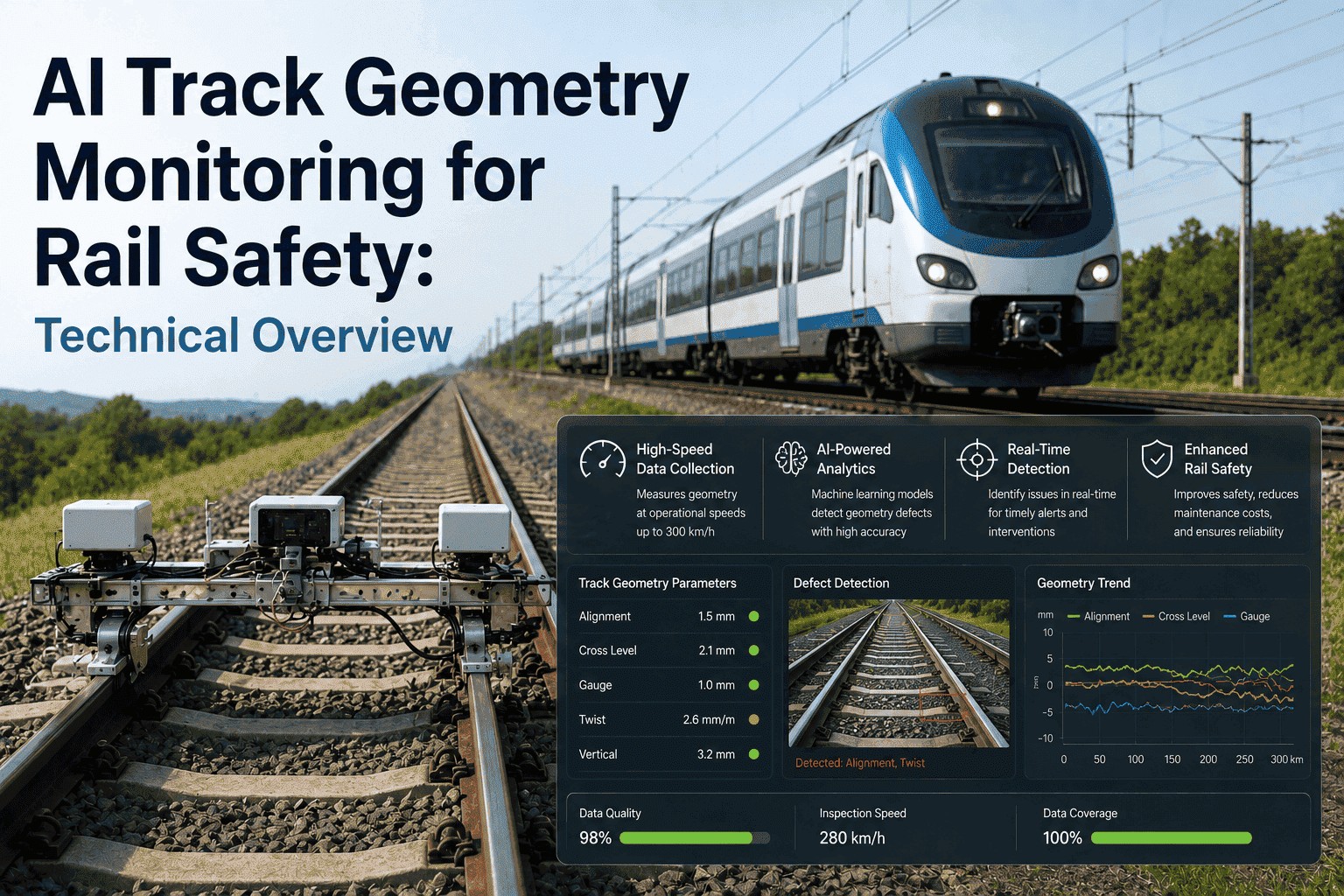
Track Geometry Monitoring Cars
At Line Speed
Instrumented vehicles run at operational speeds and measure track geometry — gauge, twist, alignment, cross-level, and longitudinal level — against regulatory tolerance standards. AI classifies each measurement against the applicable standard (EN 13848, FRA class limits) in real time, generating a structured defect record with location, severity, and the specific regulatory clause breached.
Gauge deviation detection
Alignment and twist records
EN 13848 / FRA class auto-match
GPS-tagged defect geolocation
AI Computer Vision Cameras
Visual Defect Log
High-resolution cameras mounted on inspection trains or drones photograph track components continuously. AI vision models classify surface defects — rail head cracks, fastener failures, sleeper deterioration, ballast voids, vegetation encroachment, signal obstructions — and generate timestamped photographic records linked directly to compliance frameworks. CrossTech's Hubble processes 8,000+ miles monthly this way across UK networks.
Fastener and sleeper condition
Vegetation encroachment flags
Rail head surface condition
Photographic evidence per defect
Ultrasonic Flaw Detection
Sub-Surface Integrity
Ultrasonic testing detects internal rail flaws — transverse cracks, horizontal split heads, detail fractures — that are invisible to cameras and geometry sensors. AI interprets ultrasonic waveform signatures to classify flaw type and severity, generating immediate compliance alerts when findings cross the intervention threshold defined in the applicable maintenance standard. Rail Labs' Arista platform combines ultrasonic and AI vision in a single multi-sensor pass.
Transverse crack detection
Waveform severity classification
Auto-alert at intervention threshold
Integrated with maintenance planning
IoT Switch and Asset Sensors
Continuous Monitoring
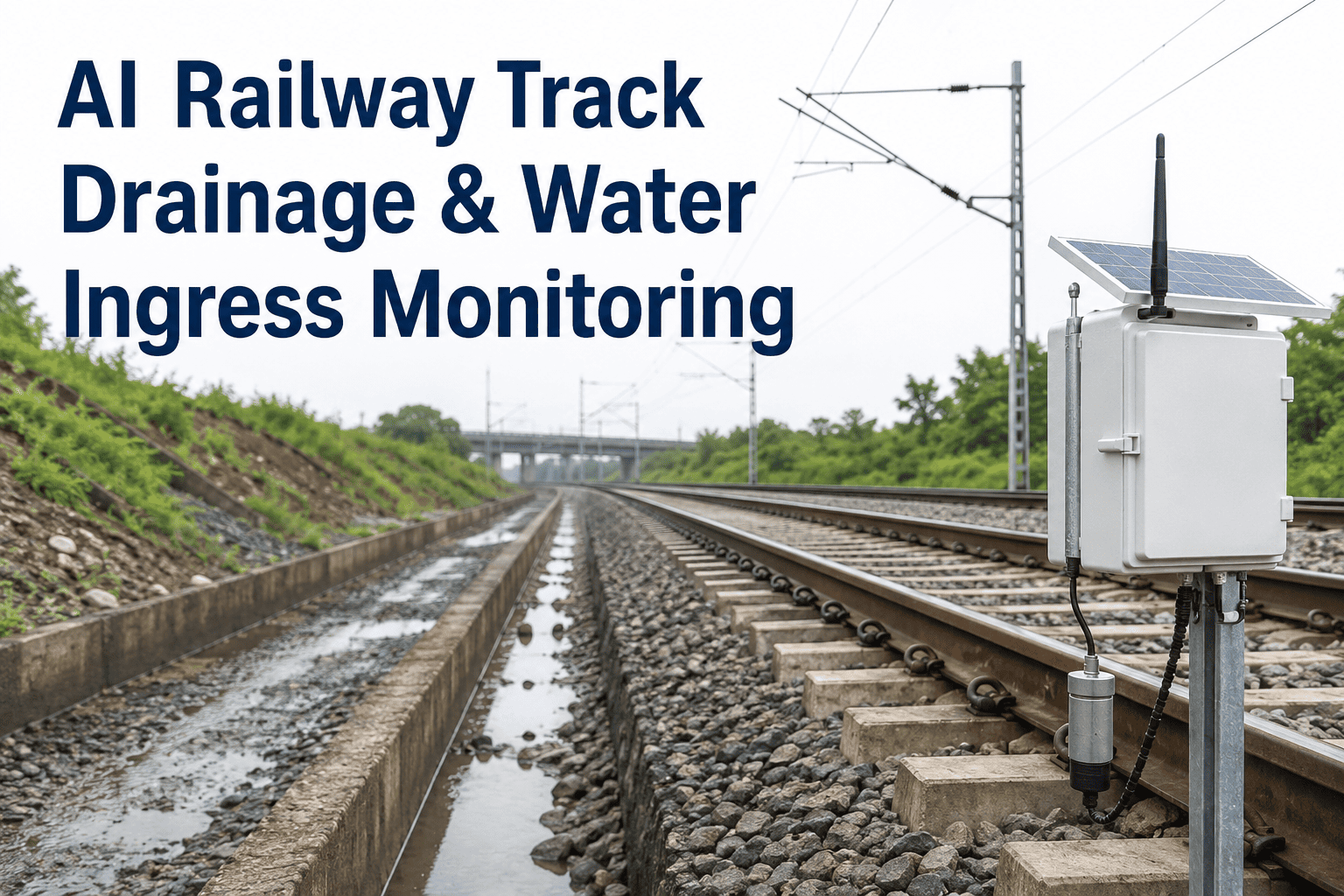
Permanent IoT sensors on switches, bridges, tunnels, and overhead line equipment monitor structural health continuously between inspection runs. KONUX and Deutsche Bahn use AI-driven IIoT devices to monitor switch health and optimize maintenance scheduling across the German network. Every sensor reading contributes to the continuous compliance evidence record — not just snapshots from periodic inspection visits.
Switch condition scoring
Bridge structural load monitoring
OHL wear and sag detection
24/7 evidence generation
From Raw Inspection Data to Audit-Ready Documentation: The AI Workflow
Collecting inspection data is only the first step. The compliance value of AI is in what happens next: structuring that data against regulatory frameworks, linking defects to corrective actions, generating the trend evidence that safety bodies require, and maintaining a tamper-proof record that holds up under investigation.
Step 01 — Data Ingestion and Georeferencing
Every sensor reading tagged to asset, location, and time
All data from inspection vehicles, drones, and permanent sensors is ingested into a unified asset registry. Each reading is automatically tagged with GPS coordinates, asset ID from the infrastructure register, inspection vehicle ID, timestamp, and the regulatory inspection cycle it belongs to. No manual data entry. No record gaps.
Step 02 — Regulatory Framework Matching
Each defect mapped to the specific clause it breaches
The AI model compares each measured value against the tolerance thresholds defined in the applicable regulatory framework — EN 13848, FRA Track Safety Standards, Network Rail NR/L2/TRK/001, ERA CSMs. When a value exceeds a limit, a compliance flag is raised with the specific clause number, the measured value, the allowable limit, and the class of defect (immediate action, planned repair, monitor). Inspectors no longer interpret standards manually.
Step 03 — Automated Work Order and Corrective Action Linkage
Every defect linked to a repair record — automatically
When a defect triggers a compliance flag, a work order is automatically created in the CMMS with the defect record, location, clause reference, required intervention, and mandated timeframe. When the repair is completed, the work order closure updates the compliance record. The system maintains the closed loop — defect raised, work order issued, repair completed, record updated — that regulators and auditors require to see. The closure rate becomes a real-time compliance KPI.
Step 04 — Trend Analysis and Safety Performance Monitoring
The deterioration history safety bodies need to assess systemic risk
ERA Common Safety Methods and ISO 55001 require evidence that safety performance is being systematically monitored over time. The AI platform maintains a continuous deterioration history for each asset — plotting condition trends across inspection cycles, flagging assets with accelerating deterioration curves, and generating the systemic risk evidence that safety bodies use to assess whether the safety management system is working. This is the data that typically does not exist in manual inspection programmes.
Step 05 — Audit-Ready Report Generation
One-click evidence packs for ORR, FRA, ERA, and RAIB
When an inspection or investigation body requests evidence, the platform generates a structured compliance report in the required format — inspection dates and coverage, defect register with clause references, work order closure records, trend analysis, and tamper-proof audit trail. Authorities can be granted read-only access to specified evidence compartments without requiring document transfer. The paper-based equivalent of this report takes weeks to compile manually. The AI platform generates it in minutes.
Regulatory Frameworks the AI Platform Documents Against
Railway safety compliance is not a single standard. Operators face overlapping frameworks from national safety authorities, international bodies, and sector-specific standards — each requiring different evidence. The AI platform maps inspection data against all applicable frameworks simultaneously.
| Framework |
Jurisdiction |
Key Documentation Requirement |
| ERA Common Safety Methods (CSM) |
European Union |
Safety level achievement evidence; systematic monitoring records; risk assessment documentation trail |
| ORR / NR CP7 |
United Kingdom |
Inspection history with continuous evidence trail; historical trend data; tamper-proof audit records |
| FRA Track Safety Standards (49 CFR Part 213) |
United States |
Documented inspection logs per class; defect notification and corrective action records; inspector credentials |
| ISO 55001 (Asset Management) |
International |
Documented information under Clause 7.5; asset lifecycle records; maintenance evidence trail for certification |
| EN 13848 (Track Geometry Quality) |
Europe (CEN Standard) |
Track quality index documentation; defect classification against tolerance bands; trend monitoring records |
| NIS2 / Cyber Security (OES) |
EU Operators of Essential Services |
Security incident reporting; audit trail integrity records; access control documentation for critical systems |
CSM · ORR · FRA · ISO 55001 · EN 13848 — All in One Compliance Dashboard
Your Next Regulatory Audit Shouldn't Require Four Weeks of Manual Evidence Assembly.
iFactory's railway AI platform maintains audit-ready compliance evidence continuously — so when ORR, FRA, or ERA inspectors arrive, the evidence pack is generated in minutes, not assembled over weeks. Book a Demo to see the compliance dashboard for your regulatory framework.
Manual Inspection vs AI-Automated Auditing: The Evidence Difference
The same track can be inspected by both approaches. The difference shows up not in what gets inspected — but in the quality, completeness, and regulatory usefulness of the evidence produced.
Manual Inspection Programme
Inspection frequency limited by inspector headcount and budget
Paper or spreadsheet records — inconsistent format, gaps inevitable
Defect records and maintenance records in separate systems
No trend data — only point-in-time snapshots per visit
Audit evidence pack assembled manually — weeks of preparation
RAIB investigation triggers paper-record search — historical gaps become public record
AI-Automated Compliance Programme
Continuous monitoring between scheduled inspections — permanent sensors and frequent AI runs
Structured digital records — GPS-tagged, timestamped, regulation-referenced, tamper-proof
Automated defect-to-work-order linkage — closed loop visible in real time
Continuous trend analysis — deterioration curves, systemic risk identification, safety monitoring evidence
Audit-ready evidence packs generated in minutes for ORR, FRA, ERA, RAIB
Regulator can be granted direct read-only evidence access — no document transfer required
AI Railway Safety Inspection: What Leading Networks Have Deployed
The AI inspection and compliance automation transition is not theoretical. The world's major rail operators have been deploying these systems for several years — and the documented results inform the business case for every operator that follows.
Network Rail — UK
Insight AI Platform — £20M+ Annual Productivity Benefit
AI-powered predictive maintenance system predicting failures up to one year in advance. CrossTech's Hubble system processes video from forward-facing cameras across 8,000+ miles of track monthly, detecting vegetation encroachment, signal obstructions, and track defects and feeding structured records into the compliance management system.
Deutsche Bahn — Germany
KONUX IIoT + AI Switch Health Monitoring
AI and IIoT devices monitor switch health condition continuously across the German network, feeding predictive maintenance scheduling and compliance evidence generation. Deutsche Bahn's Predictive Maintenance Platform monitors brakes, wheels, doors, and track infrastructure — reducing unplanned downtime and building continuous compliance records.
SNCF — France
Drone AI Inspection + Mars LGV Programme
SNCF uses AI-powered drones to inspect tracks, bridges, and tunnels — processing visual data to detect structural issues and generate preventive maintenance records. The Mars LGV project extends AI inspection to high-speed line compliance documentation, enabling continuous safety monitoring on infrastructure where manual inspection frequency is limited by operational constraints.
"
The most uncomfortable thing about our previous audit preparation process was that it took four weeks of intensive work to assemble evidence that should have been continuously maintained. When ORR arrived, we were presenting a document-assembly exercise, not a compliance programme. With the AI platform, the compliance evidence is current every day. The audit isn't something we prepare for — it's something we're permanently ready for. The regulator gets read-only access and reviews the evidence directly. Our last ORR inspection preparation time dropped from four weeks to one afternoon.
— Head of Safety and Compliance, Regional Rail Infrastructure Manager — 17 Years Railway Engineering and Regulatory Experience
Conclusion
Railway safety compliance auditing has always required two things that manual inspection programmes struggle to deliver simultaneously: high-frequency data collection across extensive networks, and structured, regulation-referenced documentation that holds up under scrutiny from ORR, FRA, ERA, and RAIB. AI closes both gaps at once. Automated inspection systems — track geometry monitoring, computer vision, ultrasonic flaw detection, and permanent IoT sensors — generate continuous data at network scale. The AI compliance layer structures that data against the applicable regulatory framework, links defects to corrective actions, maintains the deterioration trend record that safety management systems require, and generates audit-ready evidence packs on demand.
The operators already running AI inspection programmes — Network Rail, Deutsche Bahn, SNCF — are not doing so primarily for cost reduction. They are doing it because the regulatory environment increasingly requires continuous, structured, tamper-proof evidence that manual inspection cannot reliably provide. iFactory's railway AI platform delivers the full compliance workflow — from sensor data to audit-ready documentation — in a single integrated system. Book a Demo to see the compliance dashboard configured for your regulatory framework, or Get In Touch to begin the data onboarding process.
Frequently Asked Questions
Your next safety audit is a measure of how well you've been documenting all year. AI makes every day an audit-ready day.
iFactory's railway AI platform automates inspection data collection, structures compliance documentation against your regulatory framework, and gives your safety team a continuously audit-ready evidence trail. Book a Demo or sign up to see the compliance dashboard configured for your network.