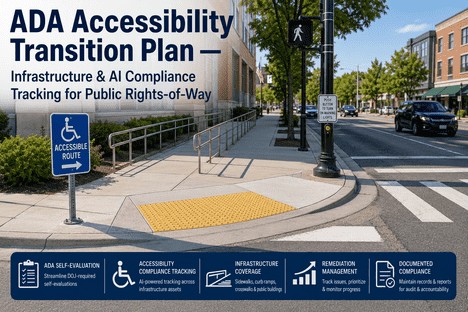
ADA Accessibility Transition Plan — Infrastructure & AI Compliance Tracking for Public Rights-of-Way
By Grace on June 27, 2026
Every public agency in the United States that receives federal funding is required by Title II of the Americans with Disabilities Act to maintain a self-evaluation and transition plan for its infrastructure — sidewalks, curb ramps, crosswalks, public buildings, parks, and pedestrian signals. The requirement is not new. It has existed since the ADA was signed into law in 1990. Yet in 2025, less than one percent of curb ramps across evaluated municipal networks were found to be fully compliant with current accessibility standards. Fewer than nine percent of sidewalks met the Public Right-of-Way Accessibility Guidelines (PROWAG) for cross slope, clear width, and surface condition. These numbers come not from small rural jurisdictions with limited budgets but from major cities that have been conducting accessibility assessments for over a decade.
Thousands of Municipalities Have ADA Transition Plans. Very Few Have a Way to Actually Track, Execute, and Report on Them.
iFactory's AI-powered compliance module turns static PDF transition plans into live, trackable, auditable workflows — with automated inspection scheduling, real-time remediation progress, and DOJ-ready reporting across every asset class in your public rights-of-way.
Projected digital accessibility market by 2035 growing at 8.6% CAGR — driven by regulatory enforcement and infrastructure modernisation
2,000+
ADA website accessibility lawsuits filed in the first half of 2025 alone — a 37% year-over-year increase with similar trends emerging in physical infrastructure enforcement
41M
Americans live with a disability — one in five adults in the US — for whom inaccessible infrastructure is not an inconvenience but a barrier to daily participation
$75K
Minimum civil penalty per ADA violation — with second offences reaching $150,000, not including litigation costs, remediation orders, and federal funding implications
The ADA Transition Plan Gap: Documents That Collect Dust vs. Systems That Drive Action
The overwhelming majority of US municipalities have an ADA transition plan on file. Many have had one for years, updated periodically by consultants who conduct facility audits, produce a PDF with a prioritised barrier inventory, establish a schedule for remediation, and then depart. What happens after the consultant leaves is where the system breaks down — and where the compliance risk compounds silently over time.
Why Most ADA Transition Plans Fail to Drive Real Infrastructure Change
The PDF Trap
A comprehensive document that no one reads after the compliance officer files it.
Most transition plans are produced as static PDF documents containing hundreds of pages of barrier inventories, photographs, priority matrices, and cost estimates. Once adopted by the council, the document sits on a website or in a filing system. There is no automated workflow connecting the barrier identified in Appendix C to a work order in the public works system. There is no alert when a scheduled curb ramp retrofit passes its target date. There is no dashboard showing the compliance officer which of the 1,200 documented barriers have been remediated and which remain open. The plan becomes a compliance artefact rather than a management tool.
No Workflow Integration
The Update Lag
Transition plans revised every three to five years cannot keep pace with infrastructure degradation.
ADA compliance is not a one-time assessment. Sidewalk surfaces degrade. Curb ramps settle and crack. New signalised intersections are constructed. Weather events damage pedestrian access routes. When a transition plan is updated on a three-to-five-year cycle, the asset inventory becomes progressively more inaccurate with each passing season. By year three of a typical plan cycle, the barrier list reflects only a fraction of the actual accessibility deficiencies in the field. Compliance officers operating with outdated inventories are making remediation priority decisions on fundamentally incomplete information.
Stale Asset Data
The Silos Problem
Parks, public works, transportation, and buildings operate independent compliance tracking systems.
In most municipal structures, ADA compliance responsibility is distributed across departments. Public works manages curb ramps and sidewalks. Parks and recreation manages trails and facility access. Buildings manages public building entrances and restrooms. Transportation manages pedestrian signals and transit stops. Each department may track its own remediation progress — in spreadsheets, project management tools, or paper files — with no central view available to the ADA coordinator. The result is fragmented reporting, inconsistent priority assignment, and a compliance posture that is only as strong as the weakest departmental tracking system.
No Centralised View
The Evidence Gap
When a compliance challenge arises, the agency cannot produce documented remediation history on demand.
Title II of the ADA requires public entities to maintain documentation of their transition plan implementation. In practice, this means a compliance officer facing a DOJ inquiry, a lawsuit, or a funding audit must be able to produce: a complete barrier inventory, a prioritised remediation schedule, evidence of progress against that schedule, and justification for any deviations. Without a centralised tracking system that timestamps every inspection, work order, and completion certificate, producing this evidence becomes a manual document-collection exercise across multiple departments — often revealing gaps that become liabilities rather than evidence of good-faith compliance.
An ADA Transition Plan Is Not a Document. It Is a Continuous Process. iFactory Makes It a Managed Workflow.
From barrier identification through work order generation to completion certification and DOJ-ready reporting — your entire ADA compliance lifecycle managed in a single AI-powered platform, across every department and every asset class.
How iFactory Transforms ADA Transition Plans from Static Documents into Live Compliance Workflows
iFactory was not built as an add-on reporting layer for existing compliance spreadsheets. It is an AI-native operations platform purpose-built for infrastructure and facility management — where every asset, every inspection, every work order, and every compliance deadline is tracked in a single data environment. The ADA compliance module extends this platform to give compliance officers, public works directors, and risk managers the tools they need to move transition plans from the PDF library to the project management workflow.
Capability 01
Centralised Barrier Inventory — Every Curb Ramp, Sidewalk Segment, Crosswalk, Signal, and Building Entrance in One Register
Single Source of Truth
iFactory ingests barrier data from your existing transition plan, GIS layers, field inspection reports, and citizen accessibility requests into a single searchable asset register. Every barrier is geolocated, categorised by asset type sidewalk, curb ramp, pedestrian signal, building entrance, park pathway, assigned a priority level based on DOJ criteria, and linked to the specific ADA standard it violates. When new barriers are identified through inspection cycles or public reporting, they are added to the register with a timestamp and automatically prioritised against the existing inventory. The compliance officer no longer reconciles multiple spreadsheets and PDF appendices. One register. One source of truth. One continuously updated picture of the municipality's accessibility posture.
GIS-integrated asset register
DOJ-aligned barrier priority scoring
Multi-department barrier ownership assignment
Capability 02
Automated Remediation Scheduling and Work Order Generation — From Barrier ID to Completion Without a Spreadsheet
Workflow Automation
When a barrier is identified and prioritised, iFactory does not leave the remediation action to a departmental email thread. The platform automatically generates a remediation work order assigned to the responsible department, with the specific ADA standard reference, the required scope of work, estimated material quantities based on asset type, and the target completion date drawn from the transition plan schedule. The work order flows into the department's existing maintenance workflow with full traceability back to the original barrier record. When the work is completed, the system records the completion date, uploads the inspection certification, and updates the barrier status in the master register instantly. The transition plan schedule is dynamically recalculated based on actual completion rates. No manual status updates. No reconciliation. No lag between field completion and compliance reporting.
Auto-generated remediation work orders
ADA standard-linked scope definition
Dynamic schedule recalculation
Capability 03
AI-Powered Inspection Scheduling and Condition Monitoring — Predictive Compliance Instead of Reactive Reporting
AI Condition Intelligence
The condition of pedestrian infrastructure is not static. A curb ramp that passed inspection last year can develop a trip hazard this season due to frost heave, settlement, or utility cut restoration. iFactory's AI-powered condition monitoring module ingests data from routine inspection cycles, citizen-reported barrier submissions, and integrated IoT sensors where deployed to build a continuously updated condition profile for every asset in the barrier inventory. The AI identifies degradation patterns that would not be visible in annual inspection data alone — a sidewalk segment near a construction site that shows accelerated surface deterioration, a crosswalk push-button location where vegetation growth is progressively obstructing access, or a cluster of curb ramps in one neighbourhood that share a common installation defect. When a condition score drops below a configurable threshold, the system escalates the asset for priority inspection and potential addition to the remediation schedule — capturing the degradation months or years before a traditional transition plan update would identify it.
Continuous condition profiling per asset
AI-driven degradation pattern detection
Automated threshold-based escalation
Capability 04
DOJ-Ready Compliance Dashboard and Audit Reporting — The Evidence Your Transition Plan Is Working, Produced in Seconds
Audit-Ready Documentation
The compliance dashboard in iFactory gives the ADA coordinator, the public works director, and the city attorney real-time visibility into the municipality's compliance posture. Every metric required by DOJ Title II regulations is available in a single configurable view: total barriers identified, barriers remediated this quarter, barriers in progress, overdue remediation items by department, average time from identification to completion, and remediation completion rate against the transition plan schedule. When the annual compliance report is due, the system generates it in seconds from live data — not from a spreadsheet that was last updated when the finance department asked for it. For DOJ inquiries or litigation response, the platform produces a complete chain of evidence for any barrier: original inspection date, priority score, work order history, completion certification, and post-remediation inspection documentation. The question "show me what you have done to address sidewalk accessibility in the southeast district since 2023" is answered in a single export, not a two-week document search across three departments.
Real-time regulatory KPI tracking
One-click audit report generation
Full barrier remediation traceability
ADA Compliance Across Asset Types — Why a Unified Platform Matters
A municipality's ADA compliance portfolio spans physically distinct asset types — each with its own inspection methodology, ADA standard reference, repair workflow, and responsible department. Managing them in separate departmental systems makes it impossible for the compliance officer to produce a unified picture of the agency's accessibility status. iFactory's asset-class architecture treats every type within a single compliance framework while respecting the specific inspection protocols and standards that apply to each.
How iFactory Manages Each Asset Class Within a Unified ADA Compliance Framework
Asset Class
Compliance Challenge
How iFactory Handles This Asset Class
Curb Ramps
PROWAG compliance for slope, width, detectable warnings, landing dimensions. Over 1 million curb ramps in a typical major city inventory.
GIS-mapped ramp register with slope measurement fields, detectable warning status, landing compliance flags. Auto-prioritised replacement work orders with standardised bill of materials.
Signalised intersection register with APS compliance fields. Integration with traffic signal maintenance workflows for coordinated APS upgrade projects.
Public Buildings
2010 ADA Standards for entrance accessibility, restroom configuration, signage, parking, path of travel, service counter height.
Facility-level barrier register with room-by-room compliance tracking. Integration with capital project planning for coordinated building accessibility upgrades.
Parks and Trails
Accessible route to play areas, surface firmness and stability, picnic table and grill clearance, fishing pier and viewing area access.
Park amenity-specific compliance checklists. Integration with parks maintenance schedules for barrier removal aligned with seasonal maintenance cycles.
"
Our transition plan was a 400-page PDF that lived on the city website. Every year, I spent two weeks pulling data from three departments to compile the annual compliance report. On iFactory, I opened the compliance dashboard during a council briefing and showed real-time remediation progress across sidewalks, curb ramps, and public buildings. One department had completed zero scheduled remediations in six months without anyone flagging it. We corrected course the same week. Previously, that gap would have been discovered during the next annual report cycle — with six more months of compounded non-compliance.
— ADA Compliance Officer, Mid-Sized Municipal Government — 12 Years Public Sector Accessibility Management
The Cost of Inaction vs. The Cost of Compliance: Why the Economics Favour a Managed Platform
When municipal budget directors evaluate the investment in a compliance management platform against the cost of maintaining the status quo, the comparison is often based on software license fees versus the perceived savings of continuing with spreadsheet-based tracking and annual consultant updates. This framing misses the largest cost categories entirely.
The Compliance Platform Investment
Platform subscriptionStarts at $18K/yr
Data migration and configurationOne-time $8-15K
Staff training and onboardingIncluded
Annual platform maintenanceIncluded in subscription
Total Year 1~$30K
The Cost of Inaction
Single ADA lawsuit settlement$75K-$500K+
Annual consultant transition plan update$40K-$100K
Staff hours on manual tracking and reporting$25K-$60K/yr
Federal funding eligibility riskUnquantifiable
Typical Annual Exposure$140K+
The question is not whether a municipality can afford a compliance management platform. The question is whether it can afford to manage ADA compliance without one — carrying the litigation risk, the consultant dependency, the staff-hour drain, and the federal funding exposure that come with disconnected spreadsheets and stale PDF documents.
Conclusion
ADA compliance for public infrastructure is not a one-time assessment. It is an ongoing operational responsibility that touches every department that manages public rights-of-way, buildings, parks, and transportation systems. The municipalities that treat their transition plan as a living management process rather than a static compliance document will be the ones that can demonstrate good-faith progress toward accessibility — and the ones best positioned to defend against compliance challenges, secure federal infrastructure funding, and serve their communities equitably.
iFactory's AI-powered ADA compliance module gives public agencies the platform they need to make the transition from static PDF to live managed workflow — with centralised barrier inventories, automated work order generation, AI-driven condition monitoring, and audit-ready compliance reporting that turns a compliance obligation into a managed process. Book a Demo to see how the platform maps to your municipality's specific asset inventory and transition plan requirements, or talk to an expert to begin your compliance workflow configuration and get your first cross-department compliance dashboard live within thirty days.
Frequently Asked Questions
iFactory includes a data migration module specifically designed for ADA transition plan imports. The platform accepts data from PDF appendices, GIS shapefiles, Excel spreadsheets, and CSV exports from common accessibility assessment tools. Barrier records are extracted, geocoded, categorised by asset type, and populated into the centralised barrier register. Priority scores, ADA standard references, photographs, and inspection dates are preserved and mapped to iFactory's compliance fields. For municipalities with no digital barrier inventory, the platform provides structured import templates that can be completed by the compliance team or filled by a third-party assessment consultant. The goal is to transition from your existing data to the live platform with minimal disruption to ongoing compliance activities. Talk to an expert to schedule a data readiness assessment for your transition plan.
iFactory's PROWAG compliance module includes asset-type-specific inspection templates that align with the 2023 Public Right-of-Way Accessibility Guidelines. For curb ramps, the inspection form captures slope measurements running and cross, detectable warning surface compliance, landing dimensions, and gutter transition height. For sidewalks, the system tracks clear width, cross slope, running slope, surface condition, and passing space intervals. For signalised intersections, the module documents accessible pedestrian signal presence, push-button location compliance, audible indication functionality, and activation timing. Each inspection template references the specific PROWAG section so field inspectors and compliance officers can immediately identify the governing standard for any identified deficiency. Book a Demo to see the PROWAG inspection workflows configured for your agency's asset types.
iFactory's role-based access architecture allows the ADA coordinator to assign barrier ownership and remediation responsibility to specific departments while maintaining a single unified view of the entire transition plan. The public works director sees only the curb ramp and sidewalk barriers assigned to public works. The parks and recreation director sees trail and facility barriers. The buildings manager sees public building compliance items. The ADA coordinator sees everything. Each department works within its own workflow environment — generating work orders, updating remediation status, uploading completion documentation — while the central compliance register is updated in real time. The coordinator receives automated alerts when departmental remediation falls behind schedule, without needing to chase status updates by email. Talk to an expert to configure the role-based access structure for your agency's departmental organisation.
For a typical municipal agency with an existing transition plan in PDF or spreadsheet format, iFactory's implementation sequence covers: week one for platform configuration and user role setup; weeks two to three for barrier data migration, GIS integration, and asset register population; week four for department-specific workflow configuration and inspection template setup; week five for training sessions with the ADA coordinator, public works team, and departmental leads; and week six for go-live and compliance dashboard activation. Full operational capability with all departments active and remediation workflows running is typically achieved within six weeks. The first cross-department compliance dashboard with real-time barrier status is available for review by the ADA coordinator within the first fourteen days. Book a Demo to build the implementation plan specific to your agency's asset inventory size, departmental structure, and current transition plan format.
A PDF Transition Plan Is a Document. A Managed Compliance Workflow Is a Defence.
iFactory's ADA compliance module — centralised barrier inventory, automated remediation workflows, AI-driven condition monitoring, DOJ-ready audit reporting. The single platform that turns your transition plan from a static file into a living compliance system.