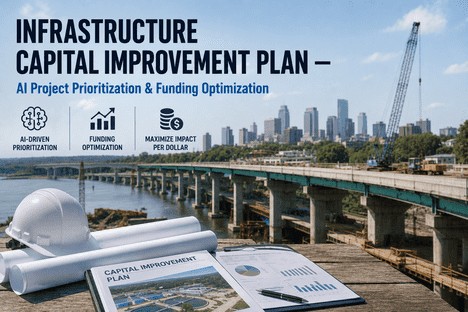
Infrastructure Capital Improvement Plan — AI Project Prioritization & Funding Optimization
By Grace on June 23, 2026
A city council approves a capital improvement programme built on departmental wish lists rather than condition data. The road reconstruction that should have been prioritised sits in Year 5 while a lower-urgency project consumes Year 1 funding — not because the data supported it, but because a stakeholder advocated louder. Three years later, the deferred road fails catastrophically, costing three times what planned rehabilitation would have cost. This is not a failure of engineering. It is a failure of prioritisation — and it repeats across thousands of municipalities and infrastructure organisations every budget cycle. The U.S. municipal infrastructure backlog alone stands at USD 786 billion. Across all sectors, 63% of capital projects experience cost overruns and 72% face schedule delays, while the global infrastructure investment gap has reached USD 2.59 trillion. These numbers are not driven by a lack of funding. They are driven by a lack of structured, data-driven prioritisation — the kind that AI-powered capital improvement planning now makes possible. iFactory's AI CIP Prioritisation module was built to close this gap.
Capital Improvement Plan · AI Project Prioritisation · Funding Optimisation · Infrastructure Investment · CIP Planning
Stop Prioritising Infrastructure Projects by Politics Instead of Data. iFactory's AI Ranks Every Project by Condition, Risk, and Community Impact — Then Optimises the Funding Sequence.
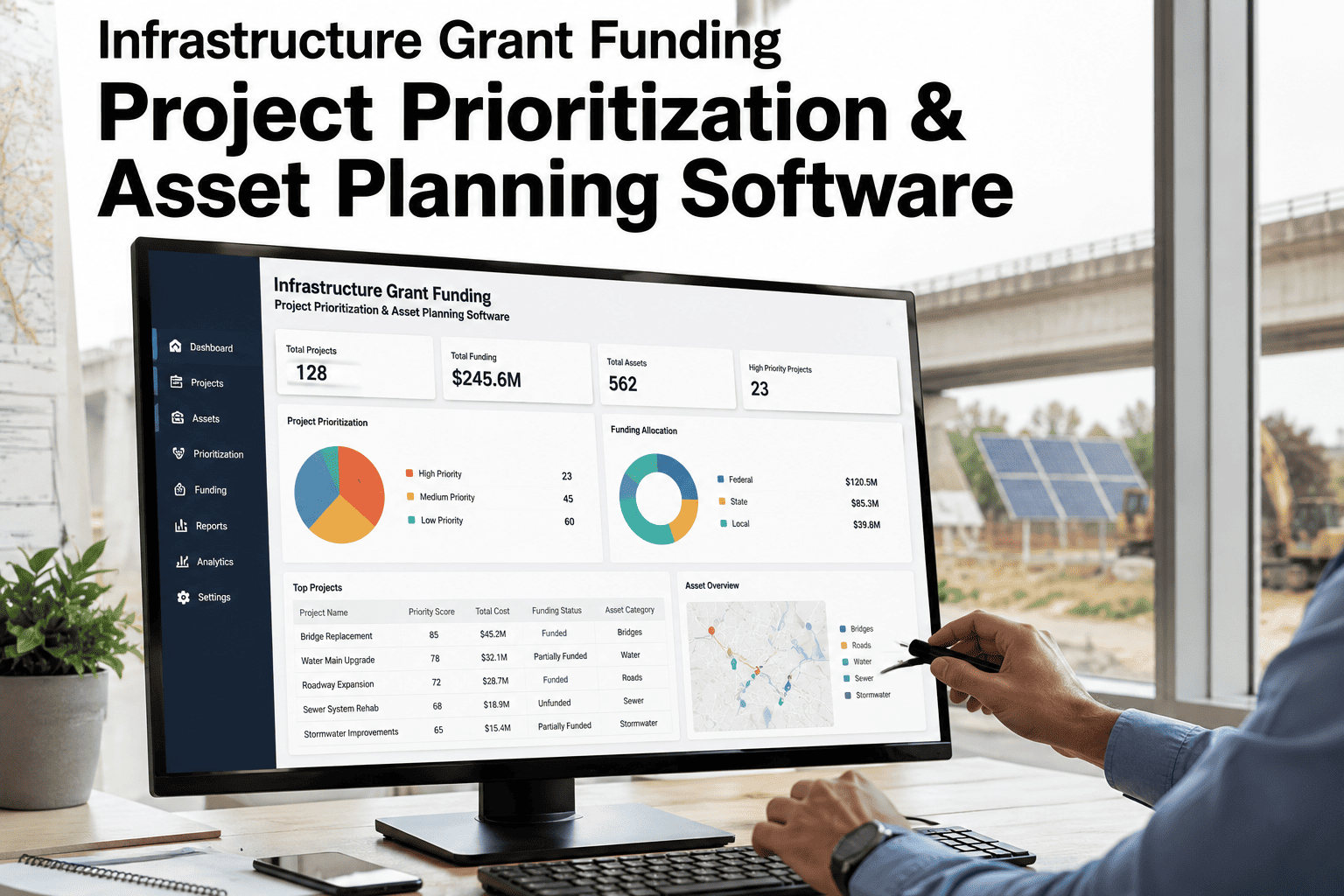
iFactory's AI-powered CIP module gives infrastructure directors, operations managers, and capital planning teams a unified platform to assess asset condition, rank projects by objective criteria, model funding scenarios, and build capital programmes that maximise infrastructure improvement per dollar spent — without spreadsheet guesswork or deferred project penalties.
Global infrastructure investment gap — 43.6% funding shortfall that structured AI prioritisation can help close by directing every dollar to the highest-impact project
63%
Of capital projects experience cost overruns — most traced back to poor front-end prioritisation that AI-driven condition and risk scoring directly addresses
3.4x
ROI differential between data-driven CIP frameworks and ad-hoc prioritisation — structured AI ranking delivers more infrastructure improvement per budget dollar
40%
Cost savings achieved when proactive condition-based investment replaces deferred reactive repairs — the central promise of AI-guided capital planning
The CIP Prioritisation Crisis — Why Most Capital Programmes Deliver Less Infrastructure Than They Should
Capital improvement planning is the single most consequential financial decision an infrastructure organisation makes. Yet most CIP processes share the same structural weakness: projects are evaluated in isolation, ranked by a mix of departmental advocacy and historical precedent, and sequenced without modelling how the timing of one investment affects the performance of others. The result is not a capital programme optimised for community impact. It is a collection of individual projects that happened to survive the budget process — with no mechanism to ensure that the sequence, timing, and funding mix produce the maximum infrastructure improvement per dollar spent.
How Traditional CIP Prioritisation Fails — and What the Pattern Costs
The Political Prioritisation Trap
Visible ribbon-cutting projects win over invisible underground infrastructure, regardless of actual condition or risk.
When project ranking depends on advocacy rather than data, the capital programme systematically underinvests in critical but invisible infrastructure. A failing water main that serves 50,000 residents gets deferred because a streetscape project with higher public visibility consumes the available budget. The consequence is not visible in the current year — it appears three to five years later as an emergency repair costing three to five times the original planned rehabilitation. This pattern repeats in every budget cycle across thousands of organisations, accumulating billions in avoidable deferred-failure cost.
Misallocated Capital + Deferred Failure Cost
The Single-Year Blindness Problem
Projects evaluated only on current-year condition miss the trajectory — and the optimal intervention window.
Traditional CIP processes assess asset condition as a static snapshot. A bridge with a condition score of 60 out of 100 is ranked against a road with a score of 45, and the road gets funded. But if the bridge is deteriorating at a rate that will take it to 30 within two years — while the road's decline is gradual — the single-year snapshot produces the wrong decision. Without rate-of-change analysis and forward-looking condition projection, capital programmes consistently miss the optimal intervention window, paying premium prices for assets that cross the deterioration threshold into critical condition before they are funded.
Missed Intervention Windows + Premium Cost
The Funding Sequence Gap
Projects are funded in isolation. The interaction effects of timing, bundling, and grant windows are never modelled.
Infrastructure projects do not exist in isolation. A road rehabilitation project scheduled a year before a utility main replacement means the road is dug up twice. A bridge repair delayed by one budget cycle may forfeit a federal grant match that covered 50% of the cost. A bundle of three small pavement projects in the same neighbourhood could be delivered at 30% lower unit cost if procured as a single contract — but the traditional CIP process evaluates each project individually and loses the bundling saving. The inability to model these interaction effects means capital programmes consistently spend more than necessary to deliver the same infrastructure outcome.
Lost Bundling Savings + Missed Grant Windows
The Data Fragmentation Barrier
Condition data lives in one system. Cost data in another. Risk data in a third. Nobody sees the full picture.
The typical infrastructure organisation manages asset data across four to six separate systems: a GIS for spatial location, a CMMS for maintenance history, a financial system for cost data, a risk register for hazard exposure, and spreadsheets for condition assessments. Every capital planning cycle begins with weeks of manual data extraction and reconciliation — producing a consolidated view that is already outdated by the time the first project ranking meeting occurs. This data lag is not neutral. It systematically advantages projects whose advocates have the resources to compile compelling justifications over projects whose objective condition data would rank them higher if it were available in the same view at the same time.
Data Lag + Systematic Ranking Bias
AI CIP Prioritisation · Project Ranking · Funding Scenario Modelling · Risk-Based Capital Planning
Every Infrastructure Dollar Should Go to the Project That Needs It Most. iFactory's AI Makes Sure It Does.
AI-powered project scoring that considers condition, risk, community impact, funding availability, and timing interactions — delivering capital programmes that are optimised for maximum infrastructure improvement, not maximum spreadsheet complexity.
How iFactory's AI CIP Module Transforms Capital Planning — From Wish List to Optimised Programme
iFactory does not build a spreadsheet with better formulas. It replaces the sequential, politics-influenced CIP process with a structured, AI-driven prioritisation engine that ingests condition data, risk scores, cost estimates, funding constraints, and community impact metrics — then produces an optimised multi-year capital programme that maximises infrastructure improvement per dollar. Every project has a defensible score. Every funding decision is modelled. Every programme has a traceable logic from asset condition to budget allocation.
Capability 01
Multi-Criteria AI Project Scoring — Every Project Ranked by Objective, Weighted Criteria
Defensible Prioritisation
iFactory's AI scoring engine evaluates every candidate project against a configurable set of weighted criteria — current asset condition, deterioration rate, failure consequence, community impact (population served, criticality to emergency services), alignment with regulatory mandates, funding availability windows, and project readiness level. Each criterion is scored from the organisation's own data — condition scores from the asset register, consequence data from the risk module, community impact from GIS demographic layers — and combined into a single priority score that is transparent, repeatable, and auditable. When a council member asks why one project ranks above another, the answer is a scored criteria breakdown, not a subjective judgment. The ranking is defensible in budget hearings, public meetings, and funding applications.
Configurable weighted scoring framework
Data-driven project ranking
Auditable score breakdown per project
Capability 02
Condition Trajectory Modelling — Predict When Each Asset Will Cross the Critical Threshold
Forward-Looking Analytics
iFactory's condition trajectory model uses historical deterioration curves, maintenance intervention effects, and environmental exposure factors to project each asset's condition score forward across the CIP planning horizon. The model answers a question that single-year condition snapshots cannot: which assets will cross the critical condition threshold within the planning period if not funded, and what is the cost differential between intervening now versus intervening after the threshold is crossed? This forward-looking view transforms capital prioritisation from a reactive exercise — fund the worst assets today — into a strategic one: fund the assets whose intervention timing delivers the greatest lifecycle cost saving. The trajectory model automatically flags assets entering the optimal intervention window, ensuring that the capital programme captures cost-saving opportunities that a static condition assessment would miss.
Forward-looking condition projection
Optimal intervention window detection
Lifecycle cost differential analysis
Capability 03
Funding Scenario Modelling — Optimise the Project Mix Across Budget Scenarios
Budget Optimisation
iFactory's scenario engine allows capital planners to model multiple funding scenarios and compare the resulting infrastructure outcomes side by side. Apply a 10% budget reduction and the model automatically resequences the project list, showing which projects shift out of the planning window and what the long-term cost impact of each deferral will be. Apply a federal grant that covers 50% of a specific project category and the model re-ranks to prioritise grant-eligible projects within the grant window. The scenario output is not a spreadsheet of adjusted numbers — it is a revised capital programme with a clear comparison of total infrastructure improvement delivered, risk reduction achieved, and lifecycle cost impact under each scenario. This transforms capital budget discussions from advocacy battles into data-driven trade-off conversations: if we reduce the programme by 15%, these four projects defer and the network risk score increases by 8% — is the budget saving worth the risk increase?
Multi-scenario budget modelling
Deferral impact quantification
Grant-eligible project optimisation
Capability 04
Project Bundling and Timing Optimisation — Reduce Cost Through Smart Sequencing and Contract Packaging
Programme Efficiency
iFactory's timing optimisation engine models project interaction effects to identify bundling and sequencing opportunities that reduce total programme cost. Projects in the same geographic area that can share mobilisation, traffic management, and contractor overhead are flagged for bundling — with the projected cost saving calculated against individual delivery. Utility coordination conflicts are identified automatically: a road rehabilitation project scheduled before a water main replacement in the same corridor is flagged for resequencing. Grant funding windows are matched against project readiness timelines so that no grant-eligible project misses its funding opportunity because it was sequenced in the wrong year. The output is a capital programme that costs less to deliver the same infrastructure scope, not by cutting project content, but by eliminating the inefficiencies of disconnected project-by-project planning.
Geographic bundling optimisation
Utility coordination conflict detection
Grant window alignment scheduling
How AI Changes the CIP Process — Phase by Phase
The difference between a traditional CIP process and an AI-powered CIP process is not automation. It is the ability to evaluate every project against every relevant criterion simultaneously, to model interaction effects between projects that traditional processes treat as independent, and to produce a capital programme that is optimised for the organisation's specific mix of condition risk, funding constraints, and community impact priorities.
Traditional CIP vs AI-Powered CIP — How Each Phase Changes
CIP Phase
Traditional Approach
iFactory AI-Powered Approach
Asset Assessment
Manual condition data collection. Static single-year snapshot. Inconsistent scoring across asset classes.
Automated condition data ingestion from inspection systems, IoT sensors, and maintenance history. Forward-looking trajectory models project condition across the CIP horizon.
Project Prioritisation
Departmental wish lists. Advocacy-driven ranking. Single-criterion sorting by condition score.
Multi-criteria AI scoring across condition, risk, community impact, and funding alignment. Weighted framework configurable by policy priority. Transparent and auditable.
Funding Strategy
Single budget scenario. No modelling of funding constraints on project sequence. Grant opportunities managed separately.
Static printed programme document. Subjective justifications. Difficult to explore trade-offs.
Interactive scenario viewer. Transparent scoring breakdown. Live trade-off visualisation. Defensible data trail for every project ranking.
Performance Monitoring
Annual programme review. No feedback loop between delivery outcomes and prioritisation model.
Continuous condition data update. Automated re-prioritisation as new data arrives. Closed feedback loop from project delivery to future scoring.
We manage a portfolio of 14,000 assets across water, wastewater, roads, and facilities with an annual capital budget of approximately USD 85 million. Every CIP cycle, my team spent six to eight weeks pulling condition data from one system, work order history from another, and cost data from a third — then arguing about which projects should rank highest in the council presentation. The first time we ran iFactory's AI prioritisation engine, it ranked our 47 candidate projects in under a minute, with a transparent score breakdown for every single one. The council approved the programme with minimal changes because they could see the data behind every ranking. We delivered the same infrastructure scope at approximately 12% lower total cost in the first cycle — mostly from bundling savings and grant timing optimisation that we had been missing for years.
— Director of Infrastructure and Asset Management, Regional Council — 18 Years Public Sector Capital Planning
Conclusion — The Capital Programme That Data Built Will Always Outperform the One That Politics Built
The global infrastructure investment gap stands at USD 2.59 trillion. Sixty-three percent of capital projects overrun their budgets. Seventy-two percent face schedule delays. Forty percent of infrastructure cost is avoidable through proactive, condition-based investment timing. These numbers are not abstract statistics. They represent the bridges that close earlier than they should, the water mains that burst in neighbourhoods where planned replacement was deferred, the roads that are dug up twice because nobody modelled the utility coordination conflict, and the grants that expire unclaimed because the right project was sequenced in the wrong budget year.
The organisations that will close this gap are not the ones with the largest capital budgets. They are the ones that prioritise their projects by objective data instead of subjective advocacy, that model funding scenarios before making commitments instead of after, and that optimise project sequencing and bundling across their entire programme instead of planning each project in isolation. These organisations do not spend more. They spend better — and they deliver measurably more infrastructure improvement per dollar as a result.
iFactory's AI CIP Prioritisation module gives infrastructure directors, operations managers, and capital planning teams the platform they need to transform their capital improvement process — from asset condition assessment through project scoring, funding scenario modelling, and programme optimisation. Book a Demo to see iFactory configured with your asset data and CIP framework, or talk to an expert about how AI-powered prioritisation maps to your organisation's specific capital planning process and infrastructure portfolio.
Stop Asking Which Project Deserves Funding. Start Knowing. iFactory's AI Ranks Every Project by the Data, Not the Advocacy.
Multi-criteria AI project scoring, condition trajectory modelling, funding scenario optimisation, and programme-wide bundling intelligence — all in a single capital planning platform built for infrastructure teams who need to defend every dollar.
iFactory is designed to enhance and structure existing CIP processes rather than replace them from day one. In the initial deployment, iFactory's AI prioritisation engine runs alongside the existing process — ingesting condition data, cost estimates, and project proposals to produce a scored project ranking that can be compared against the manually developed programme. This parallel-run phase builds confidence in the AI scoring and allows the organisation to calibrate the weighted criteria framework to its specific policy priorities. Once the scoring framework is validated, iFactory becomes the primary CIP platform, with the traditional process reserved for exception handling and stakeholder validation. Talk to an expert to discuss how iFactory maps to your current CIP cycle, timeline, and stakeholder approval process.
iFactory's AI scoring engine is designed to work with whatever data the organisation currently has, with scoring accuracy improving as more data layers are added. The minimum viable dataset is asset-level condition scores (even estimated or ordinal scores), estimated project costs, and a basic asset register. The full prioritisation framework uses: asset condition data (from inspection records, IoT sensors, or engineering assessments), deterioration rate estimates, failure consequence and risk data, community impact metrics (population served, criticality to emergency services), regulatory and compliance requirements, funding availability and grant windows, and project readiness level. Each additional data layer refines the scoring precision, but the model functions with partial data from day one — using confidence weighting to indicate which scores are data-rich and which rely on broader estimates. Book a Demo to review your current data landscape and define the scoring parameters for your organisation.
iFactory does not remove human judgment from the CIP process. It makes human judgment more informed by providing an objective, transparent scoring baseline against which politically-driven project inclusions can be evaluated. When a project is included despite a lower objective score, the platform shows the trade-off clearly: including Project A at the expense of Project B increases network risk by X% and defers Y dollars of planned rehabilitation into future budget cycles where the cost will be higher. This does not prevent the political decision. It ensures that the decision is made with full visibility of its consequences — and documented for audit and public accountability purposes. Many organisations using iFactory retain a small percentage of programme capacity for strategic or political projects, with the AI scoring determining the baseline programme and the exceptions clearly flagged. Talk to an expert about how leading infrastructure organisations balance data-driven prioritisation with legitimate strategic and political considerations.
For an organisation with an existing CIP process and data across multiple systems, iFactory's standard implementation covers: weeks one to two for system integration assessment, data mapping, and scoring framework configuration; weeks three to four for asset condition data ingestion, cost data import, and prioritisation model calibration using historical programme data; weeks five to six for scenario modelling setup, training, and parallel-run validation against the current CIP cycle; and weeks seven to eight for full go-live with stakeholder review and programme adoption. The first AI-generated prioritised project list — with scored rankings for every candidate project — is typically available for review within the first two to three weeks. Many organisations begin seeing value in the first budget cycle, with full programme optimisation benefits materialising as the condition trajectory and funding scenario models accumulate data over subsequent cycles. Book a Demo to discuss your organisation's implementation timeline based on current system landscape, data quality, and CIP cycle timing.
Yes. iFactory is designed as an integration platform that connects to existing enterprise systems rather than replacing them. The platform supports direct integration with Esri ArcGIS for spatial asset data, leading CMMS and EAM platforms for maintenance history and condition data, financial planning systems for cost and budget data, and IoT platforms for real-time sensor data. Data integration is handled through a combination of API connectors, automated data feeds, and structured import processes — with the integration layer mapping data from source systems into the CIP scoring and scenario models. The condition trajectory model and AI prioritisation engine operate on the integrated dataset, pulling data from each source system as needed without requiring manual data extraction or format normalisation. Book a Demo to review your current system architecture and confirm integration compatibility with your specific software stack.