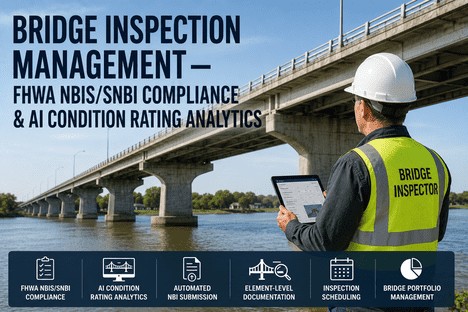
The FHWA's transition from the 1995 National Bridge Inventory Coding Guide to the Specifications for the National Bridge Inventory is the most significant bridge data reporting overhaul in a generation. With the first SNBI-based submittal due March 15, 2026, state DOT bridge programs, NBIS program managers, and inspection teams are navigating a compressed timeline to map legacy data, adopt element-level coding, and validate millions of bridge records under the new 23 CFR 650 framework. This is your compliance roadmap for the NBI to SNBI transition.
NBI to SNBI Transition · FHWA 23 CFR 650 · NBIS Final Rule · Element-Level Coding
The First SNBI Data Submittal Is Due March 15, 2026. Is Your Bridge Data Transition-Ready?
iFactory helps state DOTs and bridge agencies transition legacy NBI data to SNBI format, validate element-level coding against FHWA schema requirements, and establish compliant reporting workflows before the Coding Guide sunset.
Mar 15, 2026
First SNBI data submittal deadline. Coding Guide submittals no longer accepted after this date.
116
Coding Guide data items restructured into SNBI's expanded specification with new element-level and feature-level fields.
23
New data item categories in the SNBI covering bridge features, elements, inspections, and load ratings in a JSON-based schema.
Jun 2026
FHWA Transition Tool sunsets permanently. After this date, only NBI NextGen submittals will be accepted.
What the NBI to SNBI Transition Actually Changes for Bridge Data Reporting
The SNBI is not a revision of the Coding Guide. It is a replacement specification that redefines how bridge inventory data is structured, collected, validated, and submitted to FHWA. The transition affects every state DOT, federal agency, and tribal government that reports data to the National Bridge Inventory. Understanding what changes and what stays the same is the first step toward compliance.
Coding Guide vs SNBI — What Changes and What Does Not
Data Format
Fixed-Width to JSON-Based Schema
The Coding Guide used a positional fixed-width file format. SNBI adopts a JSON-based NBI Submittal File Schema that supports many-to-one data relationships — enabling multiple features, spans, routes, and element records per bridge. The schema has been revised for Errata 1 and accommodates temporary codes for the 2026 and 2027 transition windows. State DOTs must restructure their data export pipelines to produce valid JSON conforming to the NBI NextGen schema specification.
Schema impact: Existing ETL pipelines built for fixed-width NBI tapes will not produce valid SNBI submittals without restructuring.
Element-Level Data
Integrated Into Single Submittal
Under the Coding Guide, element-level data (previously SNBIBE) was submitted separately from inventory data. SNBI merges both into a single integrated submittal. Element identification records, condition state quantities, and inspection data are now submitted as linked datasets within the same JSON file. For NHS bridges, element-level reporting is mandatory. Each element record includes element number, parent number, total quantity, and quantities per condition state — reported per bridge per inspection cycle.
Element impact: Single submittal streamlines reporting but requires reconciliation of previously separate inventory and element datasets.
Discontinued Items
18 Legacy Items Removed From Reporting
Several Coding Guide items are discontinued in the SNBI, including Structural Evaluation (67), Deck Geometry (68), Underclearances (69), Bridge Improvement Cost (94), and Year of Improvement Estimate (97). Some of these provided information that can now be derived from SNBI items; others were calculated values that were never directly reported. Agencies must remove these items from their reporting workflows and verify that the corresponding SNBI fields capture the equivalent data where applicable.
Discontinuation impact: Remove legacy items from data collection forms and update internal bridge management system mappings accordingly.
Compliance Milestone
Not Sure Which of Your Bridge Records Need Manual SNBI Data Collection?
Run the FHWA Data Crosswalk against your inventory. iFactory's compliance workflow shows you exactly which items transition cleanly and which need field verification before the March 2026 submittal.
23 CFR 650 and the NBIS Final Rule: The Regulatory Foundation of SNBI Compliance
The NBIS Final Rule was published in the Federal Register on May 6, 2022, and took effect on June 6, 2022. It updated 23 CFR Part 650, Subpart C, and incorporated the SNBI by reference at 23 CFR 650.317(b)(1). This means the SNBI is not optional guidance — it is regulatory requirement. Every bridge inspection conducted after the Coding Guide sunset on December 31, 2025, must be performed in accordance with the SNBI. For state DOTs, the compliance implications extend to program manager qualifications, team leader certifications, inspection interval documentation, and the quality control and quality assurance framework that governs bridge inspection programs.
Section 650.309
Inspector Qualifications
Program managers and team leaders in place before June 6, 2022, have until June 6, 2024, to meet the updated qualification requirements. New personnel must meet requirements immediately. SNBI compliance training for inspectors on element-level coding is essential to ensure accurate data collection in the field.
Section 650.311
Inspection Intervals
Routine inspection intervals remain at 24 months maximum. Reduced intervals (12 or 48 months) require documented justification. Extended interval policies approved under the previous regulation were rescinded on June 6, 2024. Agencies must ensure all bridges on extended intervals have a documented transition plan to meet the March 15, 2028, complete data deadline.
Section 650.313
QC / QA Requirements
Each state must maintain systematic QC and QA procedures ensuring accuracy and consistency in bridge inspections and data reporting. SNBI introduces new validation rules at the data submittal level. The NBI NextGen validation module identifies critical errors, errors, and warnings. Datasets with critical or fatal errors will not be accepted for processing.
Section 650.315
Data Submittal Requirements
All data must be reported to FHWA as requested. The NBI NextGen system provides the submittal pipeline. Transitioned data is accepted for 2026 and 2027 submittals only. By March 15, 2028, every bridge record must be fully populated with verified SNBI data and no temporary codes may remain.
The Data Crosswalk: How Legacy NBI Codes Map to SNBI Fields
The FHWA Data Crosswalk is the authoritative mapping between Coding Guide data items and SNBI data items. It establishes the rules for transitioning legacy data and defines three transition categories: clean, partial, and no transition. Understanding which of your bridge records fall into each category is the foundation of your transition plan.
Data Crosswalk Transition Categories — What They Mean for Your Bridge Inventory
Clean
Direct Mapping Available
A clean transition means all Coding Guide codes and values map directly to corresponding SNBI codes and values with no loss of information. Examples include element number, element total quantity, condition state quantities, state code, and county code. Clean transitions should still be verified before the March 15, 2028, deadline to ensure the transitioned data is correct — but they represent the lowest-risk portion of your dataset.
Partial
Some Codes Map / Some Use Temporary Codes
A partial transition indicates that some Coding Guide codes map to SNBI codes while others map to temporary codes (indicated by a "-T" suffix), or that a significant assumption was made in the transition rules. Items with partial transitions must be individually verified and corrected. Temporary codes are accepted only for the 2026 and 2027 submittals and must be resolved to permanent codes by 2028.
No Transition
Must Be Newly Collected
These fields receive a null value in the transition process and must be populated with collected SNBI data before the March 15, 2028, deadline. Fields in this category include many of the new feature-level items, expanded condition rating codes, and new element-level identification fields. Prioritizing these fields in your data collection plan is critical to meeting the full compliance deadline.
The FHWA Transition Tool, available from April 2023 through June 2026, enables agencies to upload legacy NBI and element data files and download transitioned SNBI datasets. However, the transitioned data is explicitly described as a starting point — not a final product. Every transitioned record must be verified through inspection review or direct re-collection before the 2028 deadline. The Data Crosswalk tables also include detailed notes for developers that explain the assumptions made during transition, so agencies can evaluate whether those assumptions hold for their specific bridge inventory.
NBI NextGen: The New Data Submittal Pipeline You Need to Work With
The NBI NextGen system is FHWA's modernized database platform for receiving, validating, and managing SNBI-based data. Since January 1, 2026, it has been available for live data submittals. Understanding how NextGen validates data is essential to ensuring your submittal passes acceptance.
NBI NextGen Validation Error Levels — What Triggers Each Type
Critical
Submittal-Blocking Errors
Critical errors prevent the file from being submitted for processing. Examples include missing state code, missing feature type for any bridge, missing element identification data for NHS bridges, and invalid border bridge country codes. Any dataset with a critical error will be rejected by the NBI NextGen system and must be corrected before re-submittal.
Error
Non-Blocking But Must Be Resolved
Non-critical errors flag invalid codes, inconsistent data relationships, or missing values that are permitted during the transition period but will block submittal in 2028. Examples include null values for items that had no transition, invalid bridge railing codes, and missing inspection interval data. These must be tracked and resolved on a defined timeline.
Warning
Advisory Notifications
Warnings indicate data inconsistencies that do not currently block submittal but should be investigated. These include unusual condition state distributions, unexpected element combinations, or values that fall outside expected ranges. While warnings do not prevent submission, addressing them improves data quality and reduces audit risk.
The SNBI Compliance Timeline: From Today to March 2028
The transition to SNBI operates on a defined schedule with fixed deadlines. Missing any of these milestones creates cascading compliance risk for your bridge program. Here is the timeline every state DOT and agency needs to follow, with the actions required at each stage.
SNBI Transition Timeline — Milestones and Required Actions
Right Now
Run Data Crosswalk Analysis & Gap Assessment
Map your current NBI dataset against the SNBI Data Crosswalk. Identify which items transition cleanly, partially, or not at all. Quantify the number of bridge records that need manual SNBI data collection and build your verification schedule.
Before March 15, 2026
Submit First SNBI Dataset via NBI NextGen
Use the FHWA Transition Tool or your own crosswalk logic to produce an SNBI-based dataset. All bridges must be included with transitioned data. Critical program-management fields must be verified SNBI data. Begin field verification for partial-transition items.
June 2026
Transition Tool Sunset — No More Automated Data Transition
After this date, FHWA's Transition Tool is no longer available. All remaining data transition work must be handled through your own systems. Complete all bulk transitions before this deadline or plan for manual data entry for any remaining records.
March 15, 2028
Complete Verified SNBI Data for All Bridges
No temporary codes accepted. No null values for required fields. Every bridge record must contain fully populated, verified SNBI data. This is the final compliance deadline. FHWA business processes and program oversight will operate exclusively on SNBI data from this date forward.
"
We ran the FHWA Data Crosswalk against our full NBI dataset and discovered that nearly 30% of our bridge records had partial or no transition mappings. Without that gap analysis we would have submitted incomplete data for the March 2026 deadline. The crosswalk exercise gave us a concrete collection plan and a realistic timeline for the 2028 full-compliance submittal.
— NBIS Program Manager, State Department of Transportation — 12,000+ Bridge Inventory
Element-Level Coding Under SNBI: What Inspectors Need to Collect
Element-level data collection under the SNBI extends the previous SNBIBE framework and integrates it into the main NBI reporting pipeline. For NHS bridges, element-level reporting is mandatory. The element identification dataset includes the element number, parent element number, total quantity, and quantities for each of the four condition states. Each element inspection must be tied to a specific inspection date and inspection type.
AASHTO element numbering system (e.g., 12 for concrete deck, 110 for steel girder, 215 for reinforced concrete abutment). Includes parent element number for smart flag relationships. All elements on NHS bridges must be reported.
Condition States
B.CS.01 – B.CS.04
Four condition states (1=Good, 2=Fair, 3=Poor, 4=Severe) reported as element quantity in each state. The sum of all four states must equal the total element quantity. Inspectors must be trained on SNBI condition state definitions, which differ from Coding Guide condition ratings.
Inspection Records
B.IE.01 – B.IE.05
Each element dataset requires the associated inspection type, inspection begin date, and inspection interval. The SNBI schema supports multiple inspection records per bridge, enabling agencies to track routine, underwater, and special inspections separately with their own element-level data.
Smart Flags
Special Element Identification
Smart flags are special elements used to report conditions that affect specific elements but are not themselves physical elements. Examples include fatigue-sensitive details, pack rust, and section loss. Each smart flag is reported as an element record with its own condition state quantities and an associated parent element.
Conclusion: The SNBI Transition Is a Data Management Challenge — Not an Inspection Challenge
The NBI to SNBI transition is often framed as an inspection standards update. In practice, it is a data infrastructure transition. The bridge inspection workflow itself changes incrementally — inspectors still assess the same elements, rate the same conditions, and document the same defects. What changes is how that data is structured, validated, and submitted to FHWA. The transition requires state DOTs to reconcile legacy data formats with a modern JSON-based schema, map hundreds of legacy code values to their SNBI equivalents, and establish quality control processes that operate at the data level, not just the inspection level.
The agencies that succeed in this transition will be those that treat the data crosswalk gap analysis as the first priority — not the last. Running the crosswalk against your current NBI dataset reveals exactly how many of your bridge records need manual attention, which fields are at risk of rejection by NBI NextGen validation, and where your internal bridge management system needs schema updates. The agencies that wait until the transition tool sunset or the first submittal rejection to begin this analysis will face a compressed verification window that compounds the risk of non-compliance.
iFactory helps state DOT bridge programs and agencies navigate the NBI to SNBI transition with data crosswalk analysis, gap assessment, element-level coding validation, and compliance reporting workflows. Book a Demo to see how our platform maps your legacy NBI data to SNBI schema requirements, or talk to an expert about a compliance readiness assessment for your bridge program.
Frequently Asked Questions
Run Your SNBI Data Crosswalk Gap Analysis — Get a Compliance Readiness Assessment for Your Bridge Inventory.
iFactory helps state DOTs and bridge agencies navigate the NBI to SNBI transition with data crosswalk mapping, element-level coding validation, NBI NextGen preparation, and compliance reporting workflows purpose-built for the 2026 submittal deadline.