Fracture Critical Member Bridge Inspection and Hands On Methods
By Grace on June 18, 2026
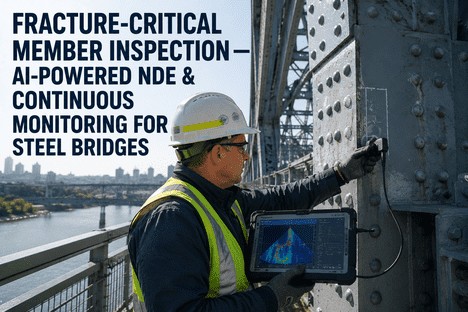
A single fracture-critical member failure can collapse an entire bridge within seconds. The Mianus River Bridge collapse of 1983 — in which a failed pin-and-hanger assembly dropped a 100-foot span of I-95 in Connecticut, killing three people — demonstrated to the bridge engineering profession what happens when tension members without load-path redundancy are not inspected at arm's length for fatigue cracks before those cracks propagate through the section. That collapse directly shaped the National Bridge Inspection Standards (NBIS) fracture-critical inspection requirements that now govern every steel bridge in the United States with nonredundant tension members. The 2022 NBIS update reclassified fracture-critical members (FCMs) as nonredundant steel tension members (NSTMs) and codified the requirement for hands-on inspection at intervals not exceeding 24 months, with mandatory 12-month intervals for NSTMs in poor condition. For bridge owners, inspection team leaders, and structural engineers, understanding exactly what qualifies as an NSTM, which NDE methods are appropriate for each detail type, and how to document the inspection for FHWA compliance is not optional — it is a regulatory and public safety obligation. This guide provides the inspection framework that every bridge engineer managing an NSTM inventory needs.
23 CFR 650.313 · NSTM hands-on inspection · FHWA NBIS 2022 · Dye penetrant · Magnetic particle · UT crack detection · Pin and hanger · Two-girder bridge
The Bridge Did Not Collapse Because the Crack Was Not Detectable. It Collapsed Because the Inspection Was Not Close Enough to Find It.
iFactory's bridge asset management platform integrates NSTM identification workflows, hands-on inspection scheduling and documentation, NDE method selection guides, and critical finding tracking — giving bridge engineers a single structured framework for managing fracture-critical inspection programmes from interval planning through FHWA compliance reporting.
Lives lost in the 1983 Mianus River Bridge collapse — the pin-and-hanger failure that established the fracture-critical inspection mandate in the National Bridge Inspection Standards
24
Maximum months between NSTM hands-on inspections per 23 CFR 650.313(f)(2) — reduced to 12 months when NSTM is rated in poor condition (NBI condition code 4 or less)
5%
Staining permitted per unit area under SSPC SP10 near-white blast cleaning for FCM steel — zero-tolerance for cracks, corrosion pits, or section loss in fracture-critical tension zones
100
Percent of butt weld length in tension on T-1 steel FCMs requiring NDE verification — ultrasonic testing per AASHTO/AWS D1.5 Clause 12 fracture control plan requirements
What Makes a Bridge Member Fracture-Critical — and Why the 2022 NBIS Renamed It NSTM
The NBIS defines a nonredundant steel tension member (NSTM) as a steel member in tension, or with a tension element, whose failure would probably cause a portion of or the entire bridge to collapse. The 2022 update replaced the earlier term fracture-critical member (FCM) with NSTM to more precisely describe the structural condition that drives the inspection requirement — not simply that the member is fracture-critical, but that it lacks load-path redundancy, system redundancy, and internal redundancy. A steel bridge with three or more primary load-carrying members is considered load-path redundant by FHWA and does not require NSTM inspection. A two-girder bridge, a single steel cap beam, a truss with nonredundant eyebar lower chords, and a pin-and-hanger suspended span assembly are all examples of NSTMs. The NBIS requires that the locations of all NSTMs be identified in the bridge inspection files and that the inspection procedures for each NSTM be documented per 23 CFR 650.313(f)(1). Agencies may choose to demonstrate through analysis that a member without load-path redundancy has system or internal redundancy such that it is not an NSTM — but this demonstration must use a nationally recognised process and be submitted for FHWA approval.
NSTM 01
Two-Girder Bridges — Simple and Continuous Span
The most common NSTM type in the national bridge inventory
Steel bridges with exactly two primary longitudinal girders are nonredundant by definition: the fracture of one girder's tension flange leaves no alternate load path to prevent span collapse. The NSTM zone includes the tension flange (bottom flange in positive moment regions, top flange over continuous supports) and the tension zone of the web extending approximately one-third of the web depth from the tension flange. Fatigue-prone details requiring hands-on inspection include welded flange splices, stiffener-to-web weld terminations, diaphragm connection plates welded to the girder web, lateral gusset plate connections, and cover plate ends. For two-girder bridges with suspended spans, the pin-and-hanger assembly adds an additional NSTM component. The hands-on inspection requirement extends to both exterior faces and, where accessible, the interior surfaces of box girder sections.
Tension flange + web tension zone
Welded detail terminations
Pin-and-hanger at suspended spans
NSTM 02
Pin-and-Hanger Suspended Span Assemblies
Zero redundancy — failure of any element causes collapse
Pin-and-hanger assemblies suspend an interior simple span from the ends of adjacent cantilever spans. The assembly consists of a pin passing through the cantilever span girder web, a hanger plate on each side of the web, and a pin passing through the hanger plate and the suspended span girder end. Every element in this assembly is nonredundant — failure of the pin, either hanger plate, or either girder end at the pin hole will release the suspended span. The Mianus River Bridge collapsed when a pin failed due to corrosion-induced locking that prevented rotation, causing cyclic fatigue cracking at the pin shoulder. Ultrasonic inspection from the accessible pin ends is the primary NDE method, with the half-inch diameter transducer technique developed after Mianus providing reliable crack detection at the shear planes. Current FHWA guidance notes that field contact ultrasonic testing can accurately locate transverse cracks at shear planes — as validated by immersion tank studies at the FHWA NDE Validation Center.
UT of pins from accessible ends
Hanger plate visual + dye penetrant
Girder end at pin hole inspection
NSTM 03
Truss Tension Members, Eyebars, and Arch Ties
Lower chords, diagonals in tension, and hangers in through-truss and deck-truss bridges
Truss bridges with two primary trusses (nonredundant configuration) have NSTM tension members including the bottom chord, tension diagonals, and vertical hangers. Eyebars — pin-connected tension members with enlarged heads at each end — are a historically significant NSTM category because their fracture is sudden, complete, and not preceded by visible deformation. The Silver Bridge collapse of 1967 (46 fatalities) was caused by a stress-corrosion crack in an eyebar head, establishing the first fracture-critical inspection mandate. Current inspection of eyebars requires hands-on visual inspection of the eyebar head, the pin hole region, and the body, supplemented by ultrasonic testing of the head-to-shank transition zone where fatigue cracks typically initiate. For arch bridges, the arch ties — the tension members that restrain the arch ends — are NSTMs requiring the same hands-on inspection protocol. Members subject to stress reversals (tension-compression cycling) are also classified as NSTMs per TxDOT and AASHTO guidance.
Bottom chord + tension diagonals
Eyebar head UT at pin hole
Arch tie — hands-on + PT/MT
23 CFR 650.313(f)(2) · Hands-on at arms length · NDE method selection · Critical finding reporting · FCM documentation · SNBI data transition
Hands-On Does Not Mean Close Enough to See. It Means Close Enough to Touch — Because Fatigue Cracks Below the Coating Are Not Visible Through Binoculars.
iFactory's NSTM inspection management module documents member locations, inspection procedures, NDE method selection, interval scheduling, and critical finding tracking — structured to meet the NBIS documentation requirements of 23 CFR 650.313(f) and the FHWA T-1 steel NDE verification mandate.
The NSTM Hands-On Inspection Requirement — What FHWA 23 CFR 650.313 Actually Requires
The NBIS defines hands-on inspection as inspection within arm's length of the member, using visual techniques that may be supplemented by nondestructive evaluation. 23 CFR 650.313(f)(2) establishes the regulatory requirement: all surfaces of NSTMs must receive a hands-on inspection at intervals not exceeding 24 months. FHWA's 2022 NBIS final rule commentary and subsequent April 2024 Q&A guidance make clear that arm's length means the inspector must be close enough to place a hand on the member — binocular inspection from an under-bridge truck basket that is 3 feet from the girder web does not satisfy the hands-on requirement. Fatigue cracks in welded steel bridges typically initiate at weld terminations and propagate through the section under cyclic loading. At 24-month inspection intervals, a crack that initiates shortly after one inspection must still be small enough at the next inspection that it has not propagated through the section. The hands-on requirement is designed to maximise the probability that the inspector's eye — supplemented by NDE at known detail types — will detect the crack before it reaches critical length.
NDE Method
Best Application on NSTMs
Detection Capability
Limitations
Dye Penetrant (PT)
Cracks adjacent to fillet welds at tee-joints, surface-breaking cracks at stiffener welds, tack weld cracks
Detects only surface-breaking discontinuities open to the surface
Requires clean, dry surface; coating must be removed; does not detect subsurface defects
Magnetic Particle (MT)
Subsurface inclusions in weld metal, near-surface cracks in flanges and webs, fatigue cracks at welded connection details
Detects both surface and near-surface (up to 0.25 inch deep) discontinuities
Ferromagnetic materials only; requires surface preparation; demagnetisation needed after inspection
Ultrasonic Testing (UT)
Hanger pin crack detection at shear planes, butt welds in tension (T-1 steel verification), eyebar head-to-shank transitions, thick-section crack characterisation
Detects both surface and subsurface defects; can size and locate cracks with high accuracy
Requires trained technician; couplant needed; difficult on complex geometries; limited access on pin ends may constrain UT scan plan
Radiographic (RT)
Cover plate end welds, complete penetration groove welds in thick flanges, weld quality verification where UT access is limited
Detects volumetric defects (porosity, inclusions) and planar defects oriented parallel to radiation beam
Radiation safety zone required; difficult on in-situ bridge members with two-sided access; thin crack detection depends on orientation relative to beam
Inspection Intervals, Critical Findings, and T-1 Steel NDE Verification
Three additional regulatory requirements govern the NSTM inspection programme beyond the 24-month hands-on mandate. First, the reduced interval requirement: NSTMs rated in poor or worse condition (NSTM inspection condition item coded 4 or less) must be inspected at intervals not exceeding 12 months. Agencies must develop documented criteria for determining when intervals must be reduced below 24 months, considering structure type, design, materials, age, condition, environment, traffic characteristics, impact damage history, loads, and known deficiencies. Second, the critical finding requirement: a structural or safety-related deficiency that requires immediate action to ensure public safety must be reported in accordance with the agency's critical finding procedures — which typically include immediate notification of the bridge owner, restriction or closure of the bridge, and a 30-day written report to FHWA. The 2022 NBIS update changed the critical finding condition rating threshold from serious (3) to critical (2) on the 0-to-9 NBI scale. Third, the T-1 steel verification mandate: bridges with FCMs fabricated from AASHTO M244 (ASTM A514/A517) steel without documented verification that butt welds in tension meet the AASHTO/AWS fracture control plan requirements must have 100 percent of those welds inspected by ultrasonic testing. Rejectable indications are classified as critical findings.
"
Our initial inventory identified 43 bridges with NSTMs across the district. When we reviewed the inspection procedures documented in the bridge files, we found that only 22 of those 43 had procedures that specifically identified the NSTM locations and described the hands-on inspection approach per member. The remaining 21 had generic language that did not distinguish NSTM inspection from routine inspection. The 2022 NBIS update gave us the regulatory driver to correct this, but the work to bring every bridge file into compliance — identifying each NSTM, writing member-specific procedures, selecting the appropriate NDE method for each detail type, training inspection teams — took 18 months. The lesson for agencies that have not yet completed this transition is to start now, because the documentation requirement is not negotiable and the bridge inventory is larger than most programme managers estimate.
The System and Internal Redemption Path — Proving a Member Is Not an NSTM
23 CFR 650.313(f)(1)(i) permits agencies to develop procedures demonstrating that a primary steel member without load-path redundancy possesses system redundancy or internal redundancy such that fracture of the cross-section at one location will not cause collapse. System redundancy exists when a bridge system can redistribute load after a partial fracture even without load-path redundancy — demonstrated through structural analysis (typically nonlinear pushdown analysis per AASHTO Guide Specifications for Analysis and Identification of Fracture Critical Members). Internal redundancy exists within a built-up member cross-section where fracture of one component (e.g., one plate in a bolted built-up girder) will not propagate through the entire member and the remaining components can redistribute the stress. Agencies with approved system or internal redundancy procedures must update them to satisfy the 2022 NBIS requirements and submit for FHWA approval by June 6, 2024. For members that successfully demonstrate system or internal redundancy, the NSTM designation is removed and the member is no longer subject to the 24-month hands-on NSTM inspection interval — but the member remains subject to special inspection requirements documented in the procedures.
Conclusion
Fracture-critical member inspection — now designated as NSTM inspection under the 2022 NBIS update — is the single most consequential bridge safety inspection requirement in the national programme, justified by the catastrophic consequences of undetected fatigue cracks in nonredundant tension members. The Mianus River and Silver Bridge collapses established the statutory mandate; the 2022 NBIS update refined and strengthened it. The requirements are clear: identify every NSTM in the bridge inventory and document its location in the bridge file, develop member-specific hands-on inspection procedures at arm's length with appropriate NDE methods selected for each detail type, inspect at intervals not exceeding 24 months (12 months for NSTMs in poor condition), document critical findings immediately, and for T-1 steel bridges, verify that butt welds in tension meet AASHTO/AWS fracture control plan requirements through 100 percent ultrasonic testing.
The inspection documentation requirement is as important as the inspection itself. FHWA compliance reviews evaluate whether the bridge files contain NSTM location identification, inspection procedures per member, interval scheduling records, and critical finding documentation that demonstrates the agency is managing its NSTM inventory systematically. The agencies that perform best in these reviews are those with structured NSTM programme management — not because the inspection teams are better, but because the documentation infrastructure ensures that no NSTM is missed, no interval is exceeded, and no critical finding is underreported. The transition from the legacy Coding Guide to the Specification for the National Bridge Inventory (SNBI) adds additional data collection requirements that agencies must integrate into their NSTM inspection workflows.
iFactory's bridge asset management platform provides NSTM identification workflows, member-specific inspection procedure templates, interval scheduling with automated compliance tracking, NDE method selection guides, T-1 steel verification documentation, and critical finding reporting — all structured to meet the documentation requirements of 23 CFR 650.313 and the 2022 NBIS update. Book a Demo to see the NSTM inspection module configured for your bridge inventory data, or talk to an expert about a free NSTM programme compliance review for one district in your network.
Frequently Asked Questions
FHWA considers bridges with three or more primary load-carrying members to be load-path redundant, meaning fracture of one member's cross-section at one location will not cause collapse because the remaining members can redistribute the load. However, PennDOT and several other state DOTs explicitly note that three-girder bridges are deemed to be NSTMs unless proven by analysis to be redundant. The analysis must account for the geometric properties of the bridge, including girder spacing, cross-frame stiffness, and the ability of the remaining two girders to carry the full load after one girder fractures. If the analysis demonstrates system redundancy through a nationally recognised methodology (such as the AASHTO Guide Specifications for Analysis and Identification of Fracture Critical Members), the NSTM designation may be removed. FHWA requires that agencies with approved system redundancy procedures submit updated procedures for FHWA approval by June 6, 2024 per 23 CFR 650.311(g). Until the redundancy analysis is approved, three-girder bridges should be treated as containing NSTMs and inspected accordingly. Talk to an expert about configuring NSTM identification workflows for your bridge inventory.
23 CFR 650.309 establishes the minimum qualifications for the inspection team leader (ITL), who must be present at the bridge at all times during each FCM and underwater inspection. The ITL must meet one of four qualification paths: (1) be a registered professional engineer with six months of bridge inspection experience; (2) have a bachelor's degree in engineering plus two years of bridge inspection experience; (3) have an associate's degree in engineering plus four years of bridge inspection experience; or (4) have a high school diploma plus six years of bridge inspection experience. Regardless of the path, the ITL must also have completed FHWA-NHI-130055 (Safety Inspection of In-Service Bridges) or FHWA-NHI-130056 (for professional engineers). For FCM-specific knowledge, FHWA-NHI-130078 (Fracture Critical Inspection Techniques for Steel Bridges) provides the specialised training in FCM identification, failure mechanics, and NDE method selection. Additionally, if the ITL performs NDE methods directly — such as UT or MT — they must hold the appropriate ASNT or ACCP certification for that method. NDE personnel qualifications should be documented in the bridge file. Book a Demo to see ITL qualification tracking integrated with inspection scheduling.
The transition from the legacy Recording and Coding Guide to the SNBI, required by 23 CFR 650.311, introduces new NSTM-specific data items that directly affect inspection interval determination. Under the SNBI, the NSTM Inspection Condition item replaces the legacy FCM Condition item, and agencies must collect and use SNBI data to establish inspection intervals. The reduced interval policy — requiring 12-month intervals for NSTMs rated poor or worse — is based on the SNBI NSTM Inspection Condition code of 4 or less. For agencies using Method 2 risk-based interval determination, the SNBI data items (including Fatigue Details, NSTM Identification, and NSTM Inspection Condition) serve as inputs to the risk assessment. Agencies must update their interval determination policies to reference SNBI data items by the June 6, 2024 transition deadline. The FHWA memorandum on inspection interval guidance (March 2023) provides the framework for correlating legacy Coding Guide data to SNBI items for purposes of interval determination during the transition period. Talk to an expert about SNBI transition tools for NSTM data management.
23 CFR 650.313(f)(1) requires that the locations of NSTMs be identified in the bridge records and that the inspection procedures be described and documented. An FHWA-compliant bridge file for an NSTM bridge should include: (1) inventory identification of each NSTM by span, member type, and specific component with tension elements; (2) documentation of whether the member has been evaluated for system or internal redundancy — and if so, the approved analysis; (3) member-specific inspection procedures describing access method (under-bridge truck, manlift, climbing, scaffolding), the NDE method selected for each detail type (e.g., UT for pins, PT for fillet weld terminations, MT for flange cover plate ends), and the specific focus areas (stiffener-to-web welds, diaphragm connection plates, cover plate ends, flange splices, pin-and-hanger assemblies); (4) the inspection interval assignment and the basis for it (standard 24-month or reduced interval with documented criteria); (5) T-1 steel verification records if applicable; (6) critical finding documentation if any have been identified; and (7) the inspection report with findings, condition assessment, and any recommendations for interval modification or remedial action. FHWA compliance reviews evaluate these seven documentation categories systematically. Book a Demo to see FHWA-compliant NSTM documentation templates.
Internally redundant members — such as bolted built-up sections where fracture of one component (e.g., one flange plate or one cover plate) will not propagate through the entire member — are not classified as NSTMs per 23 CFR 650.305 if the agency has developed and submitted approved procedures demonstrating internal redundancy. However, the NBIS requires that special inspection requirements for system or internally redundant members be documented, including inspection interval, access methods, focus areas, and conditions to monitor. FHWA's Table 1 in the NSTM inspection memorandum specifies that for internally redundant members, the inspection programme must include visual inspection of interior members and connections at some prescribed interval (typically a box girder interior inspection) and monitoring of defects that could reduce structural capacity, such as section loss from corrosion, impact damage, or fire damage. These members do not require the full NSTM 24-month hands-on protocol, but they are not removed from all special inspection requirements — they are transitioned to a documented condition-monitoring programme that reflects the reduced but not eliminated risk. Talk to an expert about documentation templates for internally redundant member inspection programmes.
The Collapse Was Not Caused by the Crack. It Was Caused by the Inspection That Did Not Reach the Member. Get a Free NSTM Programme Compliance Review.
iFactory's NSTM inspection management module — member identification, hands-on inspection procedures and scheduling, NDE method guidance, T-1 steel verification tracking, critical finding protocols, and FHWA-compliant documentation generated automatically from the inspection data your teams already collect in the field.