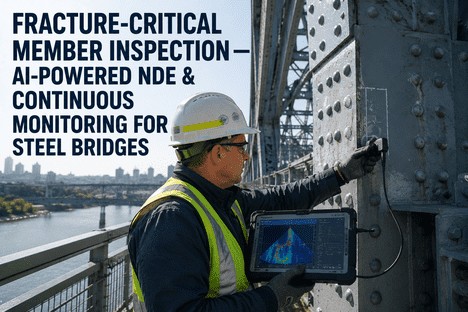
Fracture-Critical Member Inspection — AI-Powered NDE & Continuous Monitoring for Steel Bridges
By Grace on June 19, 2026
The finding arrives in the bridge file as a single line item: "NSTM Girder 3 — Span 4 — Fatigue Crack Indication at diaphragm connection plate, weld toe, 14 mm length, ultrasonic testing confirmed." For the bridge engineer managing a portfolio of nonredundant steel tension members, that line item initiates a protocol chain — critical finding notification to the FHWA division office, 30-day response window, crack growth assessment in the next inspection cycle, and a permanent record entry that will follow this bridge for the remainder of its service life. What the protocol chain does not do is tell the engineer whether that 14 mm indication was present at 10 mm six months ago, whether the crack growth rate is accelerating under the current traffic regime, or whether the four other diaphragm connection plates on the same girder are approaching the same initiation threshold. This is the structural gap in every FCM programme that relies on biennial hands-on inspection with occasional NDE point measurements: the inspection cycle captures a snapshot of crack state at a single moment, but the fatigue process that determines the member's remaining life operates continuously between those snapshots. AI-powered continuous NDE monitoring closes that gap by adding a time dimension to every crack indication the inspection programme discovers.
18,000+
Fracture-critical bridges in the US national inventory requiring hands-on NSTM inspection within arm's length of every tension member at intervals not exceeding 24 months under 23 CFR 650.313
5–15x
Cost multiplier for FCM inspection versus routine bridge inspection due to access equipment, lane closures, specialised NDE personnel, and the hands-on inspection requirement along every tension element
92–99%
Fatigue crack detection and classification accuracy documented by AI-powered NDE systems using acoustic emission and ultrasonic phased array methods integrated with deep learning networks
The NSTM Classification Framework — Three Levels of Redundancy That Define Inspection Requirements
The 2022 NBIS update introduced the term Nonredundant Steel Tension Member to replace the earlier fracture critical member designation, and with it came a formal three-tier framework for determining whether a steel tension member requires hands-on NSTM inspection. Every bridge engineer managing an inventory of steel bridges must understand this framework because the classification assigned to each member determines the inspection frequency, the inspection method, the documentation requirements, and the critical finding protocols that govern that member for its entire service life.
Tier 01
Load Path Redundancy
A bridge with three or more primary load-carrying members is considered load path redundant by FHWA definition. If any single tension member fractures, the remaining members can redistribute the load and maintain structural stability. Bridges with load path redundancy do not require NSTM classification, and the members are not subject to hands-on NSTM inspection requirements. The standard routine inspection protocol applies. For bridges with fewer than three primary members, load path redundancy does not exist, and the tension members must be evaluated for system or internal redundancy to determine whether NSTM inspection requirements apply.
Outcome: Not classified as NSTM. Routine inspection frequency applies. No FCM protocol required.
Tier 02
System Redundancy
If refined analysis demonstrates that the structure has adequate strength and stability to avoid partial or total collapse and carry traffic in the presence of a fully fractured tension member, the member may be classified as a System Redundant Member. This determination must be supported by refined three-dimensional analysis documented in the bridge file and approved by FHWA under 23 CFR 650.313(f)(1)(i). The analysis must account for dynamic effects, the condition of the deck and secondary members that provide alternative load paths, and the material and fabrication specifications of the structure. SRMs are not subject to NSTM inspection requirements but must be fabricated per AWS FCP Chapter 12 if the bridge is a new design.
Outcome: NSTM inspection not required. System redundancy documented in bridge file and subject to periodic re-evaluation.
Tier 03
Nonredundant Steel Tension Member
A primary steel member fully or partially in tension without load path redundancy, system redundancy, or internal redundancy. NSTMs are subject to hands-on inspection at intervals not exceeding 24 months, with the requirement that the inspector is within arm's length of the entire member surface. The inspection must cover all surfaces where fatigue cracks may initiate — flanges, webs, welds, bolted connections, pinned connections, and welded attachment details. Critical findings — including any crack indication confirmed by NDE — must be reported to FHWA within a defined timeframe, and the finding must remain open until resolved. NSTM inspection procedures must be documented in the bridge file and include the specific NDE methods used, the locations inspected, and the acceptance criteria applied.
Outcome: Hands-on NSTM inspection every 24 months minimum. NDE supplementation required. Critical finding protocol activated for any crack indication.
NSTM Classification · Fatigue Crack Lifecycle · NDE Method Selection · AI Crack Growth Prediction
Every NSTM Crack Indication Is a Critical Finding. The Question Is Whether the Crack Is Growing Faster or Slower Than Your Inspection Interval Can Detect.
iFactory's AI-powered NDE monitoring platform bridges the gap between biennial NSTM inspections by providing continuous acoustic emission and ultrasonic monitoring with ML-based crack growth classification, crack length estimation, and critical finding alerting as part of a complete NSTM inspection management system.
The Fatigue Crack Lifecycle in NSTMs — Where Biennial Inspection Misses the Intervention Window
Fatigue cracks in welded steel bridge members follow a four-phase lifecycle: initiation at a fatigue-sensitive detail, stable propagation under cyclic traffic loading, acceleration as the crack length approaches the critical size for the member section and steel grade, and fracture when the crack reaches critical length. The crack propagation rate is not constant — it follows a Paris law relationship in which the growth rate per load cycle increases as the crack becomes longer. The implication for NSTM inspection management is that the interval between crack detection at a given length and crack propagation to critical length is variable and depends on the stress range, the detail geometry, the steel fracture toughness, and the traffic loading spectrum. A bridge engineer who discovers a 14 mm crack at the next biennial inspection has no way of knowing whether that crack was 12 mm one year earlier — indicating a slow, stable growth rate — or 6 mm six months earlier — indicating an accelerating growth trajectory that may reach critical length before the next inspection cycle occurs.
Four Phases of Fatigue Crack Development in Nonredundant Steel Tension Members
Phase 01
Crack Initiation
Fatigue crack nucleates at a weld toe, coped edge, or surface discontinuity under cyclic tensile stress. Crack depth below 1 mm. Not detectable by visual inspection. Detectable by AE sensors and advanced PAUT with high-frequency arrays. Micro-crack AE signals identified with 92–94% accuracy using K-SVD filtered CNN classification (2025).
Phase 02
Stable Propagation
Crack grows at a rate governed by stress range and detail category. Crack depth 1–6 mm, surface length 5–30 mm. Detectable by visual inspection when surface length exceeds 12 mm. UT and PAUT provide accurate depth sizing within +/-0.8 mm. The crack growth rate can be estimated from successive measurements, but biennial inspection provides only two data points per cycle — insufficient to distinguish stable from accelerating growth.
Phase 03
Accelerated Growth
Crack approaches critical size for the section thickness and steel grade. Growth rate increases nonlinearly. Crack depth exceeds 50% of section thickness. Visual detection reliable but intervention urgency is high. Arrest holes may be drilled at crack tips to reduce stress concentration and slow propagation. The critical finding protocol is activated. Continuous AE monitoring provides real-time crack growth rate data that informs the urgency of the repair schedule.
Phase 04
Fracture / Section Failure
Crack reaches critical length. Tensile fracture propagates across the member section at sound velocity. In a nonredundant member without load path or system redundancy, fracture of the tension member may lead to partial or total collapse unless the deck provides alternative catenary load transfer. Crack arrest holes are ineffective once the crack has entered this phase. The 1967 Silver Bridge eyebar fracture and collapse demonstrated the terminal consequence of undetected fatigue cracking in a nonredundant tension member.
FCM inspection gap: Biennial hands-on inspection detects cracks only in Phase 02–03, with no data on growth rate between cycles. AI continuous NDE monitoring detects micro-crack initiation in Phase 01 and tracks growth rate in real time through all phases.
NDE Methods for NSTM Crack Detection — Capability Comparison for the Bridge Engineer
The bridge engineer responsible for NSTM inspection must select the appropriate nondestructive evaluation method for each fatigue-sensitive detail type, access condition, and crack orientation. Each NDE method detects different crack characteristics, operates at different depths, and produces different data formats. AI integration enhances each method's output by automating defect classification, sizing, and growth rate measurement — converting inspection data from qualitative indications into quantitative inputs for crack growth management.
Visual / Hands-On
Ultrasonic Testing
Magnetic Particle
Acoustic Emission
Phased Array UT
Detection Capability
Surface-breaking cracks above 12 mm length. Requires clean surface and good lighting. Inspector-dependent detection. No subsurface capability.
Surface and subsurface cracks. Sizes crack depth within +/-1 mm. Requires couplant and trained operator. Limited on complex geometries.
Surface and near-surface cracks only. Requires magnetisation and ferromagnetic steel. Good for weld toe and surface-connected cracks. No depth sizing.
Active crack growth detection only — does not detect static cracks. Real-time monitoring of crack propagation. 92–94% accuracy with AI-enhanced signal processing. Can locate crack source using sensor arrays.
Surface and subsurface cracks with full volumetric imaging. Depth accuracy +/-0.8 mm documented. 3D crack visualisation. Best sensitivity for weld inspection. FHWA-approved alternative to RT for CJP welds.
AI Integration Level
Low. AI-assisted crack detection from inspection images achieved 70% mAP in research settings. Limited by lighting and access variability.
Medium. UC-ResNet achieves 96.3% accuracy on UT A-scan classification. AI sizing of crack depth within 0.05 mm error in lab settings.
Low. MT indication classification is predominantly visual. AI applications limited to automated fluorescence crack detection.
High. K-SVD + CNN achieves 92–94% accuracy. CNN models classify crack length ranges with 91–99% accuracy. GoogLeNet transfer learning achieves 99% on AE spectrograms.
Medium-High. DL-based PAUT image classification achieves 92.9% mAP50. FMC/TFM with MP enables real-time 3D crack visualisation with automated imaging.
Continuous Monitoring
Not applicable. Visual inspection is episodic by definition.
Not practical for continuous use. Requires couplant and operator presence.
Not applicable. MT is a point-in-time inspection method.
Well-suited. Permanent sensor arrays provide 24/7 monitoring. MnDOT demonstrated 22-month continuous AE monitoring on Cedar Avenue tied arch bridge. 384 eyebars monitored on SF-Oakland Bay Bridge.
Emerging. Fixed PAUT arrays and robotic scanners enable periodic automated inspection. FMC/TFM systems with 32-channel array probes provide repeatable scanning paths.
Best Application for NSTMs
Initial screening for surface-breaking cracks at known fatigue-sensitive details. Required by NBIS as primary NSTM inspection method.
Confirming and sizing surface-breaking and subsurface crack indications. Required for T-1 steel FCM butt weld verification.
Rapid surface crack screening on accessible steel surfaces. Effective for weld toe and surface-connected fatigue cracks.
Continuous monitoring between biennial inspections. Crack growth rate tracking. Critical finding alerting for accelerating cracks.
High-resolution crack characterisation during hands-on cycles. 3D crack mapping. Weld inspection for CJP butt welds. Permanent record generation.
NDE Method Selection · AI Crack Classification · Continuous AE Monitoring · Critical Finding Alerting
The Best NDE Method for an NSTM Crack Is the One That Detects It Before the Next Inspection Cycle. AI-Enhanced AE Monitoring Makes That Possible 24/7.
iFactory integrates AE sensor arrays, PAUT imaging, and ML-based crack classification into a single NSTM monitoring platform — giving bridge engineers continuous crack growth data, automated critical finding alerts, and audit-ready inspection records between biennial cycles.
AI-Powered NSTM Inspection Management Dashboard — Three Views the Bridge Engineer Needs
The iFactory NSTM monitoring platform organises the bridge engineer's inspection management workflow around three functional views. Each view addresses a specific gap in the biennial NSTM inspection cycle — the absence of continuous crack growth data, the difficulty of prioritising across multiple crack indications in the inventory, and the administrative burden of critical finding documentation and FHWA reporting.
NSTM View 01 — Crack Registry
Continuous Crack Growth Tracking With AI-Enhanced Growth Rate Classification
Every crack indication identified during NSTM inspection is registered in the system with its location, detected length and depth, NDE method used, and a unique crack ID. For bridges with AE sensor arrays installed, the system logs AE event data continuously and classifies each event as crack growth, friction noise, or environmental signal using a K-SVD and CNN-based signal processing pipeline. The crack growth rate is calculated and displayed in mm per million load cycles with confidence intervals. When the growth rate exceeds a configurable threshold — indicating a transition from stable to accelerated growth — the system generates an alert that is logged in the bridge file and, if the threshold meets the critical finding criteria, automatically initiates the FHWA critical finding notification protocol.
Risk-Based NSTM Inspection Scheduling Across the Inventory
Not every NSTM in the inventory carries the same fatigue crack risk. The priority engine ranks NSTM bridges and individual members by a composite risk score that includes fatigue design detail category, remaining fatigue life based on traffic loading history, known crack indications and their growth rates, year of last NSTM inspection, and the structural criticality of the member. Bridges with known crack indications showing accelerating growth rates are ranked highest. Bridges approaching the 24-month inspection deadline with high fatigue risk details are flagged for early scheduling. The risk score is recalculated each time new AE data is processed or a new inspection cycle is completed — ensuring the priority list reflects current risk, not the risk state at the last biennial inspection.
Bridge engineer action: Generate quarterly NSTM inspection schedule from risk-ranked list. Prioritise bridges with accelerating crack indications.
NSTM View 03 — Audit Trail
Automated Critical Finding Documentation and FHWA Reporting
Every NSTM crack indication, every AE event classified as crack growth, every NDE measurement, and every critical finding alert is logged with the date, member identification, crack ID, measurement data, and engineer action taken. The system generates the critical finding notification letter in the format required by the FHWA division office, populating the bridge number, NSTM identification, crack description, NDE method and results, and the planned response timeframe from the system records. For each critical finding, the system tracks the status from open through action taken to resolved and verifies that the 30-day initial response window is met. The audit trail export produces a complete NSTM inspection history for any bridge in the inventory — covering hands-on inspection records, NDE measurements, AE monitoring data, critical finding actions, and arrest hole installations — in a structured format suitable for FHWA review, legal discovery, or internal quality assurance audit.
Bridge engineer action: Export complete NSTM inspection history on demand. No manual report compilation required for FHWA submission.
"
We manage 42 NSTM bridges in our inventory, and the biennial inspection cycle was the only source of crack data we had. Between cycles, we had no way of knowing whether a known crack indication was stable or accelerating. When we installed AE sensor arrays on the highest-risk bridges and connected them to the ML classification pipeline, the first six months of data changed our understanding of crack behaviour on those structures. We found that two crack indications we had classified as stable during the last hands-on inspection were generating AE event clusters consistent with active propagation under heavy truck loading. The growth rate estimates from the AE data suggested those cracks could reach critical length before the next scheduled NSTM inspection. We accelerated the repair schedule and installed arrest holes. Without the continuous AE data, those cracks would have propagated for another 14 months before the next inspection cycle caught them.
— Bridge Engineer, State DOT — Fracture Critical Member Management Programme, 42 NSTM Bridges
Conclusion
Fracture-critical member inspection is not a data collection problem — it is a data interval problem. The biennial NSTM inspection cycle captures the condition of each tension member at one moment in time, but the fatigue crack growth that determines the member's remaining life operates continuously across the 24-month interval between inspections. Every crack indication discovered during a hands-on inspection carries the same unanswered question: was this crack growing slowly and predictably, or is it on an accelerating trajectory that will reach critical length before the next inspection cycle arrives? The biennial data interval cannot answer this question. Continuous monitoring can.
The technology to close this gap exists and is deployment-ready. AE sensor arrays with ML-based signal classification have been demonstrated on full-scale fracture-critical bridges — the MnDOT Cedar Avenue tied arch AE monitoring system operated continuously for 22 months, and the SF-Oakland Bay Bridge AE system monitors 384 eyebars with 640 sensors. CNN-based crack classification models trained on AE data achieve 92 to 94% accuracy in distinguishing crack growth signals from background noise, and transfer learning models classify crack length ranges with up to 99% accuracy. PAUT systems with FMC/TFM capability provide +/-0.8 mm crack depth measurement accuracy and generate 3D crack visualisations that can be compared across inspection cycles with quantitative precision. The 2025 FHWA PAUT implementation study confirmed the feasibility of phased array ultrasonic testing as an approved alternative to radiography for bridge weld inspection — expanding the AI-ready NDE toolkit available to bridge engineers.
The bridge engineers who achieve the highest level of NSTM crack management effectiveness are not the ones who inspect more frequently. They are the ones who deploy continuous monitoring on the highest-risk members, integrate AI-based crack classification into their NDE workflow, and use the growth rate data between inspection cycles to make informed decisions about repair timing, arrest hole installation, and inspection interval adjustment. iFactory's AI-powered NSTM monitoring platform is built for that decision framework. Book a Demo to see the platform configured for your NSTM inventory and fatigue-sensitive detail portfolio, or talk to an expert about a free NSTM inspection data interval assessment for your fracture-critical member programme.
Frequently Asked Questions
Continuous monitoring supplements rather than replaces the hands-on NSTM inspection requirement under 23 CFR 650.313(f)(2). The NBIS requires that the inspector be within arm's length of the entire tension member surface at the specified inspection interval — this regulatory requirement cannot be fulfilled by remote monitoring alone. However, the AE monitoring and AI crack classification data generated between inspection cycles provides two capabilities that the hands-on inspection alone cannot: continuous crack growth rate tracking and early detection of crack initiation at micro-crack levels below visual detection thresholds. When the AE system detects crack growth activity between inspection cycles, the bridge engineer can use that data to adjust the inspection interval (subject to the minimum requirements of 23 CFR 650.313(c)), deploy targeted NDE at the AE-indicated location during the next hands-on inspection, or accelerate the repair schedule for an existing crack showing accelerating growth. The combination of hands-on inspection and continuous AI-NDE monitoring creates a closed loop that is materially stronger than either method alone. Book a Demo to see how continuous monitoring data integrates with your NSTM inspection cycle.
The signal processing pipeline operates in three stages. Stage one applies a K-SVD dictionary learning algorithm as an adaptive filter that learns the characteristic signatures of crack growth AE signals and separates them from background noise — this is the method documented in the 2025 PLOS One study that achieved 93.64% recognition accuracy for damaged area AE signals. Stage two converts the filtered AE waveforms into time-frequency images using the Choi-Williams distribution, which preserves both temporal and spectral features. Stage three feeds these spectrograms into a CNN classification model that has been trained on a dataset of known crack growth AE events, friction signals, traffic-induced structural noise, and environmental signals. The CNN classifies each AE event into one of four categories: crack propagation, crack face fretting, structural noise (traffic, wind), or electrical/mechanical noise. Events classified as crack propagation are counted in the crack growth rate calculation; events classified as fretting are logged but excluded from the growth rate to avoid false positives from crack face rubbing that does not represent actual crack extension. Transfer learning models using ResNet50V2 and VGG16 architectures have demonstrated crack length classification accuracy of up to 99% in published research (Sensors, 2026). Talk to an expert about configuring the signal classification pipeline for your bridge AE dataset.
AE monitoring detects crack propagation events — the discrete acoustic energy released when a crack extends — which means it can detect active crack growth at crack lengths well below the visual detection threshold of approximately 12 mm for an experienced inspector under good lighting and access conditions. Published research using AE sensor arrays with CNN-based classification has demonstrated detection of crack growth in the micro-crack regime where the crack depth is below 1 mm and the surface length is below 5 mm — the initiation phase of the fatigue crack lifecycle. This is the phase where visual and even conventional UT methods cannot reliably detect the crack. The practical field detection threshold depends on sensor spacing, attenuation characteristics of the steel member, and the background noise level at the bridge site. For typical NSTM applications with sensor spacing of 2 to 5 metres on girder webs and flanges, the system reliably detects crack growth events from cracks in the 2 to 5 mm surface length range — providing a detection lead time of months to years before that crack would become visible during a hands-on inspection. Book a Demo to see AE detection sensitivity validation data from NSTM field deployments.
Yes. The system is configured with the critical finding criteria defined in 23 CFR 650.313(q)(1)(i): any NSTM rated in serious or worse condition (NSTM Inspection Condition Item coded 3 or less), any condition posing an imminent threat to public safety, and any finding that warrants full or partial bridge closure. When the AE monitoring data, NDE measurement, or visual inspection input triggers a condition that meets any of these criteria, the system generates a critical finding record that includes the bridge identification number, NSTM location and description, the condition or measurement that triggered the finding, the date and time of detection, supporting data files (AE event logs, UT measurements, inspection photographs), and the initial response timeframe. The record is formatted for submission to the FHWA division office and can be exported as a PDF or structured data file. The system also tracks the critical finding status — open, investigation in progress, action taken, resolved — and generates monthly status updates as required by 23 CFR 650.313(q)(2). The audit trail view provides a complete history of every critical finding, the actions taken, and the resolution documentation. Talk to an expert about configuring the critical finding criteria and notification format for your FHWA division office requirements.
The deployment follows a phased approach beginning with a risk-based prioritisation of the NSTM inventory. Bridges are ranked by fatigue design detail category, remaining fatigue life, known crack indications, traffic volume and truck percentage, year of last NSTM inspection, and structural criticality. The top 10 to 20% of highest-risk bridges — typically those with Category C or E fatigue details, known crack indications, and high truck traffic — are selected for the first deployment phase. On each selected bridge, critical fatigue-sensitive details are identified from the bridge files: diaphragm connection plate welds, floor beam connections, lateral gusset plate attachments, cover plate ends, and any known crack locations. AE sensor arrays are installed at these locations with sensor spacing determined by the attenuation characteristics of the member section — typically 2 to 5 metre spacing on girder flanges and webs. The system is configured to operate in shadow mode for the first 30 to 60 days, during which the ML classification model calibrates to the bridge-specific noise environment. Once calibrated, the system transitions to active monitoring with crack growth rate tracking and critical finding alerting enabled. Subsequent deployment phases expand coverage to the next risk tier. Book a Demo to see a sample phased deployment plan configured for your NSTM inventory.
The Cracks You Cannot See Between Biennial Inspections Are the Ones That Determine Your NSTM Programme's Risk. Get a Free NSTM Inspection Data Interval Assessment.
iFactory's AI-powered NSTM monitoring platform for bridge engineers — continuous AE and PAUT-based crack monitoring, ML-based crack growth classification and length estimation, risk-based inspection priority scheduling, critical finding documentation, and audit-ready NSTM inspection records across the entire fracture-critical member inventory.